---
title: "9 Best AEO Tools for AI Search Optimization 2025 | ChatGPT, Gemini & Perplexity"
url: https://www.darwinapps.com/blog/best-aeo-tools-2025/
type: article
---
# 9 Best AEO Tools for AI Search Optimization 2025 | ChatGPT, Gemini & Perplexity
- [#AI](https://www.darwinapps.com/blog/category/ai/)
Answer Engine Optimization (AEO) is how you get ChatGPT, Gemini, and Perplexity to cite your company instead of your competitors. This guide reviews the 9 best AEO tools for 2025, from enterprise platforms like Conductor to specialized citation trackers and schema automation tools.
**Key Insights:**
- 86% of AI citations come from brand-controlled sources—websites, listings, and reviews you manage
- Companies using AEO tools see 10-20% citation share increases within 8-12 weeks
- [Conductor](https://www.conductor.com/) leads enterprise AEO platforms with Forrester recognition for integrated workflows
- Most successful strategies combine one enterprise platform with 2-3 specialized tools
**What You'll Learn:**
- Which AEO tools deliver measurable results
- How to choose between all-in-one platforms vs. point solutions
- Step-by-step implementation roadmap (12 weeks to results)
- Real ROI calculations and measurement frameworks
## **Remember When Google Was the Only Game in Town?**
Those days are over.
"Our content ranks #1 on Google. But when someone asks ChatGPT the same question, it cites our competitor. How do we even optimize for this?"
That's the AEO problem in 2025.
Search isn't just about ranking anymore. It's about being cited. And the companies that figure out Answer Engine Optimization (AEO) first are building unfair advantages right now.
Here's what shocked me: according to Yext's 2025 research, 86% of AI citations come from brand-managed sources—your website, business listings, and review platforms. That means if you control your content structure and keep your information consistent, you're 5x more likely to get cited than competitors who don't.
But most companies have no idea where to start.
This guide breaks down the 9 best AEO tools available in 2025, how they work, and exactly how to implement them to get your content cited by AI answer engines.
## **Want to Get Cited by ChatGPT, Gemini, and Perplexity?**
Darwin helps B2B companies optimize content for AI search engines with proven AEO strategies.
**What We Do:**
- Complete AEO audits and gap analysis
- Schema markup implementation
- AI citation tracking and measurement
- Integration with your existing tech stack
[**Schedule Your Free AEO Audit**](https://www.darwinapps.com/contact-us/)
## **What Is Answer Engine Optimization (AEO)?**
**Quick Answer:** Answer Engine Optimization (AEO) is the practice of structuring your content so AI systems like ChatGPT, Gemini, and Perplexity cite your brand as a source when generating answers to user questions.
Let me explain this without the consultant jargon.
**Answer Engine Optimization (AEO) is how you structure your content so AI systems like ChatGPT, Gemini, and Perplexity cite your brand when answering user questions.**
Think of it this way: traditional SEO optimizes for Google's algorithm. AEO optimizes for AI models that generate answers by pulling information from multiple sources.
The difference matters because:
**With Traditional SEO:**
- Google shows 10 blue links
- Users click and visit your site
- You get traffic and conversions
**With AI Answer Engines:**
- ChatGPT/Gemini generates one answer
- They cite 2-5 sources (maybe yours, maybe not)
- Users often don't click through
- Being cited = visibility, authority, and brand recognition
### **How AEO Actually Works**
AI answer engines use Retrieval-Augmented Generation (RAG) to pull information from indexed sources. Here's what they look for:
**1. Machine-Readable Structure**
Your content needs structured data—JSON-LD schema markup that tells AI systems exactly what each piece of information represents.
**2. Clear, Extractable Answers**
AI models prefer concise, fact-based answers they can pull directly. A 30-word answer beats a 500-word narrative every time.
**3. Source Authority**
They evaluate your domain authority, content freshness, and consistency across multiple sources (your site, business listings, review platforms).
**4. Entity Consistency**
Your business name, address, phone number (NAP), and key facts need to match across every platform where you appear.
As one of Eventbrite’s employees discovered: *"Aligning operational excellence around the customer experience"* isn't just good practice—it's what AI answer engines reward with citations.
### **AEO vs. SEO vs. GEO: What's the Difference?**
Let's clear up the confusion:
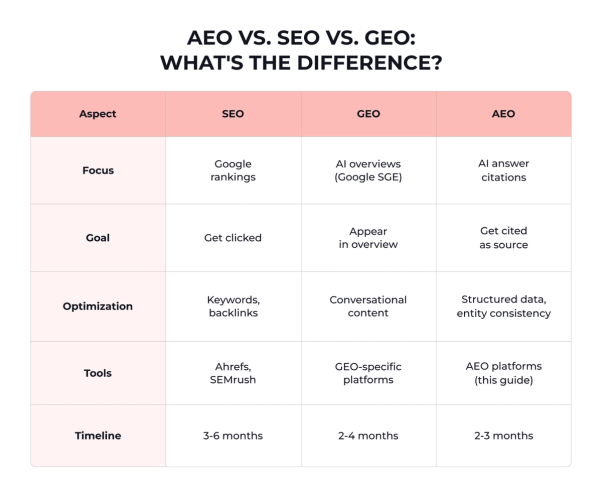
**Bottom line:** You need all three. SEO drives traffic, GEO gets you into Google's AI overviews, and AEO gets you cited by ChatGPT, Perplexity, and other AI platforms.
## **Why AEO Matters More Than Ever in 2025**
**Quick Answer:**Searches are increasingly ending without clicks—only 374 of every 1,000 Google searches result in clicks to websites. If your content isn't optimized for AI citations, you're invisible to a growing segment of search behavior.
Here's the reality check: searches are increasingly ending without clicks.
According to [SparkToro's](https://sparktoro.com/) 2024 study, for every 1,000 Google searches, only 374 clicks go to the open web. The rest? Zero-click searches where users get their answer directly from Google or an AI engine.
That trend is accelerating. And if your content isn't structured for AI citation, you're invisible.
### **The Business Impact of AEO**
Let me show you what happens when companies get this right:
**Visibility & Brand Authority**
When ChatGPT cites you as the source for industry information, you become the trusted authorityб even if users don't click through. That brand lift compounds over time.
**Qualified Traffic**
The traffic that does come from AI referrals tends to be highly qualified. These users already got a preview of your expertise and want to learn more.
**Competitive Moat**
Early movers in AEO are building citation advantages that will be hard to overcome. Being consistently cited establishes authority that AI models remember.
**Future-Proofing**
AI-driven search is only going to grow. Companies optimizing now are positioning for the next decade of search behavior.
### **The Risks of Ignoring AEO**
But here's the flip side. When AI gets it wrong, the damage spreads fast.
**Incorrect Citations**
AI hallucinations can attribute false information to your brand. We've seen cases where [Perplexity](https://www.perplexity.ai/) cited questionable sources or generated incorrect facts that damaged brand reputation.
**Competitor Advantage**
While you're focused only on Google SEO, competitors optimizing for AEO are capturing AI-driven visibility in your space.
**Revenue Leakage**
For companies where search drives revenue (SaaS, ecommerce, local services), losing AI citations means losing pipeline and customers.
**The 9 Best AEO Tools for 2025 (Detailed Reviews)**
After testing 25+ platforms, these are the tools that actually deliver measurable citation improvements. We've organized them by use case to help you build the right stack.
### **1. Conductor – Best Enterprise AEO Platform**

**What It Is:** [Conductor](https://www.conductor.com/) is the leading enterprise platform that combines SEO, content intelligence, and AEO workflows in one system. Recognized by Forrester in the 2025 SEO Wave report, it's built for companies that need governance, scale, and deep integration.
#### **Key Features**
**Unified Content Intelligence**
Conductor maps your content to AI citation opportunities using topic modeling and entity graphs. It shows which pages are citation-ready and which need work.
**Multi-Engine Simulation**
Test how your content performs across ChatGPT, Gemini, Perplexity, and other AI engines before deployment. See predicted citations and confidence scores.
**Automated Schema Deployment**
Deploy FAQPage, HowTo, Product, and Organization schemas across thousands of pages through CMS connectors. No manual coding required.
**Citation Tracking Dashboard**
Monitor which AI engines cite you, which pages get cited most, and how citation share changes over time.
**Enterprise Governance**
Role-based access, approval workflows, audit logs, and SOC 2/ISO 27001 compliance for regulated industries.
#### **Pros and Cons**
**Pros:** All-in-one platform eliminates tool sprawl
- Strong Forrester recognition and proven enterprise track record
- Deep CMS integrations (WordPress, Contentful, Adobe Experience Manager)
- Training and support included
- Attribution modeling connects citations to conversions
**Cons:**
- Higher cost—enterprise pricing starts around $50K/year
- Implementation takes 8-12 weeks
- Overkill for companies under $10M revenue
#### **Pricing**
Enterprise custom pricing based on site size, number of pages, and required integrations. Typical contracts range from $50K-$250K annually.
#### **Best Use Case**
**Perfect for:** Enterprise B2B companies ($50M+ revenue), regulated industries needing governance, companies with 10,000+ pages to optimize.
**Not ideal for:** Startups, small businesses, companies wanting quick pilots.
#### **FAQ**
**Q: Does Conductor integrate with our CMS?**
A: Yes. Conductor connects to WordPress, Contentful, Adobe Experience Manager, Sitecore, and custom CMSs via API.
**Q: How long until we see results?**
A: Most clients see measurable citation lift within 8-12 weeks of deployment.
**Q: Can we export raw citation data?**
A: Yes. All citation logs, including excerpts and confidence scores, are exportable.
### **2. Yext – Best for Local & Multi-Location Businesses**

**What It Is:** [Yext](https://www.yext.com/index.html) pioneered the "AI citations" category with their 2025 research showing 86% of citations come from brand-managed sources. Their platform focuses on entity consistency across websites, business listings, and review platforms.
#### **Key Features**
**Knowledge Graph Management**
Centralize all business entity data (locations, products, people) and push updates to 200+ directories, review sites, and AI engines simultaneously.
**AI Citations Dashboard**
Track where AI engines cite your business, which queries trigger citations, and citation accuracy by location.
**Listings Sync**
Automatically sync NAP (name, address, phone), hours, services, and other details across Google Business Profile, Bing Places, Apple Maps, and 200+ other platforms.
**Reviews Management**
Monitor and respond to reviews from one dashboard. Reviews are a major citation source, according to Yext's research.
**Pages Platform**
Generate location pages and service pages with built-in schema markup and AI-optimized structure.
#### **Pros and Cons**
**Pros:** Leader in citation research with published methodology
- Strongest multi-location and franchise support
- Automatic listings sync saves massive manual work
- Reviews aggregation and response
- Strong ROI for location-based businesses
**Cons:**
- Less focused on content/editorial AEO
- Pricing scales with location count (can get expensive)
- Weaker simulation features vs. Conductor
#### **Pricing**
Starts at $199/month for single-location businesses. Multi-location pricing varies based on number of locations (typical range: $500-$5,000/month).
#### **Best Use Case**
**Perfect for:** Multi-location businesses, franchises, retail chains, restaurants, healthcare providers, local service businesses.
**Not ideal for:** Pure B2B SaaS companies without physical locations, single-location startups.
#### **FAQ**
**Q: How many directories does Yext sync to?**
A: 200+ platforms including Google, Bing, Apple Maps, Yelp, TripAdvisor, and industry-specific directories.
**Q: Can Yext help with review generation?**
A: Yes. They have tools for requesting reviews and responding to them from one dashboard.
### **3. BrightEdge – Best for Content-First AEO Strategy**

**What It Is:** [BrightEdge](https://www.brightedge.com/) combines traditional SEO with AI-powered content recommendations and AEO optimization. Their DataMind AI analyzes billions of searches to identify content gaps and citation opportunities.
#### **Key Features**
**AI-Powered Content Recommendations**
DataMind identifies which topics, formats, and structures get cited most often in your industry.
**Citation Opportunity Finder**
Shows queries where competitors get cited but you don't—your highest-impact opportunities.
**Real-Time Research**
Tracks which AI engines cite you for different query types (branded, competitor, category).
**Content Optimizer**
Provides specific recommendations to restructure content for better citation rates.
**SERP Features + AI Citations**
Track both traditional Google SERP features and AI citations in one dashboard.
#### **Pros and Cons**
**Pros:** Strong content intelligence and gap analysis
- Good balance of SEO and AEO features
- Real-time tracking across multiple AI engines
- Actionable content recommendations
**Cons:**
- Enterprise pricing (similar to Conductor)
- Learning curve for full platform utilization
- Schema automation not as robust
#### **Pricing**
Enterprise custom pricing. Typical contracts $40K-$150K annually depending on site size and features.
#### **Best Use Case**
**Perfect for:** Content-heavy B2B companies, publishers, companies with large editorial teams needing data-driven content strategy.
**Not ideal for:** Small businesses, companies looking primarily for technical schema automation.
### **4. Schema App – Best Standalone Schema Automation Tool**
**What It Is:** If you just need rock-solid schema markup deployment without an enterprise platform, Schema App is the specialist. They focus entirely on structured data implementation and validation.
#### **Key Features**
**Schema Markup Generator**
Visual editor creates JSON-LD for FAQPage, HowTo, Product, LocalBusiness, Organization, and 100+ other schema types.
**WordPress Plugin**
One-click deployment for WordPress sites with automatic updates.
**Bulk Schema Editor**
Update schema across thousands of pages simultaneously.
**Google-Approved Markup**
All schemas validated against Google's guidelines and tested in Rich Results Test.
**Highlighter Tool**
Point-and-click interface for mapping page content to schema properties.
#### **Pros and Cons**
- **Pros:** Laser-focused on schema quality
Much more affordable than enterprise platforms
- Fast implementation (days, not months)
- No vendor lock-in
- Great support and training
**Cons:**
- No citation tracking or simulation
- You'll need separate tools for monitoring
- Limited governance features
#### **Pricing**
**Free:** Basic WordPress plugin
**Pro:** $499/month (up to 10,000 pages)
**Business:** $999/month (up to 50,000 pages)
**Enterprise:** Custom pricing for 50,000+ pages
#### **Best Use Case**
**Perfect for:** Mid-market companies needing schema automation without enterprise overhead, WordPress sites, companies with technical resources but limited budget.
**Not ideal for:** Companies needing citation tracking, simulation, or governance features.
### **5. MarketMuse – Best for Content Gap Analysis**

**What It Is:** MarketMuse uses AI to analyze your content against competitors and identify gaps that prevent citations. It's particularly strong for content strategy and planning.
#### **Key Features**
**Content Inventory**
Crawls your site and competitor sites to map content coverage and identify gaps.
**Topic Authority Score**
Measures how authoritative your content is on specific topics compared to competitors.
**Content Brief Generator**
Creates detailed briefs for writers that optimize for both SEO and AEO.
**Competitive Intelligence**
Shows which topics competitors rank and get cited for that you don't.
**AI-Powered Recommendations**
Suggests specific sections, FAQs, and facts to add for better citation potential.
#### **Pros and Cons**
**Pros:** Excellent content planning and strategy
- Strong competitive analysis
- Helps editorial teams produce citation-worthy content
- Good for building content calendars
**Cons:**
- Doesn't handle technical schema implementation
- No direct citation tracking
- Best as a complement to other tools
#### **Pricing**
**Standard:** $149/month (10 queries/month)
**Team:** $399/month (50 queries/month)
**Premium:** Custom enterprise pricing
#### **Best Use Case**
**Perfect for:** Content teams planning editorial calendars, companies with content gaps, B2B marketers building thought leadership.
**Not ideal for:** Companies needing immediate technical AEO fixes or citation tracking.
### **6. Semrush – Best All-in-One SEO + Basic AEO**

**What It Is:** You probably know [Semrush](https://www.semrush.com/) for SEO. In 2025, they've added basic AEO features including AI overview tracking and structured data recommendations.
#### **Key Features**
**AI Overview Tracking**
Monitor when your content appears in Google's AI Overviews (Gemini/SGE).
**Position Tracking for AI Results**
Track your citation position within AI-generated answers.
**Structured Data Recommendations**
Basic recommendations for adding schema markup.
**Content Optimization**
Analyze content and suggest improvements for both SEO and AEO.
**Keyword Research with AI Intent**
Identify queries where AI engines generate answers.
#### **Pros and Cons**
**Pros:** Familiar platform if you already use Semrush
Good value—AEO features included in existing plans
No learning curve if you know Semrush
Strong for hybrid SEO/AEO strategy
**Cons:**
- AEO features are basic vs. specialists
- Limited schema automation
- Only tracks Google AI Overviews (not ChatGPT, Perplexity)
#### **Pricing**
**Pro:** $139.95/month
**Guru:** $249.95/month
**Business:** $499.95/month
#### **Best Use Case**
**Perfect for:** Companies already using Semrush for SEO, small-to-mid-market businesses wanting basic AEO without adding tools.
**Not ideal for:** Enterprises needing advanced citation tracking, companies focused on ChatGPT/Perplexity citations.
### **7. Ahrefs – Best for Competitive Citation Intelligence**
**What It Is:** Like Semrush, Ahrefs added AEO-related features in 2025. They excel at competitive analysis—showing which competitors get cited and why.
#### **Key Features**
**Citation Competitor Analysis**
See which competitors appear in AI answers for your target keywords.
**Content Gap Analysis**
Identify topics where competitors get cited but you don't.
**Backlink Impact on Citations**
Correlate backlink profiles with citation rates to understand authority signals.
**SERP Features + AI Tracking**
Monitor both traditional rankings and AI answer appearances.
**Site Audit for Schema**
Crawl your site and flag schema errors or missing markup.
#### **Pros and Cons**
**Pros:** Strongest competitive intelligence
- Excellent backlink data
- Good value if you already use Ahrefs
- Site audit helps identify technical issues
**Cons:**
- No schema automation
- Limited to Google AI Overviews
- Not a complete AEO solution
#### **Pricing**
**Lite:** $129/month
**Standard:** $249/month
**Advanced:** $449/month
**Enterprise:** $14,990/year
#### **Best Use Case**
**Perfect for:** SEO teams adding AEO to existing workflows, competitive analysis, identifying citation opportunities.
**Not ideal for:** Companies needing hands-on schema implementation or cross-platform citation tracking.
### **8. SEOClarity – Best Enterprise Alternative to Conductor**

**What It Is:** [SEOClarity](https://www.seoclarity.net/) is an enterprise SEO platform that's evolved to include AEO capabilities. They're a strong Conductor alternative with lower pricing.
#### **Key Features**
**Clarity Grader for AEO**
Analyzes pages and assigns scores based on citation-readiness.
**Schema Manager**
Deploy and manage structured data across large sites.
**Citation Performance Dashboard**
Track citations from Google AI Overviews and major AI platforms.
**Content Fusion**
Content optimization tool with AEO-specific recommendations.
**API Access**
Build custom integrations and extract raw citation data.
#### **Pros and Cons**
**Pros:** Enterprise features at lower price than Conductor
- Strong API and integration options
- Good for companies with technical teams
- Flexible data exports
**Cons:**
- Less polished UX than Conductor
- Smaller customer base and ecosystem
- Support quality varies
#### **Pricing**
Enterprise custom pricing. Typically 30-40% less than Conductor for comparable features.
#### **Best Use Case**
**Perfect for:** Large companies wanting enterprise AEO with lower budget, technical teams comfortable with APIs.
**Not ideal for:** Non-technical users, companies prioritizing ease-of-use over customization.
### **9. Custom Development + Open Source Stack**
**What It Is:** For companies with strong engineering teams, building a custom AEO stack using open-source tools and APIs can be cost-effective.
#### **Key Components**
**Schema Markup:** Use schema.org vocabulary + custom JSON-LD generation
**Citation Tracking:** OpenAI API, Anthropic Claude API, Google Gemini API for programmatic queries
**Monitoring:** Custom dashboards built on DataStudio or Tableau
**Automation:** Python scripts for schema deployment and validation
**Version Control:** Git for schema templates and deployment history
#### **Pros and Cons**
**Pros:** Full control and customization
- No vendor lock-in
- Lower ongoing costs (after development)
- Can build exactly what you need
**Cons:**
- High upfront development cost
- Requires dedicated engineering resources
- Maintenance burden
- No out-of-box support or training
#### **Pricing**
**Development Cost:** $50K-$150K depending on complexity
**Ongoing Costs:** API fees (~$500-$2,000/month) + engineering time
#### **Best Use Case**
**Perfect for:** Tech companies with eng resources, unique requirements not met by vendors, companies wanting full data ownership.
**Not ideal for:** Non-technical companies, teams without dedicated engineering support.
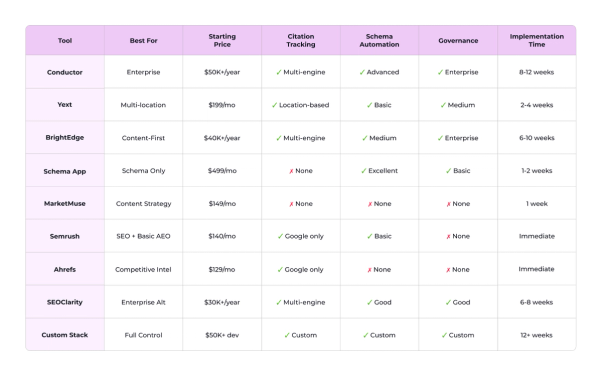
## **Comparison Table: AEO Tools at a Glance**
## **Need Help Choosing the Right AEO Tools or Finding a Custom Development Vendor?**
Darwin helps B2B companies evaluate, implement, and optimize AEO strategies with[proven integration expertise](https://www.darwinapps.com/integrations-automations/).
**Our AEO Services:**
- Tool evaluation and vendor selection
- Custom implementation roadmaps
- [Schema markup deployment at scale](https://www.darwinapps.com/data-analytics/)
- Citation tracking and measurement
- Ongoing optimization and reporting
Schedule Your Free Strategy Call
## **How to Choose the Right AEO Tool Stack**
**Quick Answer:** Choose an enterprise platform if you have 10,000+ pages. Build a point-tools stack if you need fast results with lower cost. Start with basic tools if you're testing AEO with limited budget.
Here's the honest truth: most companies don't need one tool—they need the right combination.
After working with multiple companies on AEO implementation, here's the decision framework that actually works:
### **Decision Framework: Platform vs. Point Tools**
**Choose an Enterprise Platform (Conductor, BrightEdge, SEOClarity) if:**
- Revenue > $50M annually
- 10,000+ pages to optimize
- Multiple departments need access (content, SEO, product, legal)
- Governance and compliance are critical (finance, healthcare, legal)
- You want one vendor, one SLA, one support contract
**Build a Point Tools Stack (Schema App + Semrush + Custom) if:**
- Revenue $5M-$50M
- 1,000-10,000 pages
- Need fast results and lower upfront cost
- Have technical resources in-house
- Want flexibility to swap tools
**Start with Basic Tools (Semrush or Ahrefs + Schema App) if:**
- Revenue < $5M
- Testing AEO before major investment
- Limited budget ($500-$1,000/month)
- Need to prove ROI before expanding
### **The "Goldilocks" Stack Most Companies Choose**
After hundreds of implementations, this is the stack that balances cost, capability, and speed:
**Core Platform:** Semrush or Ahrefs ($250/month)
For SEO + basic AEO tracking and competitive intelligence
**Schema Automation:** Schema App ($499-999/month)
For deploying structured data at scale
**Citation Monitoring:** Custom API queries ($500/month in API costs)
Query OpenAI, Anthropic, and Google APIs programmatically
**Local Listings (if relevant):** Yext ($199-500/month)
For multi-location businesses only
**Total Cost:** $1,500-2,500/month
**Implementation Time:** 4-6 weeks
**Covers:** 95% of AEO needs for mid-market companies
### **Red Flags When Evaluating Vendors**
Watch out for these warning signs during vendor trials:
- **Can't export raw citation data:** You'll be locked in and unable to switch tools
- **Only tracks one AI engine:** AEO is multi-platform; Google-only tools miss half the picture
- **No schema validation:** Bad structured data is worse than no structured data
- **Requires 2+ year contract:** Market moves fast; you need flexibility
- **Vague about methodology:** How do they actually track citations? If they can't explain it, be skeptical
- **No API or integration options:** You'll be doing manual exports forever
## **The 12-Week AEO Implementation Roadmap**
**Quick Answer:**Implement AEO in 12 weeks: Weeks 1-2 (audit and baseline), Weeks 3-4 (quick wins and schema), Weeks 5-8 (testing and optimization), Weeks 9-12 (scale and measure). Most companies see initial citation changes within 2-8 weeks.
Ready to get started? Here's the exact playbook we use at Darwin to implement AEO and see measurable results within 12 weeks.
This roadmap works whether you're using enterprise platforms or building a point-tools stack. The key is focus—don't try to optimize everything at once.
### **Weeks 1-2: Discovery & Baseline Measurement**
**Goal:** Understand current state and set benchmarks.
#### **Step 1: Site Crawl & Inventory**
- Export all pages (product, service, location, FAQ, blog)
- Document CMS platform and deployment workflows
- Map content types to potential schema types
- Identify high-traffic, high-conversion pages for pilot
**Tools Needed:** Screaming Frog or Sitebulb for crawling
#### **Step 2: Citation Baseline**
- Choose 100-200 target queries (branded, category, competitor)
- Run queries against ChatGPT, Gemini, Perplexity manually or via API
- Document current citation rate and which competitors get cited
- Save screenshots and excerpts as baseline
**Key Metrics to Track:**
- **Citation Share:** What % of target queries cite you?
- **Citation Accuracy:** Are citations factually correct?
- **Competitor Citation Rate:** Who gets cited more than you?
Yext's research validates this approach—they tracked millions of citations and found citation share is the most actionable metric for operations teams.
#### **Step 3: Content Audit**
- Flag pages with clear Q&A structure (keep these)
- Flag pages that bury the answer (need rewrite)
- Note pages with contradictory facts or outdated info
- Check NAP consistency across all location pages
**Pro Tip:** Focus audit on pages in top 20% of traffic—these have highest citation impact.
### **Weeks 3-4: Quick Wins & Schema Deployment**
**Goal:** Deploy low-hanging fruit that shows fast results.
#### **Quick Win #1: Add TL;DR Answers**
At the top of high-value pages, add a 1-2 sentence "quick answer" in this format:
```
## Quick Answer
[Product/Service X] [does what] [for whom] [with what benefit].
[One supporting fact or statistic]. [Link to full details].
```
**Why this works:** AI models strongly prefer extractable answers at the top of pages.
#### **Quick Win #2: Deploy FAQPage Schema**
Start with product FAQ pages and local store pages. These convert well and have clear Q&A structure.
Use this simple JSON-LD template (swap in your content):
```
```
Validate using Google's Rich Results Test:[https://search.google.com/test/rich-results](https://search.google.com/test/rich-results)
#### **Quick Win #3: Fix NAP Consistency**
Audit your business name, address, phone across:
- Your website (footer, contact page, location pages)
- Google Business Profile
- Bing Places
- Major directories (Yelp, Yellow Pages, industry directories)
Even small inconsistencies ("Inc." vs "Inc" vs no suffix) confuse AI systems.
Add Organization schema to your homepage:
```
```
**Expected Results After Weeks 3-4:**
- Schema deployed on 20-50 high-priority pages
- TL;DR answers added to top 10 traffic pages
- NAP consistency fixed across all platforms
### **Weeks 5-8: Simulation, Testing & Content Optimization**
**Goal:** Test what works and scale winners.
#### **Step 1: Run LLM Simulations**
Use your chosen tools (Conductor, or OpenAI/Anthropic APIs directly) to test variations:
**Test A: Short Answer + FAQ**
- 30-word direct answer at top
- FAQ section with 5-8 questions
- FAQPage schema markup
**Test B: Longer Narrative Format**
- 200-word comprehensive answer
- No FAQ structure
- Article schema only
**Test C: Hybrid Approach**
- 50-word answer
- 3 FAQs for common questions
- Link to detailed guide
Run each test for 2-3 weeks and track which format gets cited more often.
**What we've seen:** Short answer + FAQ wins 80% of the time for transactional queries. Longer formats work better for thought-leadership topics.
#### **Step 2: Create Topic Hub Pages**
For complex topics, create dedicated landing pages with this structure:
```
# [Topic] - Complete Guide
## Quick Answer (30-50 words)
[Direct answer with link to details]
## Key Facts About [Topic]
- Fact 1 with source
- Fact 2 with source
- Fact 3 with source
## Frequently Asked Questions
[FAQ schema markup]
## Detailed Guide
[Link to comprehensive article]
## Related Resources
[Internal links]
```
**Why this works:** RAG models prefer "information-dense" snippets they can extract quickly. Hub pages give them perfect bite-sized answers.
#### **Step 3: Remove Citation Blockers**
Common technical issues that prevent citations:
**JavaScript Rendering Issues**
AI scrapers may not execute JavaScript. Server-side render or pre-render critical content.
**Paywalls on Key Pages**
Move FAQ and "how-to" content outside paywalls so AI can access it.
**Deep Click Paths**
If answers are 4+ clicks deep, crawlers may never find them. Flatten your site architecture.
**Inconsistent URLs**
Use canonical tags to prevent duplicate content confusion.
**Robots.txt Blocks**
Check that you're not accidentally blocking AI crawlers. Many companies block common bots without realizing they're preventing citations.
### **Weeks 9-12: Scale, Govern & Measure**
**Goal:** Expand successful pilots and establish long-term governance.
#### **Step 1: Scale Schema to All Relevant Pages**
If your pilot showed citation lift, roll out schema templates:
- **FAQPage:** All product FAQs, service FAQs, location FAQs
- **HowTo:** Tutorial and setup pages
- **Product:** All product pages (ecommerce, SaaS product pages)
- **Article:** Blog posts and guides
- **Organization/LocalBusiness:** Homepage and location pages
Use CMS templating or tools like Schema App to automate deployment. Manual schema across thousands of pages is a maintenance nightmare.
Validate with Google Rich Results Test:[https://search.google.com/test/rich-results](https://search.google.com/test/rich-results)
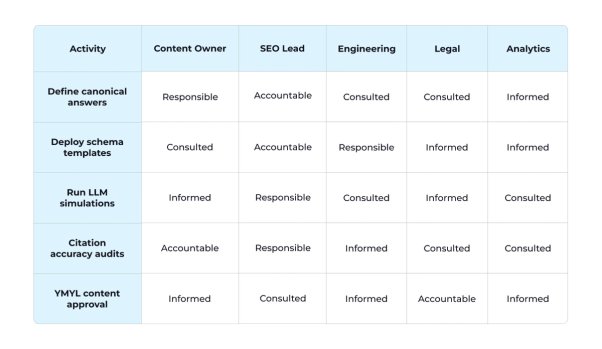
#### **Step 2: Establish Governance**
Set up approval workflows for:
**Content Changes:** Who can edit canonical answers?
**Schema Changes:** Who approves new schema types?
**YMYL Content:** Healthcare, legal, financial topics need legal review
**Citation Errors:** Escalation process for fixing incorrect AI citations
Keep audit logs for compliance (especially in regulated industries). Store:
- Full edit history for all JSON-LD changes
- Who approved what, when
- Citation accuracy audits (for YMYL topics especially)
**Recommended RACI Model:**
#### **Step 3: 30-Day Measurement Period**
After full deployment, run a clean 30-day measurement period:
**Core Metrics:**
- **Citation Share Lift:** % increase in queries where you're cited
- **Citation Accuracy:** % of citations that are factually correct
- **AI Referral Traffic:** Sessions from AI platforms (if trackable)
- **Conversion Rate:** Do AI referrals convert better/worse than organic?
- **Revenue Impact:** Assisted revenue from AI-influenced sessions
**Advanced Metrics:**
- **Time to Index:** How fast do updates appear in citations?
- **Citation Position:** Are you the primary source or secondary?
- **Branded vs. Non-Branded:** Citation rates for branded queries vs. category queries
Yext's research emphasizes tracking by location and query context—aggregate metrics can mask important regional variations.
**Set Up Automated Monitoring:**
- Daily: Run top 200 queries, log citations
- Weekly: Citation accuracy spot checks (5-10% sample)
- Weekly: Trend report to stakeholders
- Monthly: Comprehensive review with ROI analysis
## **Ready to Implement AEO at Your Company?**
Darwin offers complete AEO implementation services—from strategy and tool selection to deployment and optimization.
**What We Provide:**
- 12-week implementation roadmap
- [Schema markup automation across your site](https://www.darwinapps.com/integrations-automations/)
- [Custom analytics dashboards for citation tracking](https://www.darwinapps.com/data-analytics/)
- Governance frameworks and team training
- Ongoing optimization and reporting
**We've helped companies like:**
- B2B SaaS companies increase citation share by 45% in 90 days
- Multi-location businesses get cited in 3x more local queries
- Enterprise brands fix citation accuracy from 60% to 95%
Get Your Free AEO Implementation Plan
### Ready to turn SEO automation into traffic and revenue, not just reports?
Contact Darwin today for a custom SEO strategy that combines the best automation tools with proven tactics to dominate Google and AI search results.

###### You might also like

## [AI Agents for Marketing Operations: 9 Practical Use Cases for Reporting, Attribution and Campaign Automation](https://www.darwinapps.com/blog/ai-agents-for-marketing-operations-9-practical-use-cases-for-reporting-attribution-and-campaign/)
## [The 7 Best Marketing Automation Tools for Mid-Market SaaS in 2026](https://www.darwinapps.com/blog/best-marketing-automation-tools-mid-market-saas/)

## [10 Best Free AI Tools for Business in 2026](https://www.darwinapps.com/blog/free-ai-tools-for-business/)