

Audi of America Turns
Fragmented Sales Planning Data
Into Decision-Ready Analytics
Executive Summary
Audi of America's Sales and Logistics teams managed and analyzed extensive data related to dealerships, sales objectives, vehicle models, historical performance, and pipeline inventory. The information existed, but reporting remained fragmented: spreadsheets, SQL and SAP BusinessObjects reports, manual ad hoc requests and disconnected planning workflows. Executives, regional directors, area managers and logistics teams worked from separate reporting views when making planning decisions.
Darwin studied the existing reporting setup, mapped the business logic behind sales planning and established the data processes needed to support it: cleaning, validation and daily reporting. That foundation supported a centralized dashboard system covering national sales overview, dealer ranking, custom reports, long-term history and pipeline tracking. The platform connected dealer, regional, model, target and pipeline data, defined sales performance comparison, metric ownership and reporting clarity, and turned scattered reporting flows into shared views each stakeholder group could use.
The result was a more reliable analytics layer for sales planning decisions, one that has expanded as Audi's planning needs evolved.
The Approach
01
Surface
The operational interface where Audi's sales teams used planning data: reporting views, dealership inputs and pipeline updates, each maintained in its own tool or manual workflow.
02
Connections
Darwin connected dealer, region, model, target, historical and vehicle-status data into a single planning flow. Daily cleaning and validation kept that flow reliable.
03
Clarity
Each metric followed a defined calculation logic, so every stakeholder group read the same numbers the same way.
04
Momentum
Reporting turnaround shortened to minutes where it previously took hours, and teams spent that time on higher-priority planning work and dealer conversations.
About the Client
Mission
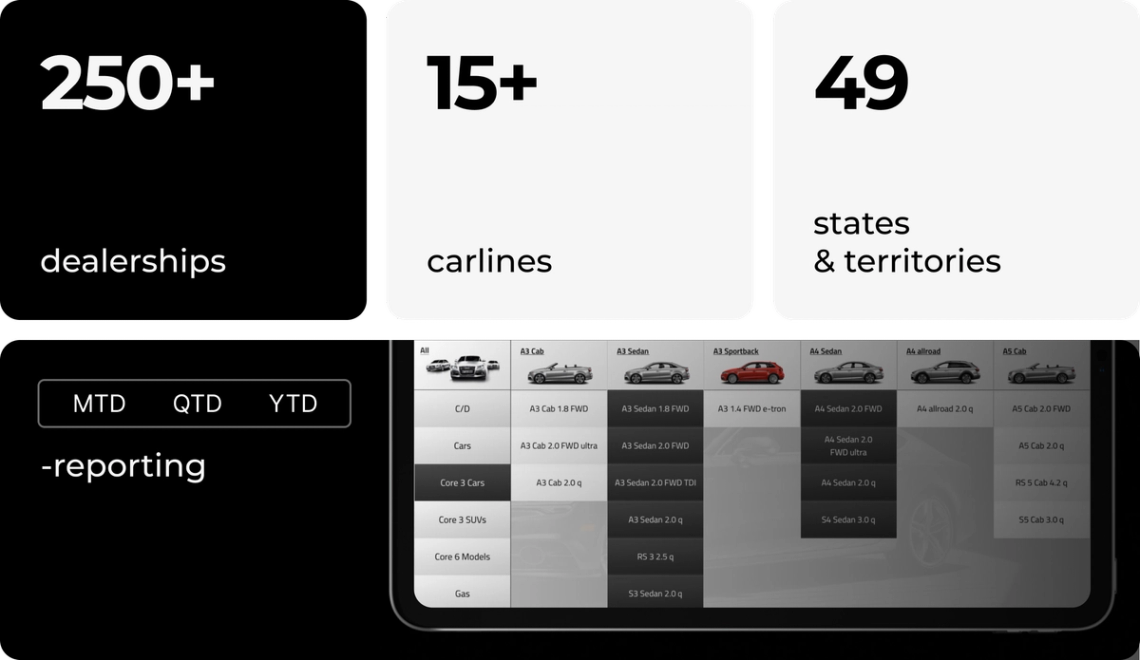
Audi of America is the U.S. division of Audi Germany, one of the world's leading premium automotive manufacturers. Audi of America's sales planning operation supports more than 250 dealerships, over 15 vehicle carlines, and a dealer network spanning 49 states and territories across the United States.
Problem Overview
The Challenge
Audi's teams had access to the data they needed. Reporting inputs came from several third-party vendors, each with its own process and timeline. The challenge came from the way reporting flows had grown: every team and tool followed its own reporting routine, with no shared structure connecting them.
Fragmented Reporting Sources
Sales planning data was stored in three places: Excel spreadsheets, a SQL Server database and SAP BusinessObjects reports. Teams handled more than 35 manual ad hoc reporting requests each month. As the scope expanded to include logistic and certified pre-owned data, that number grew past 45. Every reporting cycle required manual assembly from disconnected sources.
No Shared Logic for Comparing Sales Results
Understanding sales results meant working with several dimensions at once: region, area, dealership, model line, reporting period, target progress and historical trends. Reporting with no defined comparison logic made it harder to identify what was driving results, where attention was needed and how one period compared to another.
Limited Support for Dealer Conversations
Area managers needed current sales and target data to prepare for dealership visits. That preparation depended on manually pulling numbers from different sources, a process that added time and introduced inconsistency in the figures managers used.
Pipeline Tracking Disconnected From Sales Planning
The Solution
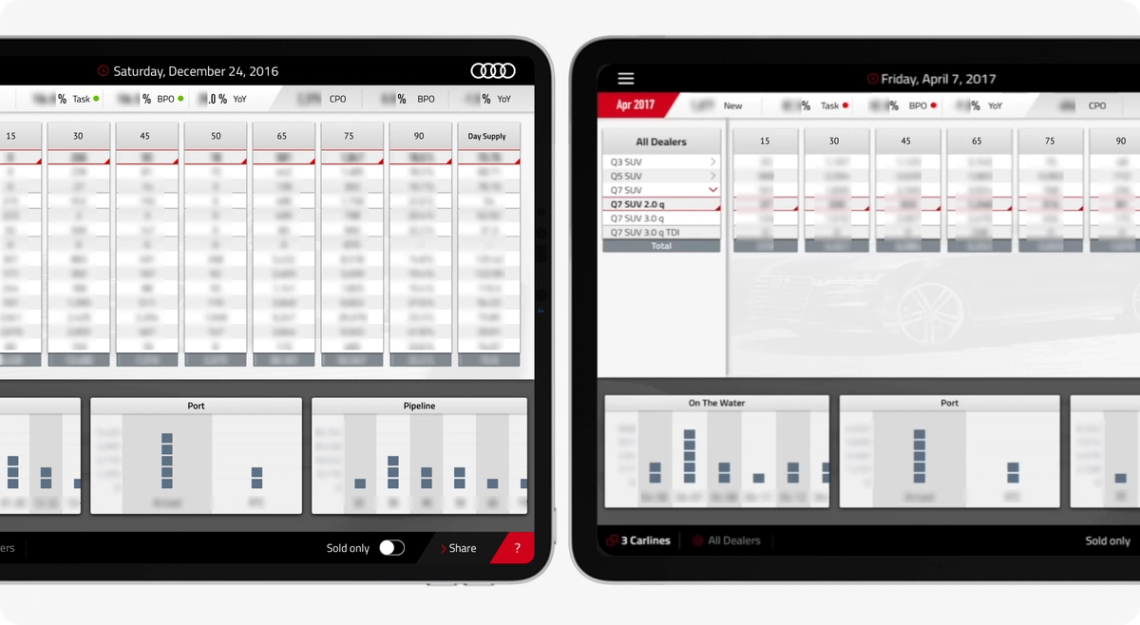
Darwin started with the reporting setup itself. The team analyzed Audi's data sources, clarified the business logic behind sales planning and defined how sales results should be compared: by region, dealer, model and reporting period, in the combinations each stakeholder group needed.Daily data operations supported everything that followed: cleaning, validation and delivery of verified data. SQL Server, SAP BusinessObjects, Integration Services, Alteryx and Tableau Prep provided the technical foundation for a centralized reporting system that replaced manual assembly from disconnected sources.
National Overview
Darwin built a custom reporting layer that linked GA4, Salesforce and BigQuery into one reporting hub. The connector established the pipeline through which all marketing and sales data flowed into Looker Studio.
Dealer Ranking
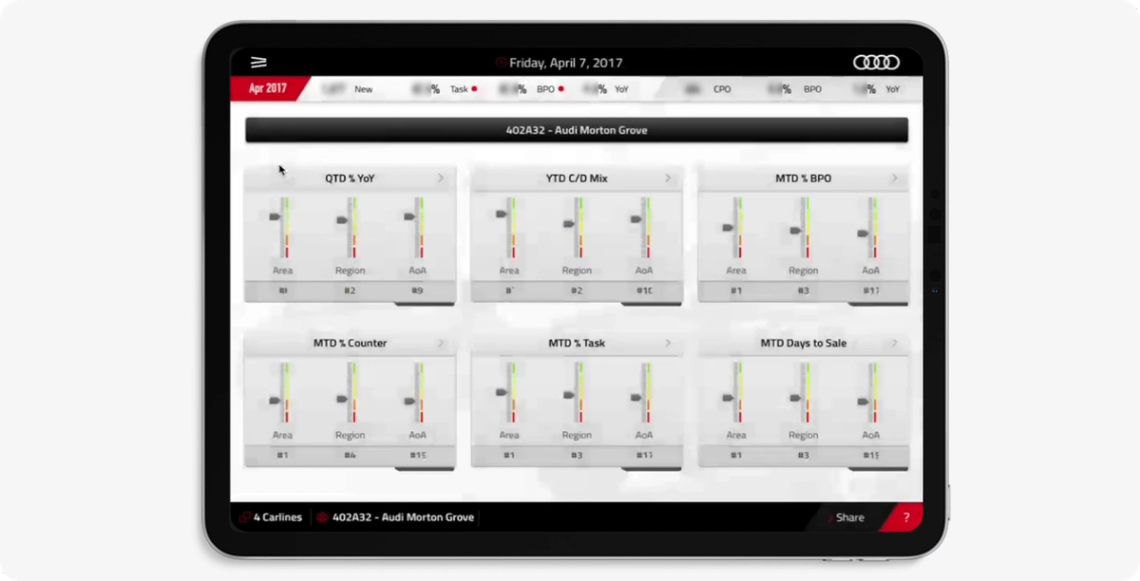
The Dealer Ranking module was built around the work area managers do before and during dealership visits. Managers entered each dealer conversation knowing how the dealer ranked against targets, how results compared to the region and how specific model lines were selling over the current period. A searchable dealer selector made it faster to open a specific dealer profile directly out of the national view.
Custom Reports
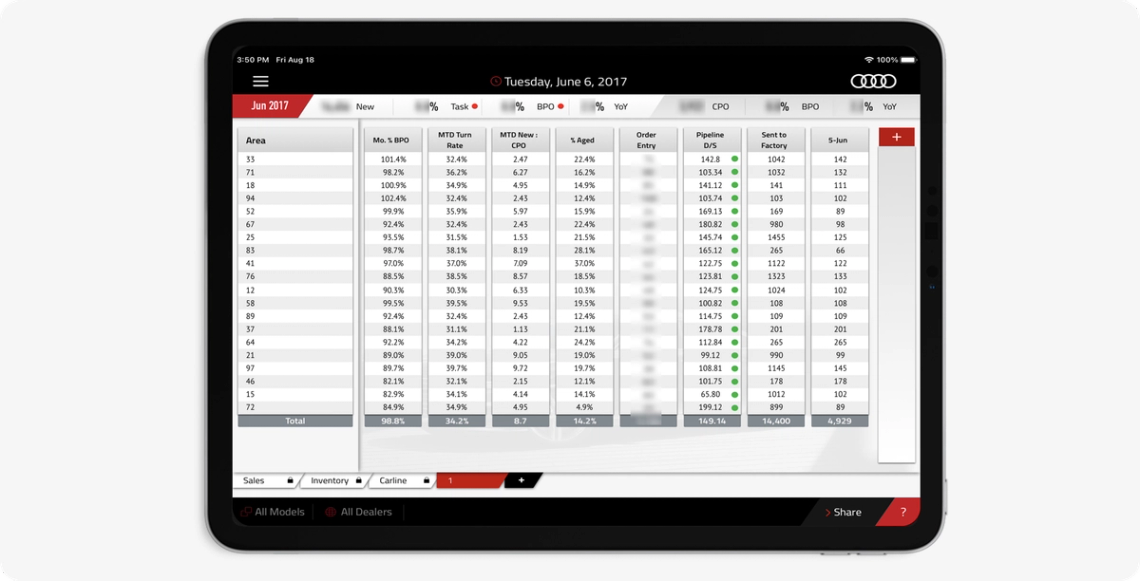
Custom Reports gave each stakeholder a way to build the view they needed and reduce reliance on manual ad hoc reporting requests. Three predefined datasets (Sales, Inventory and Car Line) covered the most common reporting needs. Users could also create individualized views by adding or removing KPI fields, saving up to five custom report configurations for repeated use.
Long Term History
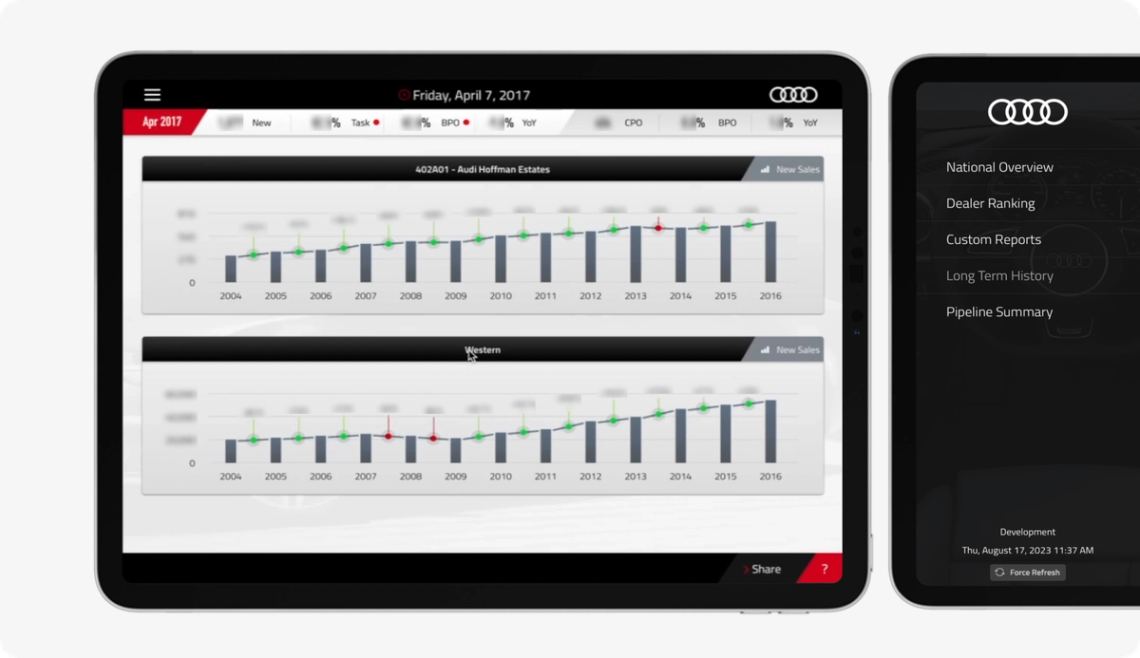
The Long Term History module gave teams historical context for current results. Managers compared current figures with previous years, identified seasonal patterns and separated short-term fluctuations out of longer trends. The module also supported dealer-to-dealer and dealer-vs-region comparison, giving area managers a structured way to benchmark results against past periods.
Pipeline Summary
The Pipeline Summary connected sales planning with vehicle delivery status. Teams tracked each vehicle through several pipeline stages, covering initial order, production, transit, port arrival and final sale, all in a single view. On-the-water cards showed projected arrival dates; port status covered customs clearance. Logistics and sales planning now drew on a shared data view.
Darwin's partnership with Audi of America created a centralized planning foundation supporting 250+ dealerships, 15+ carlines and 49 states & territories.
Key Outcomes
01
Reporting Turnaround in Minutes
Reports that previously required hours of manual assembly now reach planning teams in minutes, built on data cleaned and validated daily.
02
Reduced Manual Workload
More than 45 manual ad hoc requests each month drove the reporting workload. Self-service reports and saved configurations reduced both the request volume and the corrections manual assembly generated.
03
Consistent Data for Dealer Reviews
04
Shared Pipeline Data for Planning and Logistics
Sales planning and logistics teams make inventory, allocation and delivery decisions using the same pipeline data. Shared tracking reduced the delays that separate views created.
Before-and-After
Comparison
Area
- Reporting structure
- Data reliability
- Reporting turnaround
- Sales results comparison
- Dealer conversations
- Custom reporting
- Pipeline tracking
Before Darwin
- Spreadsheets, SQL Server and SAP BusinessObjects reports maintained separately
- Manual corrections, inconsistent numbers
- Hours of manual assembly
- Harder to compare by region, dealer, model and period
- Dependent on scattered reports and manual preparation
- Required repeated ad hoc requests
- Disconnected from sales planning
After
- Centralized analytics and dashboard system
- Data cleaned and validated daily
- Reports delivered in minutes
- Shared views with region, dealer, model and MTD / QTD / YTD filters
- Prepared in a single system with consistent numbers
- Self-service KPI views with saved configurations
- Sales planning and logistics decisions based on shared delivery data
Client Feedback
“Darwin efficiently executes initiatives to produce quality deliverables that advance internal processes. The team’s expertise enables them to fulfill a multitude of roles, mitigating potential knowledge gaps. They learned about the business, which has ensured their deliverables meet requirements.”
Senior Sales Planning Manager, Audi,
Name withheld in line with Volkswagen Group policy.

For Audi of America, the value of the work lies in what supports the dashboards: reliable data, defined reporting logic and planning decisions every team makes with the same numbers.
What began as an MVP in 2017 has evolved into the analytical foundation that Audi's sales planning relies on today. Since then, the foundation has grown to support logistic and certified pre-owned teams through data delivery.
Additional margin management and ETA forecasting were built as dedicated internal logic to improve planning and predict vehicle arrival times. Darwin's analysts have also contributed to Audi's strategy discussions alongside the reporting work.
The partnership continues today, with a foundation built to grow as Audi's planning needs evolve.
Find the reporting bottleneck slowing your planning team
Unlock tailored solutions that drive efficiency, insights, and results.