
Quick Answer
Google Analytics 4 (GA4) tracks how users behave on your website. Your customer relationship management (CRM) system tracks what happens to those users after they submit a form. Neither should be your single source of truth. GA4 should explain behavior. CRM should explain revenue. Trusted revenue reporting needs a shared data path that sends revenue signals back into ad platforms.
TL;DR
- GA4 and CRM show different numbers because they measure different things at different points in the funnel.
- GA4 maps how users find you. CRM tracks which ones pay you.
- The gap between them is where budget decisions go wrong.
- Revenue reporting becomes reliable only when GA4 and CRM share a governed data path.
- When the data ad platforms train on is clean, AI bidding, forecasting and automation all improve with it.
When your GA4 dashboard says organic search drove 40% of conversions and your CRM credits direct referrals for 60% of closed-won revenue, same campaigns, same timeframe, something in the data path is broken.
Budget decisions worth hundreds of thousands of dollars get made on conflicting data. GA4 points to one set of winning channels. The CRM insists the revenue came from somewhere else. The marketing team defends one dashboard. Finance trusts another. And the reconciliation meeting fills the calendar again.
The stronger reporting system gives each platform a defined role and governs the data path between them. This guide breaks down where each platform fails, why that gap creates organizational problems and what it takes to build attribution reporting your leadership team will trust.
What Causes the GA4 vs CRM Attribution Gap in 2026?
The conflict between GA4 and CRM attribution stems from a fundamental mismatch: both platforms measure the same customer at different moments through different lenses. Those lenses do not naturally align and the gap they create is where reporting conflicts are born.
Why Do GA4 and CRM Report Different Numbers for the Same Campaign?
GA4 fires tracking events based on browser activity. Your CRM records validated business outcomes. Form tracking is the most common friction point: GA4 may register an event when someone views a form or hits submit, but that does not guarantee the data reached your CRM. Thank-you page reloads, back-button navigation and submission errors create phantom conversions in GA4 that never become actual leads.
Spam and bot submissions compound the problem. GA4 counts every form_submit event it sees. Your CRM rejects many of those through validation filters. The offline conversion blind spot sits on top of both: when a prospect clicks your ad, calls your sales team and closes a $50,000 deal, your CRM attributes that revenue correctly while GA4 records the ad click and never sees the conversion.
What Does Inaccurate Attribution Data Cost?
Poor data quality can cost organizations significant budget each year. One industry estimate puts that figure at $12.90 million annually. Whether your situation reaches that scale or not, the direction is the same: real budget flowing into underperforming channels because attribution said they were working.
One attribution benchmark estimates that inaccurate attribution can misdirect 20 to 40% of campaign budget. For a team spending $1 million monthly, that is $200,000 to $400,000 in misdirected spend every month. Separately, research from Demand Gen Report found that close to half of marketing data used to make decisions is incomplete, inaccurate or out of date.
What Is the Real Attribution Problem in 2026?
The signal gap is no longer just a cookie problem. Safari, Firefox, iOS App Tracking Transparency, consent loss and ad blockers have collectively created a measurement gap that cookie deprecation alone does not explain. The result: GA4 receives incomplete behavioral data, CRM receives leads without their full journey context and ad platforms train bidding models on proxy metrics, not revenue outcomes.
In 2026, the question has shifted. It is no longer "can we track users?" It is "what revenue signals are we returning to GA4, CRM and ad platforms so that automation does not optimize for the wrong outcomes?" Consent Mode, offline conversion imports, CRM feedback loops and server-side tagging are now the foundation of any reliable attribution setup, not optional upgrades.
Privacy regulations have made this harder. Research published by the American Marketing Association shows GDPR compliance reduced revenue per click by 5.7% and conversion rates by 5.4%. Cookie-based tracking can miss 15 to 20% of conversions in typical setups. 20 states now have comprehensive privacy laws in effect, with new legislation continuing to take effect.
What Does GA4 Attribution Measure for Revenue Reporting?
GA4 is a behavioral analytics platform. It maps what users do on your website and assigns credit to the channels that brought them there. It excels at the top of the funnel and fails at everything that happens after a form is submitted.
Where Does GA4 Deliver Genuine Marketing Intelligence?
GA4 tracks how users first discover your brand. Session-scoped attribution captures the channel that triggered each website visit. User-scoped attribution tracks long-term acquisition sources. Data-driven attribution (DDA) analyzes touchpoints in paid, organic, social and email to understand how each channel contributes to the path. GA4 gives marketing teams the clearest view of website acquisition and on-site behavior.
What Revenue Data Does GA4 Miss After Form Submission?
GA4 records lead events and form fills but cannot tell you how many of those leads became customers, what revenue they generated, or which channels drove the most valuable pipeline. For businesses where revenue comes through phone calls or sales conversations that begin online and close offline, GA4 cannot connect those outcomes by default unless offline conversion imports, Measurement Protocol, or CRM feedback loops are implemented.
When both Google Click Identifier (GCLID) and UTM parameters are present on a click, GCLID can override manual UTM interpretation for Google Ads clicks and make cross-platform campaign taxonomy harder to reconcile. And without offline conversion imports or CRM feedback, ad platforms optimize for form fills, not for the leads that become revenue.
"Attribution software, Salesforce campaigns, and UTM tracking are great ways to measure demand capture. But they are definitely not appropriate to measure the entire marketing mix across demand creation, demand capture, and demand conversion." – Chris Walker, CEO, Passetto | Chairman, Refine Labs
What Does CRM Attribution Track for Revenue Decisions?
Your CRM sees what GA4 cannot: actual revenue. Analytics platforms track sessions and events. CRM systems follow the money from initial contact through pipeline stages to closed deals with specific dollar amounts attached.
How Does CRM Connect Pipeline Attribution to Deal Value?
CRM attribution links marketing touchpoints to financial outcomes. When a contact becomes an opportunity, your CRM records the deal amount, expected close date and the source that brought that lead in. You can trace closed-won revenue back to its origin and calculate the actual return on marketing spend.
A B2B funnel is a sequence: lead, marketing qualified lead (MQL), sales qualified lead (SQL), opportunity, and closed-won. Each stage carries different timing and signal quality. Leads arrive within hours. Closed deals take months. Channels that generate cheap leads often produce poor pipeline. A targeted LinkedIn campaign may cost more per lead but close at a higher rate with a larger deal size.
What Lead Quality Advantage Does CRM Attribution Provide?
One attribution benchmark from B2B Marketing Group found that as few as 12% of B2B marketing-generated leads convert to revenue. Your CRM tracks lead-to-customer conversion rates, opportunity creation rates and close rates by source. These reveal which channels generate revenue, not just traffic. When you optimize for lead quality over lead quantity: fewer MQLs, more SQLs, better pipeline forecasting, higher revenue per lead.
Where Does CRM Attribution Fall Short on Early Touchpoints?
CRM platforms track what happens after someone identifies themselves. Everything before that moment is invisible. A prospect may engage with your content for weeks before submitting a form. Your CRM never sees those touchpoints.
According to 6sense research, B2B buyers complete approximately 70% of their purchase process before engaging a vendor. Relying on the original source field in a CRM to describe this journey gives you a fraction of what happened. The B2B customer journey spans months and dozens of sessions and a single-touch CRM field collapses all of that into one data point.
"We looked at 500 customers and the average journey from first touch to winning a deal was 192 days. An average of 32 sessions were involved in that deal." – Steffen Hedebrandt, Co-Founder & CRO, Dreamdata
Why Does Revenue Reporting Break Even When Tracking Works?
This is the section most attribution articles skip. GA4 can be configured correctly. Your CRM can be set up properly. UTM parameters can be consistent. And the reporting still breaks, because the problem is organizational, not technical.
Why Do Marketing and Sales Attribution Conflicts Become Executive Problems?
Marketing reports pipeline influenced. Sales reports pipeline sourced. Finance reports closed revenue. All three teams look at the same deals through different attribution lenses and arrive at different conclusions about which channels are working. These are not minor discrepancies. They drive budget decisions, headcount justifications and channel investments in opposite directions.
The result is monthly reconciliation meetings that consume senior time without producing decisions. Marketing defends its numbers. Sales questions the lead quality data. Finance cannot reconcile the marketing dashboard with the revenue model. Confidence in reporting erodes and with it, the ability to scale what works.
Why Do Attribution Conflicts Grow as Teams Scale?
At small team sizes, attribution disagreements are manageable. At scale, they compound. As you add channels, campaign types and market segments, the number of paths through the funnel multiplies. Each new tool adds its own conversion definition. Without shared attribution logic, reporting becomes more fragmented exactly when reliable data matters most.
The teams that scale marketing effectively are not the ones with the best attribution model. They are the ones that agreed on shared revenue definitions early and built the data infrastructure to enforce them.
Why Do Bad Signals Degrade AI Optimization Over Time?
When platforms report different conversion counts, ad algorithms receive incorrect optimization signals. You train machine learning models on distorted data and scale stops producing proportional results. AI bidding quality depends entirely on the signal that feeds it. Miscounted form fills, missing offline conversions and misattributed sources do not just affect your dashboards. They degrade automated targeting, bidding efficiency, and forecasting accuracy over time.
This is where the data ad platforms train on starts affecting campaign optimization directly. Better attribution inputs produce better AI outputs. Worse inputs scale the wrong things faster.
How Do GA4 and CRM Attribution Compare for Revenue Decisions?
GA4 and CRM each measure part of the revenue story. Comparing them side by side shows where each system delivers and where it creates blind spots.
Why Do Conversion Definitions Produce Different Results?
GA4 records a conversion when its tracking pixel fires. Your CRM records a conversion when a contact reaches a specific lifecycle stage. Google Ads counts it when someone clicks an ad and converts within the attribution window, regardless of what happened afterward. The same customer triggers three different conversion records in three different systems.
GA4's default lookback window is 30 days, with a maximum of 90 days. LinkedIn applies a 30-day click window. A prospect clicks your LinkedIn ad in January, downloads content in February, requests a demo in March, and signs in April. Every platform's window closed months before the deal did.
Add up platform-reported conversions and you can end up attributing far more than 100% of actual revenue on paper, with each platform claiming full credit for the same closed deal.
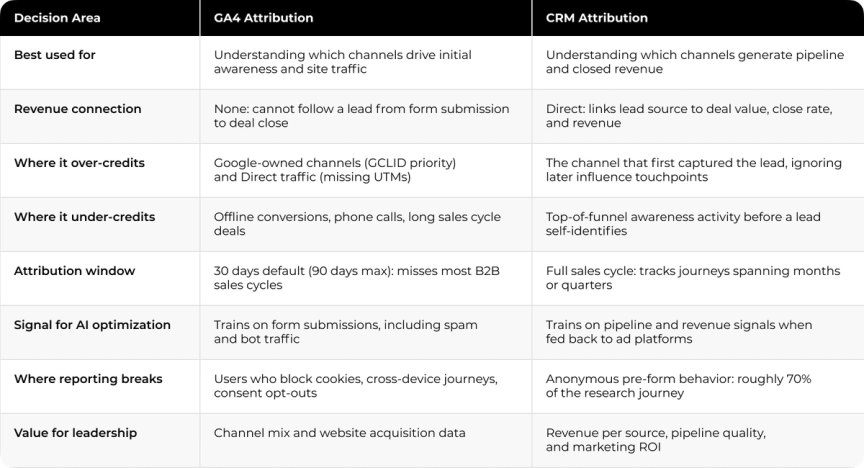
GA4 vs CRM Attribution: Side-by-Side Comparison
The table below maps where each system performs and where it creates blind spots.
Where This Fits in Darwin Flux
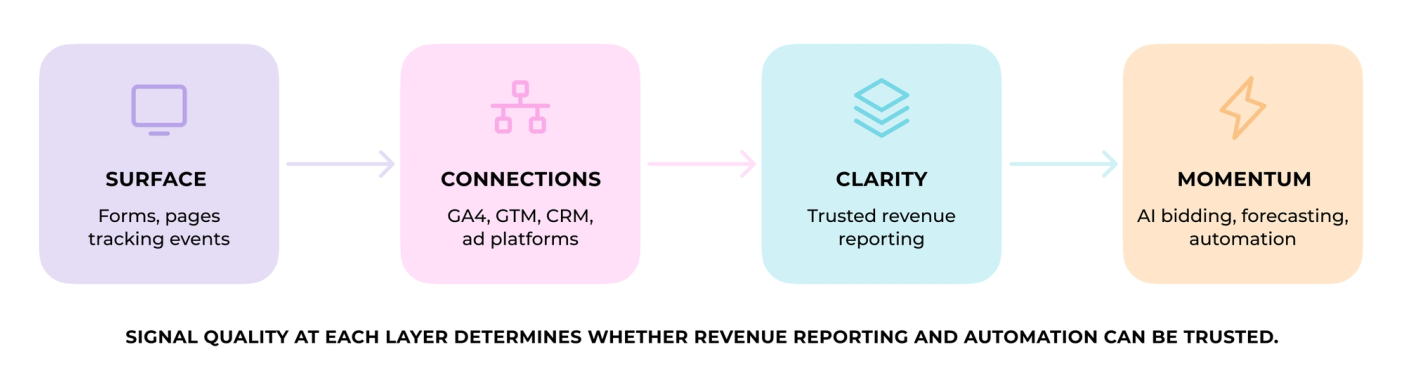
In Darwin Flux, GA4 and CRM attribution are not treated as separate reporting problems. They are parts of one revenue signal path: Surface captures the first interaction, Connections move that signal across systems, Clarity defines which numbers leadership can trust, and Momentum uses that trusted data for optimization.
Why Does an Owned Data Path Fix What a Connector Alone Cannot?
Each system should answer a different question: GA4 explains behavior, CRM tracks pipeline and BI governs revenue reporting logic. That means shared revenue definitions, governed signal flow, and aligned attribution logic among Marketing, Sales and Finance.
What Does an Owned Data Path Require?
It starts with UTM governance: consistent naming conventions that eliminate source ambiguity before data enters any platform. It continues with CRM lifecycle event mapping, identifying the moments that matter for revenue, demo requested, MQL, SQL, opportunity created and closed-won and making those events visible to GA4 and your ad platforms.
This means: store UTM source and campaign in hidden CRM fields on every form submission; store GA4 Client ID plus available click IDs (GCLID, WBRAID/GBRAID), UTMs and CRM contact IDs on the lead or contact record; send SQL, opportunity created and closed-won events back into GA4, Google Ads and Meta using enhanced conversions or Measurement Protocol.
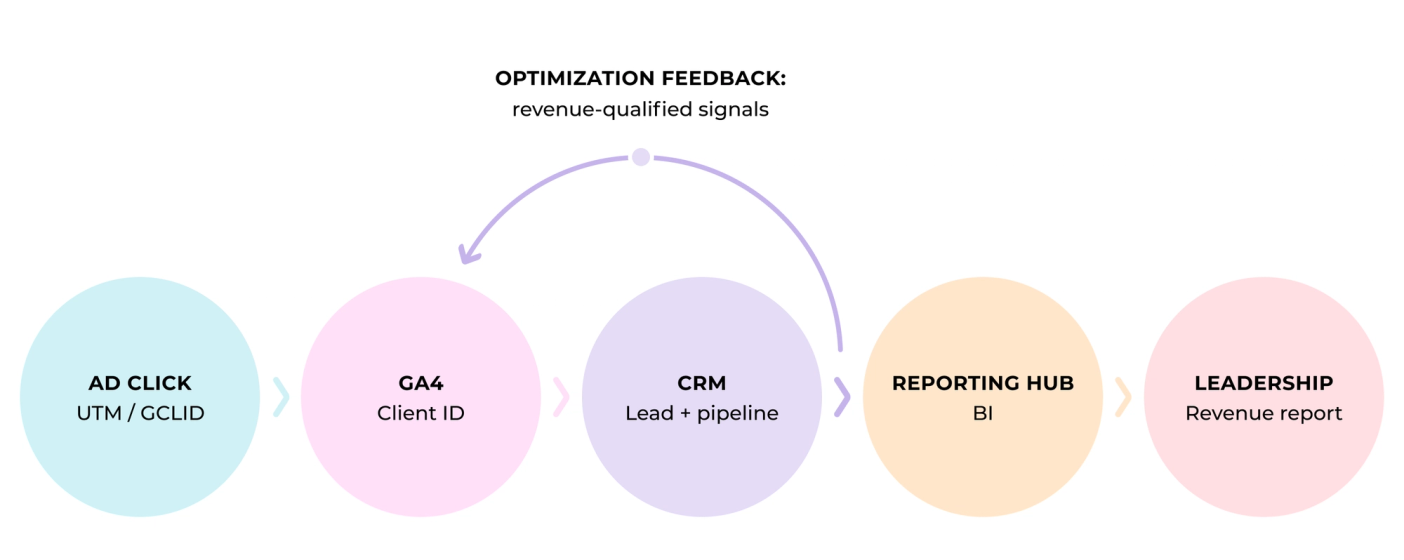
The critical link is storing GA4's Client ID when leads are created in your CRM. This connection makes the full journey traceable from anonymous first click to closed deal. Server-side tagging via tools like Stape or Segment reduces browser-level signal loss while preserving consent controls and maintaining attribution signal without bypassing user privacy choices.
How Does Feeding CRM Revenue Data Back into GA4 Improve Optimization?
When offline events such as SQL and closed-won flow back into GA4 and ad platforms via enhanced conversions or Measurement Protocol, ad algorithms can optimize against revenue-qualified signals instead of form submissions when enough clean conversion data is available. Channels that looked expensive per lead may reveal strong pipeline efficiency. Channels that looked cheap may surface poor close rates that were previously invisible.
Tools like Hightouch or Funnel.io can sync CRM lifecycle stages back to GA4 and ad platforms with minimal engineering. The outcome: ad platform machine learning trains on real revenue signals. Bidding becomes easier to calibrate. Audience targeting becomes easier to refine. Automation scales what generates revenue, not what generates volume.
How Do You Build Attribution Rules That Survive Internal Disagreements?
Define attribution logic among Marketing, Sales and Finance before building any model. Agreement on touch coverage, match to pipeline and revenue, and model stability prevents future conflicts.
As operating targets, aim for match rates above 90% of active records, touch coverage exceeding 85% of measured engagements, and pipeline reconciliation variance under 5%.
How Cleo Rebuilt Reporting Trust Between GA4, Salesforce and BigQuery
When the data path between campaigns, your website, CRM, and pipeline is fragmented, no dashboard will reconcile it. Cleo, a B2B integration and supply chain platform, faced this problem at scale.
Cleo's issue was not an analytics gap. GA4, Salesforce and BigQuery needed one reporting logic.
Key marketing metrics lived in GA4, Salesforce, and BigQuery. Monthly reporting consumed two full working days, and reporting accuracy hovered around 70% because disconnected systems prevented a unified view of marketing results.
Darwin rebuilt the data path. A custom data integration unified GA4, Salesforce and BigQuery into a single centralized reporting hub with Looker Studio dashboards aligned to Cleo's sales and marketing funnel. The result: $50K saved annually by eliminating third-party attribution tools, two reporting days recovered each month, and accuracy improved from approximately 70% to 90%.
Darwin helps marketing and RevOps teams with attribution modeling, CRM-to-GA4 signal alignment, executive reporting infrastructure, and server-side tagging. The goal is to build the operational system that makes attribution trustworthy.
Revenue reporting becomes trustworthy when every system has a defined role: GA4 for behavior, CRM for pipeline, ad platforms for optimization feedback and BI for executive reporting logic.
FAQs
Q1. Why do GA4 and CRM numbers not match?
GA4 fires on browser events. Your CRM records validated business outcomes. They measure different things at different moments and neither has data on the other side of the funnel by default.
Q2. Why does GA4 show more conversions than HubSpot?
GA4 counts every form event including spam, bot traffic and thank-you page reloads. HubSpot records only validated contacts, so it may show fewer top-of-funnel conversions than GA4.
Q3. Which attribution model should a B2B SaaS company use in GA4?
Data-driven attribution works best when GA4 has enough conversion volume to model paths reliably. Lower-volume B2B teams usually need CRM pipeline data alongside GA4 attribution to reflect actual revenue outcomes.
Q4. How does server-side tagging improve attribution accuracy?
Server-side tagging routes data through controlled server infrastructure, reducing browser-level signal loss while preserving consent controls. Optimization systems receive more complete data, and campaign optimization improves as a result.
Q5. How do you connect GA4 attribution with CRM revenue?
Store GA4 Client ID on the CRM lead record at form submission. Then send lifecycle milestones (MQL, SQL and closed-won) back into GA4 via Measurement Protocol or enhanced conversions. This closes the loop between anonymous web behavior and actual revenue.