
Quick Answer:
The best Google Analytics 4 (GA4) alternatives for B2B SaaS in 2026 connect web analytics to company-level tracking and CRM data. The right choice depends on your compliance requirements, go-to-market motion, and whether you need product analytics, attribution, or behavioral insights. This guide compares 10 platforms based on scope, use cases, and how they fit B2B SaaS teams.
TL;DR
• GA4 lacks company-level tracking, has GDPR compliance rulings across five European countries, and loses visibility into 50%+ of users who reject cookie consent.
• Leadfeeder. Identifies up to 45% of anonymous website visitors by company. Best for mid-market B2B with European traffic.
• Mixpanel. Account-level product analytics with Group Analytics. Best for B2B SaaS tracking multi-user accounts.
• Matomo. Full data ownership with CNIL approval. Best for regulated industries needing cookieless tracking.
• Plausible Analytics. Cookieless, 1.4KB script, captures 55% more data than GA4. Best for European SaaS.
• PostHog. All-in-one: analytics, session replay, feature flags, A/B testing. Best for technical teams.
• Amplitude. AI-powered product analytics with account-level tracking. Best for product-led growth companies.
• Piwik PRO. Enterprise privacy-first analytics with ISO 27001 and SOC 2. Best for healthcare and finance.
• Fathom Analytics. Simple cookieless analytics, one-page dashboard, 2kB script. Best for non-technical teams.
• Woopra. Individual user journey tracking across all touchpoints in real time. Best for multi-touchpoint optimization.
• Hotjar. Heatmaps, session recordings, and surveys combined. Best for optimizing onboarding and landing pages.
B2B SaaS teams are moving away from GA4 as compliance pressure grows and the platform lacks company-level tracking.
B2B SaaS teams running GA4 face a specific problem: the platform was built for consumer web traffic, not six-month sales cycles with multiple stakeholders. GDPR fines exceeded €4.5 billion in 2025 and 2026. Over 50% of users now reject cookies, up from 42% in 2024, which removes visibility into a large share of any audience.
This guide covers 10 platforms built for B2B SaaS teams that need privacy compliance and company-level tracking.
The Problem with GA4 for B2B SaaS Companies
GA4's pain points for B2B SaaS are fundamental design choices that clash with how B2B companies operate, not bugs that can be patched.
Missing Company-Level Tracking
GA4 prohibits collecting personally identifiable information. Names, email addresses, and phone numbers cannot be tracked. For B2B marketers, this breaks the connection between web analytics and actual revenue.
A common scenario: content generates a download. GA4 records that event. The lead enters your CRM, goes through qualification, sales meetings, and procurement. Six months later the deal closes for $250,000. GA4 has no record of anything after the initial download. Budget decisions get made on proxy metrics like form fills without a clear line to closed revenue.
GDPR Compliance Issues
Multiple European data protection authorities have ruled GA4 violates GDPR. Austria's DSB cited the Schrems II ruling. France's CNIL found GA4 non-compliant with Art. 44 GDPR. Italy's Garante declared US data transfers violated GDPR. Denmark's Datatilsynet required supplementary measures. Sweden's IMY ordered four companies to stop using GA4.
GDPR violations carry fines up to €20 million or 4% of global annual revenue. GA4 stores EU user data on US-based servers subject to US surveillance laws.
Complex Setup Requirements
Configuring form submission tracking on GA4 takes around 16 minutes with adequate GTM knowledge, compared to one minute in Universal Analytics. Standard reports reflect data with a 24-48 hour delay versus Universal Analytics' four-hour maximum. User-level data retention caps at 14 months, which creates gaps for B2B sales cycles that run longer.
Leadfeeder

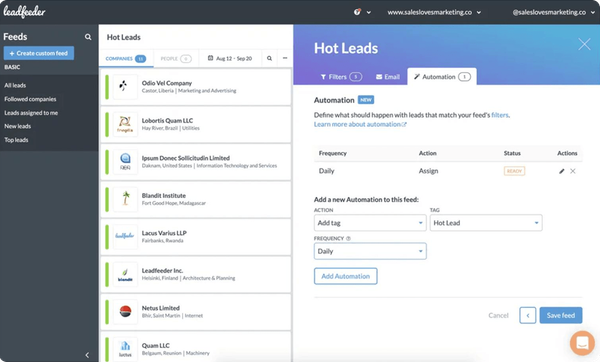
When 98% of website visitors leave without filling out a form, reverse IP lookup identifies who browsed even without a conversion. Leadfeeder reveals which companies visit your site and which pages they view.
What Leadfeeder Does Best
Leadfeeder merged with Germany-based Echobot in April 2023 to form Dealfront, an EU-native platform for B2B revenue teams. Identifies up to 45% of companies visiting your website by matching IP addresses against a database of over 40 million companies and 400 million verified contacts. Updates arrive within five minutes of a visit, which matters for time-sensitive outreach.
Behavioral data shows which pages visitors viewed and how long they stayed. Over 100 filters support segmentation by firmographics, behavior, and CRM activities. Integrations cover Salesforce, HubSpot, Pipedrive, Microsoft Dynamics, Zoho, Slack, and Zapier. All data is processed and stored within the EU.
Pricing and Plans
Free tier: 100 identified companies per month, seven days of data. Paid plans start at $99 monthly (annual billing), scaling by monthly company volume. Each paid tier includes unlimited users, unlimited visit data storage, two-way CRM integrations, and 25 credits for revealing contact details.
When to Choose Leadfeeder
Mid-market B2B companies with at least 1,000 monthly unique visitors and substantial European traffic. Match rates drop for US-only audiences. Works best for ABM strategies, sales and marketing alignment, and feeding intent signals into CRM workflows.
Mixpanel

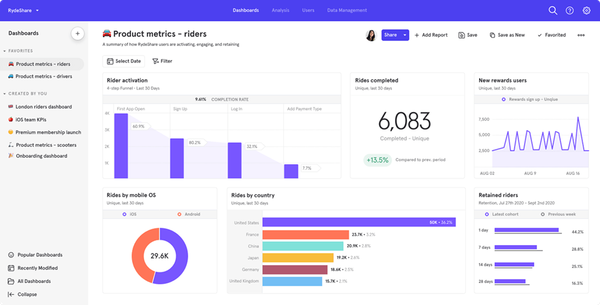
Account-level analytics changes how B2B teams understand product usage. Unlike web analytics tools that treat each user as an independent data point, Mixpanel's Group Analytics maps individual actions back to company accounts. A single $250,000 contract may involve a product manager, an engineering lead, a CFO, and a procurement officer. Each user tracked in isolation misses the account-level picture.
What Mixpanel Does Best
Account Analytics generates profiles for every company showing usage patterns, top users, and retention metrics. Activation Metrics let you query accounts based on aggregated behavior, for example: accounts where more than two users completed onboarding, or accounts with users who logged in over ten times.
Revenue Analytics connects behavioral data to financial outcomes: ARR growth, churn rate, net revenue retention, and expansion rate synced from your data warehouse. Teams executing Mixpanel's B2B framework report 20% ARR lift and 80-day CAC payback. GDPR, CCPA, PDPA, and LGPD compliance included. EU data residency at no extra charge across all plans.
DocuSign, Uber, and Expedia are among the over 26,000 companies running Mixpanel. Teams using the B2B framework with Group Analytics and CRM sync report 20% ARR lift and 80-day CAC payback.
Pricing and Plans
Free tier: 1 million monthly events. Growth plans include the first million events free, then $0.28 per 1,000 events. Group Analytics requires a paid add-on for Account Profiles and account-level reporting.
When to Choose Mixpanel
B2B SaaS products tracking multi-user accounts where usage patterns predict renewals and expansion. Integration with Salesforce or HubSpot syncs behavioral signals into CRM for account health monitoring.
Matomo

Full data ownership means no third party touches your analytics. Matomo delivers that through infrastructure you control, either through cloud or self-hosted deployment.
What Matomo Does Best
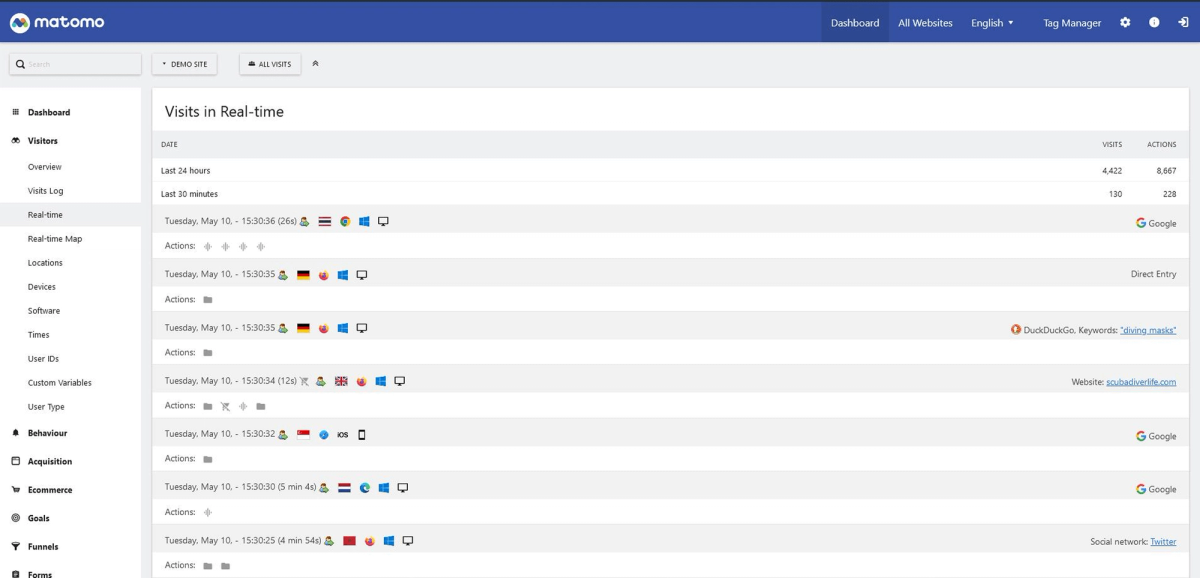
Over 1 million websites across 190 countries run Matomo. France's CNIL approved Matomo as one of the few analytics tools that can collect data without tracking consent. Austria, Italy, Denmark, and Sweden issued similar rulings against Google Analytics. Matomo avoided those problems through EU-based infrastructure.
Cookieless tracking works without consent banners in many scenarios. IP anonymization runs automatically. Supports GDPR, CCPA, LGPD, HIPAA, and PECR. No data sampling means 100% of traffic informs decisions. Unlimited websites, users, segments, and storage included. Raw SQL access connects BI tools directly.
Pricing and Plans
On-Premise is free and open source. Support plans start at €1,799 annually for up to 10 million actions, scaling to €5,929 for up to 1 billion. Cloud pricing starts lower for smaller sites.
When to Choose Matomo
Regulated industries with strict data privacy requirements. European companies avoiding GDPR violations. Teams needing complete analytics without third-party data sharing or sampling.
Plausible Analytics

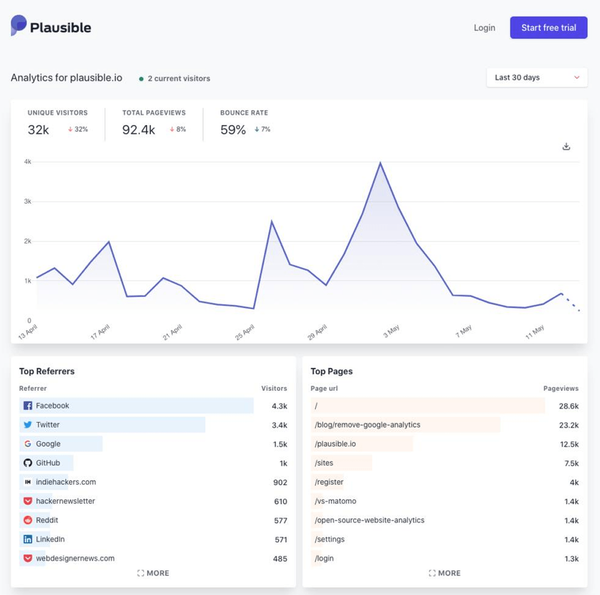
Cookie consent banners remove a large share of any audience from analytics. Visitors reject consent at rates exceeding 50%, creating a blind spot in GA4. Plausible does not use cookies at all.
What Plausible Does Best
Built and hosted in the EU with data stored in Germany. The script weighs 1.4KB, making it 75 times smaller than Google Analytics. Captures 55% more visitor data compared to GA4 because no consent banners are required. France's CNIL confirmed Plausible can collect data without tracking consent.
Revenue tracking works through custom events. The dashboard updates every 30 seconds. Historical GA data can be imported. Open source under AGPL with the full codebase on GitHub for independent security audits.
Pricing and Plans
Starts at $9 monthly for up to 10,000 pageviews. $19/month for 100,000 pageviews. $69/month for 1 million. Annual billing saves two months. Traffic spikes do not interrupt service.
When to Choose Plausible
European SaaS companies avoiding GDPR violations. Teams frustrated with GA4's setup complexity. Non-technical stakeholders who need clean, readable dashboards without developer involvement.
PostHog

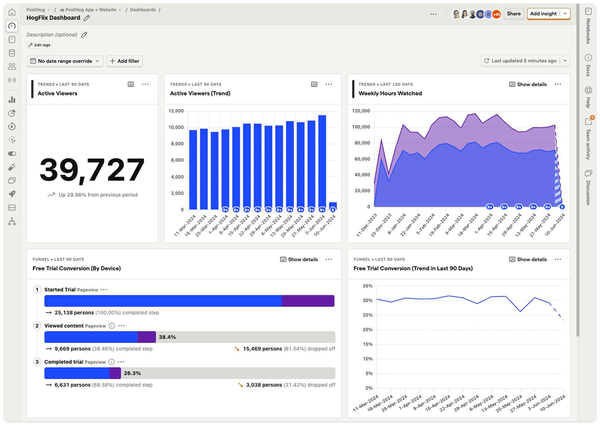
PostHog bundles product analytics, session replay, feature flags, A/B testing, surveys, error tracking, and a data warehouse into a single open-source platform.
What PostHog Does Best
Group Analytics tracks behavior at the company level rather than individual users. Autocapture records every click and pageview automatically, so events can be defined retroactively without realizing something was missed. Session recordings integrate natively, enabling direct navigation from a funnel drop-off to watching what caused it.
EU data residency is included at no extra charge. Full SQL access through HogQL gives technical teams direct database control. Self-hosting is available under MIT license for strict data sovereignty requirements.
Pricing and Plans
Free tier resets monthly: 1 million events, 5,000 session recordings, 1 million feature flag requests, unlimited team members. Startups under two years old with less than $5 million raised qualify for $50,000 in credits. Usage-based pricing starts only after free limits.
When to Choose PostHog
Technical teams comfortable with event instrumentation who need analytics, experimentation, and feature management in one ecosystem. Companies replacing multiple point solutions find the consolidated pricing advantageous.
Amplitude

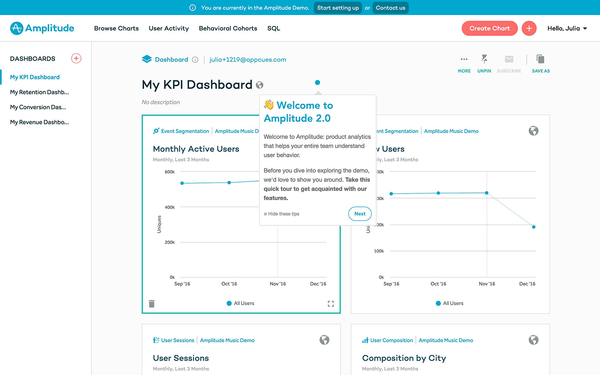
Amplitude powers analytics for over 11,000 digital products and achieves a six-month average time to payback. The platform evolved to handle B2B complexity rather than retrofitting consumer analytics for business use.
What Amplitude Does Best
The Accounts add-on provides account-level insights: onboarding speed, activity patterns, and which companies qualify as product-qualified leads. Integration with Salesforce enriches behavioral data with sales cycle information.
Client results: Criteo saw a 3x increase in campaign creation completion, Pictory reduced churn by 15%, IBM decreased conversion time by 20%, Appfire lifted activation metrics by 10-14%. AI Agents launched in February 2026 monitor products continuously and recommend actions in real time. EU data residency included at no extra charge.
Pricing and Plans
Free Starter plan: 10,000 monthly tracked users, up to 10 million events, session replay, unlimited feature flags, and web experimentation. Plus starts at $49 monthly with up to 300,000 MTUs or 25 million events. Growth and Enterprise tiers offer custom pricing.
When to Choose Amplitude
Companies running product-led growth strategies that need account-level visibility across multi-user organizations. Particularly strong when Salesforce integration and behavioral cohorts drive growth strategy.
Piwik PRO

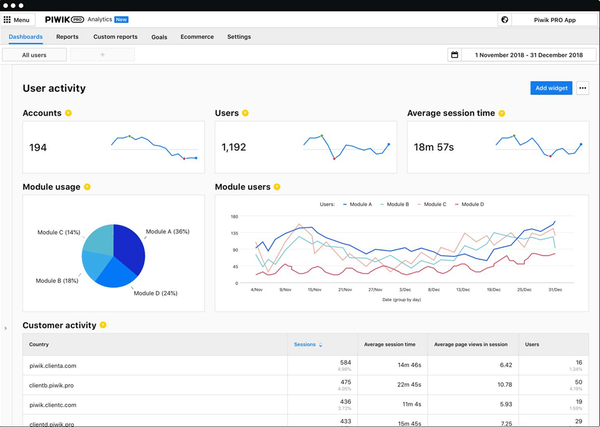
European data authorities have spent years scrutinizing analytics tools. Piwik PRO passed their tests, which is why over 650 clients across 40 countries use it for privacy-compliant analytics.
What Piwik PRO Does Best
GDPR compliance is built into the architecture. Tracks lawful basis for each data point, maintains complete audit trails for DPA inquiries, and offers EU data residency. Captures up to 4x more behavioral data than GA4 through privacy-safe anonymous signals from all visitors, even before they consent.
Four integrated modules handle analytics, tag management, data activation, and consent management. ISO 27001 and SOC 2 certifications. Healthcare organizations get HIPAA-compliant tracking with signed Business Associate Agreements. Rawlplug achieved 98-99% attribution accuracy compared to 30% with Google Analytics. ICTRecht, a Dutch legal firm specializing in data privacy, switched from GA4 to Piwik PRO specifically to ensure their analytics setup met the same GDPR standards they advise clients on.
Pricing and Plans
Business plan starts at €35 monthly: up to 2 million monthly actions, 25 months retention, EU-operated hosting in Sweden. Enterprise begins at €366 monthly (annual billing) with three tiers covering 1 million to unlimited actions.
When to Choose Piwik PRO
Regulated industries requiring GDPR, HIPAA, or strict data sovereignty. European SaaS companies that need complete audit trails and cannot risk GA4's compliance exposure.
Fathom Analytics

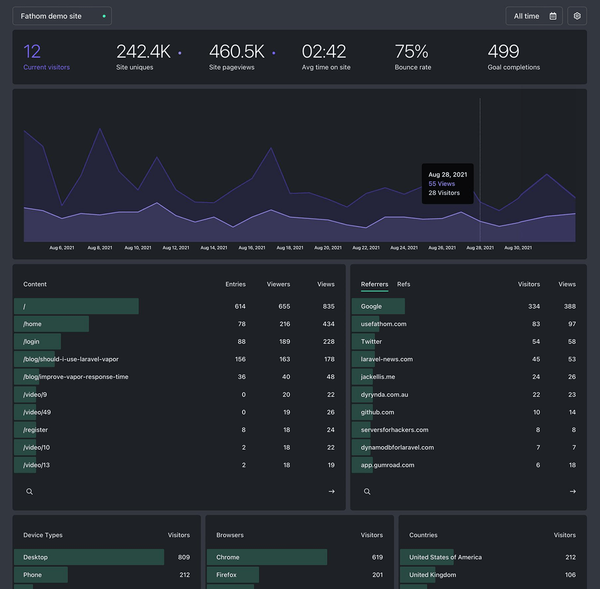
When analytics platforms require weeks to configure, Fathom offers the opposite: one-page dashboard, zero cookies, automatic privacy compliance.
What Fathom Does Best
Cookieless tracking uses hashing and salting to create anonymized user signatures from IP addresses, User Agents, hostnames, and site-specific salts via SHA256. Captures pageviews, bounce rates, and session durations without storing personally identifiable information. Script adds 2kB to source code. GDPR, CCPA, ePrivacy, and PECR compliance is automatic.
Real-time data updates every 30 seconds. Forever data retention from day one. Custom event tracking for newsletter signups, button clicks, and revenue. Historical GA data can be imported.
Pricing and Plans
Starts at $15 monthly for 100,000 pageviews, including up to 50 sites, unlimited email reports, and API access. Traffic spikes do not interrupt service.
When to Choose Fathom
Privacy-focused teams that need GA4-level web analytics without consent banner friction. Non-technical stakeholders who need clean, readable dashboards. Teams that want fast setup without GTM or developer involvement.
Woopra

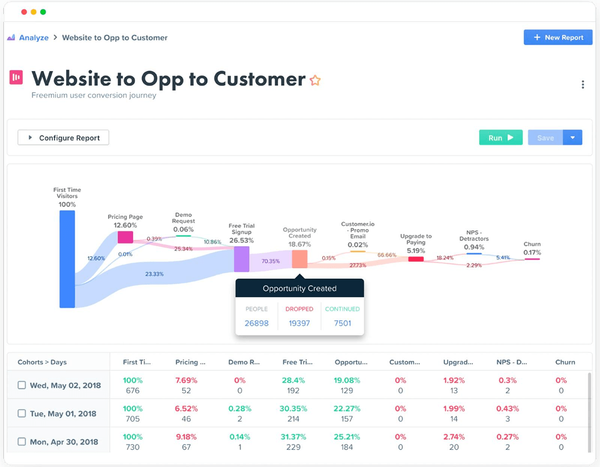
Woopra tracks behavior across every touchpoint in real time for 160,000+ customers. Customer journeys do not fit into neat funnels, and the platform is built around that reality.
What Woopra Does Best
Focuses on individual users rather than sessions or pageviews. Shows what each person does from first website visit through product engagement to support interactions on one unified timeline. Journey Reports map customer paths with drag-and-drop. Retention Reports measure how long users engage with specific features.
Triggers connect behavior directly to actions across your tech stack: a prospect views your pricing page, Woopra notifies your sales rep instantly. Salesforce integration pulls CRM data into customer profiles and exports visitor intent signals back to prioritize leads.
Pricing and Plans
Free Core plan: 500,000 actions monthly, 90-day retention. Pro plan starts at 5 million events per month with a 30-day free trial. Enterprise: custom pricing with extended data retention.
When to Choose Woopra
Companies optimizing multi-touchpoint customer journeys who need real-time visibility into how users move from acquisition through activation to adoption.
Hotjar

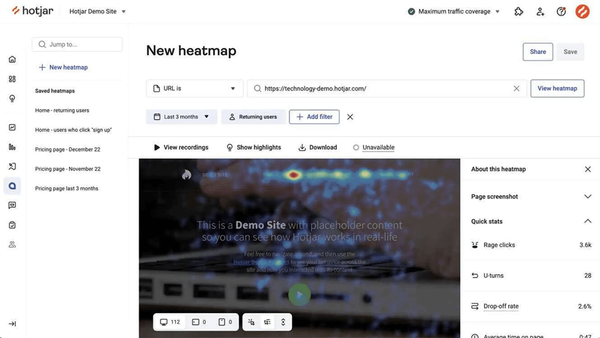
Numbers tell you conversion rates dropped. They do not show the user who clicked a broken button for two minutes before leaving. Hotjar shows what users actually experience on your site.
What Hotjar Does Best
Now part of Contentsquare, Hotjar is trusted by 1.3 million websites and tracks over 1.7 billion sessions per year. Combines heatmaps, session recordings, surveys, and feedback widgets in one package. Integrations connect with Google Analytics, Mixpanel, HubSpot, and Salesforce. 67% of new users install the tracking code in under 10 minutes.
Pricing and Plans
Splits into Observe and Ask products. Observe Plus: $39 monthly for 100 daily sessions. Business: $99 for 500+ sessions. Ask Plus: $59 monthly for 250 responses. Ask Business: $79 for 500+ responses. Bundling two paid plans saves 10% on the lower-priced option.
When to Choose Hotjar
Teams optimizing onboarding flows who need to see exactly where new users get stuck. Marketing teams using heatmaps to improve landing page conversions. Works best alongside a product analytics tool, not as a replacement.
How to Choose the Right Privacy-First Analytics Tool
Time and technical capacity determine what you can implement and maintain. That constraint shapes the choice more than budget or feature count.
Match Analytics to Your B2B SaaS Stage
Startups under $1M ARR gain the most from simple foundations. Growth-stage companies between $1M and $10M ARR benefit from deeper behavioral and revenue tracking. Enterprise teams need AI-powered attribution and prediction capabilities.
Product-led teams should prioritize Mixpanel or Amplitude to understand which in-app behaviors predict retention. Companies focused on paid acquisition need multi-touch attribution to optimize spend.
Evaluate Integration Requirements
Native integrations work for common use cases but lack flexibility for customization. Point-to-point connections seem cost-effective upfront, yet maintenance becomes painful as the stack grows. Factor in maintenance costs, upgrade expenses, and training requirements when comparing approaches.
Consider Your Budget and Team Size
Mature B2B SaaS teams combine two to three tools: attribution for marketing ROI, product analytics for behavior, and dashboards for stakeholder reporting. Start with your biggest blind spot. If you cannot connect marketing spend to revenue, fix attribution first.
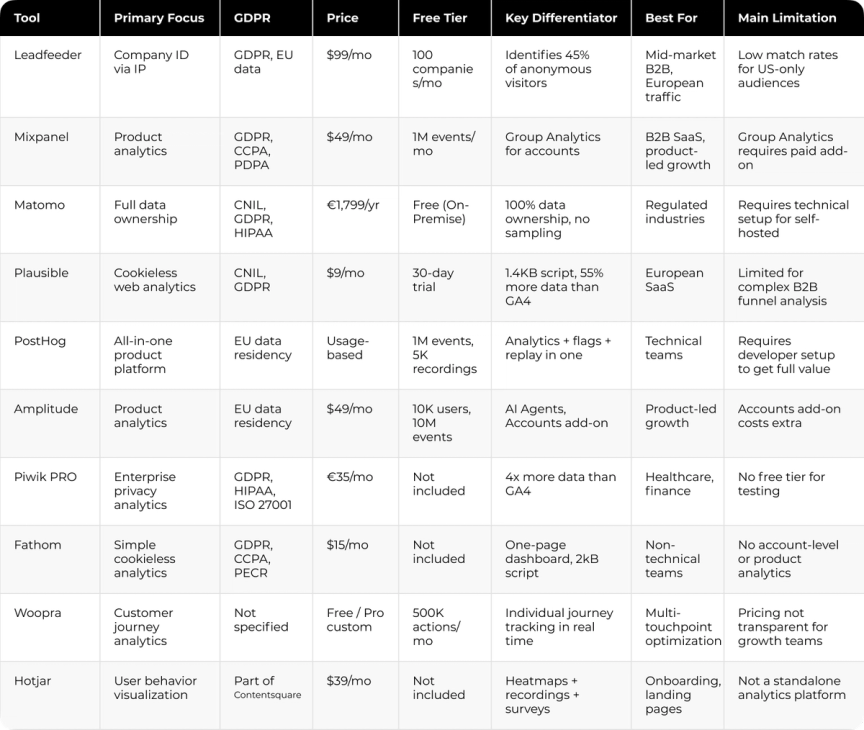
Comparison Table
How Darwin Helps B2B SaaS Teams Connect Analytics to Revenue
Selecting a privacy-compliant analytics tool covers one part of the problem. Connecting it to your CRM, attribution system, and reporting so that web behavior, product usage, and pipeline numbers stay consistent across teams is where most mid-market SaaS teams run into trouble, typically six to twelve months after implementation.
Darwin works at the infrastructure layer of marketing analytics. Cleo, a fintech integration platform, had reporting fragmented across systems with manual reconciliation consuming two working days each week. After Darwin rebuilt the analytics setup with proper CRM sync and event tracking, reporting accuracy improved from 70% to 90%, the two manual reporting days were eliminated, and annual time savings reached $50,000.
What gets implemented:
• Data and Analytics Setup: configuring event tracking, connecting analytics platforms to CRM and pipeline, and building reporting that shows attribution across the full sales cycle
• Integrations and Automations: syncing data between analytics tools, CRM, and internal systems so marketing and sales work from the same numbers
FAQs
Q1. Why are B2B SaaS companies looking for alternatives to GA4?
GA4 lacks company-level tracking, has GDPR compliance rulings across five European countries, requires complex technical setup, and loses visibility into over 50% of users who reject cookie consent. GA4's 24-48 hour data delays and inability to track the full B2B sales cycle make it inadequate for teams connecting web analytics to actual revenue.
Q2. What makes an analytics tool privacy-first and GDPR compliant?
Privacy-first tools offer cookieless tracking, EU-based data storage, and built-in compliance with GDPR, CCPA, and ePrivacy. Many have received approval from European data protection authorities to collect data without consent banners. Key features include data ownership controls, IP anonymization, and the ability to disable visitor logs entirely.
Q3. How do cookieless analytics platforms track visitors without losing accuracy?
Cookieless platforms use hashing and salting to create anonymized user signatures from IP addresses, user agents, and other non-personal data. This captures pageviews, session durations, and behavioral patterns while staying privacy-compliant. Some platforms report capturing 55% more visitor data than GA4 by removing the consent barrier.
Q4. What is the difference between product analytics and web analytics for B2B SaaS?
Product analytics tracks in-app user behavior and feature adoption after signup, including account-level tracking, cohort analysis, and retention metrics. Web analytics tracks website visitor behavior before conversion. For B2B SaaS, tools like Mixpanel and Amplitude are used to understand which behaviors predict renewals and expansion, while web analytics helps optimize acquisition.
Q5. How much should a B2B SaaS company spend on analytics tools?
Entry-level plans start around $9-15 monthly for basic web analytics. Mid-tier product analytics platforms range from $49-99 monthly for startups, scaling to $349-999 for growth-stage companies. Mature B2B SaaS teams typically combine two to three specialized tools rather than relying on one platform.