
Quick Answer:
Broken marketing data shows up as mismatched reports, inflated metrics, and attribution that does not make sense. These seven signs mean your measurement no longer supports decisions. Start with the point causing the most friction, fix it, then move to the next.
TL;DR
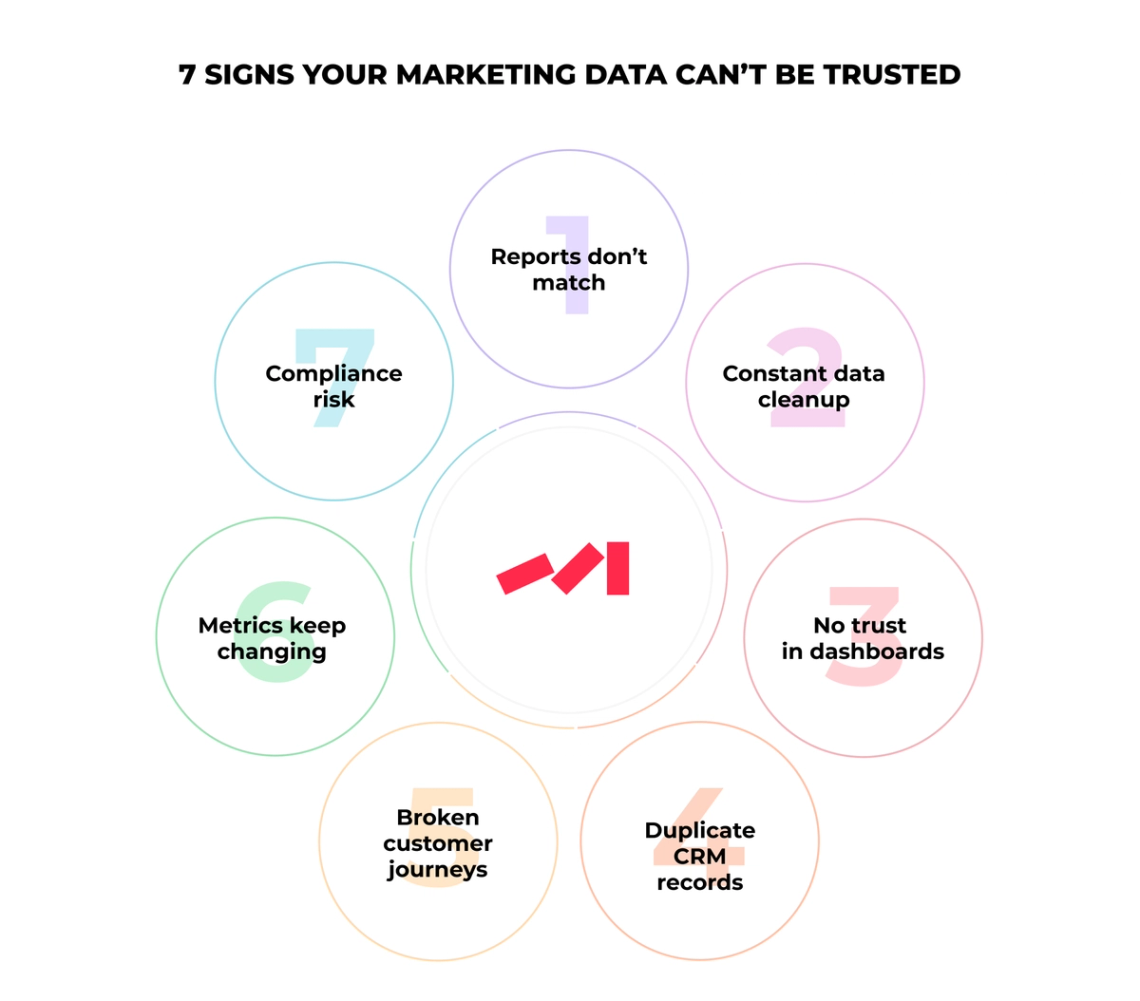
- Sign #1: Reports do not match across platforms — Break: attribution definitions. Owner: RevOps / Marketing Ops. Fix first: align conversion definitions and lookback windows.
- Sign #2: Analysts spend more time cleaning than analyzing — Break: data pipelines and naming rules. Owner: Data / Marketing Ops. Fix first: validate fields before events go live.
- Sign #3: Dashboards are debated instead of used — Break: metric ownership. Owner: RevOps / Finance / Marketing. Fix first: define which metrics leadership uses for budget decisions.
- Sign #4: CRM has more contacts than real people — Break: CRM governance. Owner: RevOps / CRM admin. Fix first: deduplication rules and required fields.
- Sign #5: Attribution shows impossible journeys — Break: identity resolution and lookback windows. Owner: Marketing Ops / Analytics. Fix first: align attribution windows to sales cycle.
- Sign #6: Campaign metrics change on every refresh — Break: pipeline freshness. Owner: Data / Analytics. Fix first: define refresh logic and reporting cadence.
- Sign #7: Compliance requests expose data gaps — Break: data inventory and retention rules. Owner: Legal / Ops / Data. Fix first: map where personal records live.
When marketing, finance, and sales walk into the same meeting with different revenue numbers, the reporting layer has already failed. Poor measurement quality costs organizations an average of $15 million per year, according to Gartner. A McKinsey survey found that 82% of organizations spend at least one full day each week fixing master record problems. If broken attribution, unreliable dashboards, and persistent CRM quality issues sound familiar, this guide breaks down the seven warning signs that your data can no longer be trusted for budget and pipeline decisions.
When Broken Connections Undermine Reporting Clarity
In Darwin Flux, broken marketing data usually starts in Connections and shows up as a Clarity problem.
Connections is where GA4, CRM, ad platforms, dashboards, and consent signals move between systems. When those paths are inconsistent, every platform produces a different version of performance.
Clarity is where the business feels the damage. Reports stop supporting budget decisions, dashboards lose trust, and leadership debates numbers rather than acting on them. The seven signs below map where Connections breaks down and Clarity disappears.
Sign #1: Why Do My Reports Show Different Numbers on Every Platform?
Each platform claims a different conversion count because they each define attribution differently and have no incentive to reconcile with each other.
Consider a straightforward scenario: a customer sees a Facebook ad on Monday, searches your brand on Wednesday, and clicks a Google ad on Friday before purchasing. Meta credits the Monday impression within its 7-day view window. Google claims the Friday click within its 30-day window. Your CRM records one sale. All three numbers are technically accurate, and none of them match.
Gaps up to 10% between platforms are expected, per industry benchmarks. When they grow larger, the numbers can no longer support confident budget allocation. Cookie-based tracking removes another 15-20% of conversions from the picture due to browser restrictions from Safari and Firefox. Apple's App Tracking Transparency adds further blind spots after users leave an app.
“Reporting is the act of identifying what happened. Analysis is the act of identifying why. This is almost always missing from our reports because it is not always easy to automate the why.” Avinash Kaushik, Chief Strategy Officer, Croud
Where This Breaks Budget Decisions
Inflated attribution can quietly distort channel mix. Last-click attribution models often dominate because they are easy to implement, even when they miss how the buyer journey works. Upper-funnel channels get cut. Bottom-funnel gets over-invested. Leadership stops trusting reports entirely, and decisions slow while teams debate which number is correct.
How to Fix Mismatched Attribution Reports
Start by aligning attribution rules across platforms before touching any tooling. Agree on a standard conversion definition, a single lookback window, and one source of record for each metric type. Once the logic is consistent, move reporting into one layer.
ETL tools like Fivetran or Supermetrics support that consolidation by pulling from each source automatically into a warehouse like Snowflake or Google BigQuery. Identity resolution tools like Branch connect device IDs across sessions to reduce cross-device gaps. After the fix, one conversion event maps to one record, regardless of which platform reported it first.
Sign #2: Analysis Slows Down Because Data Requires Constant Cleanup
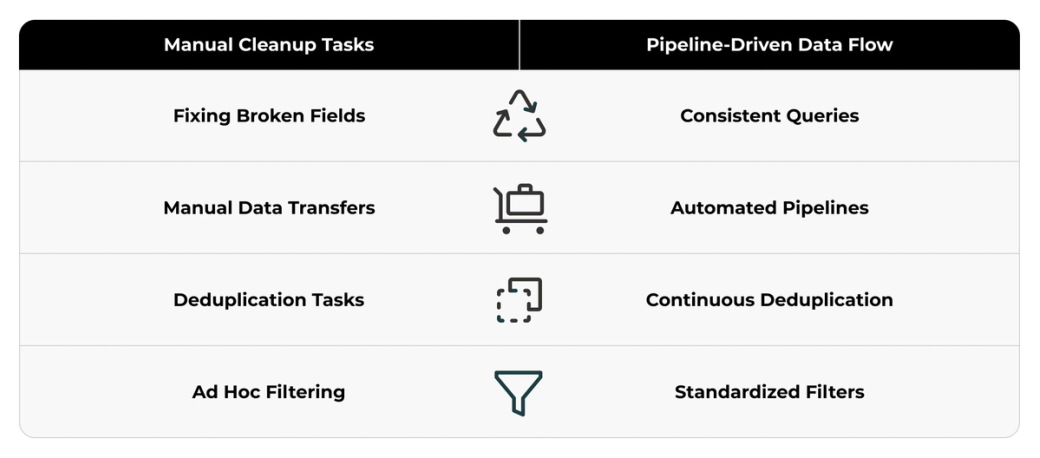
When 60% of analyst time goes to cleaning and organizing inputs, the bottleneck sits upstream in the pipeline that delivers low-quality inputs and forces remediation downstream.
The pattern that creates this: a tracking event gets shipped before the naming convention is finalized. A field gets added without metadata because a launch is imminent. A manual mapping stays in place because automation gets deferred. Over time, 70% of analyst hours go to remediation and 30% to the work they were hired to do.
What It Costs the Business
Poor reporting quality costs organizations $9.7 million annually, per Gartner. Manual entry introduces errors at 4.8%. Forecasting breaks when the numbers shift depending on who ran the last cleanup. The analysis that should inform next quarter's budget is perpetually deferred.
How to Fix the Cleaning Problem
The fix starts upstream. Define naming conventions and field requirements before any tracking event goes live. Validate fields as data enters the system so cleanup becomes an exception. What usually breaks first is the handoff between teams: marketing ships an event, engineering logs it differently, and analysts inherit the inconsistency.
ETL platforms like Improvado automate extraction, standardization, and validation on defined schedules. Assign clear ownership per dataset. When governance is in place, cleanup shifts from a recurring task to an exception.
Sign #3: Your Team Debates the Numbers Instead of Acting on Them
When marketing, sales, and finance each bring a different revenue figure to the same meeting, the reporting layer has stopped functioning as a decision tool.
64% of B2B marketing leaders do not trust their organization's marketing measurement for decision-making. When dashboards consistently show numbers that contradict what sales reports, the tool stops being used for decisions.
Where the Misalignment Comes From
40% of dashboard failures trace back to source quality, not tool selection. The other major factor: 61% of marketing leaders say their measurement does not align with organizational objectives. Marketing tracks MQLs and impressions. Executives track revenue and pipeline velocity. The same dashboard satisfies neither side, so each team builds its own version.
“The true value of marketing measurement lies in how well it is wired into company processes, supported by strong leadership sponsorship, and embraced through effective change management.” Linda Cereda, Former Global VP of Marketing Data, Nike
How to Rebuild Reporting Trust
Audit source quality before building any dashboard. Fix duplicate records and broken associations at the source. Define which metrics leadership uses for budget decisions, then build reporting around those. Establish clear ownership: marketing validates leads, sales handles opportunities, finance owns invoices, RevOps ensures systemic integrity. Once definitions are shared, the debate in Monday meetings shifts from "which number is right" to "what do we do next."
Sign #4: Your CRM Has More Contacts Than Real People
20-30% of most CRM databases are duplicates. A database showing 10,000 contacts may contain only 7,000 unique people. Every segment, campaign, and metric built on contact count is measuring the wrong thing.
A practical example of how this compounds: a RevOps team runs a re-engagement campaign to 8,000 inactive contacts. Post-campaign analysis shows a 12% response rate. When they clean the list, they find 2,400 duplicates. The real response rate was closer to 16%, from a much smaller actual audience. Budget allocation for the next quarter was already set on the wrong baseline.
How Duplicates Enter the CRM
Human entry creates errors at 1-4%. "Tamr Inc." and "Tamr Incorporated" become two records. Phone numbers formatted differently generate separate entries. Integration gaps add more without triggering any alert.
HubSpot checks for duplicates using company domain names, but ".co.uk" versus ".com" still creates separate records through integrations like ZoomInfo. A missing email address during import lets additional duplicates through without any system warning.
How to Fix CRM Duplication
Use native deduplication in your CRM. HubSpot deduplicates contacts by email and companies by domain automatically. Set custom identifiers such as company registration numbers to catch duplicates during imports. Run deduplication tools on a regular schedule and establish entry rules so new records are validated against existing ones before creation.
72% of consumers only engage with tailored messages. When contact history is split across multiple records, personalization fails and campaign costs rise as the same prospect receives multiple sends.
Sign #5: Your Attribution Shows Customers Who Bought Before They Found You
When a customer journey report shows a conversion before the first brand interaction, or a purchase on a device the contact does not own, the attribution model has lost contact with the actual buyer journey.
Why the Timeline Breaks
Cross-device tracking only attributes around 41% of conversions to the correct device path. Someone who sees an Instagram ad on a phone, researches on a work laptop, and converts on a home desktop appears as three separate users to most tracking systems. Meta uses a 7-day click window. Google Ads uses 30 days. When both measure the same journey, the timeline fragments into sequences that appear impossible.
How to Fix Broken Customer Journey Attribution
Align lookback windows to your actual sales cycle before adjusting any other setting. For B2B cycles longer than 30 days, extend GA4's lookback to 90 days. Implement identity resolution using hashed emails or unified customer IDs to connect touchpoints across sessions and devices. After the fix, upper-funnel channels receive credit for journeys they started, and budget shifts to reflect real contribution.
Sign #6: Campaign Metrics Change Every Time You Refresh the Dashboard
150 conversions at $2.50 CPA at 10 AM. 142 conversions at $2.68 CPA fifteen minutes later. Nothing changed in those minutes except how the pipeline delivered the inputs.
Why the Numbers Keep Moving
Batch pipelines process inputs periodically, not continuously. Dashboards display metrics for fixed time ranges. When you refresh, new events arrive while older ones shift categories, changing every number on the screen. Algorithm adjustments from Meta and Google add another layer of volatility in impressions, clicks, and cost-per-click on top of pipeline delay.
How to Fix Shifting Campaign Metrics
Move from batch to real-time pipelines that process events as they occur. Real-time decisioning lets you act on current signals rather than yesterday's snapshot. When the reporting layer reflects what is happening now, optimization decisions arrive before the campaign window closes.
Sign #7: A Data Subject Request Exposes Your Compliance Gap
When a contact requests deletion and their email appears in twelve different databases, half with outdated versions that should have been purged months ago, a reporting quality failure becomes a legal liability with a 30-day clock.
The Regulatory Risk
GDPR Article 5 requires personal records to be accurate and kept up to date. Without systematic quality controls, organizations cannot locate all instances of personal information across systems. GDPR violations carry fines up to 20 million euros or 4% of yearly worldwide revenue. CCPA violations cost $2,500 per unintentional violation and $7,500 for intentional ones.
Marriott International faced a $124 million fine for breaches resulting from inadequate management practices. Companies spend an additional $20,000 annually on staff time handling audit demands that follow from unresolved quality gaps. More on GDPR and CCPA compliance requirements for marketers here.
How to Fix the Compliance Gap
Review and delete personal records on a defined schedule, at minimum once every 12 months. Centralized governance frameworks create shared accountability and make audit responses manageable. Machine learning tools can surface personal records sitting in fields that were never designed to hold them.
Where to Start When Multiple Signs Apply
More than one sign can appear in the same reporting cycle. The priority depends on what is causing the most friction for leadership today.
- If reports do not match across platforms, start with attribution definitions and agree on a single conversion source of record.
- If dashboards are ignored in meetings, start with metric ownership. Define which numbers leadership uses for budget decisions and build reporting around those.
- If CRM contact counts are unreliable, start with deduplication and field governance before running any campaign or segmentation work.
- If campaign numbers shift on every refresh, start with pipeline freshness. Define refresh cadence and move toward event-based processing.
- If a compliance request has exposed data gaps, start with a data inventory. Map where personal records live across systems before the next request arrives.
How Darwin helps fix marketing measurement
Marketing measurement breaks at the points where data moves between systems. Attribution logic, CRM inputs, and reporting pipelines drift out of sync over time. As a result, the same revenue appears differently across tools, and decisions rely on numbers that cannot be verified.
Most teams already have analytics tools, dashboards, and tracking in place. The issue is not the absence of data. The issue is that measurement cannot be trusted when it is needed for budget and pipeline decisions.
Darwin works with B2B companies on the full setup. We audit where attribution, tracking, and reporting break across systems. Then we fix it.
This includes aligning attribution logic with CRM data, fixing tracking gaps across channels, and rebuilding reporting pipelines so numbers stay consistent.
When ABC Fitness Solutions resolved Google Analytics configuration gaps with Darwin’s support, user engagement increased 24% and campaign effectiveness improved 15% within six months.
Most teams we work with already have dashboards and reports. What is missing is measurement that holds under real decision pressure. That is where we focus.
FAQs
Q1. How do I know if my marketing reports are unreliable?
The clearest signs are reports that never match across platforms, analysts spending most of their time cleaning rather than analyzing, and leadership questioning the numbers in every review. If multiple signs appear at once, the quality problem has moved past a fixable inconsistency into something that actively misleads budget decisions.
Q2. Why do Google Ads and Facebook show different conversions for the same campaign?
Each platform uses different attribution windows and assigns credit independently. Meta credits conversions within 7 days of a click or 1 day of a view. Google Ads uses a 30-day click window. When the same customer touches both platforms, each claims full credit. Browser restrictions from Safari and Firefox remove another 15-20% of trackable conversions on top of that.
Q3. What does poor marketing measurement quality cost?
Gartner estimates $15 million per year on average. On top of direct costs, 82% of organizations spend at least one full day per week fixing master record problems, per McKinsey.
Q4. How do duplicate contacts affect campaign results?
Duplicates represent 20-30% of most CRM databases, making all contact-based metrics unreliable. The same prospect receives multiple messages, personalization fails, and segmentation produces skewed outputs. 72% of consumers only engage with tailored content, so scattered records directly reduce campaign effectiveness.
Q5. Where should I start when fixing broken marketing reporting?
Start with the sign causing the most friction in your current reporting cycle. Align attribution rules and conversion definitions first, then consolidate inputs into one layer. Add automated deduplication and assign clear ownership per dataset. Fix one problem properly before moving to the next.