Quick Answer:
Answer Engine Optimization (AEO) tools structure and track your content so AI systems like ChatGPT, Gemini and Perplexity cite your brand as a source. The common approach pairs one platform with two or three specialized tools for schema, content and citation tracking.
TL;DR
- 86% of AI citations come from brand-managed sources: your website, listings and reviews (Yext, 2025).
- A focused AEO stack usually pairs one platform with two or three point tools for schema, tracking, and content.
- Conductor leads enterprise AEO platforms with Forrester recognition for integrated workflows.
- Many mid-market setups combine one platform with two or three specialized point tools.
Remember when Google was the only game in town? Those days are gone. Your content ranks first on Google and then someone asks ChatGPT the same question and it cites your competitor. That is the AEO problem in 2026.
Search is no longer only about ranking. It is about being cited. The companies that figure out Answer Engine Optimization first are building advantages right now. According to Yext's 2025 research, 86% of AI citations come from brand-managed sources: your website, business listings and review platforms. If you control your content structure and keep your information consistent, you shape whether AI engines cite you.
Most companies have no idea where to start. This guide breaks down the 9 best AEO tools available in 2026, how they work, and how to implement them so AI answer engines cite your content.
Where AEO Tools Fit in a Working Citation System
AEO tools solve pieces of the problem and the pieces only pay off when they connect. A citation system starts with Surface: knowing which pages AI engines can read and which queries already cite competitors. Connections keeps your entity data consistent, so a schema change on one page never contradicts a business listing somewhere else. Clarity turns raw citation logs into a share metric a marketing lead can act on. Momentum is the weekly cadence that scales what works and retires what does not. That four-part loop is how Darwin Flux turns a scattered toolset into results you can measure.
What Is Answer Engine Optimization (AEO)?
AEO is how you structure content so AI systems cite your brand when answering user questions. Classic SEO optimizes for Google's algorithm. AEO optimizes for AI models that build answers by pulling information from multiple sources. The difference matters and it changes how you measure success.
Classic SEO gives Google ten blue links. Users click, visit your site, and you get traffic and conversions. AI answer engines generate one answer and cite a handful of sources and users often read the answer without clicking through. Being cited becomes the visibility, authority and brand recognition you used to earn through clicks.
How AEO Works
Many AI answer engines use retrieval methods, often described as Retrieval-Augmented Generation, to pull information from indexed sources before generating an answer. A few signals tend to influence whether they cite you.
- Machine-readable structure. Your content needs JSON-LD schema markup that tells AI systems what each piece of information represents.
- Clear, extractable answers. AI models prefer concise, fact-based answers they can lift directly. A short, direct answer up front is easier for them to lift than the same fact buried mid-article.
- Source authority. Engines weigh domain authority, content freshness and consistency across your site, listings and review platforms.
- Entity consistency. Your business name, address, phone number and key facts need to match everywhere you appear.
AEO vs. SEO vs. GEO: What Is the Difference?
The three disciplines overlap and each targets a different surface. The table below shows where each one wins.
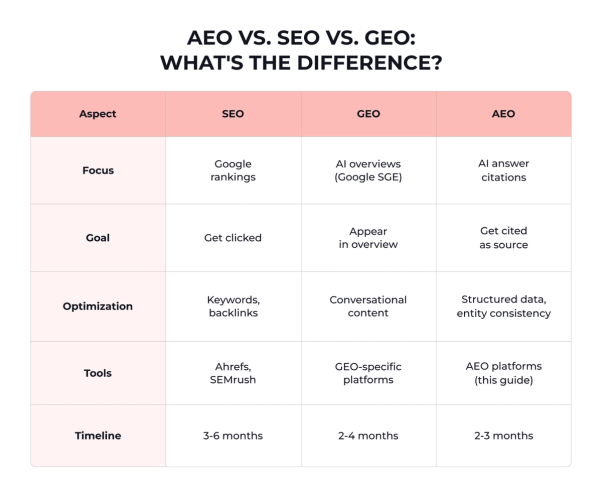
The three overlap more than the labels suggest. SEO drives traffic and feeds the authority signals AI engines read. GEO covers how you show up in Google's own AI answers. AEO covers citations in assistants like ChatGPT and Perplexity. Most teams work all three at once, since the same structured, consistent content supports each.
Why AEO Matters More Than Ever in 2026
Zero-click search is now the default. SparkToro's 2026 study estimated that for every 1,000 US Google searches, only about 276 clicks reached the open web, down from 374 two years earlier. The rest end on the results page itself or inside AI answers. That trend is accelerating, and content that is not structured for AI citation disappears from it.
The Business Impact of AEO
Getting AEO right changes four things at once.
- Brand authority. When ChatGPT cites you as the source for industry information, you become the trusted name even when users do not click. That lift compounds.
- Qualified traffic. The visitors who do arrive from AI referrals already saw a preview of your expertise and want more.
- Early-mover edge. Brands that structure content early tend to build up citation history that later entrants have to work to match.
- Future-proofing. AI-driven search keeps growing and companies optimizing now are positioned for the next decade of search behavior.
The Risks of Ignoring AEO
The downside moves just as fast. AI hallucinations can attribute false information to your brand and we have seen cases where an engine cited a questionable source or generated an incorrect fact that damaged reputation. While you focus only on Google SEO, competitors capture AI-driven visibility in your space. For companies where search drives revenue, losing AI citations means losing pipeline.
The 9 Best AEO Tools for 2026
These nine cover the range of AEO needs, from enterprise platforms to focused point tools. They are grouped by use case so you can build the stack that fits your goals.
1. Conductor – Best Enterprise AEO Platform

Conductor is the leading enterprise platform that combines SEO, content intelligence and AEO workflows in one system. Named a Leader in the 2025 Forrester Wave for SEO platforms, it is built for companies that need governance, scale and deep integration.
Key Features
Unified content intelligence maps your content to citation opportunities using topic modeling and entity graphs.
• Multi-engine simulation tests how content performs across ChatGPT, Gemini and Perplexity before deployment.
• Automated schema deployment pushes FAQPage, HowTo, Product and Organization schema across thousands of pages through CMS connectors.
• A citation tracking dashboard shows which engines cite you, which pages get cited most, and how citation share shifts.
• Enterprise governance adds role-based access, approval workflows, audit logs and SOC 2 / ISO 27001 compliance.
Pros and Cons
Pros:
• All-in-one platform removes tool sprawl.
• Strong Forrester recognition and a proven enterprise track record.
• Deep CMS integrations with WordPress, Contentful and Adobe Experience Manager.
• Attribution modeling connects citations to conversions.
Cons:
• Enterprise pricing is custom, with reported contracts commonly in the mid five figures a year.
• Implementation takes 8 to 12 weeks.
• Too heavy for companies under $10M revenue.
Pricing
Custom enterprise pricing based on site size, page count and integrations. Reported Vendr deal data shows contracts from roughly $27K to over $500K a year, with a median near $49K.
Best Use Case
Best for: Enterprise B2B companies above $50M revenue, regulated industries needing governance and sites with 10,000+ pages.
Not ideal for: Startups, small businesses and teams wanting a quick pilot.
FAQ
Q: Does Conductor integrate with our CMS?
A: Yes. Conductor connects to WordPress, Contentful, Adobe Experience Manager, Sitecore, and custom CMSs via API.
Q: How long until we see results?
A: Most clients see measurable citation lift within 8-12 weeks of deployment.
Q: Can we export raw citation data?
A: Yes. All citation logs, including excerpts and confidence scores, are exportable.
2. Yext – Best for Local & Multi-Location Businesses

Yext pioneered the AI citations category with 2025 research showing 86% of citations come from brand-managed sources. Its platform focuses on entity consistency across websites, business listings and review platforms.
Key Features
• Knowledge graph management centralizes business entity data and pushes updates to 200+ directories and AI engines at once.
• An AI citations dashboard tracks where engines cite your business and which queries trigger citations.
• Listings sync keeps name, address, phone, hours and services aligned across Google Business Profile, Bing Places, Apple Maps and more.
• Reviews management monitors and responds to reviews from one place, a major citation source in Yext's research.
• The Pages platform generates location and service pages with built-in schema and AI-optimized structure.
Pros and Cons
Pros:
• Category leader with published citation research and methodology.
• Strongest multi-location and franchise support.
• Automatic listings sync removes heavy manual work.
• Strong return for location-based businesses.
Cons:
• Lighter on editorial and content AEO.
• Pricing scales with location count and can climb.
• Weaker simulation features than Conductor.
Pricing
Starts at $199 per location per year, billed annually with no monthly option. The Complete tier at around $499 per location per year adds analytics, and multi-location contracts scale from there.
Best Use Case
Best for: Multi-location businesses, franchises, retail chains, healthcare providers and local service businesses.
Not ideal for: Pure B2B SaaS companies without physical locations.
FAQ
Q: How many directories does Yext sync to?
A: 200+ platforms including Google, Bing, Apple Maps, Yelp, TripAdvisor, and industry-specific directories.
Q: Can Yext help with review generation?
A: Yes. They have tools for requesting reviews and responding to them from one dashboard.
3. BrightEdge – Best for Content-First AEO Strategy

BrightEdge combines classic SEO with AI-powered content recommendations and AEO optimization. Its DataMind AI analyzes billions of searches to surface content gaps and citation opportunities.
Key Features
• AI-powered content recommendations identify which topics, formats and structures get cited most in your industry.
• A citation opportunity finder shows queries where competitors get cited and you do not.
• Live research tracks which engines cite you for branded, competitor and category queries.
• A content optimizer gives specific recommendations to restructure content for citations.
• SERP features and AI citations sit in one dashboard.
Pros and Cons
Pros:
• Strong content intelligence and gap analysis.
• Good balance of SEO and AEO features.
• Tracking across multiple AI engines.
• Actionable content recommendations.
Cons:
• Enterprise pricing similar to Conductor.
• Learning curve to use the full platform.
• Schema automation is less mature.
Pricing
Custom enterprise pricing. Reported contracts commonly run $25K to $150K a year, with a mid-market median near $50K.
Best Use Case
Best for: Content-heavy B2B companies, publishers and teams needing data-driven content strategy.
Not ideal for: Small businesses focused mainly on technical schema automation.
4. Schema App – Best Standalone Schema Automation Tool
Schema App is the specialist for rock-solid schema deployment without an enterprise platform. It focuses entirely on structured data implementation and validation.
Key Features
• A schema markup generator builds JSON-LD for FAQPage, HowTo, Product, LocalBusiness, Organization and 100+ other types.
• A WordPress plugin gives one-click deployment with automatic updates.
• A bulk schema editor updates markup across thousands of pages at once.
• All schema is validated against Google's guidelines and tested in the Rich Results Test.
• A highlighter tool maps page content to schema properties by point and click.
Pros and Cons
Pros:
• Laser-focused on schema quality.
• Far more affordable than enterprise platforms.
• Fast implementation in days.
• No vendor lock-in.Fast implementation (days, not months)
Cons:
• No citation tracking or simulation.
• You need separate tools for monitoring.
• Limited governance features.
Pricing
Free tier to get started. Paid plans are quote-based, scaled to the number of pages and schema types you need to manage.
Best Use Case
Best for: Mid-market companies needing schema automation without enterprise overhead and WordPress sites with technical resources.
Not ideal for: Companies needing citation tracking, simulation, or governance.
5. MarketMuse – Best for Content Gap Analysis

MarketMuse uses AI to analyze your content against competitors and find the gaps that block citations. It is strongest for content strategy and planning.
Key Features
• A content inventory crawls your site and competitor sites to map coverage and gaps.
• A topic authority score measures how authoritative your content is on specific topics.
• A content brief generator creates writer briefs optimized for both SEO and AEO.
• Competitive intelligence shows which topics competitors get cited for that you miss.
• AI recommendations suggest sections, FAQs and facts to add for citation potential.
Pros and Cons
Pros:
• Excellent content planning and strategy.
• Strong competitive analysis.
• Helps editorial teams produce citation-worthy content.
• Good for building content calendars.
Cons:
• No technical schema implementation.
• No direct citation tracking.
• Works best alongside other tools.
Pricing
Free tier with limited monthly queries. Standard at $149 a month (one user, priced per brief). Premium at $999 a month for unlimited users and briefs.
Best Use Case
Best for: Content teams planning editorial calendars and B2B marketers building thought leadership.
Not ideal for: Companies needing immediate technical AEO fixes or citation tracking.
6. Semrush – Best All-in-One SEO + Basic AEO

You probably know Semrush added AEO features in 2025, including AI overview tracking and structured data recommendations. You likely know it for SEO, and now it covers hybrid SEO and AEO work.
Key Features
• AI visibility tracking shows where your brand appears in AI answers.
• Prompt and share-of-voice tracking follows how often you appear versus named competitors.
• Structured data recommendations cover the basics of adding schema.
• Content optimization suggests improvements for both SEO and AEO.
• Keyword research with AI intent flags queries where engines generate answers.
Pros and Cons
Pros:
• Familiar platform if you already use Semrush.
• Good value, with AEO features inside existing plans.
• No learning curve for current users.
• Strong for a hybrid SEO and AEO strategy.
Cons:
• AEO features are basic next to specialists.
• Limited schema automation.
• Prompt volume is capped on lower tiers, so wide query sets get costly.
Pricing
Pro at $139.95 a month. Guru at $249.95 a month. Business at $499.95 a month.
Best Use Case
Best for: Companies already using Semrush for SEO and small-to-mid-market teams wanting basic AEO. Not ideal for: Enterprises needing deep schema automation or governed multi-brand workflows.
7. Ahrefs – Best for Competitive Citation Intelligence
Ahrefs added AEO-related features in 2025 and excels at competitive analysis of who gets cited and why. It shows which competitors appear in AI answers and the authority signals behind it.
Key Features
• Brand Radar shows which competitors appear in AI answers across ChatGPT, Gemini, and Perplexity for your prompts.
• Content gap analysis finds topics where competitors get cited and you do not.
• Backlink impact analysis correlates backlink profiles with citation rates.
• SERP features and AI mention tracking cover classic rankings and AI answer appearances side by side.
• A site audit flags schema errors and missing markup.
Pros and Cons
Pros:
• Strongest competitive intelligence.
• Excellent backlink data.
• Good value if you already use Ahrefs.
• Site audit surfaces technical issues.
Cons:
• No schema automation.
• AI mention counts read as directional, not exact.
• Not a complete AEO stack on its own.
Pricing
Lite at $129 a month. Standard at $249 a month. Advanced at $449 a month. Enterprise at $14,990 a year.
Best Use Case
Best for: SEO teams adding AEO to existing workflows and competitive analysis. Not ideal for: Companies needing hands-on schema implementation or precise citation counts.
8. SEOClarity – Best Enterprise Alternative to Conductor

SEOClarity is an enterprise SEO platform that grew into AEO and undercuts Conductor on price. It is a strong Conductor alternative for teams comfortable with more configuration.
Key Features
• Clarity Grader for AEO scores pages on citation-readiness.
• A schema manager deploys and manages structured data across large sites.
• A citation dashboard tracks citations from Google AI Overviews and major AI platforms.
• Content Fusion is a content optimization tool with AEO-specific recommendations.
• API access supports custom integrations and raw citation data exports.
Pros and Cons
Pros:
• Enterprise features at a lower price than Conductor.
• Strong API and integration options.
• Good for teams with technical resources.
• Flexible data exports.
Cons:
• Less polished experience than Conductor.
• Smaller customer base and ecosystem.
• Support quality varies.
Pricing
Published tiers run from roughly $750 to $4,500 a month, with the enterprise tier around $4,500 a month, generally undercutting Conductor for comparable scope.
Best Use Case
Best for: Large companies wanting enterprise AEO on a lower budget and technical teams comfortable with APIs.
Not ideal for: Non-technical users prioritizing ease of use over customization.
9. Custom Development + Open Source Stack
For companies with strong engineering teams, a custom stack of open-source tools and APIs can be cost-effective. It trades upfront build cost for full control and data ownership.
Key Components
• Schema markup uses schema.org vocabulary and custom JSON-LD generation.
• Citation tracking queries the OpenAI, Anthropic and Google Gemini APIs programmatically.
• Monitoring runs on custom dashboards built in Looker Studio or Tableau.
• Automation uses Python scripts for schema deployment and validation.
• Version control keeps schema templates and deployment history in Git.
Pros and Cons
Pros:
• Full control and customization.
• No vendor lock-in.
• Lower ongoing cost once built.
• You build exactly what you need.
Cons:
• High upfront development cost.
• Requires dedicated engineering resources.
• Maintenance burden sits with your team.
• No out-of-box support or training.
Pricing
Development runs $50K to $150K depending on scope. Ongoing API fees of $500 to $2,000 a month plus engineering time.
Best Use Case
Best for: Tech companies with engineering resources and unique requirements that vendors do not meet.
Not ideal for: Non-technical companies without dedicated engineering support.
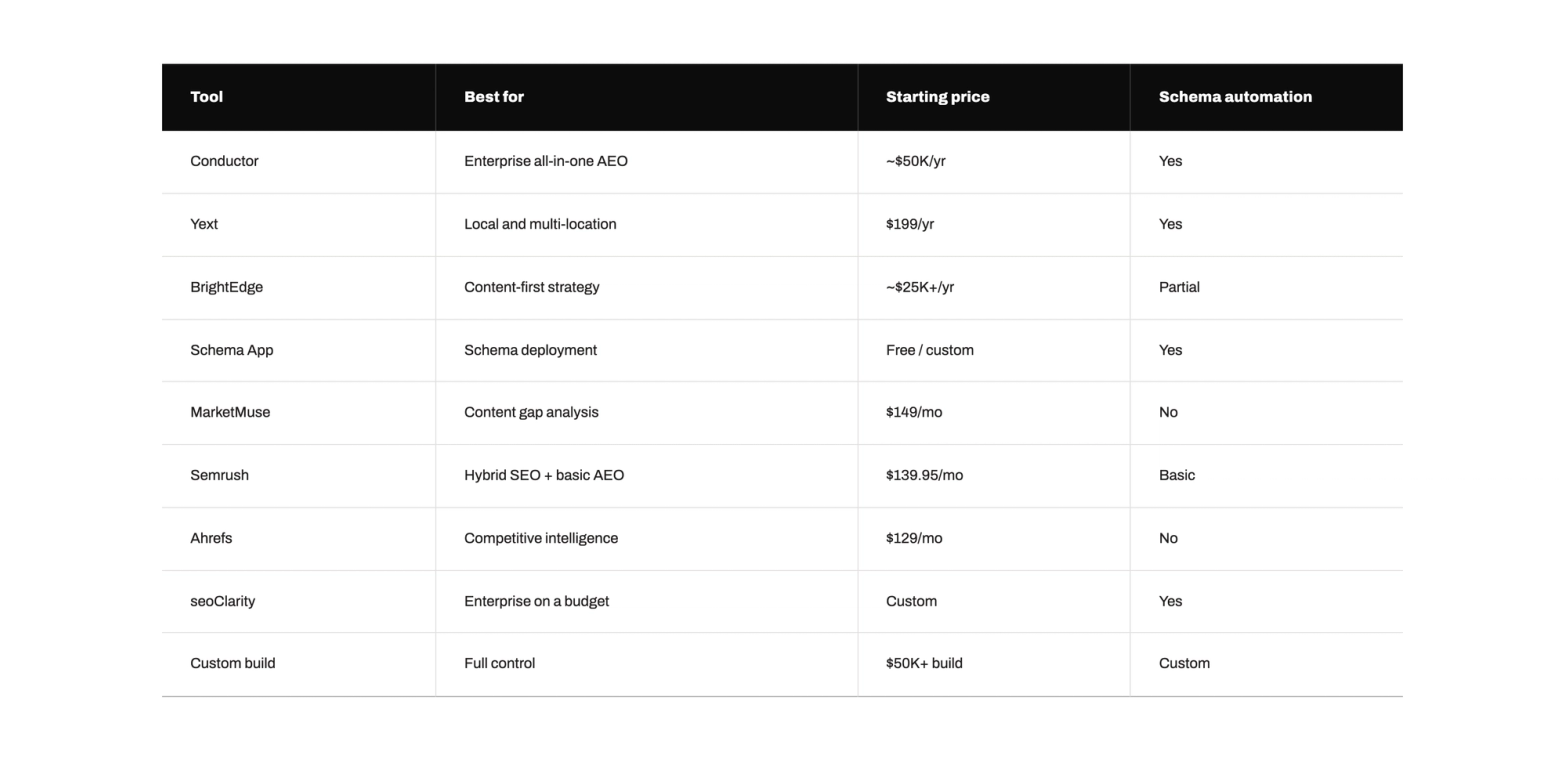
Comparison Table: AEO Tools at a Glance
The table below lines up all nine options by primary strength, starting price and best-fit company.
Narrowing nine tools to a working stack is easier with a second opinion on your site and goals.
Need Help Choosing the Right AEO Tools or Finding a Custom Development Vendor?
Darwin helps B2B companies evaluate, implement, and optimize AEO strategies with proven integration expertise.
Our AEO Services:
- Tool evaluation and vendor selection
- Custom implementation roadmaps
- Schema markup deployment at scale
- Citation tracking and measurement
- Ongoing optimization and reporting
How to Choose the Right AEO Tool Stack
Most companies do not need one tool. They need the right combination. The framework below sorts the decision by revenue, page count and how much governance you need.
Decision Framework: Platform vs. Point Tools
Choose an Enterprise Platform (Conductor, BrightEdge, SEOClarity) if:
- Revenue > $50M annually
- 10,000+ pages to optimize
- Multiple departments need access (content, SEO, product, legal)
- Governance and compliance are critical (finance, healthcare, legal)
Build a point-tools stack (Schema App plus Semrush plus custom) when:
• Revenue sits between $5M and $50M.
• You have 1,000 to 10,000 pages.
• You need fast results and lower upfront cost.
• You have technical resources in-house.
Start with basic tools (Semrush or Ahrefs plus Schema App) when:
• Revenue is under $5M.
• You are testing AEO before a major investment.
• Budget is $500 to $1,000 a month.
• You need to prove return before expanding.
The Stack Most Companies Choose
One combination balances cost, capability and speed for mid-market teams. A base platform of Semrush or Ahrefs around $250 a month handles SEO plus basic AEO tracking. Schema App at $499 to $999 a month deploys structured data at scale. Custom API queries near $500 a month monitor citations across OpenAI, Anthropic and Google. Yext at $199 to $500 a month covers local listings when they apply. Total cost lands at $1,500 to $2,500 a month, implementation takes four to six weeks and it covers most AEO needs for mid-market companies.
Red Flags When Evaluating Vendors
Watch out for these warning signs during vendor trials:
- Can't export raw citation data: You'll be locked in and unable to switch tools
- Only tracks one AI engine: AEO is multi-platform; Google-only tools miss half the picture
- No schema validation: Bad structured data is worse than no structured data
- Requires 2+ year contract: Market moves fast; you need flexibility
- Vague about methodology: How do they actually track citations? If they can't explain it, be skeptical
- No API or integration options: You'll be doing manual exports forever
The 12-Week AEO Implementation Roadmap
This roadmap works whether you use an enterprise platform or a point-tools stack. The key is focus. Optimize a pilot set first, prove the lift, then scale.
Weeks 1-2: Discovery & Baseline Measurement
Goal: Understand current state and set benchmarks.
Step 1: Site Crawl & Inventory
- Export all pages (product, service, location, FAQ, blog)
- Document CMS platform and deployment workflows
- Map content types to potential schema types
- Identify high-traffic, high-conversion pages for pilot
Tools Needed: Screaming Frog or Sitebulb for crawling
Step 2: Citation Baseline
- Choose 100-200 target queries (branded, category, competitor)
- Run queries against ChatGPT, Gemini, Perplexity manually or via API
- Document current citation rate and which competitors get cited
- Save screenshots and excerpts as baseline
Key Metrics to Track:
- Citation Share: What % of target queries cite you?
- Citation Accuracy: Are citations factually correct?
- Competitor Citation Rate: Who gets cited more than you?
Yext's research validates this approach—they tracked millions of citations and found citation share is the most actionable metric for operations teams.
Step 3: Content Audit
- Flag pages with clear Q&A structure (keep these)
- Flag pages that bury the answer (need rewrite)
- Note pages with contradictory facts or outdated info
- Check NAP consistency across all location pages
Pro Tip: Focus audit on pages in top 20% of traffic—these have highest citation impact.
Weeks 3-4: Quick Wins & Schema Deployment
Goal: Deploy low-hanging fruit that shows fast results.
Quick Win #1: Add TL;DR Answers
At the top of high-value pages, add a 1-2 sentence "quick answer" in this format:
## Quick Answer
[Product/Service X] [does what] [for whom] [with what benefit].
[One supporting fact or statistic]. [Link to full details].
Why this works: AI models strongly prefer extractable answers at the top of pages.
Quick Win #2: Deploy FAQPage Schema
Start with product FAQ pages and local store pages. These convert well and have clear Q&A structure.
Use this simple JSON-LD template (swap in your content):
<script type="application/ld+json">
{
  "@context": "https://schema.org",
  "@type": "FAQPage",
  "mainEntity": [
    {
      "@type": "Question",
      "name": "What are your business hours?",
      "acceptedAnswer": {
        "@type": "Answer",
        "text": "We're open Monday-Friday 8am-6pm ET, Saturday 9am-2pm ET. Closed Sundays."
      }
    },
    {
      "@type": "Question",
      "name": "Do you offer same-day delivery?",
      "acceptedAnswer": {
        "@type": "Answer",
        "text": "Yes, we offer same-day delivery for orders placed before 3pm ET in our service area."
      }
    }
  ]
}
</script>
Validate using Google's Rich Results Test: https://search.google.com/test/rich-results
Quick Win #3: Fix NAP Consistency
Audit your business name, address, phone across:
- Your website (footer, contact page, location pages)
- Google Business Profile
- Bing Places
- Major directories (Yelp, Yellow Pages, industry directories)
Even small inconsistencies ("Inc." vs "Inc" vs no suffix) confuse AI systems.
Add Organization schema to your homepage:
<script type="application/ld+json">
{
  "@context": "https://schema.org",
  "@type": "Organization",
  "name": "Your Company Name Inc.",
  "url": "https://www.yoursite.com",
  "logo": "https://www.yoursite.com/logo.png",
  "contactPoint": {
    "@type": "ContactPoint",
    "telephone": "+1-555-123-4567",
    "contactType": "customer service"
  },
  "address": {
    "@type": "PostalAddress",
    "streetAddress": "123 Main Street",
    "addressLocality": "New York",
    "addressRegion": "NY",
    "postalCode": "10001",
    "addressCountry": "US"
  }
}
</script>
Expected Results After Weeks 3-4:
- Schema deployed on 20-50 high-priority pages
- TL;DR answers added to top 10 traffic pages
- NAP consistency fixed across all platforms
Weeks 5-8: Simulation, Testing & Content Optimization
Goal: Test what works and scale winners.
Step 1: Run LLM Simulations
Use your chosen tools (Conductor, or OpenAI/Anthropic APIs directly) to test variations:
Test A: Short Answer + FAQ
- 30-word direct answer at top
- FAQ section with 5-8 questions
- FAQPage schema markup
Test B: Longer Narrative Format
- 200-word comprehensive answer
- No FAQ structure
- Article schema only
Test C: Hybrid Approach
- 50-word answer
- 3 FAQs for common questions
- Link to detailed guide
Run each test for 2-3 weeks and track which format gets cited more often.
What we've seen: Short answer + FAQ wins 80% of the time for transactional queries. Longer formats work better for thought-leadership topics.
Step 2: Create Topic Hub Pages
For complex topics, create dedicated landing pages with this structure:
# [Topic] - Complete Guide

## Quick Answer (30-50 words)
[Direct answer with link to details]

## Key Facts About [Topic]
- Fact 1 with source
- Fact 2 with source
- Fact 3 with source

## Frequently Asked Questions
[FAQ schema markup]

## Detailed Guide
[Link to comprehensive article]

## Related Resources
[Internal links]
Why this works: RAG models prefer "information-dense" snippets they can extract quickly. Hub pages give them perfect bite-sized answers.
Step 3: Remove Citation Blockers
Common technical issues that prevent citations:
JavaScript Rendering Issues
AI scrapers may not execute JavaScript. Server-side render or pre-render critical content.
Paywalls on Key Pages
Move FAQ and "how-to" content outside paywalls so AI can access it.
Deep Click Paths
If answers are 4+ clicks deep, crawlers may never find them. Flatten your site architecture.
Inconsistent URLs
Use canonical tags to prevent duplicate content confusion.
Robots.txt Blocks
Check that you're not accidentally blocking AI crawlers. Many companies block common bots without realizing they're preventing citations.
Weeks 9-12: Scale, Govern & Measure
Goal: Expand successful pilots and establish long-term governance.
Step 1: Scale Schema to All Relevant Pages
If your pilot showed citation lift, roll out schema templates:
- FAQPage: All product FAQs, service FAQs, location FAQs
- HowTo: Tutorial and setup pages
- Product: All product pages (ecommerce, SaaS product pages)
- Article: Blog posts and guides
- Organization/LocalBusiness: Homepage and location pages
Use CMS templating or tools like Schema App to automate deployment. Manual schema across thousands of pages is a maintenance nightmare.
Validate with Google Rich Results Test: https://search.google.com/test/rich-results
Step 2: Establish Governance
Set up approval workflows for:
Content Changes: Who can edit canonical answers?
Schema Changes: Who approves new schema types?
YMYL Content: Healthcare, legal, financial topics need legal review
Citation Errors: Escalation process for fixing incorrect AI citations
Keep audit logs for compliance (especially in regulated industries). Store:
- Full edit history for all JSON-LD changes
- Who approved what, when
- Citation accuracy audits (for YMYL topics especially)
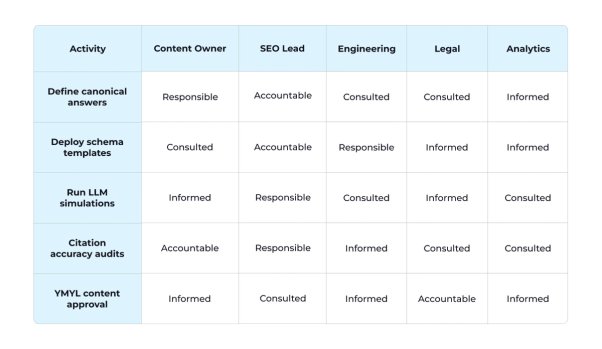
Recommended RACI Model:
Step 3: 30-Day Measurement Period
After full deployment, run a clean 30-day measurement period:
Core Metrics:
- Citation Share Lift: % increase in queries where you're cited
- Citation Accuracy: % of citations that are factually correct
- AI Referral Traffic: Sessions from AI platforms (if trackable)
- Conversion Rate: Do AI referrals convert better/worse than organic?
- Revenue Impact: Assisted revenue from AI-influenced sessions
Advanced Metrics:
- Time to Index: How fast do updates appear in citations?
- Citation Position: Are you the primary source or secondary?
- Branded vs. Non-Branded: Citation rates for branded queries vs. category queries
Yext's research emphasizes tracking by location and query context—aggregate metrics can mask important regional variations.
Set Up Automated Monitoring:
- Daily: Run top 200 queries, log citations
- Weekly: Citation accuracy spot checks (5-10% sample)
- Weekly: Trend report to stakeholders
- Monthly: Comprehensive review with ROI analysis
Ready to Implement AEO at Your Company?
Darwin offers complete AEO implementation services—from strategy and tool selection to deployment and optimization.
What We Provide:
- 12-week implementation roadmap
- Schema markup automation across your site
- Custom analytics dashboards for citation tracking
- Governance frameworks and team training
- Ongoing optimization and reporting
We've helped companies like:
- B2B SaaS companies increase citation share by 45% in 90 days
- Multi-location businesses get cited in 3x more local queries
- Enterprise brands fix citation accuracy from 60% to 95%
FAQs
Q1. What is the difference between AEO and SEO?
SEO optimizes content to rank in Google's classic results and earn clicks. AEO structures content so AI engines like ChatGPT and Perplexity cite your brand inside generated answers. You need both, because they target different surfaces of search.
Q2. How long does it take to see AEO results?
Most companies see initial citation changes within two to eight weeks of deploying schema and structured answers. A full 12-week rollout gives you enough data to measure citation-share lift with confidence.
Q3. Do I need an enterprise platform or point tools?
It depends on scale. Above 10,000 pages and multiple departments, an enterprise platform pays off. Between 1,000 and 10,000 pages, a point-tools stack of schema, tracking and content tools gives faster results at lower cost.
Q4. Which AI engines should I optimize for?
Optimize for ChatGPT, Gemini and Perplexity together, since each favors different sources. Tools that track only one engine give a partial view, so multi-engine tracking helps.
Q5. How do I measure AEO success?
Track citation share (the percent of target queries that cite you), citation accuracy and how AI referral traffic converts compared with organic. These three metrics tell you whether your content is getting cited and whether those citations drive value.