Quick Answer:
An AI visibility audit checks whether ChatGPT, Claude, Perplexity, and Google AI Mode name your brand when buyers ask for recommendations in your category. You run a fixed set of buyer prompts across each platform, record where your brand appears and with what sentiment, then compare that footprint with competitors to see which gaps to close first.
TL;DR
- AI answers now shape a growing share of product research and B2B vendor discovery, so a brand can rank in Google and still stay absent from AI recommendations.
- An audit runs 30 to 50 buyer prompts across ChatGPT, Claude, Perplexity, and Google AI Mode, then logs mentions, citations, and sentiment for each.
- Three visibility tiers matter: a mention names you, a citation attributes a source, a recommendation endorses you as a preferred option.
- Reading the data means measuring mention coverage, competitive share of voice, and the prompts where rivals dominate.
- Manual tracking holds up to a point; past 50 prompts or several competitors, automated tools keep the picture consistent.
Your site can perform well in Google Search and still stay absent when someone asks ChatGPT, Claude, or Perplexity for recommendations in your space. An AI visibility audit closes that blind spot.
A SEO/GEO audit shows which technical, content, and entity signals make that gap harder to close.
AI search now handles many real buying decisions. A growing share of product research, software comparison, and B2B vendor discovery happens inside AI-generated answers. When AI platforms leave your brand out, you lose trust, authority, and revenue to competitors who solved this earlier.
This guide shows how to run an AI visibility audit, what to look for, and how to track your AI brand visibility on every platform.
From Blue Links to Brand Recall: Where AI Discovery Reshapes Visibility Work
An AI visibility audit answers one question: does the machine know your brand well enough to name it? That question breaks into four pieces, and the four pillars of Darwin Flux line up with each.
Surface covers how the market and the models first encounter your business, which is the raw footprint an audit measures. Connections track the entities, mentions, and third-party sources that teach a model to associate your brand with a problem. Clarity keeps your claims, proof, and product data consistent enough for a model to quote you with confidence. Momentum turns a one-time snapshot into a tracked signal that moves as models update. You can read the full framework in Darwin Flux.
Understanding AI Brand Visibility and LLM Visibility
AI brand visibility is the degree to which large language models recognize your brand and surface it in generated answers. It grows from the mentions, citations, and context a model absorbed during training and retrieval, so it behaves differently from a keyword ranking.
“The web isn't shrinking, distribution is shifting. Brands that treat AI answers as a primary channel, not a side effect, will own the next decade of organic reach.” — Rand Fishkin, Co-founder, SparkToro
How AI Search Platforms Work Differently
AI search platforms synthesize an answer from many sources, where classic search engines return a ranked list of links. That single design choice reshapes how your brand earns attention.
Ask Google a question and you get a page of links. Ask ChatGPT or Perplexity the same question and you get a conversational answer that draws from many sources with no click required. The shift changes what AI brand visibility depends on.
AI platforms run on large language models. These models read the intent behind a natural-language query and draw on entity associations to compose a response, so context and meaning carry the weight that keyword density once held.
Semrush projects that traffic from large language models will pass classic organic search around 2028. ChatGPT alone reports more than 900 million weekly active users. SparkToro and Similarweb found that zero-click Google searches in the US rose from 60.45% in 2024 to 68.01% in early 2026, so most searches now end on the results page itself.
The platforms also behave differently from one another. Perplexity commonly uses live web retrieval with inline citations, so log the retrieval mode you used for each test. ChatGPT can answer from model knowledge and, when web search is enabled, from retrieved web sources. Record the mode used for each test.
What Gets Your Brand Mentioned in AI Answers
AI tools weigh mentions of your brand from many corners of the web, including unlinked ones. Classic SEO rewarded sites with many high-quality inbound links, and AI visibility widens that scope to plain-text references a link never touched.
Repeated, consistent brand associations on reliable sources can make it easier for retrieval systems and models to connect your brand with a topic. When a model has encountered your brand name beside a specific problem often enough, that association becomes easier to surface.
Source quality, entity consistency, and clear, extractable content can make it easier for AI systems to connect a brand with a category. Useful signals include consistent claims, structured tables and definitions, and credible third-party references.
Brand mentions and classic SEO strength tend to move together. A seoClarity analysis of 432,000 keywords found that about 97% of AI Overviews cite at least one source from the top 20 organic results, which points to real overlap between organic ranking and AI search visibility.
AI platforms read well past your website. They learn from podcasts, directories, PR coverage, review sites, industry blogs, social discussions, forums, and interviews. The more your brand appears in authoritative discussion, the stronger your trust signals grow.
The Three Types of AI Visibility: Mentioned, Cited, Recommended
AI visibility comes in three weights. A mention is a factual reference with no evaluative framing. A citation is a source attribution that signals authority. A recommendation is an active endorsement that positions a brand as a preferred option.
These three tiers carry different weight for brand perception, user behavior, and conversion. ChatGPT leans toward recommendation, surfacing brands as preferred options more readily than it cites them as sources. Google AI Overviews lean toward source aggregation, attributing citations more readily than offering a clean recommendation.
The tier matters because being recommended puts your brand in front of buyers as a preferred option. AI-referred traffic that arrives on the back of a recommendation reaches buyers who already trust the endorsement. Seer Interactive found that brands cited inside AI Overviews earn roughly 35% more organic clicks than non-cited brands on the same query.
A brand with 10,000 neutral mentions and zero recommendations sits in a weaker spot than a brand with 500 mentions and 200 recommendations. Retrieval is one thing, and authoritative citation is another: a source can appear in results yet fall short of recommendation status when its evidence score stays low.
Different platforms can disagree on the same query, naming different brands or framing sentiment in different ways. That cross-platform gap means any single-platform monitoring plan gives you a partial view of your AI brand visibility.
Preparing Your AI Search Visibility Audit
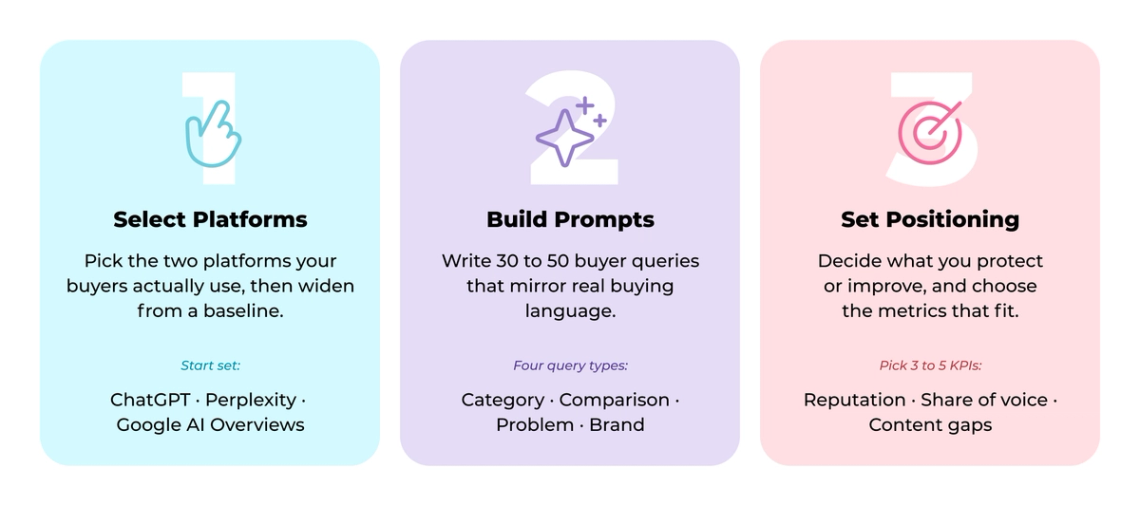
Preparation sets the audit's accuracy. You choose the platforms your buyers use, build a prompt set that mirrors real buying language, and define the positioning you want to protect or improve.
1. Select AI Platforms to Monitor
Platform choice follows where your buyers do research. Enterprise software buyers often favor ChatGPT for vendor discovery and Perplexity for deep comparison. Consumer brands often need visibility in Google's AI-generated summaries and shopping recommendations. B2B services firms often watch Claude, given its adoption in professional-services teams.
Begin with two platforms where you have confirmed user activity, then widen the set based on baseline results. You may find meaningful traffic from an unexpected platform, or learn that an assumed priority does not match real behavior. Let the data lead expansion so each platform gets a proper read.
For baseline coverage, begin with Perplexity, ChatGPT, and Google AI Overviews as a practical starting set. Confirm the mix against where your buyers do research. Widen to the full platform set once the baseline holds.
2. Create Buyer-Focused Test Prompts
Build a prompt set of 30 to 50 queries before you run anything. The set should cover four query types.
- Category queries: the buyer wants a product like yours and has not named your brand. Example: "What are the best tools to track how my brand appears in ChatGPT?"
- Comparison queries: the buyer is shortlisting. Example: "Compare AI brand monitoring platforms."
- Problem queries: the buyer describes the pain and skips the category name. Example: "How do I know if ChatGPT is recommending my competitor?"
- Brand queries: the buyer already knows your name. Example: "What does Astiva AI do?" These verify accuracy, and they measure discovery less directly.
Run each prompt 5 to 10 times per platform. Record whether your brand appears, at what position, and with what sentiment. One run tells you little, and frequency over many runs is the real signal.
3. Document Your Current Brand Positioning
Decide what you are protecting or improving. It may be brand reputation. It may be competitive positioning. It may be the need to keep AI systems from citing outdated product information.
Different goals call for different metrics. Reputation means tracking sentiment trends and factual accuracy. Competitive intelligence means measuring share of voice and how often you surface against rivals. Content teams focused on AI content creation want to know which topics and formats attract AI citations.
Choose three to five KPIs tied to what matters most for your business. For perception work, brand sentiment tracking sets a baseline for comparing AI responses with classic media coverage.
Running Your AI Visibility Audit Across Platforms
Each platform needs its own testing routine. The steps below keep results comparable so you can trust the footprint you record.
How to Test Brand Mentions in ChatGPT
Open ChatGPT in incognito mode and log out before you run any prompts, since a logged-in session personalizes answers from your history and custom instructions. Test each prompt with web search on and off: search off shows what ChatGPT learned in training, and search on shows live retrieval. ChatGPT drives a large share of AI referral traffic today, which makes it a high-priority platform for AI brand visibility tracking, though that share shifts as rivals gain ground.
How to Test Brand Mentions in Claude
Claude names brands in a large share of responses and skips external links by default, so brand presence there builds awareness more than direct clicks. When Claude's web search tool is active, citations include URL, title, and snippet fields, which makes outputs easy to parse for tracking. Test prompts on a consistent schedule and note whether your brand appears in narrative context, since Claude often produces detailed comparisons.
How to Test Brand Mentions in Perplexity
Perplexity cites sources inline with numbered references, which makes citation tracking more measurable than on other platforms. Run prompts in a dedicated browser profile to cut personalization noise and keep weekly results comparable. Track three outcomes: mentions where your brand is named in answer text, citations where your brand appears in references, and links that click through to your site. As of May 2025, CEO Aravind Srinivas reported Perplexity handling around 780 million queries a month, growing more than 20% month over month, so retrieval-first platforms carry real weight.
How to Test Brand Mentions in Google AI Mode
Google AI Mode and AI Overviews appear on a large and rising share of US searches, with Similarweb putting AI Overviews on close to half of queries in 2026. Because of how the feature pulls content, its cited URLs overlap only partly with classic search results, and a visible AI summary lowers the rate at which users click a standard result. Test queries that trigger AI Mode in your category and record which sources appear.
Tracking Citation Links and Source Data
Record which brands and domains were cited, whether a citation carried a link or only a brand name, your brand's position in the response, and which specific URLs were linked. Store the source URLs shown in references so you can analyze what each platform trusts. Citation frequency measures how often your content is cited in AI responses for your tracked prompts.
Recording Sentiment and Accuracy
Track two things separately, because they measure different problems. Sentiment runs on a four-point scale: Endorsement, Neutral, Cautious, or Negative. Accuracy runs on its own scale: accurate, partly inaccurate, or inaccurate, which is where you flag hallucinations about your brand. Store evidence snippets for every mention so both calls stay grounded. Report sentiment as the share of mentions in each band and report accuracy as its own share. Keep them apart, since blending them into one score lets a run of neutral mentions inflate the result.
Reading Your Audit Data to Find Actionable Insights
Raw logs turn useful once you convert them into a few tracked metrics. Coverage, competitor dominance, and the reasons behind a miss point you toward the fixes that matter.
Calculate Your Mention Coverage Rate
Add up every mention in your competitive set, your own brand included, then divide your mentions by that total for a competitive share of voice. If you and four competitors collect 200 mentions in the prompt set and your brand appears in 40, your share of voice is 20%. Track it monthly, since a single number gives position while the trend line shows whether you gain or lose ground.
Your mention inclusion rate works the same way: the percentage of relevant prompts where your brand appears out of the total. Brand visibility tends to follow a three-tier pattern, with household names appearing in a high share of relevant answers, established mid-market brands in a moderate share, and niche brands in a low one.
Identify Which Prompts Show Competitor Dominance
Run comparison queries and record which competitors appear beside your brand. Check whether the descriptors are accurate, whether your price point reads as value or as a barrier, and whether AI recommends you with enthusiasm or as an afterthought. The competitors that surface in AI-generated answers reveal the market's current positioning.
Prompts like "Best enterprise CRM for financial services" often replace bottom-of-funnel search. Track which brands AI favors for these high-intent queries, since the pattern behind those citations exposes your content gaps, authority perception, and topic coverage.
Analyze Why Certain Platforms Miss Your Brand
When a brand first sees the gap between how it views itself and how AI platforms describe it, the root cause often sits in the information and proof available on your site and third-party sources, including your product data. Run your core product and comparison queries through the major AI platforms and document the discrepancies: outdated positioning, wrong integration or pricing details, missing proof on your product pages, docs, and review profiles. Fix those source pages first, then amplify.
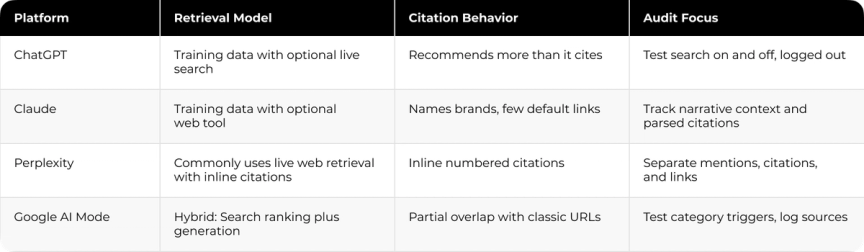
How the Four Platforms Compare for a Visibility Audit
Each platform exposes brand data in its own way, so the audit method shifts per platform. The table sums up what to expect and how to test.
Using AI Visibility Audit Tools for Continuous Monitoring
A one-time audit shows where you stand today, and a monitoring setup shows how that position moves as models update. The shift from manual checks to tooled tracking is a question of scale and cadence.
“Classic search measurement is really about performance, but AI Search channels are more branding channels so you have to think about performance differently.” — Mike King, Founder and CEO, iPullRank
When Manual Audits Stop Being Practical
Manual tracking holds up until your query set passes 50 prompts, you watch more than three competitors, or leadership asks for regular trend reporting. Past that point, spreadsheets turn into a bottleneck. Models refresh their knowledge often, so monthly snapshots can miss shifts. Purpose-built AI visibility audit tools hold a consistency that manual work struggles to match.
What to Look For in AI Visibility Audit Tools
Platform coverage comes first. A tool should track ChatGPT, Perplexity, Google AI Overviews, Gemini, and Claude at minimum, since single-platform monitoring leaves blind spots where competitors win quietly.
Several tools now compete in this space, among them Evertune, Nightwatch, Otterly, SE Ranking, and Conductor, each with a different emphasis on source-level attribution, sentiment analysis, or enterprise reporting. The category matters more than any single name: look for sentiment analysis, prompt-level tracking, competitive benchmarking, and recommendations that go past raw mention counts.
How to Set Up Automated Brand Tracking
Run your full query set monthly as a baseline, and move high-stakes categories to a weekly cadence. Continuous monitoring catches model updates and competitor moves through alerting, so you learn about a shift when it happens. Set clear refresh frequencies before launch, review the process a few times a year, and connect AI visibility metrics to real traffic and conversions.
Turning an Audit Into Durable AI Visibility
An audit shows the gap between how buyers describe your category and how AI answers describe your brand. Closing that gap is systems work: consistent product data, structured proof, and content that a model can quote without hedging. Most teams can run the first audit on their own, and the harder part is fixing the data and content signals underneath so the next audit reads better.
Darwin works this way with long-term clients. In a multi-year engagement with Audi, the work centered on continuous improvement of the underlying web and data systems, holding the foundation steady enough to build on release after release. That same discipline, clean data and structured, quotable content, is what moves a brand from absent to cited in AI answers.
Run your first audit this week to learn where you stand. Then treat the fixes as an ongoing signal that you revisit as the models keep updating and the field you are measured against keeps moving.
FAQs
Q1. What are AI brand mentions and how do they differ from citations?
An AI brand mention names your brand in a response, often without a link. A citation attributes or links to your content as a source. Mentions build awareness, and citations build credibility that can send traffic to your site.
Q2. Which AI platforms should I prioritize when tracking visibility?
Start with ChatGPT, Perplexity, and Google AI Overviews as a practical starting set. Once you have a baseline on those, expand to Claude and Gemini based on where your specific audience does research.
Q3. How often should I run AI visibility audits?
Run your full query set monthly as a baseline to track trends. In a high-stakes or fast-moving category, move to weekly. Past 50 prompts or several competitors, automated tools keep results consistent.
Q4. Why does my brand appear on one AI platform and not others?
Each platform favors different sources and data types. Perplexity leans on structured comparisons and community threads, ChatGPT on well-established reference sources, Gemini on schema and Knowledge Graph presence. Your footprint depends on what you built for each.
Q5. What metrics measure AI visibility success?
Track mention coverage rate, competitive share of voice, and sentiment. Coverage shows how many relevant prompts name you, share of voice compares you with rivals, and Sentiment shows whether mentions are endorsement, neutral, cautious, or negative. Track accuracy separately to flag incorrect claims about your brand. Review monthly for trends.