Quick Answer:
Data governance works when six roles have clear ownership: a Chief Data Officer sets direction, a Data Governance Manager runs the program, Data Owners approve access and quality rules for their datasets, Data Stewards keep definitions and quality in daily order, IT Managers secure the systems and Data Users follow the rules and report issues. A RACI matrix records who decides and who executes for each governance task.
TL;DR
- Six roles carry governance. The CDO, Data Governance Manager, Data Owners, Data Stewards, IT Managers and Data Users each own a part of it.
- Owners decide, stewards maintain. Data Owners are accountable for a dataset; Data Stewards do the daily work of keeping it accurate and well defined.
- One accountable person per task. A RACI matrix records who is Responsible, Accountable, Consulted and Informed for each governance activity.
- Governance programs often stall. Gartner predicts 80% of data and analytics governance initiatives will fail by 2027; named owners give a program the business reason it needs.
- AI extends the scope. In 2026, the same roles also govern the data that AI agents and automated reports read.
Data is the backbone of modern business, and organizations need clear roles and responsibilities to ensure data governance operates effectively.
Whether you're a data manager, compliance officer, or IT leader, understanding and implementing these roles is essential for maintaining regulatory compliance, improving decision-making, and building an organization that thrives in the data-driven world.
“You can have all of the fancy tools, but if [your] data quality is not good, you're nowhere.” — Veda Bawo, director of data governance, Raymond James
This guide explains the six main data governance roles, what each one is responsible for, how to assign them with a RACI matrix and how to train the people who hold them. It is written for data managers, marketing and revenue operations leads, compliance officers and IT leaders who need a working structure they can apply to their own teams. For the wider strategy picture, see our complete guide to data strategy.
Where Governance Ownership Breaks in a Marketing Data Stack
Governance ownership breaks wherever data moves between systems and no person is named for the handoff. The Darwin Flux operating model follows that path in four pillars, and each one needs a clear owner. On the Surface, website forms, landing pages and consent banners collect the first records, so someone has to own field definitions and consent rules at the point of capture. Connections cover GA4, GTM, the CRM, ad platforms and the integrations between them; this wiring often has no owner at all, which is why stewards and IT managers need shared responsibility for it.
Clarity depends on shared metric definitions and a single source of truth, and that is the work Data Owners and Data Stewards sign off on. Momentum is the payoff: automation, AI workflows and faster decisions, which only hold up once the data feeding them has an accountable owner. The roles below map onto these four pillars, and a gap in any one of them shows up as a reporting dispute downstream. Our marketing analytics governance checklist turns this map into concrete checks for revenue teams.
Why Are Data Governance Roles Important?
Data governance roles matter because accountability for data quality, access and compliance only exists when a specific person holds it. Policies and tools describe the rules, and people apply them every day.
Gartner predicts that 80% of data and analytics governance initiatives will fail by 2027, because they lack a real or manufactured crisis that pushes the business to act. Named roles give a program that reason: an owner who feels the cost of bad data has a motive to fix it. Clear roles also shorten the time it takes to answer a regulator, an auditor or a CFO who asks where a number came from.
"When roles and responsibilities are clear, data professionals can champion the initiatives, driving their success." – Thomas C. Redman, President, Data Quality Solutions
The symptoms of missing ownership are easy to spot: teams argue about which report is correct, fixes stall in ticket queues and nobody can say who approved a data-sharing request. Our list of signs your marketing data is too broken to trust shows how these gaps look in day-to-day reporting.
What Are the Main Data Governance Roles and Responsibilities?
The main data governance roles are the Chief Data Officer, the Data Governance Manager, Data Stewards, IT Managers, Data Owners and Data Users. Together they cover strategy, daily operations, technical control and everyday use of data.
Small companies often combine several roles in one person, and that works as long as each responsibility is written down. The descriptions below show what each role owns and where it hands work to the others.

1. Chief Data Officer (CDO)
The Chief Data Officer owns the company-wide data strategy and makes sure governance supports business goals. This executive sponsor secures budget, settles disputes between departments and keeps data on the leadership agenda. Responsibilities include:
- Setting the governance framework and the priorities it serves.
- Owning regulatory risk under laws such as GDPR, HIPAA and CCPA together with legal and security leaders.
- Representing data investments in the C-suite and tying them to revenue, cost or risk outcomes.
2. Data Governance Manager
The Data Governance Manager turns the CDO strategy into policies, workflows and a working calendar. This person runs the program day to day and reports progress to leadership. Key responsibilities are:
- Writing and maintaining policies for data quality, privacy and security.
- Running governance workflows such as data audits, issue escalation and access reviews.
- Reporting program status, risks and open issues to the CDO or a governance council.
3. Data Stewards
Data Stewards keep data accurate, documented and correctly classified within their business area. They connect business users with technical teams and handle most of the daily governance work.
"Data Stewards are people that are held formally accountable for the data they define, produce and use." – Robert S. Seiner, President and Principal Consultant, KIK Consulting & Educational Services
Their responsibilities include:
- Monitoring data quality in their domain and correcting errors at the source.
- Maintaining business definitions, labels and classification in line with policy.
- Translating business questions for IT teams and technical constraints for business users.
Stewards also benefit from tooling that flags broken records early; our review of data quality monitoring tools for marketing ops teams compares the main options.
4. IT Managers
IT Managers build and run the systems that keep governed data secure and available. They put the technical controls in place that make policies enforceable. Responsibilities include:
- Designing access controls, encryption and monitoring that protect data from unauthorized use.
- Managing storage, backups and recovery so data stays available when needed.
- Working with stewards and the governance manager on automation, lineage tracking and compliance reporting.
Security controls are one part of this role; Darwin covers the wider set in its security and compliance work.
5. Data Owners
Data Owners are accountable for specific datasets, including who can access them and which quality rules apply. The role usually sits with a senior business leader who understands why the data exists, such as the head of sales for pipeline data. Responsibilities are:
- Approving access requests and defining permitted uses of the dataset.
- Confirming that the dataset meets internal policies and external regulations.
- Agreeing on definitions and usage rules with Data Stewards and other owners.
When owners for the CRM, ad platforms and finance systems each define revenue differently, month-end reports drift apart. Our playbook for reconciling CRM, ad platform and finance revenue numbers shows how owners settle those definitions.
6. Data Users
Data Users are the employees and internal stakeholders who work with data every day and follow governance rules while doing it. Their reports of errors are often the first signal that a problem exists. Responsibilities include:
- Following access, privacy and security rules for the data they use.
- Reporting anomalies, duplicates or errors to the responsible Data Steward.
- Taking part in training on governance practices and tools.
Privacy duties reach every user who touches customer records; our customer data privacy checks for SaaS teams using AI list the controls that matter most.
How Do You Assign Data Governance Responsibilities Effectively?
You assign data governance responsibilities effectively by linking each role to an existing business process and recording decisions in a RACI matrix. This gives every task one accountable person and stops work from falling between teams.
Map Roles to Business Processes
Mapping roles to business processes means giving governance duties to the people who already create or use the data. A marketing operations manager who maintains lead fields in the CRM is a natural Data Steward for that data, and the CMO is a natural Data Owner.
Use a RACI Matrix
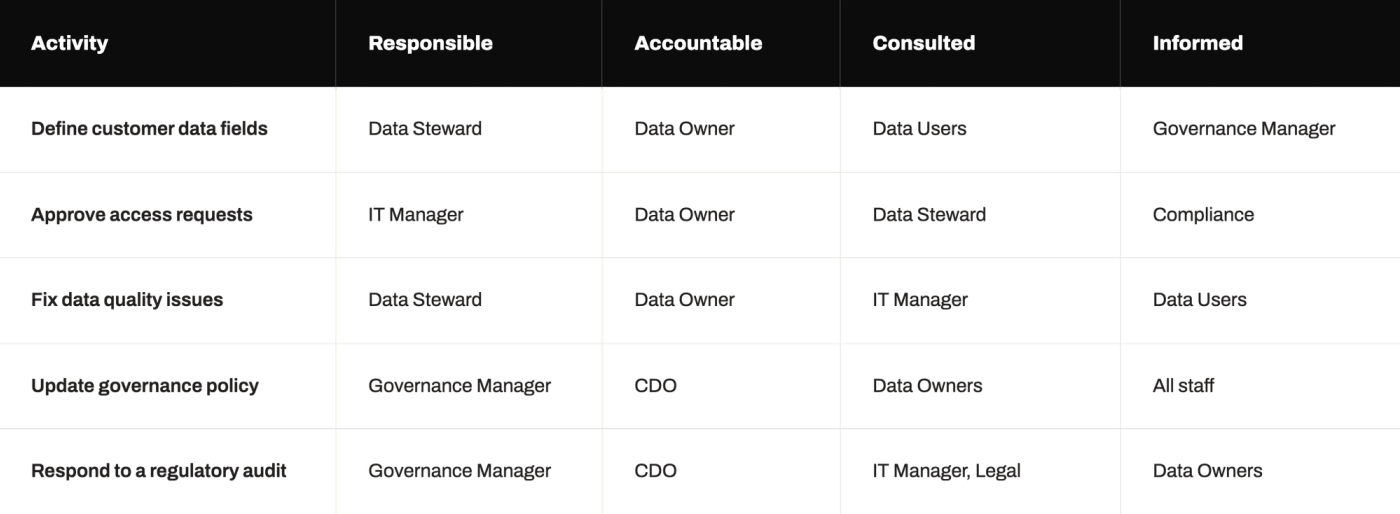
A RACI matrix lists each governance activity and marks who is Responsible, Accountable, Consulted and Informed. Each activity should have exactly one Accountable person. The example below shows a common split for a customer dataset:
Foster Collaboration Between IT and Business Units
Collaboration between IT and business units works best when shared problems get cross-functional owners. IT understands the systems, and business teams understand what the data means, so integrations, tracking changes and migrations need both. Darwin builds these connections as part of its integrations and automations work.
Align Roles With Organizational Goals
Aligning roles with organizational goals means you staff governance first where the business feels the most pain. A SaaS company focused on pipeline accuracy should start with owners for CRM, marketing automation and attribution data. Our guide on which customer data stack to build first helps decide where those owners sit.
Agreeing on response times also helps; the marketing ops SLA for tracking and routing breaks gives stewards and IT a shared target for fixing issues.
How Do AI and Automation Change Data Governance Roles?
AI and automation extend data governance roles to the data that models, agents and automated reports read and write. The six roles stay the same, and each one takes on new questions about AI use.
Data Owners now decide which datasets an AI agent may use. Stewards check that the definitions an agent relies on match the ones people use, and IT Managers log what automated workflows change. Our guide to marketing data readiness for AI agents lists what to fix first, and the article on AI agent audit logs for GTM teams covers what to record once agents go live.
Regulation points the same way. Article 10 of the EU AI Act requires data governance and management practices for the training, validation and testing data of high-risk AI systems, so named owners for that data are part of compliance.
How Do You Train a Data Governance Team?
You train a data governance team through role-specific sessions, certifications, practice scenarios and mentoring. Each format builds a different skill, so programs work best when they combine them.
- Regular training. Run short sessions on privacy rules, governance tools and quality checks, and adapt the content to each role.
- Certifications. Programs such as the DAMA Certified Data Management Professional (CDMP) give stewards and managers a shared vocabulary and a structured learning path.
- Workshops and simulations. Work through realistic cases, such as a conflicting revenue report or a data access request, so people practice decisions together.
- Mentoring. Pair new stewards with experienced governance managers who can answer questions as they come up.
Training pays off when people can apply it to their own data in the same week. Short, repeated sessions tied to real issues keep governance part of normal work.
Common Mistakes When Assigning Data Governance Roles
The most frequent mistakes are leaving governance to IT alone, giving one dataset several accountable owners and naming roles with no time set aside to do the work. Each mistake creates the same result: decisions wait and data quality slips.
- Placing all governance in IT, which separates it from the people who define and use the data.
- Naming several Data Owners for one dataset, which leaves no one able to make the final call.
- Adding stewardship to job titles with no hours or goals attached.
- Writing policies with no process for reporting and fixing issues.
Our Data & Analytics service sets shared definitions and makes ownership clear when the setup changes, since tooling helps only once those decisions exist.
Data Governance Roles Compared
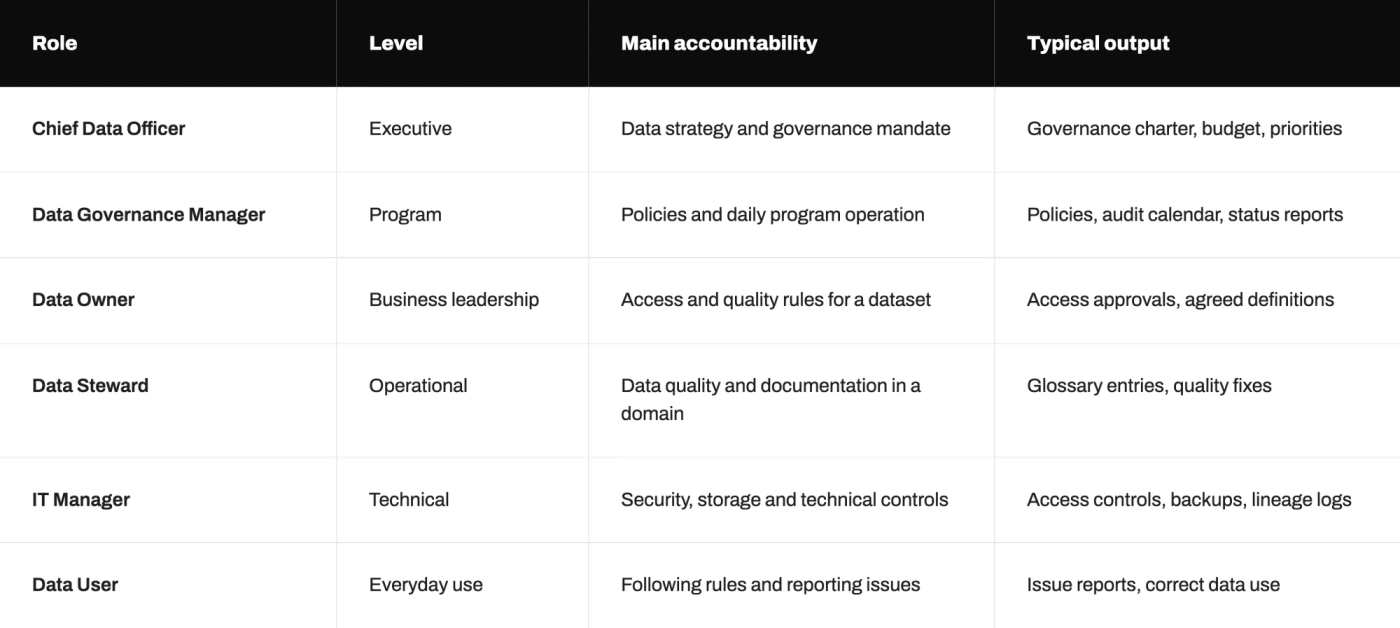
The table below compares the six data governance roles by level, main accountability and typical output, so you can see where each one fits.
How Clear Metric Ownership Fixed Reporting at Cleo
Clear metric ownership fixes reporting disputes faster than any new dashboard, because the dispute is usually about who decides the definition. Many marketing teams pull data from GA4, a CRM and a warehouse with no agreed rules for combining them, so every report starts from scratch.
Cleo faced this problem. Its marketing data sat in GA4, Salesforce and BigQuery, monthly reporting took two full working days and accuracy was about 70%. Darwin built a reporting hub in Looker Studio and defined reporting logic, metric ownership and shared definitions for pipeline, ROI and CAC. Reporting accuracy rose to about 90%, the team recovered two working days each month and Cleo removed about $50K a year in third-party attribution spend.
The lesson for governance is simple: tools improve reporting only after owners agree on what the numbers mean. Start with the metrics leadership reviews most often, name an owner for each one and record the definition where every team can find it.
FAQs
Q1. What are the main roles in data governance?
The main roles are the Chief Data Officer, Data Governance Manager, Data Owners, Data Stewards, IT Managers and Data Users. The CDO sets direction, the manager runs the program, owners approve rules, stewards maintain quality, IT secures systems and users follow policies.
Q2. What is the difference between a data owner and a data steward?
A Data Owner is accountable for a dataset and approves access and quality rules. A Data Steward does the daily work of keeping that dataset accurate, documented and classified. Owners decide; stewards carry out and maintain those decisions.
Q3. Does a small company need every data governance role?
A small company needs every responsibility covered, and one person can hold several roles. A head of marketing operations might act as owner and steward for CRM data. What matters is that each duty is written down and assigned.
Q4. How do you use a RACI matrix for data governance?
List each governance activity, such as defining fields or approving access, and mark who is Responsible, Accountable, Consulted and Informed. Give each activity one Accountable person. Review the matrix when teams, systems or regulations change.
Q5. Who should own data governance in a company?
A senior executive, often the Chief Data Officer, should sponsor data governance and hold final accountability. Daily operation sits with a Data Governance Manager, and business leaders own the datasets their teams create and use.