
Quick Answer:
Choosing the right AI implementation partner depends on one question: can they get your project into production, or will you end up with another pilot collecting dust.
The nine companies below have documented production deployments, verified client outcomes, and the technical depth to handle enterprise complexity. Match their scale to your current stage before committing.
TL;DR
- Darwin Apps connects AI with CRM, analytics, and marketing systems so teams can act on signals and move faster on revenue decisions.
- Accenture delivers AI programs at enterprise scale with structured rollout across business units.
- IBM Consulting implements AI in regulated environments with strong control over data and model governance.
- Deloitte leads enterprise AI programs with focus on compliance, risk, and internal adoption.
- Cognizant applies AI across industries with repeatable delivery models and Responsible AI practices.
- Slalom helps teams turn AI use cases into measurable outcomes through close collaboration and cloud integrations.
- TTMS speeds up AI rollout using pre-built components and cost-efficient delivery models.
- Palantir embeds AI into operational workflows where decisions depend on complex data.
- RTS Labs builds and deploys AI systems end-to-end with full engineering ownership.
AI adoption in enterprise teams is accelerating. Full AI implementation among CIOs jumped from 11% to 42% year over year, and AI budgets have nearly doubled. 68% of organizations still struggle to move projects beyond the pilot stage.
The gap between running a proof of concept and deploying AI in production is where most implementations fail. Choosing the right partner early determines whether your AI investment delivers measurable results or becomes another stalled initiative.
Why Enterprise Teams Need AI Implementation Companies
Enterprise teams need AI implementation partners to move from isolated pilots to production systems that integrate with existing workflows and deliver measurable outcomes.
What Is the AI Readiness Challenge?
Many enterprise teams are not ready to support AI in production due to fragmented systems and inconsistent information management practices.
63% of organizations either do not have or are unsure if they have the right information management practices for AI. Gartner predicts that through 2026, organizations will abandon 60% of AI projects unsupported by AI-ready systems.
Most teams run into scale issues once AI needs to work across multiple systems. Information is spread between disconnected ERPs, CRMs, warehouses, and legacy systems, with inconsistent schemas and missing metadata. When AI processes this input, it struggles to identify reliable signals.
Why Do AI Pilots Fail to Reach Production?
AI pilots fail to reach production when systems, processes, and ownership are not prepared to support them at scale.
IDC research found that 88% of observed proofs of concept never make it to widescale deployment. McKinsey reports similar results, with only one-third of AI pilots reaching production.
“For machine learning to succeed, enterprises need leadership from the top. When it changes one part of the business, other parts shift as well, from marketing and production to supply chain and hiring systems,” said Erik Brynjolfsson, Director of the Stanford Digital Economy Lab.
Pilots run in controlled environments with curated inputs. Production involves real-time systems, security constraints, and actual users.
How Do Enterprise Systems Complicate AI Integration?
Enterprise systems complicate AI integration due to legacy infrastructure, missing APIs, and inconsistent formats. Many core systems were not designed to support real-time AI workloads or direct integration into workflows. As a result, connecting AI to live operations requires additional layers for data handling, security, and auditability.
What Governance Requirements Should Enterprises Plan For?
Enterprises need clear governance frameworks to manage risk, ensure compliance, and support AI use in production environments.
A Gartner survey identified AI governance among the top three challenges for organizations. Without proper frameworks, enterprises face regulatory penalties, biased decisions, information leaks through poorly secured models, and loss of audit trails required under GDPR, HIPAA, or emerging AI Acts. While 42% of organizations believe their strategy is well-prepared for AI adoption, only 40% have institutionalized governance committees or formal oversight structures.
How We Selected These AI Implementation Companies
We selected these companies based on criteria that indicate whether AI projects reach production and sustain real-world use.
Technical Depth Across the AI Stack
- Technical depth across the AI stack. Companies operating in only two or three layers of the stack often require multiple vendors. We prioritized firms demonstrating end-to-end capability, from ingestion through model deployment and observability.
- Enterprise delivery track record. We focused on documented production deployments, not pilot collections. Enterprise delivery includes procurement, security reviews, and integration with systems built years ago.
- MLOps and production reliability. Model downtime costs $125,000 per hour. We evaluated version control practices, CI/CD automation, and model drift monitoring.
- Security and governance frameworks. 63% of organizations lack AI governance initiatives. We prioritized companies offering unified governance from day one.
"Successful AI implementation is less about the algorithm and more about the surrounding infrastructure — the data pipelines, the integration points, and the governance layer." — Andrew Ng, Founder of DeepLearning.AI, Co-Founder of Coursera
Looking for an AI implementation partner? These companies work with AI in production and integrate it into enterprise systems.
1. Darwin Apps

Darwin Apps is a B2B marketing systems and RevOps consultancy that helps enterprise teams build the AI readiness layer their marketing and sales operations need before scaling. Work starts with systems and integrations, the operational foundation that determines whether AI delivers measurable results or adds overhead.
Many issues appear before model development. CRM connections break, automation flows have no clear ownership, and AI tools are added to workflows that do not support them. These gaps need to be resolved before AI is deployed.
What Darwin Apps Does
Darwin works with enterprise marketing and revenue teams across three areas: assessing AI readiness in existing tech stacks, designing integration architecture between CRMs, automation platforms, and AI tools, and building workflows that connect outputs to business processes.
Industries and Notable Clients
Darwin works with B2B SaaS, technology, and professional services companies. Notable clients include Seagate, Thomson Reuters, Meltwater, and VTS. Projects focus on lead qualification systems, marketing automation architecture, and CRM integrations.
Pros and Cons
Pros:
- RevOps-first approach aligned with how marketing and sales teams operate.
- Focus on integration and workflow design.
- Faster time to value for teams with defined operational goals.
Cons:
- Specialized focus means Darwin may not fit large-scale AI infrastructure projects or industries outside B2B technology and services.
Best Fit
B2B enterprise teams that need AI readiness assessment, RevOps integration, and a partner who understands both the technical and commercial sides of AI implementation.
2. Accenture

Accenture delivers AI implementation at enterprise scale, with 779,000 employees globally and 80,000 AI and analytics professionals. Its AI Refinery platform, built on NVIDIA AI Foundry, is designed to support large-scale generative AI adoption. The platform includes Agent Builder, pre-configured industry solutions, and simulation tools to support the transition from pilot to production.
What Makes Accenture Stand Out
Many Advanced AI projects require changes in information infrastructure. Accenture treats AI and underlying systems as part of one continuous workflow. Revenue from Advanced AI hit $1.10 billion in Q1 2026, up 120% year over year. Its expanded Anthropic partnership supports training for 30,000 professionals on Claude.
Industries and Notable Clients
Accenture operates across 40 industries in over 120 countries. Pre-built solutions cover marketing automation, clinical trial systems, and industrial asset troubleshooting. Over 3,000 reusable agents have been deployed across more than 1,300 Advanced AI clients.
Pros and Cons
Pros:
- Large-scale delivery capability.
- Proprietary AI Refinery platform.
- Partnerships with NVIDIA, Anthropic, and major cloud providers.
Cons:
- Organizational size can slow execution on focused projects.
- Smaller specialized firms may move faster in narrow scopes.
Best Fit
Fortune 500 companies running large-scale AI programs that require global delivery, regulatory alignment, and long-term execution support.
3. IBM Consulting

IBM Consulting is recognized by IDC, Gartner, and Everest Group as a leader in AI and generative AI services. Its Enterprise Advantage platform, launched in early 2026, is designed to support the transition from pilot projects to governed production systems.
What Makes IBM Consulting Stand Out
Enterprise Advantage operates across Azure, AWS, and on-premises setups. This allows teams to work without restrictions on a single cloud provider. More than 75,000 consultants earned generative AI certifications since 2023. Watson services support different types of implementations, from smaller projects to large-scale enterprise deployments.
Industries and Notable Clients
Virgin Money deployed an AI-powered banking assistant. A life sciences company accelerated regulatory submission using agentic workflows. Pearson uses Enterprise Advantage to combine human expertise with AI assistants for personalized learning.
Pros and Cons
Pros:
- Recognized by major analyst firms.
- Cloud-agnostic platform. Large certified consultant base.
- Pre-built industry templates.
Cons:
- Platform dependency risk without strong internal expertise.
- Premium pricing.
Best Fit
Fortune 500 companies in regulated industries that require cloud flexibility, governance, and long-term operational support after deployment.
4. Deloitte

Gartner ranked Deloitte as the number one consulting services provider worldwide by revenue. Its Enterprise AI Navigator includes four integrated modules: AI Identifier, Impact Analyzer, Workflow Designer, and Agent Studio. These modules help address common issues in enterprise AI, including unclear investment priorities and disconnected pilots.
What Makes Deloitte Stand Out
42,000+ AI professionals operate from 45+ delivery centers with 500+ reusable assets. Over 300 technology alliances support solution selection that fits existing systems without requiring full rebuilds.
Industries and Notable Clients
Thomson Reuters integrated AI and machine learning capabilities through a unified interface. Kroger modernized employee experience using machine learning tools. A healthcare organization improved payment accuracy using AI-based detection.
Pros and Cons
Pros:
- Leading market position. 500+ reusable assets.
- Broad technology alliance network.
- Enterprise AI Navigator with integrated modules.
Cons:
- Premium pricing.
- Large firm structure can slow delivery on focused engagements.
Best Fit
Fortune 500 companies requiring end-to-end transformation, delivery at scale, and multi-industry experience.
5. Cognizant

Cognizant’s Synapse program includes reskilling one million workers for the AI era by 2026. Its Neuro platform connects standalone AI models into coordinated, secure systems that support workflow automation. The company focuses on three areas: productivity improvements, cloud platform modernization, and enterprise agent-based systems.
What Makes Cognizant Stand Out
Cognizant maintains a dedicated Responsible AI practice led by a Chief Responsible AI Officer. A healthcare insurer reported $1.40 million in savings over three years using Cognizant’s generative AI-powered appeals management, reaching 90% accuracy while reducing team size from 20 to 5 FTEs in seven months.
Industries and Notable Clients
Clients include Nike, OpenAI, Aston Martin, Formula One, Volkswagen, and healthcare insurers. A UK insurance company reported an 18% reduction in QA costs and a 90% decrease in framework development time.
Pros and Cons
Pros:
- Workforce reskilling initiatives.
- Dedicated Responsible AI governance.
- Enterprise platforms with documented client outcomes.
Cons:
- Service-heavy engagement model limits self-service.
- Integration complexity increases with legacy systems.
Best Fit
Large enterprises that require vertical AI solutions with formal governance, particularly in regulated industries.
6. Slalom

AWS named Slalom the 2024 GenAI Consulting Partner of the Year. The company highlights a common gap: while 91% of organizations plan to increase AI spending by 2026, only 39% measure ROI. Slalom’s AI Value Platform supports planning by estimating three-year ROI, total cost of ownership, and use cases before budgets are approved.
What Makes Slalom Stand Out
Slalom operates in 52 offices across 12 countries. Its work covers strategy alignment, delivery, governance, infrastructure readiness, and change management. The company partners with AWS, Google Cloud, and other providers to build solutions where off-the-shelf software does not fit.
Industries and Notable Clients
Jaja Finance reduced customer response times by 90% with a GenAI assistant. Celink achieved 121% ROI over three years through use case prioritization. United Airlines improved customer care resolution speed. The Chicago Cubs defined 12 fan segments in 12 weeks using ML models.
Pros and Cons
Pros:
- AWS GenAI Partner of the Year.
- Focus on ROI estimation before project start.
- Experience delivering in regulated industries.
Cons:
- Premium pricing may exceed mid-market budgets.
- Large firm structure can slow decision-making on focused projects.
Best Fit
Enterprises moving from pilot projects to production, especially those working with legacy infrastructure.
7. TTMS

TTMS is a Warsaw-based consultancy focused on cost-efficient AI implementation, with pricing typically 30-40% lower than Western firms.
What Makes TTMS Stand Out
TTMS develops production-ready accelerators based on patterns tested in real projects, which helps reduce implementation time. As a certified partner of Microsoft, Adobe, and Salesforce, the company works within existing enterprise systems and adapts AI capabilities to current workflows.
Industries and Notable Clients
Clients include Roche, Schneider Electric, Volvo, Hitachi, and ABB. Pharmaceutical teams use document automation to reduce research time. Legal teams apply document summarization to speed up case preparation.
Pros and Cons
Pros:
- Pre-built accelerators shorten implementation timelines
- Competitive pricing model
- Experience integrating AI into existing enterprise systems
- Familiarity with GDPR requirements
Cons:
- Coordination challenges with US-based teams due to time zones
- Lower visibility compared to global consulting firms
Best Fit
Teams that need to introduce AI into existing workflows without redesigning underlying systems.
8. Palantir

Palantir develops AI platforms for organizations operating in high-risk environments such as defense, healthcare, and critical infrastructure. Its platform connects language models to operational systems within controlled environments, allowing teams to work with live data while maintaining strict access and control.
What Makes Palantir Stand Out
Palantir’s ontology layer models relationships between data, processes, and entities, giving AI systems the structure needed to operate within real workflows. The company’s bootcamp approach focuses on building working prototypes quickly and expanding them into production use.
Industries and Notable Clients
Palantir works with the U.S. Department of Defense, NHS, Airbus, BP, Cleveland Clinic, and major financial institutions. Commercial clients include Jacobs Engineering, PG&E, and Fiat Chrysler.
Pros:
- Built for high-stakes operational environments
- Provides AI with structured, usable context
- Strong governance and audit capabilities
Cons:
- High cost and organizational commitment
- Longer setup time compared to lightweight tools
Best Fit
Large organizations running critical operations that require controlled environments and reliable decision support.
9. RTS Labs

RTS Labs is an engineering-focused company with over 14 years of experience building enterprise systems. The company operates through a hybrid model, combining consulting with hands-on system delivery.
What Makes RTS Labs Stand Out
RTS Labs runs projects through a single delivery model that combines strategy, engineering, and deployment. Their client base includes over 600 organizations across finance, banking, insurance, logistics, and retail.
Industries and Notable Clients
RTS Labs works across finance, banking, insurance, logistics, and retail. Notable clients include ConnectBank, the Financial Regulatory Authority, Evergreen, and Suncoast. Projects include conversational AI for sales teams, customer portals that reduce support load, and platforms used in regulated environments.
Pros:
- Long-term experience in enterprise engineering
- Clear ownership from architecture to rollout
- Experience with LLM applications and MLOps pipelines
- Compliance handled during implementation
Cons:
- Lower brand recognition compared to large global consultancies
- Smaller geographic footprint
Best Fit
Companies that need external engineering support to build and launch AI systems under strict regulatory requirements.
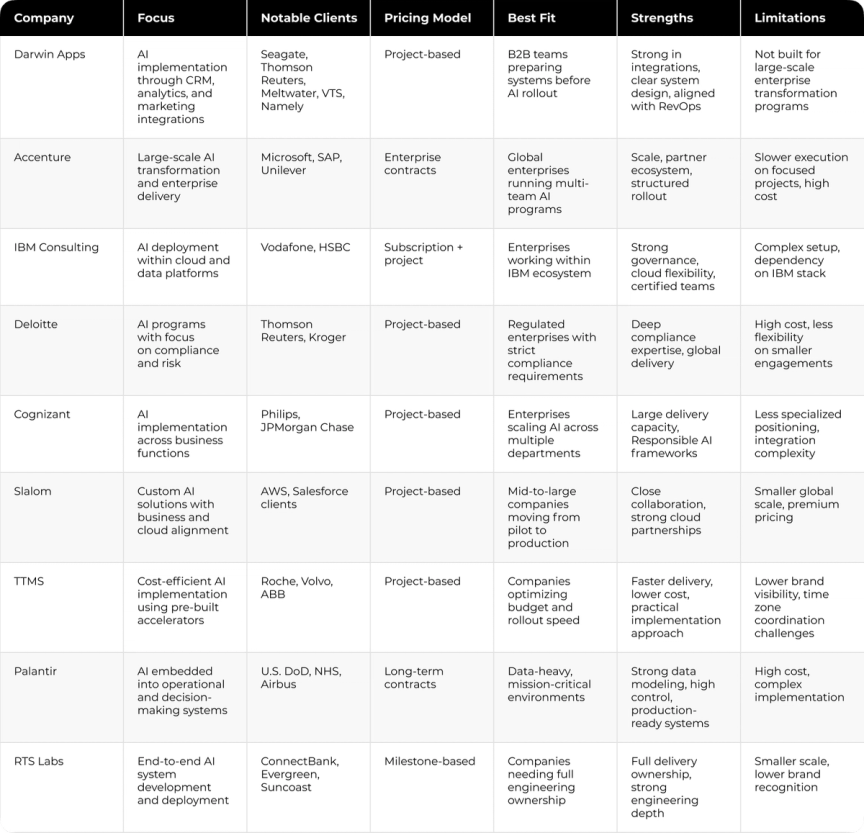
Comparison Table
Why AI Projects Stall Before Production
Most AI projects stop after the proof-of-concept stage because the surrounding systems are not prepared to support them.
CRMs remain disconnected, automation lacks ownership, and outputs are generated without a clear place in the workflow.
Production requires systems that can support how teams actually work.
Darwin works with B2B marketing and revenue teams to prepare this foundation and connect AI to real business processes.
This work includes:
- AI readiness & enablementAssessment of the current stack and definition of a clear path to deployment
- Integrations & automationsConnecting AI tools with CRM and revenue systems
- Data & analytics setupEnsuring outputs remain consistent and reliable
With the right system in place, AI can be introduced into existing workflows without additional complexity.
FAQs
Q1. Why do most AI projects fail to reach production in enterprises?Most AI projects do not reach production because the systems around the model are not ready. Common issues include poor data quality, difficulty integrating with legacy systems, lack of MLOps processes, and unclear ownership. Production requires working with real systems and workflows, not isolated models.
Q2. What should enterprises look for when selecting an AI implementation partner?Focus on teams with experience in real deployments, not only strategy. The partner should be able to integrate AI into existing systems and take responsibility for delivery. Ask for examples of projects that reached production.
Q3. How much does enterprise AI implementation typically cost?Costs depend on scope and complexity. Smaller projects may start from five-figure budgets, while large implementations can reach six or seven figures. Many providers use custom or milestone-based pricing.
Q4. What is the difference between AI implementation companies and technology consultants?AI implementation companies focus on putting models into working systems, including integration and ongoing operation. Technology consultants often focus on strategy or architecture without full responsibility for delivery.
Q5. How long does enterprise AI implementation take?Timelines depend on system readiness and project scope. Planning may take a few weeks, while implementation can take several months. Projects move faster when data and workflows are already structured.