Quick Answer:
AI auditing is a structured review of an AI system's data, model behavior, and decisions against ethical, legal, and operational standards. It confirms that inputs are representative, outputs are fair and explainable, and the whole pipeline meets applicable legal requirements and management standards, including the EU AI Act, GDPR, and ISO/IEC 42001. The goal is a system a business, a regulator, and a customer can all trust.
TL;DR
- An AI audit checks four things: data quality, model behavior, decisions and outcomes, and governance records.
- Four audit types cover it: technical, ethical, legal and compliance, and operational.
- Regulation is tightening. The EU AI Act sets conformity-assessment obligations for certain high-risk AI systems, and ISO/IEC 42001 gives a certifiable management standard.
- Oversight gaps are common. In McKinsey's survey, a large share of teams review only a fifth or less of gen-AI content before it ships.
- Audit early, keep records, use mixed teams, and re-review models on a schedule.
More than half of IT and data-analytics leaders report an AI governance framework in place, whether as a dedicated one or an extension of existing governance, according to Gartner's research on AI governance for responsible AI. Adoption of governance is climbing because AI now sits inside decisions that carry real weight, from credit scoring to medical triage, and questions about fairness and accountability arrive at the same speed as the technology.
AI auditing answers those questions with evidence in place of assurances. It is the practice that checks each claim against evidence: that the training data holds up under inspection, that the model behaves the way its owners say it does, and that its decisions can be traced and defended. This guide covers what an AI audit is, why it matters, the four audit types, who runs them, and how to build the practice into your own systems.
Where Trustworthy AI Auditing Begins
A credible AI audit starts with the data feeding the system, not the model on top of it. If the signal underneath is broken, every downstream finding inherits the flaw. This is why Darwin approaches AI trust as a pipeline problem. Darwin Flux frames the work in four connected stages. Surface finds where data quality and consent break at the point of collection. Connections keeps that signal intact as it moves between systems. Clarity turns the connected data into decisions a person can read and defend. Momentum keeps the audit alive after deployment, through continuous monitoring and scheduled re-review.
What is AI Auditing?
AI auditing is the structured review of an AI system against ethical, legal, and operational standards. It reaches past the question of whether a model runs and asks whether it should be trusted. The audit interrogates three things: the quality and representativeness of the data inputs, the fairness of the outcomes, and the soundness of the decision logic behind them.
Reggie Townsend puts the foundation plainly. Ethical AI rests on the people who build it as much as the tools they use.
“We need to make sure AI helps us to experience a better world and that begins with responsible innovators and AI governance,”— Reggie Townsend, Vice President of the SAS Data Ethics Practice
A typical audit centers on three areas:
- Data inputs: is the data diverse and representative, free of hidden bias?
- Model behavior: does the system make fair and accurate predictions under varied conditions?
- Decisions and outcomes: are the results reliable, explainable, and compliant with regulation?
Why AI Auditing Matters
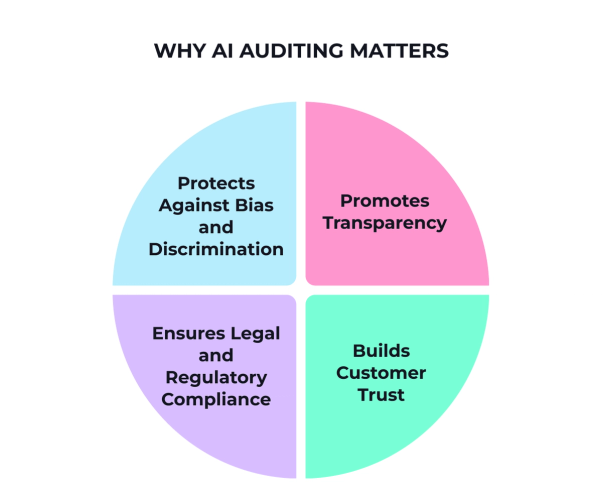
AI auditing matters because it converts trust from a claim into something a business can demonstrate. It lowers risk, makes decisions traceable, and gives regulators and customers a reason to believe the system. Four benefits stand out.
1. It protects against bias and discrimination
AI systems can absorb and magnify the biases in their training data. Some hiring algorithms have favored male candidates over equally qualified women because the historical data taught them to. Regular audits surface these patterns early and give teams a chance to correct them before the harm reaches a real applicant.
2. It makes decisions traceable
Auditing makes AI decisions legible, which matters most in healthcare and finance, where a single output can change a life. When the reasoning behind a decision can be explained and reviewed, the organization can stand behind it.
3. It keeps you compliant as rules tighten
Governments are moving quickly, and staying ready is now a baseline expectation. The EU AI Act introduces conformity-assessment obligations that apply to certain high-risk AI systems, depending on their category and the applicable timelines. The U.S. Blueprint for an AI Bill of Rights sets out principles for fairness and transparency. Reading these shifts early turns compliance from a scramble into a plan.
4. It builds customer trust
Customers register accountability. According to research firm Arize AI, the number of Fortune 500 companies naming AI as a risk factor in their annual financial reports reached 281, a 473.5% jump from the 49 companies that did so in 2022. A visible audit process signals that a business takes that risk seriously, which reassures the people and stakeholders who depend on the system.
The Four Types of AI Audits
AI auditing splits into four review types, each aimed at a different dimension of the system. Together they cover the algorithm, its social impact, its legal standing, and the processes that keep it running.
1. Technical Audits
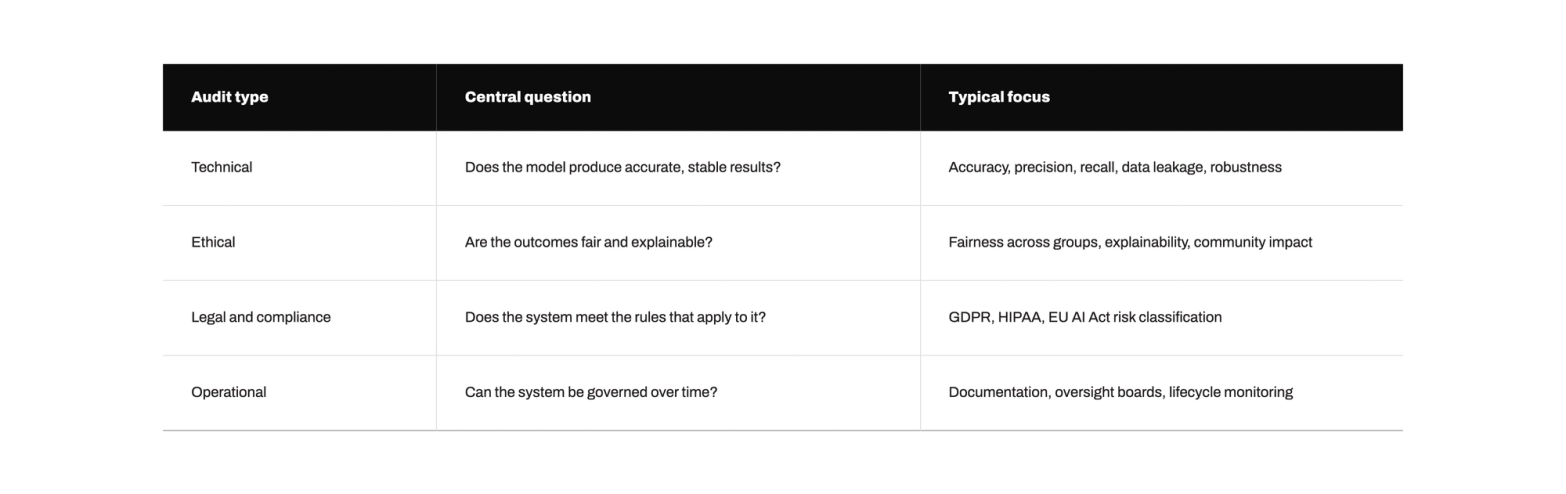
Technical audits examine the algorithm itself, the foundation everything else sits on. They cover model accuracy, precision, and recall; data leakage that would skew predictions unfairly; and how the model holds up against unexpected or adversarial inputs.
2. Ethical Audits
Ethical audits look past function to how the system aligns with fairness and social values. They test whether outcomes stay equitable across demographics, whether decisions can be explained to the people they affect, and what second-order effects the system creates for communities.
3. Legal & Compliance Audits
Legal and compliance audits confirm the system meets the regulations that apply to it. Common ones include GDPR for data privacy, HIPAA for protected health data, and the EU AI Act, which classifies systems by risk level and regulates each tier accordingly.
4. Operational Audits
Operational audits check the processes that keep an AI system healthy in production. They review documentation of decisions and updates, governance mechanisms such as AI fairness boards, and lifecycle management: whether the model is monitored and improved after it goes live.
AI Audit Types at a Glance
The four audit types answer different questions and demand different expertise. This table sets them side by side.
What a Strong AI Audit Examines
A strong AI audit works across four dimensions, and each one produces evidence the others depend on. A weak result in any single dimension undercuts the findings from the rest.
1. Data integrity
Auditors check whether the training data is balanced, representative of the intended population, and ethically sourced. They look for missing values, skewed distributions, and hidden bias, since these are among the most common causes of AI failure. When the data checks out, the model and outcome reviews rest on a verified starting point.
2. Model behavior
Auditors study how the model behaves under ordinary, rare, and extreme conditions to confirm it produces coherent outputs. The work concentrates on anomalies, unintended behaviors, and weak spots that would undermine the model once it meets messy inputs in production.
3. Risk mitigation
Auditors look for the safeguards that handle bias, discrimination, and false positives before they cause harm. Fairness checks, edge-case testing, and systems built to absorb unexpected inputs all count here. The aim is a model that stays resilient when conditions shift.
4. Governance Documentation
Auditors verify the records: audit logs, model cards, and decision-making frameworks. Clear documentation supports regulatory compliance and gives stakeholders a readable account of how decisions are made, how risks are managed, and how the system changes over time.
Who Conducts AI Audits?
AI audits draw on a mix of internal and external roles, and the right blend keeps the work both grounded and credible. Three groups tend to be involved:
- Internal risk teams bring organizational context and can pinpoint risks specific to the business.
- Third-party auditors such as PwC or Deloitte add independent expertise and lend the findings credibility.
- AI assurance specialists such as Credo AI focus narrowly on AI ethics and governance.
Independent researchers see the same pressure building from the outside.
“The risks posed by AI systems are becoming increasingly significant as AI adoption accelerates across industry and society,”— Peter Slattery, Research Scientist at MIT FutureTech and lead of the AI Risk Repository project
Industries That Rely on AI Auditing
AI auditing carries the most weight in sectors where an automated decision touches money, health, or civil rights. Oversight is uneven, which is part of why the practice matters.
Alex Singla frames the gap in oversight directly.
“20 percent or less of gen-AI-produced content is checked before use,” — Alex Singla, Senior Partner and global co-leader of QuantumBlack, AI by McKinsey
Four sectors lean on auditing hardest:
- Healthcare: diagnostic tools need audits to confirm accurate results and fair treatment across patient groups.
- Finance: credit scoring and fraud detection stay compliant and reliable only when the models behind them are verified.
- HR & Recruitment: audits keep resume-screening tools inclusive and free of built-in bias.
- Government: reviewing AI in public safety and social programs helps build systems that serve communities fairly.
AI Auditing and Regulation
Regulators are formalizing what a defensible AI audit looks like, and the direction is consistent across regions. Three developments shape the current picture:
- The EU AI Act sets conformity-assessment obligations for certain high-risk systems, with the specifics depending on category and timeline.
- In the United States, the Federal Trade Commission has signaled enforcement around transparency and accountability in AI claims.
- Globally, ISO/IEC 42001 gives organizations a certifiable AI management standard that supports consistent auditing across regions.
Proactive audits do more than avoid fines and reputational damage. They let a business set its own pace ahead of regulation, which is where the practice pays for itself.
AI Auditing Tools and Frameworks
The tooling for AI compliance divides into two groups: platforms that document and monitor systems, and frameworks that structure the approach.
- Documentation and monitoring: IBM AI FactSheets, Arthur AI, Credo AI, Google Model Cards, and Fiddler.
- Frameworks: the NIST AI Risk Management Framework, IEEE P7003, and the ModelOps framework for lifecycle governance.
Best Practices for Auditing AI
The teams that audit AI well share a few habits, and each one is easier to adopt early than to retrofit.
- Audit early: build compliance into the design phase, while the model is still taking shape.
- Keep detailed records: audit logs and model cards make every change and decision traceable.
- Build mixed teams: pair data scientists with legal experts and ethicists for rounded oversight.
- Stay adaptable: retrain and re-review models on a schedule to hold compliance as conditions change.
Auditing Is How AI Earns Trust
Unaudited AI tends to fail in expensive ways: biased decisions, privacy exposure, and the slow erosion of trust that follows. The remedy is a practice embedded across the model lifecycle: design, deployment, and ongoing monitoring, well past a single pre-launch review.
A single root cause sits under most audit failures. The data feeding the model was never sound to begin with, so no amount of model-level review could rescue the outputs. Cleo’s reporting problem illustrates that principle. The work was a data-integration fix, not an audit of an AI model, and the lesson still carries over. When an AI system needs to produce decisions worth trusting, the inputs and definitions underneath it have to agree first. Darwin connected GA4, BigQuery, and Salesforce into one reporting hub and raised reporting accuracy to roughly 90%; before the rebuild it sat near 70%. The team also recovered two days of manual work each month and saved about $50K a year by retiring redundant tools. The audit lesson is straightforward: review the data foundation, then review the model outputs.
Build the audit in early, keep the records, and treat trust as something you demonstrate on a schedule and can prove on demand.
FAQs
Q1. What is an AI audit?
An AI audit is a structured review of an organization's AI systems and the processes around them. It evaluates the design, development, deployment, and ongoing use of the system to find risks and confirm it meets ethical standards and applicable regulations.
Q2. Why should a business conduct an AI audit?
An audit lets a business catch risks before they become public failures, and it demonstrates a real commitment to responsible AI. In a growing number of regulated sectors, audits are also a compliance requirement.
Q3. What are the main types of AI audit?
There are four: technical audits for model accuracy and robustness, ethical audits for fairness and explainability, legal and compliance audits for regulations such as GDPR and the EU AI Act, and operational audits for documentation and lifecycle governance.
Q4. How often should AI systems be audited?
Auditing works best as a recurring practice on a fixed schedule. Models drift as data and conditions change, so a regular schedule of re-review, plus continuous monitoring in production, keeps compliance and accuracy from slipping.
Q5. How can organizations promote responsible AI use?
Set clear guidelines for developing and deploying AI, run regular audits to catch bias and risk, and involve diverse stakeholders in decisions. Ongoing monitoring, transparent explanations of how decisions are made, and honest disclosure of a system's limits round out the approach.