
Quick Answer:
Salesforce, HubSpot and Adobe now ship AI agents that measure, score and act on marketing data on their own schedule. These agents work reliably when the underlying data foundation is clean: UTM governance in place, CRM lifecycle events mapped and attribution logic consistent. Without that foundation, agents amplify the same errors faster.
TL;DR
- Salesforce Agentforce uses the Atlas Reasoning Engine to execute revenue intelligence, lead scoring and cross-channel budget decisions autonomously
- HubSpot Breeze embeds agentic AI directly into the CRM so agents act where contact and deal data already lives
- Adobe Experience Platform Agent Orchestrator connects agents spanning marketing, content and experience workflows into one governed system
- AI agents deliver measurable ROI when data governance, CRM quality and attribution logic are already in order
- SaaS marketing teams that pilot one high-impact workflow now build the operational advantage that scales
A B2B SaaS marketing team runs three ad platforms, two nurture tools and a CRM that does not agree with any of them. Campaign reports arrive on Friday. By Monday, the budget decisions those reports were supposed to inform are already made on gut feel. This is the problem agentic AI is built to solve, and the reason Salesforce acquired Qualified and Adobe acquired Semrush for $1.9 billion. This article covers what each platform is building, what it requires to work and what SaaS marketing teams need to do before deploying agents.
Why Did 2026 Become the Turning Point for Agentic AI in Marketing Analytics?
Marketing teams spent 2024 and 2025 testing generative AI for content creation. That phase is over. The market shifted when organizations realized speed alone does not win customers. The shift now is from AI that assists human decisions to AI that makes and executes decisions within governed workflows.
Where This Fits in Darwin Flux
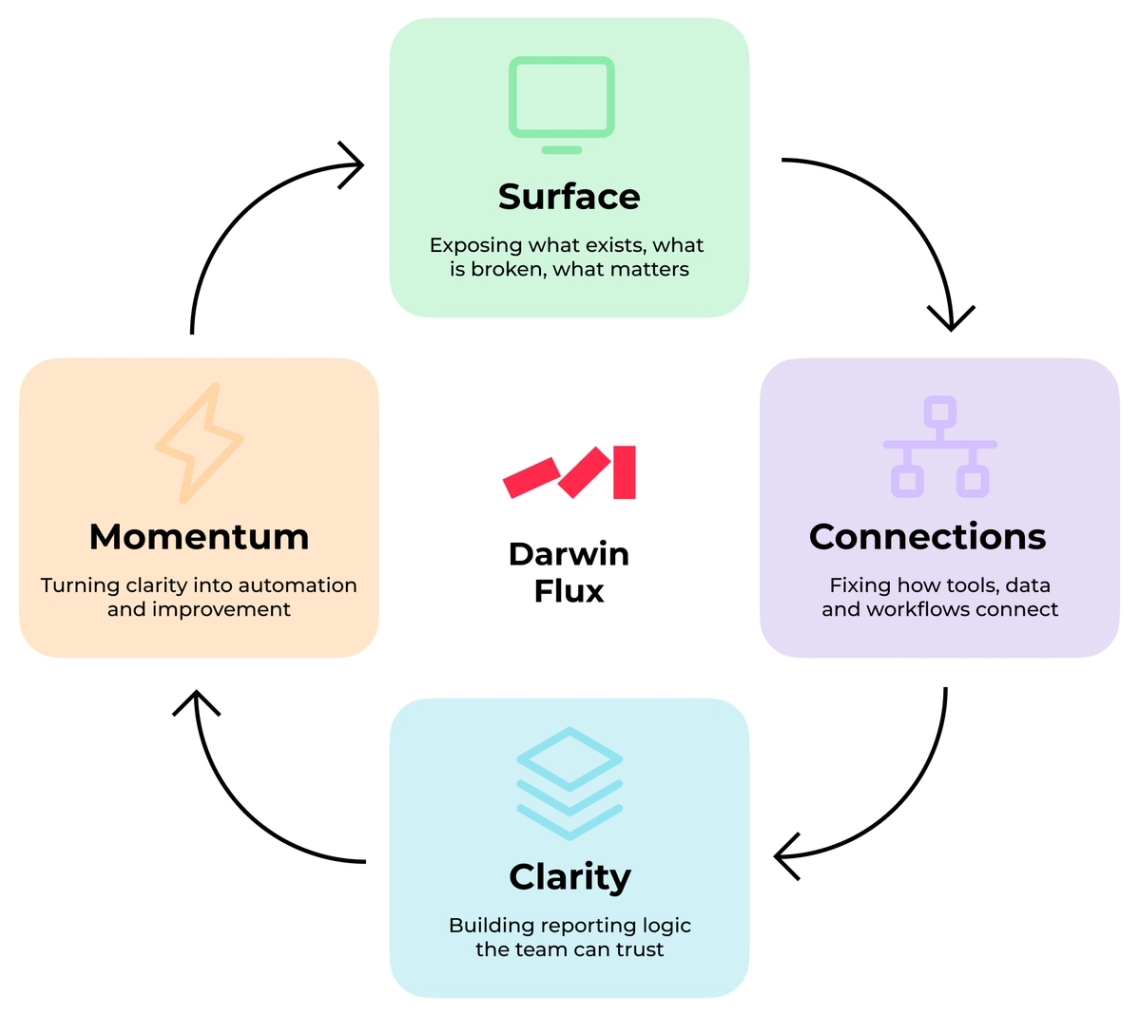
In Darwin Flux, agentic AI sits at the Momentum layer, but it depends on everything beneath it. Surface captures the first signal: website behavior, form submissions and campaign touchpoints. Connections move that signal cleanly through GTM, CRM, ad platforms and data warehouses. Clarity establishes consistent attribution logic and a reporting source of truth. Momentum is where agents operate: optimizing budgets, scoring leads and orchestrating journeys based on signals that are already clean. Without the Surface-to-Clarity foundation, agents have no reliable signal to act on.
What Makes an AI Agent Different from Rules-Based Automation?
Rules-based marketing automation executes conditional logic set up months in advance: if a lead reaches a certain score, the system sends the next email in sequence. Agentic AI makes judgment calls based on what it observes right now: funnel position, campaign data, revenue targets and behavioral signals combined.
“SaaS platforms provide infrastructure that takes years to build right: compliance, governance, scalability, integrations; these challenges don’t just disappear because of AI.” Jon Miller, co-founder of Marketo, founder of Phave
The agent reads what is happening in the funnel right now, acts on it and refines its logic from each outcome. The next step is determined by the data, not a scheduled human review. McKinsey estimates agentic workflows can accelerate campaign creation and execution by 10 to 15 times. Organizations that implement them can expect 10 to 30 percent revenue growth from hyperpersonalized marketing. Agentic AI is projected to create between $450 billion and $650 billion in annual value by 2030.
How Is Salesforce Using Agentforce to Change Marketing Analytics?
Salesforce fused Agentforce with Marketing Cloud as a system where agents support campaign, customer and revenue workflows. The architecture connects three elements: unified customer data in Data Cloud, engagement coordination and intelligence that plans, creates and adjusts as campaigns run.
How Do Revenue Intelligence Agents Replace Manual Attribution?
Revenue intelligence in Salesforce pulls together sales data to surface trends, projections and campaign insights for quarterly strategy. The system monitors KPIs, spots red flags in pipeline before quotas slip and describes individual deal health, supplemented by AI predictions of whether a deal will stall, close or get pushed. Coaching dashboards alert reps when amounts change, then recommend next steps like identifying an executive sponsor.
Revenue intelligence agents surface what is happening in pipeline right now. When a deal shows signs of stalling, the agent identifies the specific reason, such as a key decision-maker who has not been contacted, and flags it for action.
What Does Predictive Pipeline Scoring Do for Active Campaigns?
Einstein Lead Scoring runs automatically every 10 days to refresh scores based on current data. A survey of sales teams using AI revealed that 98% think it improves lead prioritization. Machine learning models trained on both anonymous aggregate data and company-specific records mean predictions improve over time. Einstein Behavior Scoring works in parallel, predicting when prospects are ready to buy based on live behavioral signal.
Agentforce and Cross-Channel Budget Execution
Agentforce Marketing agents handle campaign creation, personalization, journey management and spend decisions. They pause low-performing ads with marketer approval and shift contacts to optimal journeys based on engagement data. Built-in agents surface campaign insights in Slack so teams act directly from one place. Marketers define the strategy and agents handle execution. The result is time back for decisions that require human judgment.
What Is Data Cloud's Role as a Unified Identity Layer?
A single customer often appears across CRM, marketing automation, service desk and loyalty programs, each holding its own version of the record. Identity Resolution in Data Cloud connects those records without collapsing them. The keychain approach links records, preserving each system's version under a single resolved identity. A contact may appear with different emails, billing addresses and account IDs across systems. The keychain approach links all records to the same resolved identity without collapsing them into one.
“The number one challenge they cited was data. The AI engines themselves are becoming commodities. Anyone can buy a seat or get API access. Differentiation comes from the data you feed into it.” Scott Brinker, VP Platform Ecosystem at HubSpot, founder of chiefmartec.com
How Does HubSpot Breeze Embed Agentic AI Into the Growth Stack?
HubSpot took a different path. The company embedded agentic AI directly into its CRM through Breeze, expanded in Spring 2026, so decisions and actions happen where the data already lives. The principle: AI should operate inside the system where contact records, deal history and engagement data are stored.
How Do Behavioral Triggers Drive Engagement Decisions?
Behavioral triggers deliver messaging when contacts demonstrate intent. Timing follows buyer behavior. Open rates for behavioral trigger emails reach 45 to 65 percent compared to 25 percent for broadcast campaigns. Click-through rates reach 15 to 25 percent versus 3 to 5 percent for generic messaging. Conversion rates land between 8 and 15 percent, above the 2 to 3 percent from non-triggered workflows.
HubSpot lifecycle stages advance contacts automatically based on predefined behavioral triggers and engagement thresholds. Custom properties track industry-specific behaviors like demo requests, pricing page visits and competitor comparison downloads, revealing which touchpoints predict purchase intent most reliably.
AI Agents and Lead Qualification at Scale
The Prospecting Agent monitors buying signals, researches accounts using CRM and external data, drafts personalized outreach and recommends timing based on real activity. Darwin applied this approach for Wizehire, combining funnel optimization, cleaner tracking and AI-supported lead handling. The engagement reduced CPL by 26% and cut lead response time from 2 to 4 hours to 15 minutes.
Adaptive lead scoring updates with each new deal, refining how future leads are scored based on verified conversion data. The system predicts probability that a contact will convert within 90 days through properties like Likelihood to Close and Contact Priority Tier. Customer Agent handles Tier 1 support and reduced first-response time by 76 percent for one SaaS provider, with CSAT scores rising from 82 to 91 percent within three months.
HubSpot Connections to Third-Party Agentic Systems
Agent.ai, the agentic platform built by HubSpot's CTO, surged past 500,000 users in early 2026. Tools like Segment or Amplitude capture in-app events as they happen. Reverse ETL platforms like Census or Hightouch push this data from product databases into HubSpot CRM and Marketing Hub, making product signals available for segmentation, scoring and automated workflows.
How Is Adobe Agent Orchestrator Redefining Marketo's Role?
Salesforce and HubSpot built agents that act inside CRM and revenue data. Adobe built agents that coordinate the full buyer journey: content, buying group assembly, webinar follow-up and chat, all governed through one reasoning layer. Experience Platform Agent Orchestrator serves as the reasoning engine, using large language models and a comprehensive knowledge base to generate responses and execute tasks.
Adobe Agent Orchestrator: Goal-Based Journey Logic
Marketo nurture programs before Agent Orchestrator ran on fixed cadences: one email per week, two per week, regardless of what the buyer was doing. Adobe Experience Platform Agents drop the calendar logic entirely. They push contacts toward the next stage at every touchpoint, adjusting journeys based on what the buyer actually does. Agents act autonomously or flag decisions for human review depending on stakes and policy.
How Does Audience Agent Assemble Buying Groups?
Audience Agent automatically discovers, recommends, creates and activates buying groups by analyzing CRM profiles, marketing activity and web content. Forrester research shows 13 people are involved in B2B purchasing decisions on average. Marketers cut buying group assembly time from weeks to minutes using this capability.
What Role Does AI Play in Marketo Webinars and Chat?
Interactive Webinars in Marketo Engage uses generative AI to create summaries and video chapters for on-demand viewers. One agency cut webinar build time by 30 percent and saw two times higher attendee retention. Dynamic Chat delivers conversation automation using generative AI trained on sales, marketing and product knowledge. Conversation summaries give sales agents key discussion topics before meetings, cutting prep time.
What Should SaaS Marketing Teams Do Now?
Nearly 90 percent of CMOs are experimenting with AI use cases, but less than 10 percent have captured value at the workflow level. The gap between testing and production deployment defines who wins.
Where Should a Team Start with Agentic Workflows?
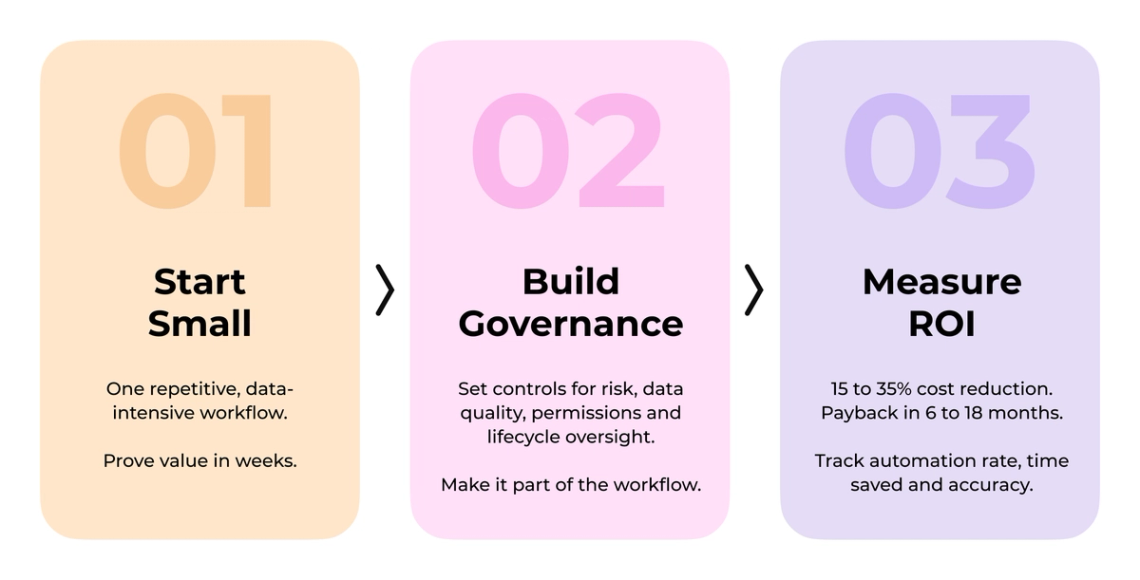
Start with one use case that delivers visible ROI within weeks. Pick workflows that are repetitive, data-intensive and impact broad audiences. McKinsey tracked one organization that introduced agentic marketing in three waves, with content creation pilots running four times faster. The first wave should prove value within weeks, not quarters.
The architecture decision matters early. MCP enables autonomous tool discovery and iterative reasoning, suited for flexible operations. Direct APIs deliver deterministic results with lower latency for workflows that require strict policy enforcement. Effective agent systems use both.
What Does AI Governance Look Like in Practice?
AI governance frameworks help organizations scale agentic AI while aligning adoption with company values. Without governance, teams face model drift, privacy liabilities and agents releasing poor decisions at scale. Governance covers four areas: risk management controls, ethical use policies, data quality standards and lifecycle oversight. It should be built into deployment pipelines so checks happen automatically.
What ROI Do AI Agents Deliver Compared to Rules-Based Automation?
AI agent deployments show 15 to 35 percent operational cost reductions with payback in 6 to 18 months. Organizations project ROI in the 150 to 200 percent range. Track automation rate, time saved per employee and accuracy improvements alongside cost metrics.
How Darwin Builds the Foundation That Makes AI Agents Work
Most B2B SaaS marketing stacks were not built to support agents. Attribution logic conflicts between GA4, CRM and ad platforms. Lifecycle events are missing or mislabeled in the CRM. UTM governance breaks at the campaign level. When agents run on this foundation, they scale the wrong decisions faster.
Darwin works with B2B SaaS marketing and revenue teams to build the data and workflow infrastructure that makes agentic AI reliable. That includes CRM data audit and lifecycle event mapping, UTM governance and attribution logic alignment, server-side tagging and signal enrichment, AI readiness assessment before deployment, and ongoing governance once agents are live.
For a kitchen and interior design company, Darwin built an AI qualification system around lead intake, RevOps workflow and automation logic. The result was 30% growth in lead conversion.
Darwin worked the problem in sequence: identified which lead signals mattered, connected them to the qualification workflow, defined what a conversion looked like, and only then let automation run. That order is what made the 30% result repeatable.
FAQs
Q1. Does HubSpot support agentic AI capabilities?
Yes. HubSpot integrated agentic AI through its Breeze platform, expanded in Spring 2026. Agents are embedded directly into the CRM, where they analyze customer context, make decisions and execute actions within workflows using current contact and deal data. The Prospecting Agent and Customer Agent are two production-ready examples available to HubSpot customers now.
Q2. Has Salesforce implemented agentic AI in its marketing platform?
Yes. Salesforce deployed Agentforce, which uses the Atlas Reasoning Engine to understand user intent, determine required data and actions, and autonomously execute tasks across workflows and integrations. Salesforce customers on Enterprise Edition and above can access Agentforce through Salesforce Foundations, which includes 200,000 Flex Credits at no additional charge.
Q3. What agentic AI solutions does Adobe provide for B2B marketing teams?
Adobe offers agentic AI through Experience Platform Agent Orchestrator, which connects agents spanning marketing, content and experience operations into one governed system. Key capabilities include Audience Agent for buying group assembly and Dynamic Chat for AI-powered conversation automation within Marketo Engage.
Q4. How does agentic AI differ from rules-based marketing automation?
Rules-based marketing automation executes predefined conditional logic: if score reaches X, send Y. Agentic AI makes judgment calls based on current data in CRM, behavioral signals, campaign results and revenue targets. It reads live funnel signals, acts on them and refines its logic from each outcome. The next step is set by what the data shows at that moment.
Q5. What does a marketing team need before deploying AI agents?
Clean data foundations come first. That means consistent UTM governance, mapped CRM lifecycle events, aligned attribution logic across GA4 and ad platforms and a defined reporting source of truth. Agents deployed without these in place will automate on incorrect signals. The operational gains from agentic AI are proportional to the quality of the data the agents run on.