
Quick Answer:
The best AI lead scoring tool depends on your stack and motion. Einstein and HubSpot native scoring work well if your CRM data is clean and volume is sufficient. MadKudu fits product-led growth companies. 6sense and ZoomInfo Copilot serve enterprise ABM teams with intent data budgets. Kumo.ai handles multi-system relational data. Apollo.io covers early-stage teams that need prospecting and basic scoring in one place.
TL;DR:
- Salesforce Einstein. Built into Sales Cloud. Transparent factor-level scoring. Requires 1,000+ leads and 120+ conversions in 180 days to train reliably.
- HubSpot Predictive. Three scoring types with score decay. Enterprise-only for AI. Blackbox model with no manual weight adjustment.
- MadKudu. Dual scoring: Customer Fit and Likelihood to Convert. Built for PLG. Requires 10,000+ users and Segment or similar CDP.
- 6sense Revenue AI. Account-level intent scoring from 1T+ daily signals. Finds anonymous in-market accounts before form fills.
- Kumo.ai. Graph-based scoring across relational warehouse tables. 89% accuracy vs 75% for single-table ML.
- Apollo.io. All-in-one prospecting platform. AI scoring is secondary. Email accuracy 65 to 70% with 15 to 25% bounce rates.
- ZoomInfo Copilot. 230M+ contact database with real-time buying signals. Enterprise pricing from USD 14,995/year.
61% of B2B marketers send every lead to sales with no scoring at all. Only 27% of leads that marketing passes over are qualified, per Improvado's lead qualification research. That is a significant amount of rep time spent on accounts that were not ready to buy.
Organizations using lead qualification tools achieve 138% ROI on lead generation compared to 78% without it. AI scoring models can deliver 75% higher conversion rates than rule-based approaches in setups where the underlying data is clean and the model has enough signal to train on.
SaaS teams on Salesforce or HubSpot already have scoring capabilities built into their platforms. The question is whether those capabilities are running on reliable data. Here are seven tools worth evaluating, with the data requirements and integration context each one needs to work.
Where AI Scoring Fits in a Revenue-Ready Stack
AI lead scoring tools address one layer of a larger problem. The score a model produces is only useful when the data it trains on is accurate, the lead it scores routes to the right rep, and the outcome feeds back into reporting that leadership trusts. Each of these is a separate infrastructure question.
Surface is where behavioral and firmographic data enters the system: web events, form fills, CRM records, product usage logs. Connections is where that data moves between tools: the sync between your scoring platform, your CRM, and your routing rules. Clarity is where revenue teams agree on what the numbers mean: a lead score threshold that triggers an SLA, an attribution model that Finance and Marketing read the same way. Momentum is where AI scoring, bidding optimization, and forecasting run on top of that foundation.
Scoring failures often happen in Connections or Clarity, not in the scoring algorithm itself. A lead scored 94 that routes to the wrong territory, a PQL that fires a Slack alert but does not update the CRM record, a score threshold that nobody calibrated against actual conversion data. The tools below vary by signal source and methodology. The question to ask about each: what does it need from your stack, and what breaks when that dependency is weak.
Salesforce Einstein Lead Scoring

Scoring Logic and Data Requirements
Einstein Lead Scoring is built directly into Sales Cloud, which means no third-party sync and no separate scoring platform. The system analyzes historical conversion patterns in Salesforce and assigns each lead a score from 1 to 99 based on similarity to previously converted leads.
The scoring is transparent by design. A lead scoring 87 shows the specific factors that pushed it there: industry fit, job title match, content engagement count, each with its contribution visible on the record. Einstein tests Logistic Regression, Random Forests, and Naive Bayes models and automatically selects whichever performs best on your data.
Data requirements are strict. You need at least 1,000 leads created in the past 180 days, with 120 of those converted and linked to accounts and contacts. Below 200 closed deals, Einstein pulls from a global model built on anonymous Salesforce customer data, which reduces specificity to your ICP.
Where the Model Has Blind Spots
Einstein only sees what lives in Salesforce. Conversations in Slack, LinkedIn messages, and phone calls that are not logged create gaps that skew predictions. Inconsistent field population, such as mixing "Technology" with "Tech" with "Software" in industry fields, trains the model on noise. If reps mark lost deals as closed-won, Einstein learns the wrong conversion patterns.
The model also cannot be adjusted manually. If Einstein down-weights leads from a channel you recently improved, you cannot override it without waiting for the model to retrain on new data.
Pricing

Sales Cloud Enterprise runs USD 175/seat/month as a base. Einstein Lead Scoring is an add-on at approximately USD 50/seat/month, bringing the total to roughly USD 225/seat/month. Performance and Unlimited editions include Einstein at USD 300 and USD 350/seat/month respectively. All plans require annual contracts.
Best Fit
Einstein works well for high-volume transactional sales where deals are similar in structure and speed matters more than deep personalization. Teams already paying for Sales Cloud Einstein are getting lead scoring automation at no additional cost. It is not the right tool for complex buying committees that require account-level intelligence or for teams whose CRM data discipline is inconsistent.
HubSpot Predictive Lead Scoring

Three Scoring Types and How They Differ
HubSpot offers three scoring types rather than one. Engagement scores track behavioral signals: page visits, email opens, form fills. Fit scores review demographic alignment with your ICP. Combined scores merge both dimensions. You can run all three simultaneously and apply different scores to different business units or product lines.
The scoring model addresses some structural problems that rule-based systems cannot. Score decay reduces points over time, so a form submission from six months ago does not carry the same weight as one from last week. Action capping prevents someone who fills out the same form five times from appearing more qualified than they are. Exclusion lists let you stop scoring job applicants or existing customers.
Data Requirements and Model Limitations
HubSpot's predictive scoring uses machine learning to calculate the probability that a contact will close as a customer within 90 days. The system needs a minimum of 50 contacts, split evenly between 25 converted and 25 non-converted. Contact evaluation takes up to an hour after the model runs.
The model is blackbox. You know the inputs and outputs but not the weighting logic. You cannot adjust factor weightings manually when you spot an obvious issue. The system only sees HubSpot data, which means product usage, customer success interactions, and Slack conversations that do not flow into HubSpot create blind spots.
Predictive scoring is Enterprise-only. Manual scoring is available from Professional.
Pricing

Prices are for Sales Hub as of mid-2026. Marketing Hub Professional starts at USD 890/month; Enterprise at USD 3,600/month. Predictive lead scoring is Enterprise-only across both Sales and Marketing Hub. The Enterprise tier includes up to 25 scoring systems.
Best Fit
HubSpot predictive scoring works well for teams already on HubSpot Marketing Hub that need to prioritize inbound leads at scale. The three scoring types are useful for organizations with diverse customer segments requiring different qualification criteria. It is less suited to teams selling through channels outside HubSpot's visibility or those with fewer than 200 closed contacts in their database.
MadKudu

Dual Scoring for Product-Led Growth
Product-led growth companies face a problem that CRM-based scoring cannot solve: thousands of free signups arrive monthly, but product behavior is not in the CRM. MadKudu scores leads on two dimensions simultaneously: Customer Fit (firmographic alignment with your ICP) and Likelihood to Convert (product engagement patterns).
MadKudu scores leads on two dimensions simultaneously: firmographic alignment with your ICP (Customer Fit) and product engagement patterns (Likelihood to Convert). Sales sees both signals on every lead and can prioritize based on the full picture.
The system ingests product analytics from Segment, Amplitude, and Mixpanel. A user who invites teammates, completes onboarding, and uses the API daily scores higher than someone who signed up once and went quiet. Live Slack notifications alert reps when high-scoring leads hit activation milestones.
"Since implementing MadKudu we have seen a 60% increase in converting from SQLs and a 212% increase in ACV from our ABM motions." – Timothy Smith, VP Head of Demand Generation, Contentful
Data Requirements and Constraints
MadKudu's ML models require 10,000+ users and 4 to 6 weeks of RevOps configuration to train properly. Accuracy degrades below that threshold. The platform supports only English, which limits usability for international teams.
MadKudu scores existing leads but does not find new ones. There is no prospecting database, no enrichment beyond firmographics, and no outbound signal detection. One customer saw 40% revenue growth after implementation, though the G2 rating of 4.5 from 46 reviews reflects a niche and relatively small review base.
Pricing

MadKudu does not publish a fixed price list. The Growth plan is quoted in the USD 999 to 1,999/month range depending on configuration. Median annual spend is around USD 32,000 to 35,000 based on Vendr purchase data, with negotiated discounts of up to 31%.
Best Fit
MadKudu fits PLG companies with freemium or trial products where product usage is the primary conversion signal and signup volume justifies the cost. It requires an existing CDP like Segment. Traditional B2B companies running outbound or paid media without a self-serve product motion will get limited value from it.
6sense Revenue AI

Intent-First Scoring Before the Form Fill
Most predictive scoring trains on CRM data. 6sense builds on external signal networks: first-party website activity, intent data from the Signalverse, and third-party research from G2, TrustRadius, and Bombora. This matters when your historical CRM data is thin or when you want to identify accounts before they engage with your site.
6sense scores across four dimensions: account profile fit (firmographic and technographic ICP match), contact profile fit (persona match to your typical buyer), account in-market score (likelihood the account is researching a purchase in your category), and account reach score (probability of winning based on outreach timing and type).
Accounts that meet your threshold across these dimensions become 6sense Qualified Accounts (6QAs). Unlike MQLs built on point systems, 6QAs reflect account-level readiness rather than isolated contact behavior. Opportunities sourced from 6QAs carry 99% higher average opportunity value and close 27% faster than non-6QA opportunities, per 6sense's own data.
Signal Infrastructure
The Signalverse processes over a trillion B2B signals daily. 6sense interprets intent data across third-party publisher sites, connects it to internal account sources, and surfaces accounts that are researching your category before they fill out a form. Buying committee mapping identifies all active stakeholders within a target account. Web de-anonymization captures early-stage research activity.
Pricing
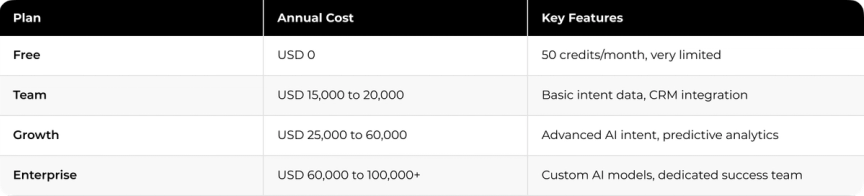
The median 6sense buyer pays around USD 55,211 per year, with costs reaching USD 130,483 in larger deployments, per Warmly's pricing analysis. All paid plans require multi-year contracts with a two-year minimum.
Best Fit
6sense fits enterprise B2B teams running ABM who need to identify in-market buying committees before competitors do. It requires a USD 40K+ annual budget, dedicated ops support, and an existing engagement stack. The platform has a steep learning curve that multiple G2 reviewers cite as the primary disadvantage, and the UI can lag when refreshing data. Teams with fewer than 20 reps will find it difficult to generate enough activity volume to justify the cost.
Kumo.ai

Graph-Based Scoring Across Relational Data
Kumo.ai treats your database as a connected graph rather than a flat table. Other tools score prospects row by row. Kumo reads raw relational tables directly from your data warehouse, CRM records, product usage logs, support tickets, billing history, without requiring you to flatten them into a single table first.
The foundation model, KumoRFM, was pre-trained on tens of thousands of relational datasets to understand how business entities relate across databases. This approach reaches 89% accuracy on the SAP SALT benchmark, compared to 75% for traditional single-table machine learning and 63% for rule-based scoring.
The graph neural network finds signals that flat-table models structurally miss: prospects whose colleagues at the same company already purchased, or prospects who viewed pricing pages after a webinar, detected by traversing relationships between tables. Kumo-scored prospects convert 3.2x more often than rule-based scoring, and sales reps reclaim 60% of prospecting time, both figures are from Kumo's published benchmarks.
"Graph-based lead scoring delivers 3.2x higher conversion rates than rule-based scoring." – Kumo.ai, Lead Scoring Solution Provider
Technical Requirements
Kumo connects directly to Snowflake or Databricks and processes data inside your warehouse without exports. You write predictions in plain English using Predictive Query Language (PQL), which replaces months of feature engineering with SQL-like syntax. Scores update continuously as new activity flows in.
Setup requires relational data across multiple tables. Native Salesforce or HubSpot scoring is simpler when everything lives in a single CRM table. Nvidia acquired Kumo in June 2026, bringing the founding team, former leaders from Pinterest, Airbnb, and LinkedIn, into its enterprise AI portfolio.
Pricing
Kumo offers a free tier with enterprise pricing available on request. Specific costs are not published.
Best Fit
Kumo fits SaaS teams with data spread across CRM, product analytics, support systems, and billing platforms who need higher prediction accuracy than single-table models can provide. It is overkill when all your data lives in one CRM table.
Apollo.io

Prospecting Platform with Built-In AI Scoring
Apollo.io is an all-in-one sales platform that includes AI scoring as one of many features, alongside a 230M+ contact database, email sequencer, and dialer. More than 600,000 companies use it primarily because it consolidates prospecting, sequencing, and scoring in one platform.
The AI auto-scoring assigns ratings, Excellent, Good, Fair, Not a Fit, based on how well prospects match your defined filters and signals. Apollo refreshes these models as you update contact stages. You can build custom scores unique to your business.
Data Quality Considerations
Apollo surfaces verified contacts using 65+ data points and 200+ filters. Ground email accuracy hovers around 65 to 70%, with bounce rates of 15 to 25%, per independent reviews. Per-seat pricing multiplies fast as teams grow.
Pricing
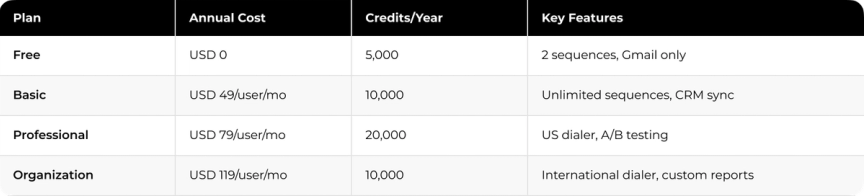
Credits expire monthly with no rollover.
Best Fit
Apollo works for solo SDRs and early-stage teams that need a sequencer with built-in data and do not yet need a dedicated scoring platform. It is less suited to scaling outbound teams or those requiring sophisticated multichannel automation.
ZoomInfo Copilot

Largest B2B Database with Real-Time Buying Signals
ZoomInfo Copilot sits on top of the world's largest B2B contact database. Other AI scoring tools analyze only your CRM data. Copilot pulls from 230M+ contacts, intent signals across third-party sites, and real-time buying signals. In beta testing, users created nearly twice as many sales opportunities compared to non-users and reduced account research time by 10 hours per week, per ZoomInfo's internal beta data.
Key Capabilities
Buying Groups identify decision-makers using website insights and case study data. Account Summaries combine first- and third-party data showing pain points, upcoming deals, and previous engagements. Copilot Chat answers account-specific questions in real time. The AI Email Generator crafts personalized messages adjustable for tone and length.
Spring 2025 updates added account tracking, expanded intelligence for renewals and upsells, and direct signal delivery into Salesforce or HubSpot. Users report 25% pipeline increases, 60% productivity gains, and 58% more booked meetings, ZoomInfo's own reported figures.
Pricing

All plans require annual commitments. Teams save 8.1 hours per week on average, per ZoomInfo's internal data.
Best Fit
Enterprise B2B teams with budgets exceeding USD 15K per year who need complete account intelligence alongside lead qualification. The learning curve is steep, with complexity cited as the primary disadvantage across G2 reviews. Data accuracy issues affect 13% of reviewers.
Comparison Table
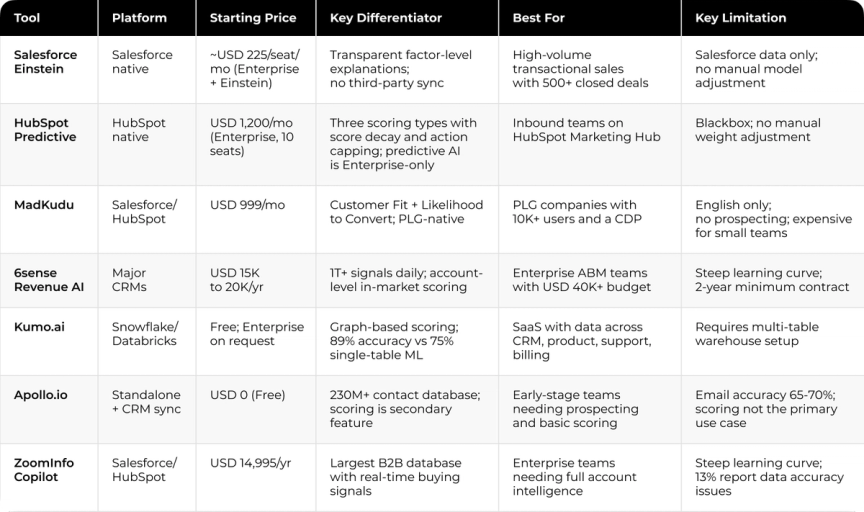
The Score Is Only as Good as the Data Behind It
The tools above produce scores. What determines whether those scores move pipeline is the infrastructure they run on: CRM fields with consistent values the model can train on, routing logic tied to score thresholds, and reporting that connects score changes to revenue outcomes.
Darwin works with B2B marketing and RevOps teams to build that infrastructure layer. The AlertMedia case shows the same operating principle in another part of the marketing system: recurring checks, defined ownership, automated alerts, and a clear reporting trail turned website risk into a managed process. AI scoring depends on the same kind of foundation. When the underlying system is reliable, a score becomes a signal teams can act on. Without it, a score is just another number no one fully trusts.
FAQs
Q1. Does Salesforce have built-in lead scoring?
Yes. Salesforce Einstein Lead Scoring ranks leads from 1 to 99 based on similarity to previously converted leads. It is included in Performance and Unlimited editions and available as an add-on for Enterprise. It requires at least 1,000 leads and 120 conversions in the past 180 days to build a reliable custom model.
Q2. What is the difference between traditional and AI-powered lead scoring?
Traditional scoring assigns manual point values to specific actions. AI-powered scoring analyzes historical conversion patterns and predicts which leads are most likely to close, but requires sufficient conversion history and clean CRM data to train on.
Q3. Which lead scoring tool is best for product-led growth companies?
MadKudu. It scores on Customer Fit and Likelihood to Convert simultaneously, ingests product usage data from Segment, Amplitude, and Mixpanel, and surfaces PQLs based on activation milestones. It requires 10,000+ users to train reliably.
Q4. How much does AI lead scoring software cost?
Native CRM options: Salesforce Einstein runs approximately USD 225/seat/month (Enterprise base plus add-on); HubSpot predictive scoring is Enterprise-only at USD 1,200/month for 10 seats. Standalone tools range from USD 999 to 1,999/month (MadKudu) to USD 15K to 100K+ annually (6sense, ZoomInfo Copilot).
Q5. What data does an AI lead scoring model need to work reliably?
All AI scoring models need sufficient historical conversions to identify patterns. Einstein needs 1,000 leads and 120 conversions in 180 days; HubSpot needs at least 50 contacts split evenly between converted and non-converted; MadKudu needs 10,000+ users. Data quality matters as much as volume.