
Quick Answer:
AI agents for marketing operations are software systems that automate specific tasks: pulling attribution data, routing leads, cleaning CRM records, validating campaigns before launch, and generating reports without manual input. Each agent handles one function. Together they reduce the manual coordination that consumes marketing operations time. Useful agents start with clean tracking, governed CRM data, consistent naming and clear reporting logic.
TL;DR
- AI agents are already being used in marketing operations for attribution monitoring, real-time reporting, lead scoring, CRM cleanup, campaign QA, and workflow orchestration.
- Reporting automation and campaign QA tend to show results first. Attribution monitoring and lead routing take longer to stabilize.
- Every use case depends on a data foundation: governed tracking, clean CRM records, consistent naming conventions. Without a reliable foundation, agents only accelerate the noise.
- The sections below include operational requirements for each use case and realistic benchmarks from teams that have already implemented them.
Your attribution report credits paid search for 42% of pipeline. Your CRM says 60% came from outbound. Your reporting dashboard shows last month as your best month. Your finance team is asking why revenue did not follow.
When attribution data and CRM pipeline numbers disagree, the gap comes from how data moves between systems. As teams add platforms, campaigns, and workflows without a governing system connecting them, that gap widens. AI agents are being deployed to close it, and the results depend on what they run on top of.
This guide covers nine use cases where AI agents are already reducing manual work in marketing operations, what each one requires to perform reliably, and what teams have seen after implementation.
Why AI Agents Are Appearing in Marketing Operations Now
Marketing operations teams are adopting AI agents because coordination work has become too large to manage manually: reports need to be assembled, leads routed, CRM records cleaned, campaign errors caught and budget shifts explained quickly.
The value of each agent depends on the system underneath it.
What AI Agents Actually Depend On
AI agents run on top of marketing operations infrastructure. The infrastructure has to exist first.
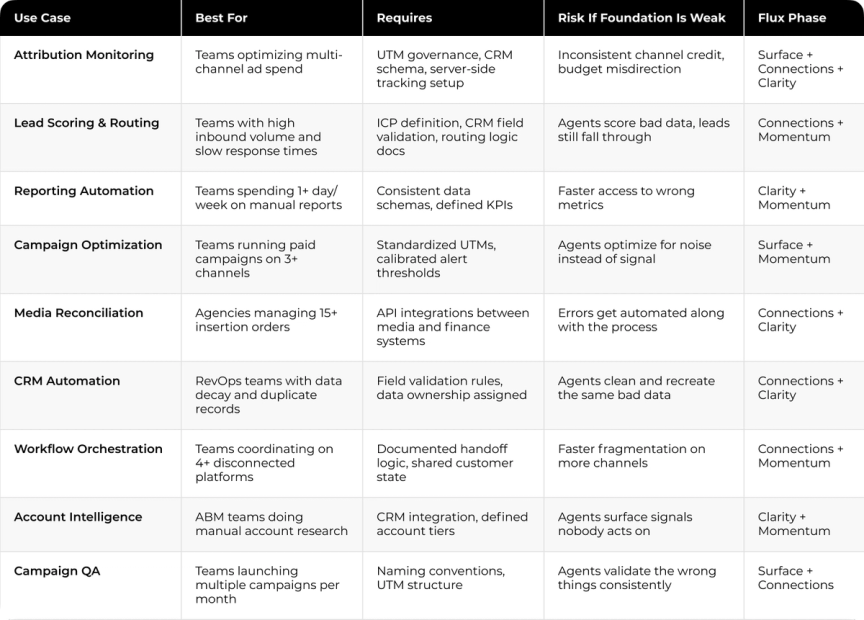
Attribution agents need governed conversion logic and clean channel tagging. Reporting agents need consistent data schemas in every connected platform. CRM agents need field-level validation rules and ownership policies. Campaign QA agents need standardized naming conventions and UTM structures.
When those foundations exist, agents accelerate work. Without them, agents surface noise faster.
How The Data Foundation Behind AI Agents Works
In Darwin Flux, the nine use cases below are parts of one operational system. Surface is where user behavior starts: website, landing pages, forms and conversion actions. It also defines the signals that later need to be tracked and connected. Connections move that signal through systems (GTM, server-side tagging, GA4, CRM, ad platforms). Clarity defines which numbers leadership can trust. Momentum is where automation compounds once the foundation is reliable.
How Do AI Agents Automate Campaign ROI and Attribution Monitoring?
Marketing teams running on last-click attribution give full credit to the final touchpoint before conversion. The problem: the average B2B buyer interacts with 6 to 8 marketing touchpoints before converting, on multiple devices and over multiple weeks.
Multi-touch attribution was built to fix this. It introduced a different problem set. Privacy regulations have made user-level tracking unreliable. Walled garden platforms do not share cross-channel data. MTA relies on correlation: an impression followed by a purchase does not confirm the impression drove it.
How AI Attribution Agents Work
AI attribution agents replace rule-based models with probabilistic ones. Markov chain attribution calculates each channel's value using the removal effect. Shapley value attribution applies cooperative game theory to calculate each channel's marginal value for every possible touchpoint combination.
Server-side tracking allows attribution agents to update scores in seconds rather than days. Identity resolution connects anonymous site visitors to known contacts and links multiple stakeholders within a buying committee.
“We looked at 500 customers and the average journey from first touch to winning a deal was 192 days. An average of 32 sessions were involved in that deal.” – Steffen Hedebrandt, Co-Founder and CRO, Dreamdata
Operational Requirements
- Conversion events must align with actual business outcomes. Each event needs a revenue value assigned.
- Channel tagging must follow a governed UTM convention. Without it, attribution agents create new categories for every naming variation.
- CRM and ad platform data must feed into a unified schema before attribution logic runs.
Business Impact
Organizations using AI attribution can cut marketing expenses by 20% by identifying which channels drive revenue and shifting budget toward them. Decisions move from weekly guesswork to real-time reallocation.
How Does AI Lead Scoring and Routing Automation Reduce Pipeline Delays?
Sales reps spend up to 60% of their time on prospecting, and most of that time goes to leads outside the Ideal Customer Profile. Responding within five minutes makes leads nine times more likely to convert compared to responding after an hour. Manual processes cannot keep pace when inbound volume grows.
Static lead scoring rules are built for fixed conditions. Scores become outdated as soon as buyer behavior or market conditions shift.
How AI Lead Agents Work
AI lead agents analyze firmographic data, behavioral signals, technology stack, hiring patterns, and intent indicators simultaneously. Predictive models learn from historical CRM data and adjust scoring weights dynamically as new patterns emerge.
Automated routing assigns leads based on score, territory, product interest, account ownership, and rep availability. High-intent leads from target accounts go directly to enterprise reps. Lower-intent prospects enter structured nurture sequences.
Darwin applied this logic in a recent AI qualification engagement for a kitchen and interior design company, where an AI-driven qualification system helped increase lead conversion by 30%. The result came from connecting qualification logic, workflow automation and RevOps execution into one operational system, with AI operating within it.
Operational Requirements
- ICP definition must be specific: company size, industry, technology stack, behavioral triggers.
- CRM must have field-level validation to ensure input data is consistent.
- Routing logic must be documented and governed. Without clear ownership rules, high-intent leads fall through gaps even when scoring is accurate.
Business Impact
Companies using AI lead scoring see a 30% increase in sales productivity and recover 10 to 15 hours per rep per week.
What Does Real-Time Marketing Reporting Automation Actually Replace?
Marketing teams spend 20% or more of their workweek on reporting. Log into each platform, export CSVs, normalize inconsistent naming, build charts, paste into slides, add commentary, send. By the time the report goes out, the data is already outdated.
How AI Reporting Agents Work
AI reporting platforms connect directly to ad platforms, CRM systems, and analytics tools, pulling, transforming, and visualizing data without manual exports. Machine learning detects anomalies, flags significant changes in conversion rates or spend pacing, and surfaces findings before they become expensive.
Standard dashboards show historical data. AI reporting agents diagnose causes, prescribe optimizations, and distribute alerts automatically.
“Marketing data is only valuable when it reaches the right person at the right time with the right context. Automation is how you close that gap.” – Christopher Penn, Co-Founder and Chief Data Scientist, Trust Insights
Operational Requirements
- KPIs must be defined against business outcomes before automation is configured.
- Data schemas must be consistent in every connected platform. When campaign naming varies between tools, normalization becomes the bottleneck.
- Alert thresholds must be governed. Automated alerts on ungoverned data produce noise.
Business Impact
AI-powered dashboards reduce reporting time by up to 80%. Teams reclaim 8 to 10 hours per week previously spent on manual compilation.
How Do AI Campaign Agents Reduce Wasted Ad Spend in Real Time?
The average marketer spends 84 minutes daily searching for the information needed to make decisions. Campaign data lives in separate platforms. By the time a shift is reviewed, conditions have already moved.
Ad platform algorithms change continuously. Creative that drove conversions early in the week can experience ad fatigue by the end of it. Audience segments that performed last week may be saturated today.
How AI Campaign Agents Work
AI campaign agents process real-time data streams continuously, identifying anomalies such as cost per click increasing 30% overnight and triggering alerts before budget damage accumulates. Machine learning analyzes engagement patterns, detects creative fatigue, and predicts trajectory based on historical patterns.
Operational Requirements
- UTM parameters, offer IDs, and campaign hierarchy must be standardized before AI monitoring is configured.
- Alert thresholds must be calibrated to actual account patterns. Generic defaults produce noise.
Business Impact
One SaaS company cut detection-to-action time by 70% and reduced wasted spend by 18% after deploying live monitoring.
Can AI Agents Solve the Media Spend Reconciliation Problem?
Media reconciliation spans 15 or more manual steps: insertion order creation, purchase order approval, vendor billing, payment timing, budget pacing, and variance tracking. Hidden costs silently consume 15 to 30% of budgets through agency markup opacity, overlapping tool subscriptions, and currency conversion fees.
How AI Budget Agents Work
AI budget agents connect media planning systems directly to financial platforms via API integration, eliminating manual data reentry. Real-time dashboards show budget pacing by campaign and channel, with variance alerts that fire the moment spending drifts from plan. Automated invoice matching uses OCR to process vendor invoices and assign cost codes based on historical patterns.
Business Impact
At Caterpillar, machine learning cut quarterly forecasting time from three weeks to 30 minutes. Finance teams using automated expense management save 13 hours weekly per team member.
How Does AI CRM Automation Fix Data Quality at Scale?
Organizations estimate up to one-third of their CRM data may be inaccurate at any given time. Sales teams lose 20 to 30% of their time to duplicate records, missing fields, outdated contacts, and broken automations.
How AI CRM Agents Work
AI-enhanced CRM systems automate enrichment using natural language processing, pulling updates from emails, call recordings, the web, and external data providers. Duplicate detection identifies and merges redundant records automatically. Real-time validation prompts corrections at the point of entry before bad data enters the system.
Identity resolution connects anonymous website visitors to known contacts. Automated renewal workflows trigger based on contract timelines and engagement signals.
Operational Requirements
- Field-level validation rules must be configured during CRM setup. Configuring them after data quality problems appear is too late.
- Data ownership must be assigned. AI systems that clean data without human accountability reproduce the same problems over time, just more slowly.
- Regular audits must be scheduled. Automated cleaning reduces decay rate. Manual oversight remains part of the process.
Business Impact
CRM automation cuts lead research and response times by more than 60%. Companies implementing AI-driven CRM tools report 324% ROI over three years.
What Does AI Workflow Orchestration Actually Coordinate Across Marketing Systems?
Marketing execution runs on disconnected platforms. Email automation lives in one system, paid media in another, content management in a third, CRM in a fourth. Each team operates on its own cadence, with its own data model and reporting structure. Actions that should trigger automatically require human coordination instead.
How AI Orchestration Agents Work
AI orchestration agents coordinate multiple specialized agents within a unified workflow, managing multi-step processes on distributed systems from one operational point. Orchestration tools like n8n create predefined sequences that eliminate manual handoffs between platforms, channels, and teams. Email, SMS, web personalization, and paid media can operate from a shared customer state, updated in real time.
Business Impact
Organizations using workflow automation see a 14.5% increase in sales productivity and a 12.2% reduction in marketing overhead. Clarins achieved a 45% increase in lead capture and 30x ROI within 12 weeks of implementing journey orchestration.
How Does AI Account Intelligence Reduce Research Time for Sales Teams?
Account-based strategies depend on a complete view of account state: engagement history, stakeholder roles, buying signals, health indicators. That intelligence lives in call recordings, support tickets, CRM notes, website activity logs, and third-party data providers. Assembling it manually takes hours per account.
How AI Account Agents Work
AI account agents monitor accounts continuously from more than 1,000 data sources, detecting buying signals such as leadership changes, funding announcements, and hiring surges. Agents synthesize these into structured account summaries and surface them in existing CRM workflows.
Business Impact
Teams using AI account intelligence save six hours per week per seller on account research. Organizations report 50% reduction in research time and 40% more pipeline generated from target accounts.
How Do AI QA Agents Catch Campaign Launch Errors Before They Go Live?
Campaign launches fail in predictable ways: wrong audience targeting, missing UTM parameters, broken tracking pixels, off-brand creative, budget misconfiguration. Teams launching multiple campaigns per month cannot manually validate every naming convention, pixel, and tracking parameter on every channel.
How AI QA Agents Work
AI QA agents automate validation from requirements through deployment: generating context-specific test data, executing tests in multiple environments, and blocking launches for critical failures such as missing conversion tracking or broken UTM structure. AI QA infrastructure can reduce campaign error rates by removing dependency on manual checklists.
Business Impact
Content approval times dropped 75% after AI QA agent implementation. Teams save 30 hours per month on validation tasks.
AI Agents for Marketing Operations: Use Case Comparison
Where Should a SaaS Marketing Team Start with AI Agents?
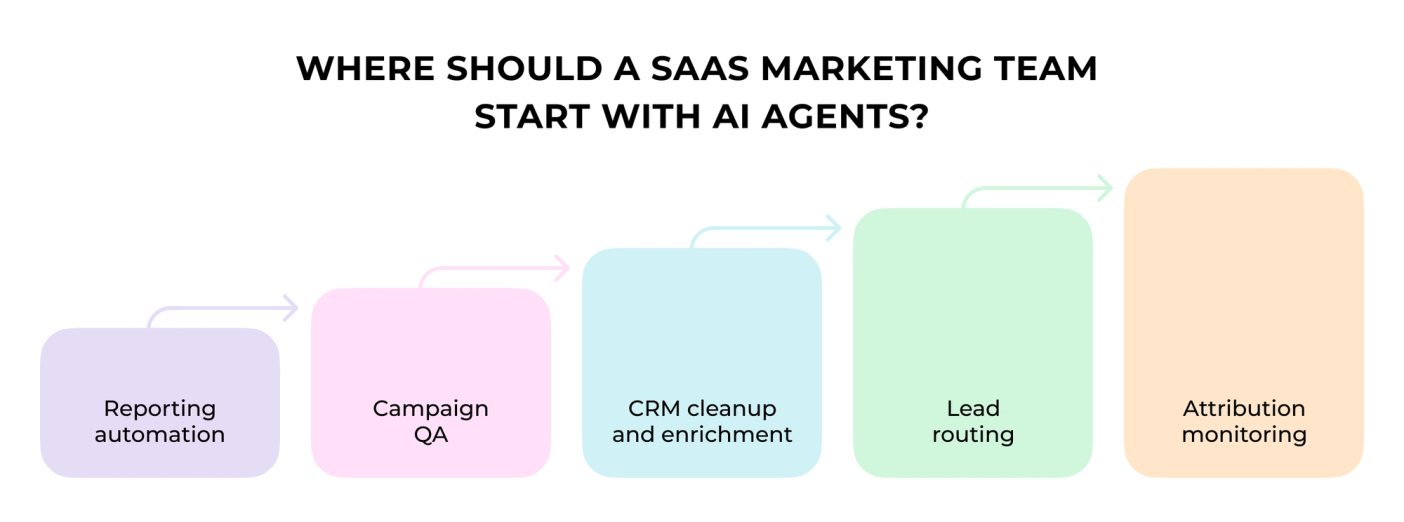
Nine use cases can feel like nine decisions. The right sequence starts with the use cases that have the clearest operational requirements and the lowest risk if the foundation is incomplete.
- Reporting automation: fastest time to value, clearest ROI, operational requirements are well-defined
- Campaign QA: lower risk, immediate error reduction, and can start with a narrower set of naming, UTM and tracking standards
- CRM cleanup and enrichment: foundational for every other use case downstream
- Lead routing: high ROI once ICP and scoring logic are defined
- Attribution monitoring: requires the most complete infrastructure and delivers the most strategic value once that foundation is in place
Fully autonomous campaign and budget agents carry the highest risk when the data foundation is incomplete. They are better suited to teams that have already resolved reporting consistency and attribution governance.
How Darwin Builds the Infrastructure AI Agents Run On
When the data path between campaigns, your website, CRM and pipeline is fragmented, no automation tool will reconcile it. The use cases in this guide are interconnected. Attribution accuracy depends on tracking governance. Lead scoring depends on CRM data quality. Reporting depends on consistent data schemas. Campaign QA depends on UTM standards.
Darwin builds that foundation using the Darwin Flux framework. Engagements begin with a diagnostic of current infrastructure: tracking coverage, CRM governance, attribution logic, integration architecture. Darwin then builds what is missing before AI agents are configured on top.
Darwin helps marketing and RevOps teams with AI agent implementation, CRM workflow automation, attribution stack design, and integrations and automation infrastructure. The goal is to build the operational system that makes AI automation reliable.
Revenue reporting, lead conversion, and campaign results all improve when every system has a defined role and a governed data path connecting them.
FAQs
Q1. Do AI agents for marketing operations work without existing data infrastructure?
They function. Reliable output requires a governed data foundation. Attribution agents trained on inconsistently tagged campaigns produce inconsistent attribution. Lead scoring models trained on incomplete CRM records learn the wrong patterns. Each use case section above includes the operational requirements that need to be in place before agents produce stable output.
Q2. How much time can marketing teams save by implementing AI reporting automation?
AI-powered reporting reduces manual compilation time by up to 80%. Teams reclaim 8 to 10 hours per week. Purpose-built solutions can be operational within a week.
Q3. What ROI can companies expect from AI attribution and CRM automation?
Organizations using AI attribution cut marketing expenses by 20% by identifying high-ROI channels. CRM automation delivers approximately 324% ROI over three years according to industry benchmarks. Results depend on data quality and how well operational requirements are met before agents are configured.
Q4. How does Darwin Flux relate to AI agent implementation?
Darwin Flux (Surface, Connections, Clarity, Momentum) is the operational framework that AI agents run on top of. Surface is where user behavior starts: website, landing pages, forms and conversion actions. It also defines the signals that later need to be tracked and connected. Connections builds the integration between systems. Clarity defines governed reporting logic. Momentum is where agents produce compounding efficiency gains.
Q5. Where should a marketing team start if they want to implement AI agents?
Start with a marketing operations audit. The use cases with the fastest ROI (reporting automation, campaign QA, CRM enrichment) have the clearest operational requirements and the lowest implementation risk. Darwin's diagnostic process identifies which use cases are ready to deploy and which require infrastructure work first.