Quick Answer
Lean B2B marketing teams evaluating ABM platforms should match the tool to their actual team capacity and data readiness. Vendor feature lists are the wrong starting point. AdRoll ABM (formerly RollWorks) is the practical entry point for teams under 10 people running HubSpot with ACV below $75K. Demandbase fits mid-market Salesforce setups where disconnected sales and marketing handoffs are the primary operational problem. 6sense justifies its cost only when tracking multi-threaded enterprise deals with six-month cycles, $200K+ ACV, and a dedicated RevOps function to manage the platform.
TL;DR
- AdRoll ABM covers the ABM playbook at a fraction of the cost of alternatives, with no dedicated RevOps FTE required for most lean teams
- Demandbase is built for coordinating disconnected marketing and sales motions on Salesforce; mid-market teams at $75K-$300K ACV get the most from it
- 6sense is enterprise infrastructure: predictive AI processing over a trillion buying signals daily, justified only at $200K+ ACV with 8+ person buying committees
- 6sense and AdRoll ABM ingest Bombora third-party intent data; Demandbase primarily relies on its own proprietary intent network; the differentiator is signal depth and CRM integration
- Implementation timelines range from days (AdRoll ABM) to 3-6 months (6sense); that gap directly determines when your team starts seeing pipeline impact
Choosing between 6sense, Demandbase, and AdRoll ABM (the platform formerly known as RollWorks) requires more than a feature comparison. All three surface in-market accounts that have not yet filled out a form. Where they diverge is in how they connect to your existing HubSpot or Salesforce setup, how long it takes to generate a meaningful pipeline report, and how much of your team's bandwidth they consume after launch. This guide breaks down the real differences so you can match the platform to your team's current data readiness and the stack you have today.
The Four-Stage Readiness Check Behind Every ABM Platform Decision
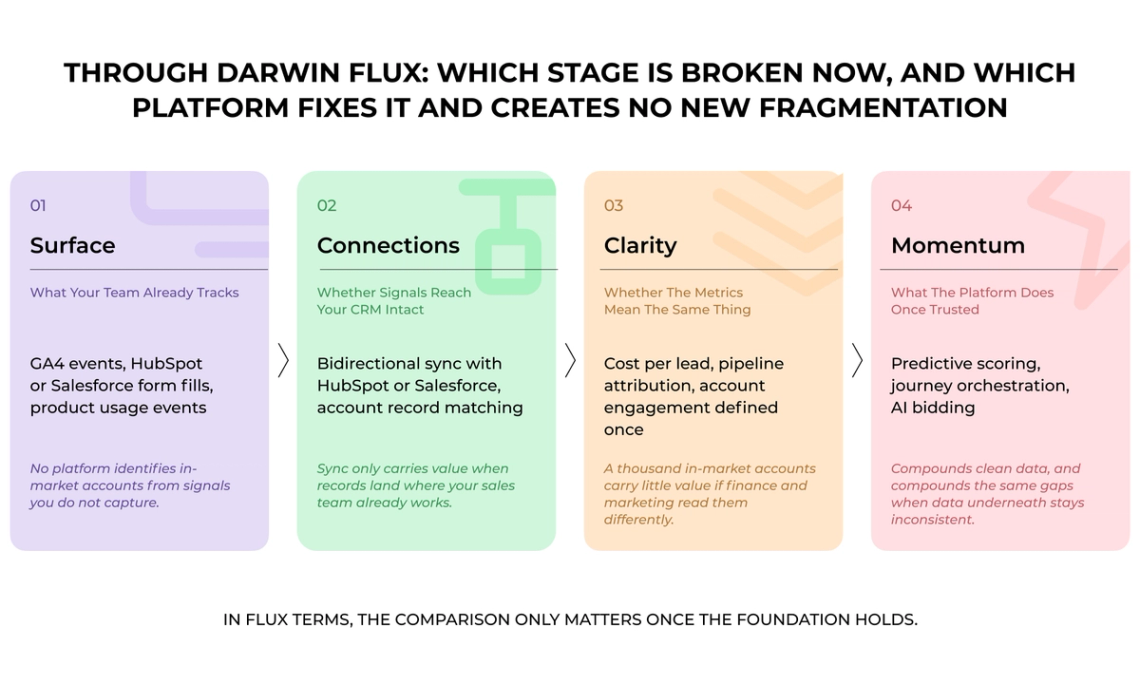
Through Darwin Flux, the question is which stage of ABM signal readiness is broken now, and which platform fixes it without adding fragmentation. ABM platform selection starts with what your team already tracks. GA4 events, HubSpot or Salesforce form fills, and product usage events form the signal layer every platform claims to score. A platform cannot identify in-market accounts from signals your stack does not capture.
The next question is whether those signals reach your CRM and reporting layer without losing context. 6sense, Demandbase, and AdRoll ABM all promise bidirectional sync, but the sync only carries value when account records, lead source data, and intent signals land in the same place your sales team already works.
Clarity is where most platform evaluations break down. Cost per lead, pipeline attribution, and account engagement need to mean the same thing in marketing's dashboard and the board deck. A platform that surfaces a thousand in-market accounts carries little value when finance and marketing cannot agree on what counts as a qualified one.
Momentum follows once that foundation holds. Predictive scoring, automated journey orchestration, and AI bidding compound the value of clean data, and they compound the same gaps when the data underneath stays inconsistent.
In Flux terms, the comparison below maps which stage of stack readiness is broken now, and which platform fixes it without adding fragmentation.
Why Your Data Readiness Determines the Right ABM Platform
The more useful question, when evaluating any ABM platform, is whether your current stack can absorb what you are about to buy. Each platform assumes a different level of readiness from your HubSpot or Salesforce instance, your UTM governance, and your reporting definitions.
The starting layer is signal capture. 6sense requires clean CRM history and consistent account data to train its predictive models. Demandbase needs behavioral data segmented by journey stage to identify what drives revenue. AdRoll ABM needs a minimum of 200 target account domains and a connected CRM to begin scoring. When website events, forms, and conversion actions are not tracked consistently, no ABM platform surfaces accurate intent.
Signal connections determine whether the platform works as intended. HubSpot, Salesforce, GA4, and ad platforms need to speak the same account language. 6sense pushes buying stage into Salesforce and pulls pipeline data back for attribution. Demandbase queries Salesforce for up to 3,000 records per API call and writes calculated fields daily. AdRoll ABM syncs account scores through an in-CRM widget. Each integration assumes the CRM data is structured well enough to produce meaningful output on the receiving side.
Clarity in reporting is where many marketing teams discover the gap. When the account-level data path between your website, GA4, CRM, and ad platforms is not governed consistently, ABM reports show activity but cannot connect it to pipeline or revenue. The problem is not the platform. The reporting definitions are.
That foundation also determines whether automation helps or compounds the problem. AI bidding in Google Ads, predictive scoring in 6sense, and journey triggers in Demandbase all optimize against the signal you feed them. When that signal is incomplete or inconsistent, automation scales bad assumptions and compounds the problem.
Brianna Miller, Director of Demand Generation at Cohere Health, described the decision point plainly after evaluating 6sense, Demandbase, and AdRoll: “I don’t have a budget for it, and I don’t have a whole team member dedicated to it.” Budget and operational capacity should drive platform selection. Feature depth is secondary.
6sense vs Demandbase vs AdRoll ABM: Quick Comparison Overview
These three platforms were built from different starting points, and those origins determine everything from onboarding time to the daily workflow your team runs. Understanding where each platform came from helps you evaluate which one matches the problem you are actually trying to solve.
How Each Platform Was Built and Why It Matters
6sense built Revenue AI from the ground up as a predictive intelligence engine, processing over a trillion buying signals daily to identify in-market accounts automatically. Demandbase started as a B2B ad-targeting product and layered ABM coordination on top, which explains why its audience-to-ad workflow feels more direct than competitors. AdRoll ABM sits between the two, designed for lean teams running HubSpot who need operational ABM with no dedicated ops function.
“Too often, ABM teams end up locked into complex tools that looked great in the demo, but in practice don’t help them reach and convert real buyers.” Dominique Jackson, Content Marketing Manager, Influ2
6sense requires 3-6 months to deploy due to predictive model configuration and data taxonomy setup. AdRoll ABM reaches campaign-ready status within days to a few weeks for teams already running HubSpot. Demandbase falls in the middle but demands ongoing manual model maintenance for its Pipeline Predict scoring after launch.
How Intent Data Sources Actually Differ
6sense and AdRoll ABM ingest Bombora's third-party intent feed as part of their signal mix. Demandbase primarily relies on its own proprietary intent network, though Bombora data can be layered in via integrations. Raw intent data volume alone is not the differentiator. 6sense maps 25M+ accounts using its own data plus the largest third-party intent stack in the category. Demandbase covers 17M+ accounts and adds G2 review-intent signals through its platform partnership. AdRoll ABM reaches 700K+ accounts via IP-to-company resolution plus partner data.
Where the platforms diverge is interpretation. 6sense applies proprietary search behavior data gathered through its network and anonymous research patterns from thousands of B2B publisher sites. Demandbase owns direct access to the bidstream and monitors over 1 trillion monthly interactions, per its own published figures. AdRoll ABM combines Bombora with conversion intent signals from its own ad network, a narrower but directly actionable signal set for advertising-first programs.
Pricing Tiers at a Glance
None of the three publishes list pricing. Every contract is custom-quoted based on account volume, seat count, and module selection. The figures below are directional estimates from third-party procurement databases. Your actual quote will differ based on negotiation timing and scope.
AdRoll ABM starts at approximately $10K-$12K per year for its entry tier, with full ABM capabilities in the $25K-$50K range. Demandbase median contract lands at $65,981 per year based on Vendr data from 175 tracked purchases, ranging from $22K to $164K. 6sense median sits at approximately $55K-$63K per year per Vendr and Salesmotion data, with Growth-tier deployments running $60K-$120K plus implementation costs and credit overages.
Which Team Size and Budget Each Platform Fits
B2B companies at $5M-$25M ARR running HubSpot with ACV under $75K should evaluate AdRoll ABM. Teams at $50M-$150M ARR on Salesforce with ACV of $75K-$300K should review Demandbase. Companies above $100M ARR with a dedicated RevOps function fit 6sense's cost structure. The platform requires 0.5-1 FTE to manage ongoing configuration, adding $80K-$150K in fully-loaded headcount cost on top of the platform fee.
The team-size fit matters because ABM platforms do not create operational capacity. They assume it. A Demandbase or 6sense deployment with no dedicated owner produces dashboards but not pipeline.
Platform Capabilities Breakdown: What Each Tool Actually Does
Feature comparisons are useful for shortlisting, but the more relevant question is which capabilities your team will use in the first 90 days. The sections below focus on the mechanics that affect day-to-day program execution.
How Each Platform Identifies and Prioritizes Target Accounts
6sense claims 85%+ match accuracy on account identification, a figure stated by 6sense CTO Viral Bajaria in vendor documentation and broadly consistent with independent reviews as of 2026. The Company Graph uses IP addresses, cookies, and advertising IDs to track buyers through remote work patterns. Demandbase reports 77% match rates after filtering consumer traffic, a figure published on Demandbase's own blog. AdRoll ABM draws on 2.6 billion digital identities and Experian's cross-device graph for identification.
For account scoring: 6sense surfaces 6sense Qualified Accounts by combining buying stage predictions with ICP fit scores from historical Salesforce deal data. Demandbase applies Context Intelligence to align account signals with pipeline goals. AdRoll ABM uses Journey Predictions that score accounts as High (25x more likely to convert) or Medium (5x more likely) based on firmographic fit, intent, and engagement patterns, a simpler model that requires less RevOps configuration to maintain.
Campaign Execution and Channel Coverage
6sense Intelligent Workflows provides a drag-and-drop canvas that coordinates campaigns through display, LinkedIn, Google Ads, email, and sales engagement from one interface, adjusting messaging automatically when buying stage changes. Demandbase coordinates programs through advertising, web personalization, and sales using its Journey engine, which triggers multi-step campaigns based on live behavioral and intent data from Salesforce. AdRoll ABM delivers through its DSP with BidIQ optimization through web, Connected TV, LinkedIn, and Facebook, reallocating budget toward better-performing creatives with no manual intervention required.
Connected TV advertising is available to AdRoll ABM customers and reaches streaming platforms through AVOD and FAST inventory; availability may vary by package tier. Neither 6sense nor Demandbase bundles CTV at lower price tiers.
CRM Integration Depth and Sales Intelligence
All three platforms sync bidirectionally with Salesforce and HubSpot, but the integration depth differs. 6sense pushes account activity, intent signals, and buying stage into Salesforce and HubSpot records, then pulls pipeline data back for closed-loop attribution. Demandbase queries Salesforce for up to 3,000 records per API call and writes calculated fields daily between 10:00 a.m. and 10:00 p.m. UTC, per Demandbase's official integration documentation. AdRoll ABM surfaces engagement spikes through an in-CRM widget and syncs account scores plus new account suggestions automatically.
Ben Smith, Marketing Director at Reachdesk, described the shift to signal-driven CRM workflows after implementing 6sense: “It’s the difference between being reactive and proactive. We’re not waiting for someone to fill out a form. We’re reaching out to them at the right time, with the right message, because we can see the buying signals.” That shift requires the CRM to be structured well enough for the platform to route intent signals to the right rep at the right time.
AI Scoring and Predictive Analytics
6sense runs the most sophisticated predictive layer, using historical Salesforce deal data plus Bombora and proprietary intent to forecast conversion probability and optimal engagement timing. Demandbase employs machine learning for account scoring but requires manual tuning against closed-won data to maintain accuracy over time, a maintenance requirement that affects lean teams with no dedicated marketing ops. AdRoll ABM applies predictive scoring to grade accounts A through D based on firmographic and technographic fit, a model that requires less ongoing configuration.
AI bidding and automated scoring only improve results when the underlying signal is clean. When GA4 events, UTM parameters, and Salesforce fields are inconsistent, predictive models in any of these three platforms optimize against bad assumptions.
Implementation Time and What It Requires
AdRoll ABM reaches campaign-ready for experienced teams within days to a few weeks, requiring pixel installation and CRM connection as the primary setup steps. Demandbase takes 5-7 weeks through four phases: foundation, data integration, segment building, and adoption, each phase requiring active involvement from marketing ops and a Salesforce admin. 6sense demands at least three months to configure predictive models and establish data taxonomy, with a CRM history clean enough to train the AI layer until meaningful scoring begins.
The implementation gap matters because platform fees start from contract signature. Campaign launch comes weeks or months later. A 6sense deployment that takes three months to configure costs the same in months one and two as it does after the models are trained.
Pricing Comparison: What Lean Teams Actually Pay
Published pricing does not exist for any of the three platforms. The figures below draw from Vendr contract databases, G2 buyer reports, and Salesmotion and Docket analyses of real procurement cycles through mid-2026. Treat them as directional ranges, not guarantees.
6sense Cost Structure and Credit System
Based on Vendr and Salesmotion contract data, the 6sense median buyer pays approximately $55K-$63K per year. Growth-tier deployments, where the predictive AI layer lives, run $60K-$120K plus implementation and credit overages. The entry Team tier starts around $25K-$35K for 5-15 seats, but this tier excludes predictive AI scoring, which is the platform's primary differentiator over AdRoll ABM and Demandbase.
The credit system is where costs compound. Each contact lookup in 6sense consumes credits that expire at renewal and do not roll over. A 20-person sales team researching 10 accounts weekly burns through 800+ credits per month on contact data alone. Implementation adds $5K-$50K depending on Salesforce or HubSpot setup. Managing 6sense at full capacity requires 0.5-1.0 dedicated RevOps FTE, a cost that often exceeds the platform fee for teams under 200 employees.
Demandbase Pricing and Hidden Line Items
Demandbase contracts median at $65,981 per year based on Vendr's analysis of 175 purchases. Mid-market deployments targeting 500-2,000 accounts run $45K-$65K for the platform fee. Onboarding runs approximately $29K as a separate line item covering CRM integration and training, a figure confirmed by Docket, Salesmotion, and multiple independent sources.
Each user seat beyond the base contract allotment, which is ten seats in most contracts, costs $1,200-$3,000 per seat per year. A 25-person team on a mid-tier Demandbase contract can push total spend past $90K, and that is platform fee alone. Annual or multi-year commitments are required, with no monthly option and no free trial at any tier.
AdRoll ABM Pricing and What Ad Spend Adds
AdRoll ABM offers the most accessible entry point among dedicated ABM platforms. Industry-aggregated pricing from Vendr and G2 puts ABM Starter at approximately $10K-$12K per year, Standard at $25K-$50K, and Advanced at $75K+. Ad spend sits separately, billed through dynamic CPM with 15-18% variable service fees deducted from campaign budgets. Implementation runs $5K-$15K with campaign launch possible within the first few weeks for teams running HubSpot or Salesforce.
Year-One Total Cost of Ownership by Team Size
Year-one TCO ranges from approximately $40K for AdRoll ABM Starter to $1M+ for 6sense Enterprise at scale. AdRoll ABM does not require a dedicated FTE to manage ongoing configuration for most B2B teams under 500 employees, while 6sense and Demandbase require 0.5-1.0 FTE. That headcount adds $80K-$150K in fully-loaded annual cost on top of the platform fee for mid-market deployments. For a 50-person B2B SaaS company, that headcount cost alone often exceeds the AdRoll ABM platform fee.
Matching ABM Platforms to Your Team's Reality
ABM programs fail for two reasons: bad data, or a platform that outpaces the team running it. The sections below map each platform to the specific team profile and data maturity where it produces results.

Brianna Miller, Director of Demand Generation at Cohere Health, walked through her own evaluation of 6sense, Demandbase, and AdRoll in the episode above. She chose AdRoll after accounting for both budget constraints and team bandwidth, the two variables that determine whether an ABM program runs or stalls:
“I don’t have a budget for it, and I don’t have a whole team member dedicated to it.” Brianna Miller, Director of Demand Generation, Cohere Health
That decision gave Cohere Health a program they could launch and report on within a more realistic window for the team, not a platform waiting for infrastructure to catch up.
When 6sense Is the Right Choice
6sense makes sense when you are selling into enterprise accounts with 8+ person buying committees at $200K+ ACV, your Salesforce instance has 12+ months of clean deal history to train the predictive models, and you have a dedicated RevOps or marketing ops resource to manage ongoing configuration. The predictive intelligence earns its cost when multi-threaded deal tracking and intent-based LeanData routing directly change which rep gets which account.
Below that ACV threshold, or with no dedicated platform owner, you pay for capabilities your team will not operationalize for at least 18 months.
When Demandbase Fits Lean Marketing Operations
Demandbase works when the primary operational problem is coordinating disconnected marketing and sales motions in Salesforce. The platform turns Salesforce behavioral signals into coordinated GTM action by analyzing accounts and buying group activity to identify what drives pipeline movement. Teams that already run Salesforce with marketing automation but struggle with manual handoffs between marketing campaigns and sales follow-up benefit the most from Demandbase's Journey engine.
Demandbase requires behavioral data mature enough to segment accounts by buying stage, which means 12+ months of Salesforce history and a marketing ops resource who can maintain segment definitions as the pipeline changes.
When AdRoll ABM Is the Right Starting Point
AdRoll ABM was designed for teams new to structured ABM who need account targeting, CTV advertising, and CRM-based journey predictions, with no dedicated ops function needed. An Onboarding Success Manager helps prioritize and plan the program until a dedicated Customer Success Manager takes over. The platform suits revenue-focused B2B marketers running HubSpot who need to align sales and marketing around a defined target account list with no additional headcount.
Cohere Health chose AdRoll ABM over 6sense because the team needed intent data and CRM integrations. Enterprise-grade predictive AI requires a full-time resource to configure and maintain, which was not available. That fit produced a program they could run and measure from launch. You need at least 200 company domains representing your best customers for ICP training to launch the first campaign.
What ABM Programs Need Beyond the Platform
Expect 18-24 months of continuous program activation to see full ABM results regardless of platform. Most teams see primary program effects within 3-6 months. According to HG Insights technographic data, 85% of enterprise B2B technology companies deploy two or more ABM platforms, with market leaders averaging 2.5 ABM tools in their GTM stack.
The most common implementation failure is treating ABM as a one-time project. It is a long-term program. ABM requires C-suite buy-in at launch, KPIs tied to pipeline influence, with form fills excluded as the primary metric, and enough content to personalize campaigns through 50-200 target accounts simultaneously.
Making the Decision: Which Platform Should You Choose
Platform selection comes down to three variables: your current go-to-market motion, the operational capacity of your team, and the data quality in your HubSpot or Salesforce instance. The sections below give the decision logic for each scenario.
Decision Framework by Budget and Team Maturity
Teams with $100K+ ABM budgets, 6+ month sales cycles, and 5+ stakeholders per deal get the most from 6sense or Demandbase. Mid-market operations running $25K-$60K budgets on HubSpot fit AdRoll ABM. Teams under $25K should start with Bombora standalone intent data or Apollo.io. The underlying account data problem needs to be solved for an ABM layer to add value.
Budget for the full investment. The platform fee is only one line item: team training, CRM integration work, segment definition, and the ongoing bandwidth to run account-level campaigns and keep people on active pipeline work.
6sense Alternatives to Evaluate
ZoomInfo pairs intent signals with contact records and addresses the outreach gap 6sense leaves between account identification and sales action. Bombora delivers standalone intent data at $25K-$50K per year with no bundled features your team may not need. Apollo.io offers functional ABM at the lowest entry price for teams that primarily need contact data and basic intent. Cognism combines intent with phone-verified European contact data for teams with EMEA pipeline focus.
Demandbase Alternatives Worth Evaluating
The closest Demandbase alternative for full ABM coordination is 6sense. ZoomInfo provides significantly more contact data with predictable access pricing. Bombora operates as a purpose-built intent provider when you need signals with no full platform commitment and the headcount cost that comes with it.
Questions to Ask During Platform Demos
Ask vendors how fast you can launch your first personalized campaign from contract signature. Implementation kickoff is a separate milestone. Demand specifics on data accuracy for your ICP in your specific market, and skip generic coverage statistics. Ask what support looks like six months post-launch when the onboarding team transitions to customer success. Request references from customers with your team size who can confirm actual costs and real implementation timelines.
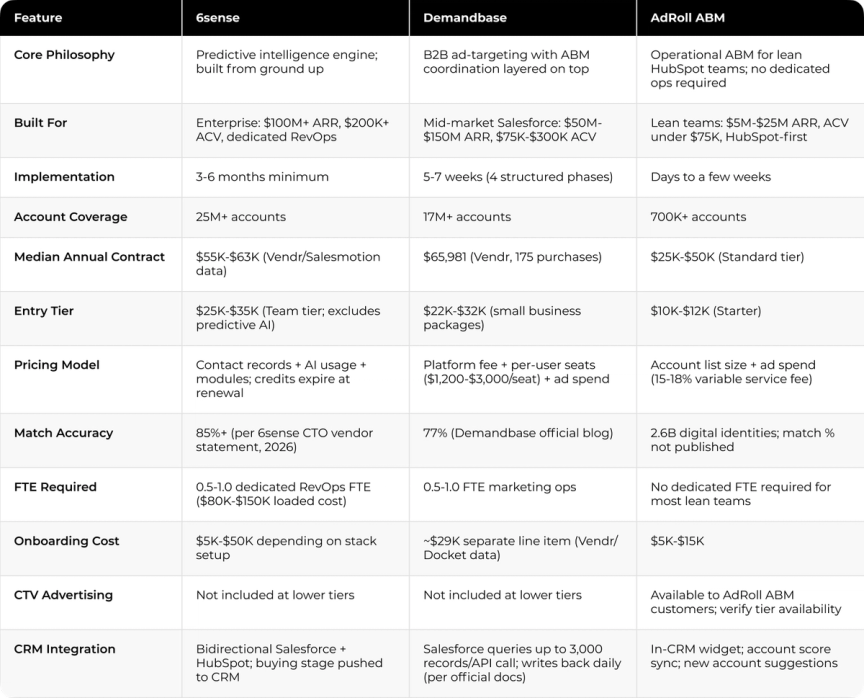
Platform Comparison Table
The table below summarizes the key structural differences between 6sense, Demandbase, and AdRoll ABM based on verified third-party data as of June 2026. Pricing figures are directional estimates from Vendr, Salesmotion, and Docket. Actual quotes will vary.
When the Stack Is Right, the Platform Works
Lean B2B marketing teams that struggle to see ROI from ABM platforms share a common pattern: the data foundation was not ready at the time of purchase. Website events were tracked inconsistently, Salesforce fields carried no shared standard, and GA4 measured conversions on a different definition than CRM. Those gaps are what make ABM reports show activity without pipeline.
The fix sits in sequencing. Signal capture gets cleaned up first, CRM data gets structured for account-level reporting second, and only then does the platform layer get asked to do its job. That order turns ABM reports into pipeline within one or two quarters. Reversing it spends the same window troubleshooting a platform that was never the actual problem.
Four questions worth answering ahead of any platform demo: What buying signals is your team already capturing through your website, HubSpot, or Salesforce? How consistently do those signals connect through GA4, CRM, and ad platforms? What does your sales team actually look at when reaching out to an account? What does a successful ABM quarter look like in a board deck for your company? The platform that connects those four answers to a measurable output is the right one.
Darwin works with B2B marketing teams to audit their GTM stack when they commit to ABM infrastructure, identifying where signal capture breaks down, where CRM data is not structured for account-level reporting, and which platform fits the team's current operational capacity.
FAQs
Q1. Which ABM platform is better for mid-sized companies: Demandbase or AdRoll ABM?
For mid-sized companies at $50M-$150M ARR on Salesforce with a marketing ops resource, Demandbase is the stronger fit. AdRoll ABM is the better starting point when budget is under $60K and the team is new to structured ABM.
Q2. How does 6sense compare to Demandbase in terms of predictive analytics?
6sense leads in predictive AI depth and buying-stage scoring; Demandbase leads in ad-targeting precision and Salesforce-connected web personalization. Both require dedicated operational resources and several months of implementation until the scoring layer produces reliable output.
Q3. What does AdRoll ABM (formerly RollWorks) actually do?
AdRoll ABM connects account identification, multi-channel advertising (display, LinkedIn, Facebook, Connected TV), and CRM-based journey predictions in one platform. It draws on 2.6 billion digital identities and reaches campaign-ready status within weeks for teams with clean HubSpot or Salesforce data.
Q4. What are the real cost differences between 6sense, Demandbase, and AdRoll ABM?
Based on Vendr data: AdRoll ABM Standard runs $25K-$50K per year with no dedicated FTE; Demandbase median is $65,981 plus $29K onboarding and per-seat fees; 6sense median is $55K-$63K, with Growth-tier deployments reaching $60K-$120K. For teams under 500 employees, the required RevOps headcount for 6sense or Demandbase often exceeds the AdRoll ABM platform fee on its own.
Q5. How long does it take to see results from an ABM platform?
AdRoll ABM reaches campaign-ready in days to weeks; Demandbase takes 5-7 weeks across four phases; 6sense requires at least three months to configure predictive models. Most teams see primary program effects within 3-6 months, and full results require 18-24 months of continuous activation.