
Quick Answer:
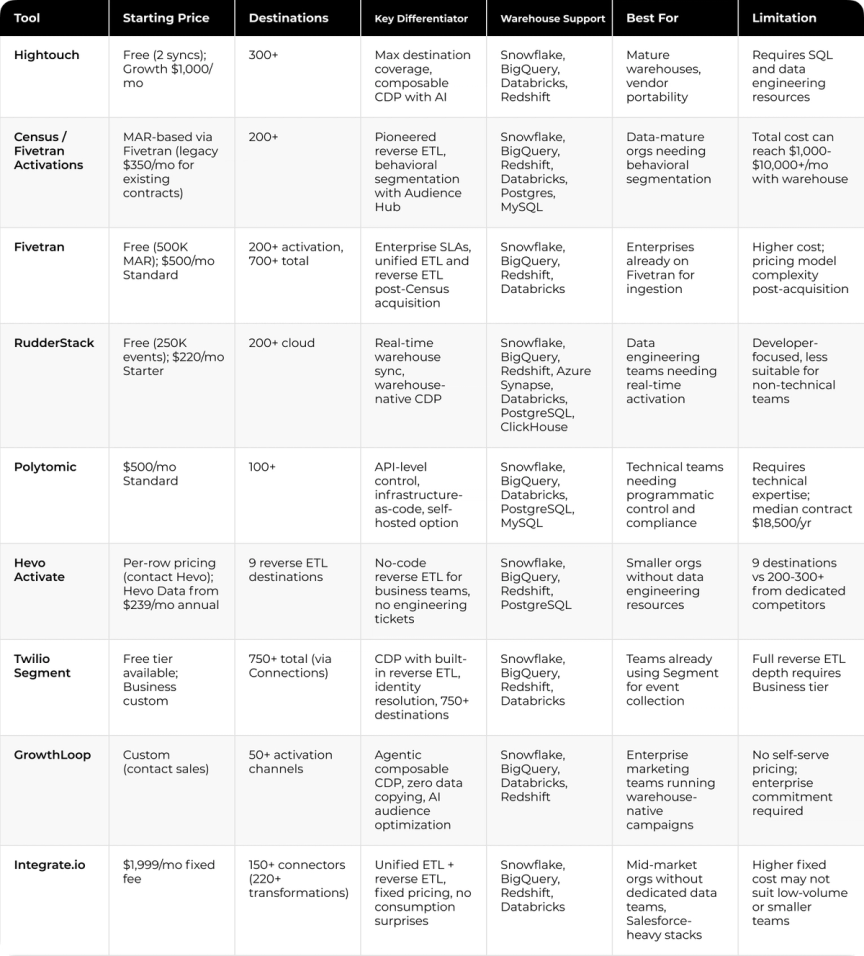
The right reverse ETL tool depends on three decisions: which destinations your go-to-market (GTM) stack requires, whether your team has SQL-capable engineers to manage data models, and how frequently campaigns need audience updates. Hightouch leads on destination breadth with 300+ integrations. Census / Fivetran Activations stands out for behavioral segmentation. Fivetran consolidates extract, transform and load (ETL) and reverse ETL under one vendor after acquiring Census in May 2025. RudderStack delivers real-time sync for teams that need immediate audience updates. Twilio Segment combines event collection and warehouse activation in one platform across 750+ destinations. GrowthLoop runs natively on your warehouse without copying data. For teams without data engineers, Hevo Activate and Integrate.io offer no-code and fixed-fee options respectively.
TL;DR
- Hightouch. 300+ destinations, composable customer data platform (CDP) with AI, best for mature warehouse setups needing broad activation coverage
- Census / Fivetran Activations. Behavioral segmentation, Audience Hub, pioneered the reverse ETL category, now part of Fivetran ecosystem
- Fivetran. Enterprise-grade, unified ETL and reverse ETL after Census acquisition in May 2025
- RudderStack. Real-time sync, warehouse-native CDP, three-part pipeline architecture
- Polytomic. Developer-first, API-level control, self-hosted option for compliance-heavy teams
- Hevo Activate. No-code, business-team-friendly, 9 reverse ETL destinations, lowest barrier to entry
- Twilio Segment. 750+ destinations via Connections, CDP plus reverse ETL in one platform, identity resolution included
- GrowthLoop. Agentic composable CDP, no data copying, AI-driven audience optimization for enterprise marketing
- Integrate.io. Fixed-fee pricing at $1,999/mo, unified ETL and reverse ETL, strong for bidirectional Salesforce workflows
Reverse ETL tools help marketing and RevOps teams sync warehouse data into customer relationship management (CRM) systems, ad platforms, and other go-to-market systems. Instead of relying on manual CSV exports or delayed audience updates, teams can automate customer data activation across the revenue stack.
For B2B SaaS companies, this affects more than operational efficiency. CRM field consistency, audience freshness, lifecycle stage alignment, and reporting accuracy all depend on how reliably warehouse data moves between systems.
The tool choice matters, but the bigger risk is operational: unclear field ownership, inconsistent lifecycle definitions, and sync logic that does not match campaign cadence. This guide compares nine reverse ETL platforms based on destination coverage, sync reliability, governance controls, warehouse compatibility, and GTM use cases.
Where Reverse ETL Fits in the Darwin Flux Framework
Reverse ETL sits primarily in the Connections and Clarity layers of Darwin Flux.
Connections: Warehouse data has to move reliably into CRM, ad platforms, and marketing automation tools. Without that, audience freshness and CRM field consistency break the moment a sync fails silently.
Clarity: teams need to know which fields sync, which definitions are trusted, and whether campaign audiences reflect the same source of truth across marketing, sales, and finance.
Momentum comes later, when those connections are reliable enough to support automation, personalization, and AI-assisted campaign workflows. A reverse ETL tool alone does not get you there. The field governance and sync logic have to be right first.
1. Hightouch: Maximum Destination Coverage for CRM and Ad Platforms

Hightouch has evolved into a composable CDP and AI platform built for marketers, though the reverse ETL engine remains at its core. The most extensive part of that engine is integration support for 300+ destinations spanning advertising platforms, marketing automation, CRMs, and customer success tools.
Overview and Key Features
The platform syncs governed warehouse data into operational tools without creating duplicate sources of truth. You get SQL-based interfaces for technical teams and a no-code audience builder called Customer Studio for marketers who prefer not to write queries. According to Hightouch documentation, the setup process takes under 20 minutes, and you can run your first sync shortly after.
Change Data Capture (CDC) optimization means Hightouch does not send full query results on every sync run. It compares current results to previous runs and sends only new, changed, or removed rows. You can enable the Lightning sync engine to compute CDC in your warehouse for higher performance at scale.
The platform includes Customer Studio for no-code segmentation, AI Decisioning for campaign optimization, Identity Resolution for profile stitching, and Match Booster for improving ad platform match rates.
Pricing Structure
Hightouch pricing is sync-based, not destination-based. The free tier has up to 2 active syncs with unlimited destination count and unlimited user seats. The Growth plan starts at $1,000 per month. Business pricing is custom-quoted. The median annual contract is $15,000, with discounts of 25-35% common through negotiation.
Integration Capabilities
The 300+ integration catalog covers advertising (Google Ads, Meta Ads, LinkedIn, TikTok), CRMs (Salesforce, HubSpot), marketing automation (Braze, Iterable, Marketo), support tools (Zendesk, Intercom), and analytics platforms (Amplitude, Mixpanel). Hightouch ships new integrations weekly.
Best For
Hightouch fits organizations with mature cloud data warehouses like Snowflake, BigQuery, Databricks, or Redshift. Teams running batch-oriented use cases, daily audience syncs, CRM enrichment, and segment-based campaigns that tolerate latency will get the most out of it.
2. Census / Fivetran Activations: Data Activation Platform for Behavioral Segmentation

Census pioneered the reverse ETL category and remains a reference point for teams evaluating data activation platforms. Since the Fivetran acquisition in May 2025, the product is available as Fivetran Activations inside the Fivetran ecosystem. The platform syncs data from cloud data warehouses to 200+ business tools, targeting use cases where understanding customer behavior guides marketing and sales decisions.
Overview and Key Features
The platform architecture centers on three building blocks: models, segments, and syncs, all surrounded by governance layers. Data teams can write SQL models directly. Marketing teams use the visual model builder and Audience Hub to create behavioral segments without touching code.
Behavioral segmentation capabilities include Customer 360 profile creation, dynamic account-based marketing (ABM), and granular audience building based on customer behavior metrics. You can create lead scoring models with first-party data, sync product-qualified leads across channels, and trigger campaigns based on calculated behavioral metrics. The AI Columns feature uses large language models (LLMs) to generate enriched fields before they reach downstream tools.
Native integrations with dbt for model management and Looker for metrics layer support mean you are not rebuilding data definitions across tools. The smart alerting system notifies you when syncs fail or data quality drops.
“The quest for a single source of truth has always been the holy grail of marketing. A Customer 360 built on top of a cloud data platform does not generate revenue by itself. It has to be used to run better campaigns and experiments.” – Boris Jabes, Co-founder and CEO, Census (now Fivetran)
Pricing Structure

Important: Census was acquired by Fivetran in May 2025. New customers are now onboarded to Fivetran Activations under a consumption-based Monthly Active Rows (MAR) model. Legacy Census flat-fee pricing (Professional at $350/month) still applies to some existing contracts but is no longer the default for new buyers. For current pricing, use the Fivetran pricing estimator.
Total ownership costs, including warehouse expenses ($500-$5,000+/month for Snowflake or BigQuery), data engineering time, and MAR overages, typically run $1,000-$10,000+ monthly for production workloads.
Integration Capabilities
Census connects to operational databases like Postgres and MySQL, as well as warehouses like Snowflake, BigQuery, Redshift, and Databricks. The 200+ destination catalog covers CRMs (Salesforce, HubSpot), advertising platforms (LinkedIn, Facebook, Google Ads), marketing automation (Marketo, Intercom), and analytics tools (Amplitude). The Salesforce integration allows upsert or append-only sync behaviors with field mapping from warehouse columns to Salesforce objects.
Best For
Census / Fivetran Activations is the right fit for data-mature organizations with existing cloud data warehouses who want to operationalize modeled data across their GTM stack. Companies like Canva, Figma, Mixpanel, and Notion rely on it. Once SQL models exist, marketing teams can self-serve audience creation without opening tickets.
3. Fivetran: Enterprise-Grade Reverse ETL with SLA Guarantees

Fivetran acquired Census in May 2025 and became one of the first platforms to handle both traditional ETL and reverse ETL under one roof. The integration created Fivetran Activations, which combines fully managed data ingestion with data activation capabilities that share the same connectors, governance controls, and data lineage.
Overview and Key Features
Fivetran Activations delivers 200+ pre-built reverse ETL destinations that sync transformed warehouse data back into business applications. The Audience Hub lets marketing teams build target audiences without SQL knowledge, building directly in your warehouse.
AI Columns use LLMs like ChatGPT, Claude, and Gemini to generate new fields that boost datasets before activation. Fivetran supports over 700 connectors for data ingestion, handles schema drift and incremental syncs without manual intervention, and backs everything with enterprise-grade security.
Pricing Structure
Fivetran uses usage-based pricing built around Monthly Active Rows (MAR). You only pay for distinct rows inserted, updated, or deleted each month. Standard plan examples show $198-$202 monthly for around 10,000-12,000 activation MAR. Four tiers: Free (up to 500K MAR for connections, 3,500 MAR for activations), Standard ($500 per million MAR), Enterprise ($667 per million MAR), and Business Critical (custom). Annual contracts discount pricing by 5% to 22%+.
Integration Capabilities
The 200+ activation destinations cover CRMs like Salesforce and HubSpot, advertising platforms including Google Ads, Facebook, LinkedIn, and TikTok, plus marketing automation tools like Braze and Intercom. Fivetran supports Snowflake, BigQuery, Redshift, and Databricks as warehouse sources.
Best For
Fivetran makes the most sense for enterprises already invested in the Fivetran ecosystem for data ingestion who want to consolidate vendors. This delivers if you need SLA-backed reliability, formal compliance certifications (SOC 2, HIPAA, GDPR), and unified lineage across both inbound and outbound data movement.
4. RudderStack: Real-Time Data Warehouse Sync for Marketing
RudderStack operates as a warehouse-native CDP. You are building your customer data infrastructure on top of Snowflake, BigQuery, Databricks, or Redshift, not adding a separate data silo to manage.
Overview and Key Features
The architecture spans three distinct pipelines. Event Stream connects your event data to marketing tools and your warehouse. Cloud ETL brings data from your existing tools into the warehouse. Reverse ETL pushes custom audiences, profiles, and conversions from your warehouse back out to operational systems.
Behavioral events populate tools like Klaviyo, Salesforce Marketing Cloud, and Marketo in real time through the real-time data warehouse sync capability, enabling advanced triggering and automation that batch systems cannot match. Implementation takes less than 90 days according to RudderStack documentation.
Cart abandonment campaigns, propensity modeling, frequency caps, and return on ad spend (ROAS) optimization all run on the same infrastructure.
Pricing Structure
The pricing model is volume-based. Starter plans begin at $220 monthly for 1 million events and scale to $660 for 3 million, $990 for 7 million, and $1,360 for 10 million events. The free tier includes 250,000 monthly events and reverse ETL with 10 connections.
Integration Capabilities
Warehouse support covers Snowflake, BigQuery, Redshift, Azure Synapse, Databricks Delta Lake, PostgreSQL, and ClickHouse. The 200+ destination catalog includes advertising platforms (Google Ads, Facebook, LinkedIn), CRMs (HubSpot, Salesforce), and marketing automation (Marketo, Iterable, Mailchimp).
Best For
RudderStack is the right choice for data engineering teams who prefer code-first workflows over visual interfaces. The open-source core (AGPL-3.0) and Segment API compatibility make it a natural fit for organizations migrating from Segment who want more control and lower costs.
5. Polytomic: Developer-First Reverse ETL Solution

Polytomic gives developers API-level control over data syncing while keeping the experience practical for non-technical users. The platform unifies ETL, ELT, reverse ETL, and CDC streaming in one system. Technical teams get both point-and-click interfaces for quick setups and full programmatic access when they need it.
Overview and Key Features
The defining feature is Polytomic Connect, a standalone API that manages data syncing between your systems and your customers' systems. You get native client SDKs in Python, TypeScript, Go, and Java, plus first-class Terraform integration to manage everything as code. The sync engine detects changes at the source and only moves what has changed, saving on API calls and database load.
Security compliance covers SOC 2, GDPR, CCPA, and HIPAA. Self-hosted deployment via Docker lets you run Polytomic in your private cloud.
Pricing Structure
Pricing begins at $500 monthly for the Standard tier, which includes syncing between databases, warehouses, spreadsheets, apps, and APIs, plus unlimited users and connections, and live chat support with engineers. The median annual contract runs around $18,500.
Integration Capabilities
The connector library has 100+ integrations spanning data warehouses (Snowflake, BigQuery, Databricks), databases (PostgreSQL, MySQL with CDC streaming), SaaS tools (Salesforce, HubSpot, Marketo, NetSuite), ad platforms (Google Ads, Facebook Ads, LinkedIn Ads), and general HTTP APIs.
Best For
Polytomic is purpose-built for technical teams who prefer infrastructure-as-code workflows and need programmatic control. Organizations requiring self-hosted deployment for compliance or data sovereignty will find the on-premise option relevant.
6. Hevo Activate: No-Code Reverse ETL for Business Teams

Hevo Activate is built so business teams can sync warehouse data to operational tools without writing code or opening engineering tickets. Launched as part of Hevo Data's broader offering in 2017, it handles warehouse-to-business-app synchronization through simplified workflows that marketing, sales, and support teams can manage themselves.
Overview and Key Features
The core architecture revolves around SQL queries that pull data from your warehouse, but execution does not require database expertise. The SQL Query Editor includes built-in validation checks that prevent you from saving broken queries. The schema mapper provides an accessible interface to match warehouse fields to destination objects.
Hevo Activate operates on incremental updates after the original sync. It identifies only new and changed records since the last run instead of resending entire datasets. Data recovery mechanisms resume where things left off if connectivity drops mid-sync.
Pricing Structure

Note: the connector counts in the pricing table above refer to the full Hevo Data platform (150+ connectors for ETL). Hevo Activate specifically supports 9 reverse ETL destinations including Salesforce, HubSpot, Mailchimp, and Slack. The $239/month Starter price is for the full Hevo Data platform on annual billing. Hevo Activate (reverse ETL) is a separate add-on with per-row pricing. Contact Hevo for current Activate-specific rates.
Integration Capabilities
Warehouse sources include Snowflake, BigQuery, Redshift, and PostgreSQL. Hevo Activate supports 9 business application destinations. This is much smaller than the 200-300+ destination catalogs offered by Hightouch or Census / Fivetran Activations, which matters if your GTM stack spans multiple ad platforms or CRMs.
Best For
Hevo Activate is a practical option for organizations that need reverse ETL but lack dedicated data engineering resources. Companies already using Hevo for traditional ETL can extend into activation without adding another vendor.
“Marketers fundamentally need to do three things: understand their customers deeply, activate data to engage their customers through campaigns, and measure the impact and performance of those campaigns.” – Darrell Alfonso, Director of Marketing Strategy and Operations, Indeed
7. Twilio Segment: CDP with Built-In Reverse ETL for Unified Activation

Twilio Segment builds reverse ETL into a broader CDP, not as a standalone sync tool. The platform combines event collection, identity resolution, and warehouse activation in one system. Used by over 25,000 companies and processing trillions of API calls annually, Segment connects to 750+ destinations through its Connections layer.
Overview and Key Features
Segment's reverse ETL capability sits inside a four-module architecture: Connections for the customer data pipeline, Protocols for data governance and schema enforcement, Unify for real-time identity resolution, and Engage for audience building and journey orchestration. Reverse ETL and Profiles Sync extend this to warehouse-centric workflows.
The Profiles Sync feature pulls identity-resolved profiles from the warehouse and activates them across downstream tools without duplicating data. Unify builds unified customer profiles that combine real-time event streams with warehouse-modeled attributes. Consent management and data classification run across all flows, which matters for B2B SaaS teams operating under GDPR or CCPA requirements.
Pricing Structure
Segment offers three primary tiers: Free, Team, and Business. The free plan includes a limited volume of reverse ETL records and access to the full destination catalog. Team and Business pricing requires a custom quote based on Monthly Tracked User (MTU) volume and feature requirements. Full reverse ETL depth (including governance controls and Profiles Sync) requires the Business tier. Pricing scales with MTU volume, so costs grow as your tracked audience grows. See segment.com/pricing for current details.
Integration Capabilities
Segment supports 750+ destinations via Connections, covering advertising platforms (Google Ads, Facebook, LinkedIn), CRMs (Salesforce, HubSpot), marketing automation (Braze, Marketo, Iterable), analytics tools (Amplitude, Mixpanel), and data warehouses (Snowflake, BigQuery, Redshift, Databricks).
Best For
Segment fits teams that want event collection and reverse ETL in one platform. Organizations already running Segment for behavioral data collection get the clearest return, since warehouse activation builds on the same identity graph and connector ecosystem.
8. GrowthLoop: Agentic Composable CDP for Warehouse-Native Marketing

GrowthLoop is a composable CDP built to operate entirely on data warehouses. Founded in 2015 by two former Google employees and rebranded from Flywheel in 2023, the platform positions itself as an intelligence layer on top of your existing warehouse. All segmentation, orchestration, measurement, and AI run directly on live, governed warehouse data with no ingestion pipelines, normalization, or vendor-managed storage.
Overview and Key Features
The platform connects directly to BigQuery, Snowflake, Databricks, and Redshift without copying data into a separate vendor environment. Marketing teams build audience segments visually, then activate those segments across ad platforms, CRM systems, and email tools.
GrowthLoop includes an Audience Hub for visual segment building, a Journeys layer for multi-step campaign orchestration, and an Insights component for closed-loop performance analysis. Two AI assistants, Marve and The Loop, help marketing teams optimize audiences and adapt campaign strategy based on live performance data. Enterprise teams typically deploy in under 60 days.
Pricing Structure
GrowthLoop does not publish self-serve pricing. Pricing is based on activated records and products with no usage-based or consumption-per-row fees. Contact sales for a custom quote based on warehouse size and activation destinations.
Integration Capabilities
Warehouse sources include BigQuery, Snowflake, Databricks, and Redshift. Activation destinations span 50+ channels including advertising platforms (Google Ads, Meta, LinkedIn, TikTok, Microsoft Ads), CRMs (Salesforce, Salesforce Marketing Cloud, HubSpot), and email tools (Iterable, Braze, Klaviyo).
Best For
GrowthLoop is built for enterprise marketing teams with existing warehouse infrastructure on BigQuery, Snowflake, or Databricks who want to give non-technical marketers self-serve audience activation. Teams without a warehouse or with limited data engineering capacity will find the setup requirements high relative to the platform's enterprise scope.
9. Integrate.io: Unified ETL and Reverse ETL Platform

Integrate.io handles traditional ETL, ELT, CDC, and reverse ETL in one platform. Founded in 2012 and built for operational use cases, it is particularly well-suited for organizations with complex bidirectional Salesforce workflows.
Overview and Key Features
The platform delivers 220+ low-code transformations through a drag-and-drop interface that non-technical users can operate. Business analysts build production pipelines without opening SQL editors. CDC replication keeps operational systems current with 60-second updates. The bidirectional Salesforce connector extracts data, transforms it, and loads it back into Salesforce without custom API work.
Pricing Structure
Fixed-fee pricing at $1,999 monthly eliminates consumption surprises. You get unlimited data volumes, unlimited pipelines, and unlimited connectors. Teams switching from consumption-based platforms save 34-71% on average according to Integrate.io data.
Integration Capabilities
The 150+ connector library covers databases, warehouses (Snowflake, BigQuery, Redshift, Databricks), SaaS apps, and ad platforms. Salesforce, HubSpot, Google Ads, and Facebook Ads sync bidirectionally.
Best For
Mid-market organizations without dedicated data teams benefit most. Customer support averages 2-minute first response and 51-minute resolution times, with 92% satisfaction scores.
Comparison Table
Why the Right Reverse ETL Tool Is Not Enough
Most reverse ETL implementations stall at the same point: the platform is configured, but data models are not ready, field mapping does not match the destination schema, and sync frequency does not align with campaign cadence. The tool is running. The connection between warehouse and revenue system is not.
Darwin treats reverse ETL as part of the marketing operating system: the connection layer that determines whether CRM fields, audiences, and reporting logic can be trusted. That means configuring the platform, modeling the data correctly for each destination, and making sure CRM fields, ad audiences, and lifecycle triggers reflect what your warehouse actually knows about each account.
Connections: Darwin connects your warehouse to the CRM, ad platform, and marketing automation tools your team relies on, with field-level governance built in from day one.
Clarity: Darwin gives RevOps and marketing teams a clear view of what data is syncing, when it synced, and whether destination fields match the source model. When data quality drops, you know before the campaign fires on bad segments.
Momentum: Darwin maintains sync reliability as your data model evolves, so audience definitions and CRM enrichment stay current without engineering tickets.
For Cleo, Darwin connected BigQuery, GA4, and Salesforce into a unified marketing analytics layer. The work helped remove costly third-party attribution tools, improve reporting accuracy, and cut two days of manual reporting each month, saving $50K annually.
Darwin services relevant to this article:
• Data & Analytics Engineering
• Marketing Infrastructure & CRM Integrations
FAQ
Q1. What are the most popular reverse ETL tools in 2026?
The leading reverse ETL platforms in 2026 include Hightouch, Census / Fivetran Activations, RudderStack, Polytomic, Hevo Activate, Twilio Segment, GrowthLoop, and Integrate.io. Each offers different strengths in destination coverage, pricing models, and technical requirements.
Q2. Which reverse ETL tool offers the most integration options?
Twilio Segment leads with 750+ destinations via its Connections layer. Hightouch follows with 300+ reverse ETL-specific destinations. Census / Fivetran Activations covers 200+ destinations. The right choice depends on which specific CRM, ad platform, and marketing automation tools your team uses.
Q3. Are there affordable reverse ETL options for smaller teams without data engineers?
Hevo Activate is specifically designed as a no-code reverse ETL solution for business teams without dedicated data engineering resources. It allows marketing, sales, and support teams to sync warehouse data to operational tools through simplified workflows, though it supports fewer destinations (9 applications) compared to enterprise-focused alternatives. For current Activate-specific pricing, contact Hevo directly.
Q4. What is the difference between traditional ETL and reverse ETL?
Traditional ETL moves data from various sources into a centralized data warehouse for analysis. Reverse ETL does the opposite: it syncs transformed data from your warehouse back out to operational business applications like CRMs, marketing platforms, and ad tools. Some platforms like Fivetran and Integrate.io now offer both capabilities in a unified solution.
Q5. Which reverse ETL platform is best for real-time data synchronization?
RudderStack excels at real-time data warehouse synchronization, enabling behavioral events to populate marketing tools like Klaviyo, Salesforce Marketing Cloud, and Marketo instantly, not through batch processing. GrowthLoop also supports real-time activation with its agentic AI layer that continuously learns from live campaign outcomes.