
Quick Answer:
AI agents fail when the underlying data is broken. Before deploying automation across reporting, attribution, or campaign operations, fix five foundational problems: scattered data across disconnected platforms, inconsistent formats and naming standards, unresolved customer identities, stale data pipelines, and missing governance.
TL;DR
- AI agents fail when run on broken data: scattered across platforms, inconsistently formatted, or missing governance.
- Five problems block most AI analytics deployments: data silos, format inconsistency, unresolved identities, stale pipelines, and missing governance frameworks.
- Fixing these requires a structured audit, deduplication, identity resolution, standardized naming, and automated validation. No agent should touch production data before these are in place.
- Data readiness is measurable: six quality dimensions with specific targets determine whether agents can operate reliably.
Your CRM credits outbound for 60% of pipeline. GA4 shows paid search drove most conversions. Your attribution platform gives a third number. An AI agent deployed on top of this data does not reconcile the conflict. It picks one version and scales it. The reporting gets faster. The errors get bigger.
This is the real risk of deploying AI agents before fixing the data foundation. Only 30% of CMOs report their organizations have the infrastructure needed to achieve their AI goals, yet the AI agent market is projected to grow from $5.1 billion in 2024 to $47.1 billion by 2033. Teams are deploying faster than their data can support.
This guide identifies the five data problems most likely to break AI analytics workflows and shows how to fix them before automating at scale. The focus is on marketing operations: attribution, reporting, campaign operations, and lead routing. These are the functions where bad data causes the most damage.
The Four Layers AI Agents Depend On
In Darwin Flux, marketing infrastructure is organized into four layers. Each one has to work before the next one can deliver value. For AI agents, this sequence is not optional. It is the failure point most deployments hit.
- Surface. Website events, CRM forms, GA4 conversion actions, UTM parameters: the raw signals AI agents read. If Surface data is inconsistent or ungoverned, agents learn from noise.
- Connections. How data moves between systems: GA4 to BigQuery, CRM to attribution platform, ad platforms to reporting. Broken Connections mean agents work in isolation, with no shared view of the customer journey.
- Clarity. Consistent reporting logic: shared metric definitions, deduplication rules, attribution windows. Without Clarity, the same campaign shows three different conversion numbers depending on which system you ask.
- Momentum. Bidding optimization, lead routing, campaign automation, forecasting. Momentum depends on Surface, Connections, and Clarity being in place. Without that sequence, automation runs on signals that were never reliable to begin with.
The five data problems in this guide map directly to these four areas. Fixing them in sequence is what makes AI agents reliable.
Why Marketing Data Readiness Determines AI Agent Success
Marketing data readiness determines whether AI agents produce useful output or amplify existing errors at scale.
How AI Agents Use Data to Make Decisions
AI agents operate through a continuous cycle of perceiving information from multiple touchpoints, reasoning through context using machine learning models, and taking action across marketing channels. These systems pull structured and unstructured data continuously, using natural language processing and pattern recognition to interpret behavioral signals in real time.
The data requirements are specific. Agents need unified customer profiles with identity resolution across devices and channels, real-time behavioral event streams (not batch-only data refreshes), and historical training data for model evaluation and outcome measurement. When data from key channels is missing, agents make attribution decisions based on fragments, and optimizations built on incomplete signals compound over time.
Agents also depend on what is documented. Data quality in most organizations is protected by tribal knowledge: unwritten rules experienced team members carry in their heads. Agents have no access to that context. When seasonality patterns, regional variations, or industry-specific nuances are not captured in the data itself, agents produce confident but incorrect results.
The Cost of Poor Data Quality in Automation
Poor data quality costs businesses an average of $12.9 million per year. For marketing, that figure shows up in wasted ad spend, broken campaign performance, and decisions built on faulty information. Data scientists waste 60% of their time on data quality issues, with some estimates reaching 80% in manual data management workflows.
Unity Technologies deployed machine learning models on corrupted datasets in 2022, resulting in approximately $110 million in lost revenue from underperforming models and the cost of retraining affected datasets. If 10 to 25% of B2B contact records contain critical errors, budget is wasted on records that generate zero value: bad email addresses, disconnected phone numbers, outdated company fields. Each one triggers automated actions that reach nobody.
"AI will only ever be as useful as the first-party data that powers it." Barr Moses, CEO, Monte Carlo Data
Data Readiness vs. AI Model Sophistication
No amount of algorithmic sophistication overcomes flawed data. Model parameters can be optimized, approaches fine-tuned, and infrastructure scaled. When data has problems, the model learns the wrong lessons and fails when it matters most.
The businesses that succeed with AI agents are those that invested in data quality before deployment, particularly in resolving records across disparate systems and establishing shared metric definitions. Data readiness must shift from an IT metric to a business metric.
5 Critical Data Problems Blocking Your AI Analytics Workflows
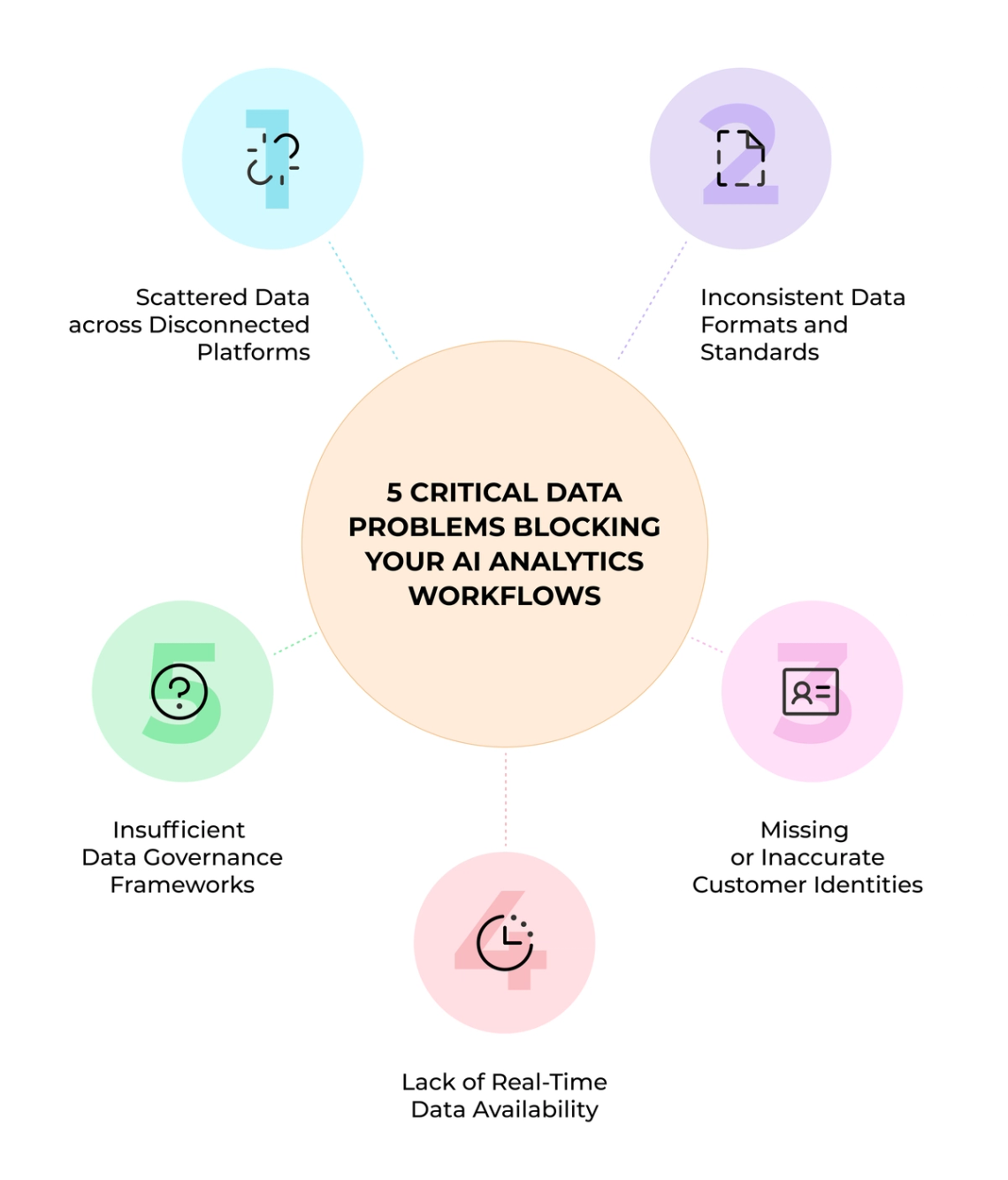
1. Scattered Data across Disconnected Platforms
Attribution breaks first when data is siloed. Your paid search data sits in Google Ads, lead data in HubSpot, revenue data in Salesforce. None of them agree on which campaign closed the deal. Research shows 46% of businesses cite data silos as their biggest analytical challenge. The average enterprise runs dozens of disconnected marketing tools, each generating its own version of performance.
An AI agent deployed on top of siloed data inherits every blind spot. It routes leads based on incomplete engagement history. It optimizes campaigns using partial conversion data. It generates reports that contradict the CRM. A single source of truth is the prerequisite. Without one, attribution numbers split across systems and no single report reflects the full picture. 28% of workers cannot access data from other internal teams and 34% face difficulty sharing data across teams.
2. Inconsistent Data Formats and Standards
Attribution reporting fails silently when naming conventions drift. One team tags campaigns as "Q1_webinar," another uses "q1-webinar-2026," a third enters it manually as "Webinar Jan." GA4 creates three separate campaign buckets. Your attribution model splits credit three ways. The AI agent optimizing budget allocation acts on all three as separate signals.
The same problem appears in CRM field formats: dates as MM/DD vs DD/MM, states as "CA" vs "California," lead sources with 14 spelling variants. Data standardization requires enforcement at the point of entry, not cleanup after the fact. Without it, Connections between systems break and every downstream report inherits the inconsistency.
"Data is the lifeblood of all AI. Without secure, compliant, and reliable data, enterprise AI initiatives will fail before they get off the ground." Lior Solomon, VP of Data, Drata
3. Missing or Inaccurate Customer Identities
Lead routing and attribution both depend on knowing who a person is across touchpoints. Without identity resolution, the same buyer appears as three separate contacts: one from a webinar form, one from a paid ad click, one from a demo request. Each gets scored and routed independently. The AI agent prioritizes the wrong record, assigns credit to the wrong campaign, and misses the full journey.
The average B2B CRM carries a duplicate rate between 10 and 30%. That is an attribution accuracy problem. Every duplicate inflates pipeline numbers, distorts lead scoring, and sends automated workflows in the wrong direction.
4. Lack of Real-Time Data Availability
Reporting breaks when data arrives too late to act on. Most business intelligence solutions rely on daily batch updates. Marketing analytics tools like Google Analytics have up to a 24-hour delay between site visits and available data. For campaign operations, that lag means an AI agent optimizing bids or shifting budget is working on yesterday's signal. A campaign that burned through budget overnight gets flagged the next morning.
Real-time data matters most in the moments that compound: when a campaign starts underperforming, when a lead goes cold, when a high-intent signal needs immediate follow-up. Clarity in reporting requires accurate data and timely data. Stale inputs produce confident but wrong recommendations.
5. Insufficient Data Governance Frameworks
An estimated 41% of analysts and 30% of marketers do not trust their data. That distrust has a direct operational cost: teams override AI recommendations, manually verify reports before sharing them, and spend cycles reconciling dashboards with no time left to act on insights.
Without governance, UTM parameters drift, campaign naming breaks, and conversion tracking misconfigures. 47% of large enterprises cannot rely on their CRM data as a single source of truth. When the foundation is ungoverned, Momentum (the ability to act confidently on data) never builds. AI agents operating without governance rules do not surface problems. They automate past them.
Building AI-Ready Marketing Data Infrastructure
Fixing data readiness for AI starts with four foundational steps. Each addresses specific failure points that prevent agents from delivering accurate results.
Centralize Data from All Marketing Channels
A data foundation built on cloud data warehouses (Snowflake, BigQuery, Databricks, Redshift) serves as the operational center. Centralized architecture lets teams build audience segments directly from the warehouse. All departments contribute to and pull from the same source of customer truth.
This consolidation eliminates inefficiencies from scattered information. Security becomes simpler with one asset to monitor. Storage costs drop when multiple vendors are not paid for historical data retention.
Implement Data Quality Standards
Data quality standards establish guidelines for accuracy, consistency, and reliability throughout the organization. Companies draw from an average of 400 different sources. Standardized validation protocols become necessary from the point of entry.
Six dimensions apply: accuracy ensures data reflects real conditions; completeness provides integrated views for analysis; consistency allows reliable comparison between systems; timeliness means operating on current information; uniqueness prevents duplicate entries; relevance aligns data collection with strategic goals.
Establish Identity Resolution Processes
Deterministic matching uses exact, verified identifiers like email addresses. Probabilistic methods complement this to build fuller pictures of online identity. Together, they create unified profiles that update as new information arrives, eliminating the scenario where mobile browsing, desktop research, and in-store conversion create three separate records. Data governance rules determine which identifiers are authoritative and how conflicts are resolved.
Enable Cross-Platform Data Interoperability
Semantic interoperability preserves meaning between systems using common vocabularies and data models, maintaining context across the full data path. Industry-standard formats, open APIs, and metadata management prevent vendor lock-in and enable continuous sharing between tools. This is what makes workflow automation reliable: agents pull from connected systems that speak the same language.
Step-by-Step Process to Fix Your Marketing Data
Data cleanup determines whether AI agents thrive or produce unreliable outputs. Here is how to fix what is broken in a systematic way.
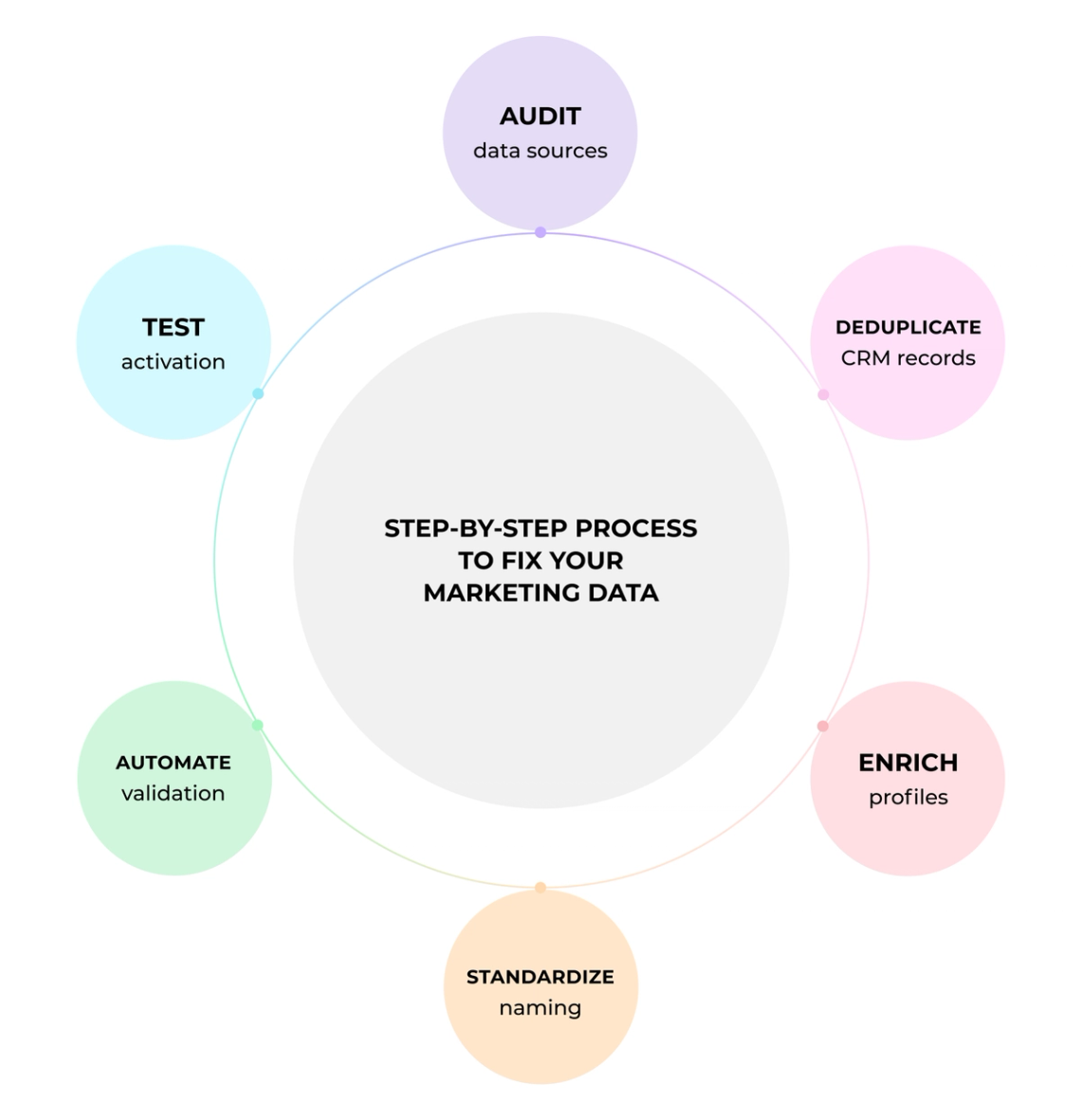
1. Conduct a Complete Data Audit
Map every system that feeds data into your operations: website forms, landing pages, email platforms, sales tools, event systems, paid ad integrations, manual uploads. AI deployment starts here. List what each source sends and note inconsistencies in naming conventions or conflicting lifecycle values.
Check records for completeness. How many contacts lack mandatory fields (email, company, lead source)? Review accuracy by examining date fields and timestamps. Break down anomalies that deviate from expected patterns. This assessment establishes the baseline before cleanup begins.
2. Clean and Deduplicate Existing Records
Duplicate data plagues most databases. Research shows 40% of leads contain errors. Fuzzy matching algorithms identify duplicates even when names, emails, or company fields differ. Advanced matching cuts duplicate records by 40%.
Merge matching records into single profiles. Preserve activity history and ownership data. Apply rules for both exact matches on email addresses and probabilistic matches combining multiple fields.
3. Enrich Profiles with Additional Attributes
Add depth through behavioral signals, purchase history, and demographic information. Klaviyo generates insights including channel affinity, predictive lifetime value, and churn risk as customers interact. External data sources append firmographic details for B2B accounts or interest affinities based on demographic segments.
4. Standardize Naming Conventions
Without naming conventions, duplicate events track the same action differently and inconsistent casing creates parallel datasets. Establish frameworks with consistent delimiters (preferably underscores) that describe what files contain. Apply the same logic to campaign names, field formats, GA4 conversion actions, and UTM parameters across all platforms.
5. Set Up Automated Data Validation
Live validation checks data as it enters systems and prevents bad records from corrupting the database. Scripts create repeatable checks that flag missing values, incorrect formats, and duplicates. This is a prerequisite for AI readiness: catching errors at entry, before they reach the database.
6. Test Data Activation Workflows
Create dummy identities and test data in sandbox environments before deploying to production. Verify that enriched profiles sync to downstream tools where teams execute campaigns. Test attribution logic end-to-end. Confirm that conversions are credited correctly before agents start optimizing on those signals.
Evaluating Your AI Data Readiness before Automation
Quantifiable proof that data can handle the load is required before deploying agents into production workflows.
Data Quality Assessment Criteria
The AI data readiness checklist starts with six dimensions that translate directly into agent performance:
- Completeness. Required fields exist. Target 95% overall, 98% for critical fields like email and industry.
- Accuracy. Values match reality. Target 97% on sampled audits.
- Validity. Formats follow rules. Target 99% or higher.
- Consistency. The same entity has similar values across systems. Target mismatches under 1%.
- Uniqueness. Duplicate rates stay below 2%.
- Freshness. Time since last update: under 90 days for most records, 60 days for high-value segments.
Testing AI Agent Accuracy with Current Data
Run offline evaluations with curated golden datasets before any production deployment. Score for accuracy and policy violations. Check for hallucinations. Test with past campaign outputs, edge cases, and compliance scenarios that have labeled outcomes. Batch testing with specific metrics manages non-deterministic behavior.
Identifying Gaps in Data Coverage
Map which target accounts have owners, activity, and pipeline versus those that sit untouched. Missing data prevents decisions based on reliable metrics. If data exists but is not accessible to all teams, agents inherit those same blind spots.
Measuring Data Freshness and Accuracy
Data freshness describes how recently information was collected and processed. Processing can take 24-48 hours, and reports may change during that window. Track median days since last update per critical field. Stale data produces inaccurate insights and missed opportunities.
How Darwin Fixes Marketing Data Foundations before AI Deployment
Marketing and RevOps teams that attempt AI automation without addressing data quality end up scaling the same errors they started with. Broken attribution does not improve when automated. It runs faster and touches more systems. The same applies to inconsistent GA4 event taxonomy, unresolved customer identities, and stale CRM records.
Darwin works as a technical partner at the data layer. The engagement starts with a structured audit: CRM data quality, GA4 event taxonomy, UTM governance, consent signal configuration, and pipeline architecture. From there, remediation is hands-on: deduplication, field standardization, BigQuery export setup, semantic layer configuration, and role-based permissions.
Darwin saw the same principle in its Kitchen and Interior Design work. The AI qualification system improved lead conversion by 30%, but the result depended on more than automation alone. The system needed reliable lead inputs, clear qualification criteria, and structured routing logic before AI could make useful decisions.
Services relevant to marketing data readiness:
- Data & Analytics: audit, pipeline architecture, BigQuery export, semantic layer setup
- AI Readiness & Enablement: AI data readiness assessment, agent deployment preparation
- Security & Compliance: consent signal configuration, data permissions, audit logging
Teams that fix the data layer before deployment avoid the cycle of debugging AI outputs and rebuilding trust in dashboards after the fact.
FAQs
Q1. Can AI agents work on existing marketing data without a full infrastructure rebuild?
They can start without a rebuild, but output quality depends on what the data foundation supports. Attribution agents trained on inconsistently tagged campaigns produce inconsistent attribution. A targeted audit of which layers are governed comes before connecting any agent to production workflows.
Q2. Which marketing workflows break first when data is ungoverned?
Attribution breaks first. Inconsistent UTM parameters and GA4 event naming prevent any attribution model from producing reliable output. Lead routing breaks next, when agents score and route leads based on CRM records with duplicates or missing fields.
Q3. How does Darwin Flux relate to AI data readiness?
Darwin Flux defines four layers agents depend on in sequence: Surface (event capture, UTM, forms), Connections (data flow between GA4, CRM, ad platforms), Clarity (shared metric definitions, attribution windows), and Momentum (bidding, routing, automation). Agents only produce reliable output when the layers beneath them are in place.
Q4. What should a marketing team fix before deploying an AI agent?
Start with GA4 event taxonomy and UTM governance. Then check CRM data quality: duplicate rate, field completeness, lead source consistency. Define shared metric definitions before connecting any agent to reporting. Agents deployed before these are in place produce output that looks plausible but cannot be trusted.
Q5. How do you know when marketing data is ready for AI automation?
Six dimensions determine readiness: completeness (95% of required fields), accuracy (97% on sampled audits), validity (99% format compliance), consistency (under 1% cross-system mismatches), uniqueness (below 2% duplicate rate), and freshness (under 90 days since last update). Run offline evaluations on historical datasets before connecting any agent to live workflows.