Quick Answer
A tech stack is the set of frontend and backend technologies that run an application together. The best stack for 2026 depends on the project: MERN and MEAN suit interactive web apps, LAMP and WordPress fit content sites, Django and Ruby on Rails serve fast-moving startups, and .NET or Spring anchor enterprise systems. Match the stack to scale, budget, security and team expertise, not to popularity.
TL;DR
- A tech stack combines frontend, backend, an operating system and development tooling into one working system.
- The choice sets development speed, scalability, responsiveness, cost, maintenance and scope.
- Twelve proven stacks cover most 2026 builds, spanning JavaScript-only fullstack, serverless, AI and blockchain.
- Composable, modular stacks are the direction of travel: Gartner projects 70% of organizations mandated toward composable DXP technology by 2026.
- Connections decide a stack's real value: com
Choosing a tech stack sets the ceiling for how fast a product ships, how far it scales, and what it costs to maintain. This guide explains what a tech stack is, how the choice shapes development, the components every stack shares, and twelve proven stacks for 2026 with real-world examples, so the right combination becomes a decision made on evidence.
Where a Connected Stack Pays Off
A stack delivers most when its tools share data and stay observable in one place. That is the practical case for a connected layer such as Darwin Flux. It brings every source into one Surface, keeps the Connections between systems intact, gives teams the Clarity to see what each component is doing, and preserves the Momentum to ship changes without re-plumbing the product each time. Those four ideas map onto stack decisions directly: pick components that expose their data, integrate cleanly, stay legible, and let a team move fast as requirements shift.
What is a Tech Stack?
A tech stack is the combination of technologies that together power a software application, spanning the frontend that users see and the backend that runs the logic behind it. The stack defines how a product performs its function, and each layer carries a distinct job.
Composable architecture is gaining ground in digital experience platforms. In its 2025 Magic Quadrant for Digital Experience Platforms (Gartner, 28 January 2025), Gartner states that by 2026 at least 70% of organizations will be mandated to acquire composable DXP technology in place of monolithic suites, up from 50% in 2023, as reported by the MACH Alliance.
A simple e-commerce site shows the split in practice. The frontend combines HTML for structure, CSS for design and JavaScript for interactivity. The backend runs Python for logic, Django as the web framework and PostgreSQL for data storage.
How Can a Software Stack Impact Your Product Development?
The stack you select influences every stage of development, from planning and setup through deployment and maintenance. Six effects matter most:
- Development speed. Frameworks such as React or Vue streamline the frontend, and runtimes such as Node.js simplify backend work, so the tooling sets the pace at which developers build.
- Scalability. Serving millions of users depends on scalable frameworks and cloud services that let the product grow with demand.
- Speed. An optimized stack keeps responses fast and lags minimal, which users treat as a baseline expectation.
- Cost efficiency. Expenses track available developer expertise and licensing. Open-source tools lower cost and ask for more customization in return.
- Maintenance and updates. A stack with a large community stays compatible with new technologies and is easier to update over its life.
- Project scope. A clearly defined scope guides technology choices and resource allocation, and keeps development aligned with the goal.
Integrating these choices well is what delivers a working product that meets the business goal.
Companies with a well-optimized software stack see a 200% boost in conversion rates, and 87% of users are less likely to churn after a seamless interaction.
Let’s build smarter!
Tech Stack Components Explained
Every stack divides into a frontend layer, a backend layer and a supporting development layer, with the operating system underneath them all. Each part has a defined role.
Frontend Stack (What Users See)
The frontend covers everything a user touches in the browser and shapes the user experience. Common pieces:
- HTML and CSS. The building blocks of web structure and style.
- JavaScript. Makes pages interactive and dynamic.
- React or Angular. Frameworks for building highly interactive interfaces.
- TypeScript. Adds type safety and readability to JavaScript-heavy applications.
Backend Stack (Where the Logic Runs)
The backend drives functionality through server-side languages, frameworks, databases and infrastructure, handling business logic, authentication and data. Typical components:
- Languages. Python, Java, Ruby or PHP.
- Frameworks. Django, Flask, Express.js or Spring.
- Databases. MongoDB, MySQL or PostgreSQL.
- Servers. Cloud services such as AWS, Azure or Google Cloud, which handle scaling and maintenance automatically.
Operating System (The Foundation)
The operating system is the base every other component runs on, and the three common choices each suit different work. Linux offers open-source flexibility and strong community support, which fits web servers and cloud infrastructure where cost and security lead. Windows suits projects tied to the .NET ecosystem and Microsoft tooling. macOS pairs a refined interface with tight integration for cross-platform and mobile work.
Development Tooling
This layer holds the tooling that supports the build itself, set up before development starts. Key pieces:
- Version control. Git and GitHub for tracking and managing code changes.
- Testing tools. Selenium, Jest, Mocha.
- DevOps platforms. Jenkins, Docker and Kubernetes for automation and deployment.
Best Software Development Stacks (Real-World Examples)
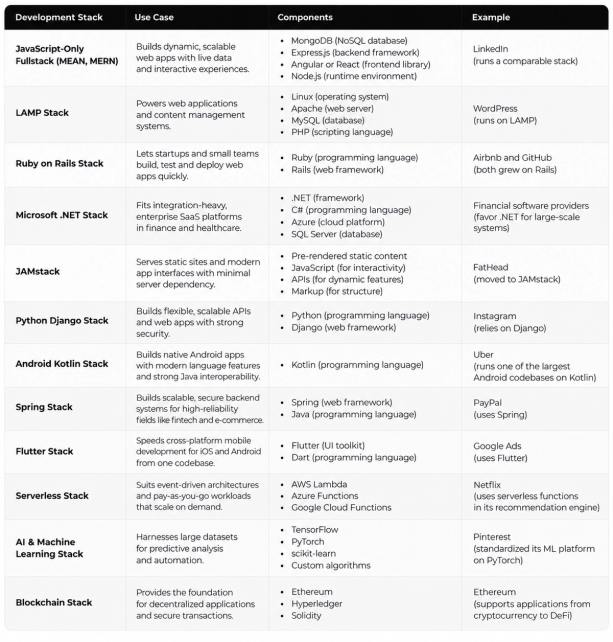
The twelve stacks below cover the range most 2026 projects draw from, each with the use case, its components and a company that runs it in production.
1. JavaScript-Only Fullstack (MEAN, MERN)
Use case. Builds dynamic, scalable web apps that handle live data and interactive experiences.
Components. MongoDB for NoSQL data, Express.js for backend logic, Angular or React for the interface, and Node.js as the runtime.
Example. LinkedIn runs a comparable stack for its modular structure and fast feature deployment.
2. LAMP (Linux, Apache, MySQL, PHP)
Use case. Powers web applications and content management systems on a proven, cost-effective foundation.
Components. Linux as the OS, Apache as the web server, MySQL for relational data and PHP for server-side scripting.
Example. WordPress sites rely on LAMP, which underpins millions of blogs and business sites.
3. Ruby on Rails Stack
Use case. Lets startups and small teams build, test and deploy web apps quickly.
Components. The Ruby language with the Rails framework, supporting clean code and rapid development cycles.
Example. Airbnb and GitHub both grew on Rails in their early stages.
4. Microsoft .NET Stack
Use case. Fits integration-heavy, enterprise SaaS platforms in fields such as finance and healthcare.
Components. The .NET framework with languages such as C#, integrating with Azure and SQL Server.
Example. Financial software providers favor .NET for large-scale systems.
5. JAMstack (JavaScript, APIs, Markup)
Use case. Serves static sites and modern app interfaces with minimal server dependency.
Components. Pre-rendered static content, JavaScript for interactivity, APIs for dynamic features and Markup for structure.
Example. FatHead moved to JAMstack for faster page loads and better retention.
6. Python Django Stack
Use case. Builds flexible, scalable APIs and web apps that need rapid development and strong security.
Components. Python as the main language with Django as the high-level framework.
Example. Instagram relies on Django to manage large-scale operations reliably.
7. Android Kotlin Stack
Use case. Builds native Android apps with modern language features and strong Java interoperability.
Components. Kotlin, a concise and expressive language that raises developer productivity.
Example. Uber runs one of the largest Android codebases on Kotlin, a migration its engineering team has documented publicly.
8. Spring Stack (Java)
Use case. Builds scalable, secure backend systems for high-reliability fields such as fintech and e-commerce.
Components. The Spring Framework on Java, with tooling for enterprise microservices.
Example. PayPal uses Spring to run demanding, secure backend processes.
9. Flutter Stack
Use case. Speeds cross-platform mobile development for iOS and Android from one codebase.
Components. Flutter, backed by Google, using the Dart language and customizable widgets.
Example. The Google Ads mobile app uses Flutter for a consistent cross-platform experience.
10. Serverless Stacks
Use case. Suits event-driven architectures and pay-as-you-go workloads that scale on demand.
Components. Cloud functions such as AWS Lambda, Azure Functions or Google Cloud Functions, scaled automatically by the provider.
Example. Netflix uses serverless functions in parts of its recommendation engine to absorb peak load.
11. AI and Machine Learning Stack
Use case. Harnesses large datasets for predictive analysis and cognitive automation.
Components. TensorFlow, PyTorch or scikit-learn combined with custom algorithms.
Example. Pinterest standardized its machine-learning platform on PyTorch, documenting the shift in its engineering blog.
12. Blockchain Development Stack
Use case. Provides the foundation for decentralized applications and secure digital transactions.
Components. Platforms such as Ethereum and Hyperledger with Solidity for smart contracts.
Example. Ethereum supports applications from cryptocurrency to decentralized finance.
A modern stack ranges from a simple framework to an advanced, multi-service architecture depending on project size and complexity, and larger builds gain speed and scalability from the advanced end. Matching the stack to project requirements, target platforms, community support and team expertise is what points you to the right one.
Spotlight: Ruby on Rails in 2026
Ruby on Rails stays a leading choice for web development in 2026 because it pairs simplicity with scalability. The stack combines the expressive Ruby language, the Rails framework and a database such as MySQL or PostgreSQL, which lets developers build quality applications quickly.
Its convention-over-configuration approach cuts setup time and moves effort toward features, with built-in routing, templating and internationalization for rich interfaces. The community keeps the ecosystem current through a deep library of gems, frequent security updates and shared best practice, which makes Rails a durable pick for startups and established companies launching web apps at speed.
Tips for Choosing Your Ideal Tech Stack
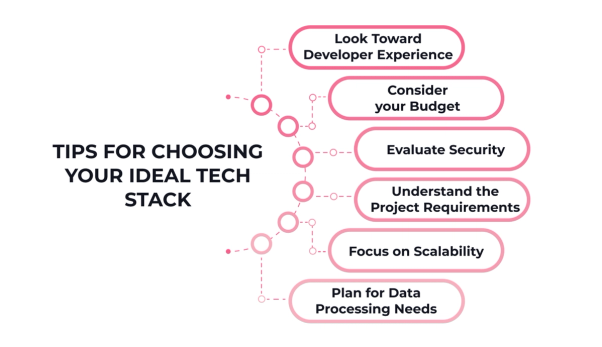
The right stack follows from matching a handful of practical factors to your project. Weigh these six:
- Developer experience. Choose technologies with an active community, forums and thorough documentation, which speed development and resolve issues faster.
- Budget. Open-source tools cut cost with lighter support, and proprietary tools add licensing alongside dedicated support and advanced features. Weigh the trade-off against your plan.
- Security. Favor a stack with strong encryption, frequent updates and active patching, which matters most for sensitive user data or payments.
- Project requirements. Assess the type, size and scope of the build and its speed needs, since a small app and a large platform point to different stacks.
- Scalability. Check that the stack will handle growth in traffic, data and functionality as the product expands.
- Data processing. For high data volumes, treat processing capability as a first-class factor, since it supports analytics and future scale.
Turning Stack Choices Into Working Infrastructure
A well-chosen stack is only half the work. The harder problem is the one most teams hit later: the tools are picked, but the data between them is inconsistent, ownership is unclear, and no one trusts the numbers a dashboard reports. A stack that cannot be measured cannot be improved.
Cleo faced exactly that. Their reporting spanned GA4, Salesforce, BigQuery and Looker Studio, and the figures did not line up. Darwin rebuilt the connections between those systems and lifted data accuracy from 70% to 90%, recovered roughly two working days each month that had gone to manual reconciliation, and saved close to $50,000 a year in the process.
The lesson carries back to stack selection. Components are worth choosing for how cleanly they connect and how honestly they report, because that is where a stack either compounds in value or quietly costs a team its time.
FAQs
Q1. What is a tech stack in simple terms?
A tech stack is the set of technologies that run an application together, covering the frontend a user sees and the backend that handles logic, data and infrastructure.
Q2. Which tech stack is best for a startup in 2026?
Startups that need to ship quickly favor Ruby on Rails or the Python Django stack, since both support rapid development while staying scalable. The best fit still depends on the team's expertise and the product's requirements.
Q3. What is the difference between frontend and backend stacks?
The frontend stack builds what users interact with in the browser through HTML, CSS and frameworks such as React. The backend stack runs the server-side logic, databases and APIs that power those interactions.
Q4. How do I choose the right tech stack?
Match the stack to project scope, budget, security needs, scalability and the depth of community support, and weigh the strengths of each option against how the product is expected to grow.