
Quick Answer:
B2B teams enable a buying group by finding the unresolved question that keeps its members from agreeing, giving the role that owns that question evidence it can check and forward on its own, and tracking whether the opportunity then moves to its next stage. Progress shows up in roles engaged per account, open questions closed and time in stage, so content views stay a secondary signal.
TL;DR
- Stalls start inside the group. Gartner found that 74% of B2B buyer teams show unhealthy conflict during the buying decision process, and groups that reach consensus are 2.5 times more likely to report a high-quality deal.
- Name the blocking question. Log every open objection as a pending decision with its owner, the evidence that closes it and a review date.
- Match evidence to the role. Finance, IT and security, users, executives and the champion each check a different kind of proof.
- Make answers self-serve. Buyers rank vendors before first contact, so pricing structure, security facts and implementation details belong on public pages and in forwardable briefs.
- Measure movement by stage. Track roles engaged, questions resolved, time in stage and no-decision outcomes as a category of their own.
A buying group can like your product and still fail to buy it. Forrester's State of Business Buying 2026 counts 13 internal stakeholders and nine external influencers in a typical purchase decision, and any one of them can reopen a question the rest of the group thought was settled. Buyer enablement is the work of helping that group reach a decision it can defend to its own leadership.
For marketing, RevOps and sales leaders the job has three parts: find the question that stops the group, supply evidence the right role can verify with no sales call needed, and measure whether the account moves through the buying process. This article covers each part and closes with a measurement model that ties stakeholder engagement to opportunity stages.
Where Buyer Progress Breaks Between the Website and the CRM
Buyer progress breaks in four places, and the four pillars of Darwin Flux give each place a name. On the Surface, the signals a buying group leaves on your site, such as a pricing page visit, a security document request or a demo form, have to fire and carry consent correctly. Connections decide whether those signals reach the CRM attached to the right account and opportunity, so a finance leader's visit counts toward the deal it belongs to. Clarity means sales, marketing and RevOps read the same definitions for a stalled deal, an engaged role and a resolved question. Momentum is the weekly routine that turns those readings into next steps, so a missing security answer reaches the person who can supply it while the deal is still active.
Why Do B2B Buying Groups Stall?
Buying groups stall when members disagree on the problem, the decision criteria or the risk, and nobody owns the question that would settle it. Gartner's survey of 632 B2B buyers found that 74% of B2B buyer teams show unhealthy conflict during the buying decision process, which Gartner defines as conflicting objectives, disagreement on the best course of action or being overruled by outside decision-makers. Groups that do reach consensus are 2.5 times more likely to report a high-quality deal.
Group size adds to the risk. Challenger's buyer research tracked the average group growing from 5.4 to 6.8 to 10.2 people, and in its 2019 survey of 667 B2B buyers, 38% of purchases ended with no deal. Forrester reported in its 2024 buying study that 86% of B2B purchases stall during the buying process.
“B2B buyers are under immense pressure to justify investments and minimize risk.” – Barbara Winters, VP, Principal Analyst, Forrester
Missing Information or Internal Disagreement
A stall caused by missing information and a stall caused by disagreement look alike from the seller's side, and they need different fixes. When the main contact keeps asking for more case studies and more technical detail, they may lack an answer, or they may be collecting support for an internal argument they have not won yet. Ask the contact directly which one it is and who else holds an open view on the purchase. Missing information calls for evidence, and disagreement calls for shared decision criteria the whole group signs off on.
Agreement That Change Is Needed
Check early whether every member agrees the current approach is broken. A group that has not agreed on the problem cannot agree on a vendor, and that gap can explain a long silence after a strong demo. Questions about implementation timing and requests to bring more colleagues into the evaluation suggest the group accepts the need for change. Buying signals from your own site, such as repeat visits to pricing and integration pages from the same account, add a second view, and our guide on when intent data should change sales priorities explains how to weigh them.
How Do You Identify the Question Stalling a Buying Group?
Identify the stalling question by mapping each role to its open concern, logging every objection as a pending decision with an owner and checking which concern blocks the next stage. The three steps below turn a vague stall into a named question with a named owner.
Map Who Recommends, Approves and Can Block the Purchase
Start with the people who can approve the deal and the people who can stop it. The economic buyer controls the budget, a technical evaluator can halt the purchase on security or integration grounds, and procurement and legal sign off on terms separately from the spending decision. Forrester reports that procurement professionals are decision-makers in 53% of business buying cycles. Four questions to the champion surface this map quickly:
- Who approves the budget, and who approves a change to it later?
- Who signs the contract or formally confirms the purchase?
- Who validates security, data handling and integration fit?
- Which outside advisor, such as a consultant or analyst, shapes the group's view?
Log Every Objection as a Pending Decision
The recommended operating model in this article starts with a pending-decision log. Record each open objection in the CRM as a pending decision with four fields: the question, the role that owns it, the evidence that would close it and a review date. The log separates a missing-information problem from a disagreement problem, since disagreement shows up as two roles holding opposite positions on the same question. It also lists the evidence the team still needs to produce, which gives sales and marketing one shared backlog for buyer enablement.
Watch for Reset Triggers
Some events reopen decisions the group considered closed, and the same operating model treats them as new entries in the log. A security review that surfaces new requirements, a price approval that moves above the champion's authority or legal redlines on terms everyone accepted can each send the deal back a stage. Give each trigger an owner and a review date, so the stall appears in the pipeline on the day it starts.
What Proof Does Each Buying-Group Role Need?
Each role needs evidence it can verify on its own terms: finance checks cost and payback, IT and security check controls and integration, users check the daily workflow and executives check outcomes against their goals. Gartner's research adds a rule for framing that evidence. Content tailored to the buying group improved consensus by 20%, and content with only individual-level relevance reduced consensus by 59%, so every role-specific asset should tie back to the goal the whole group shares.
Role-specific evidence must support one shared decision and one set of shared criteria, so it helps the group reach consensus and keeps separate narratives from forming. The matrix below pairs each role with the question that tends to stall it, the evidence that closes the question and the signal that shows the role has moved.
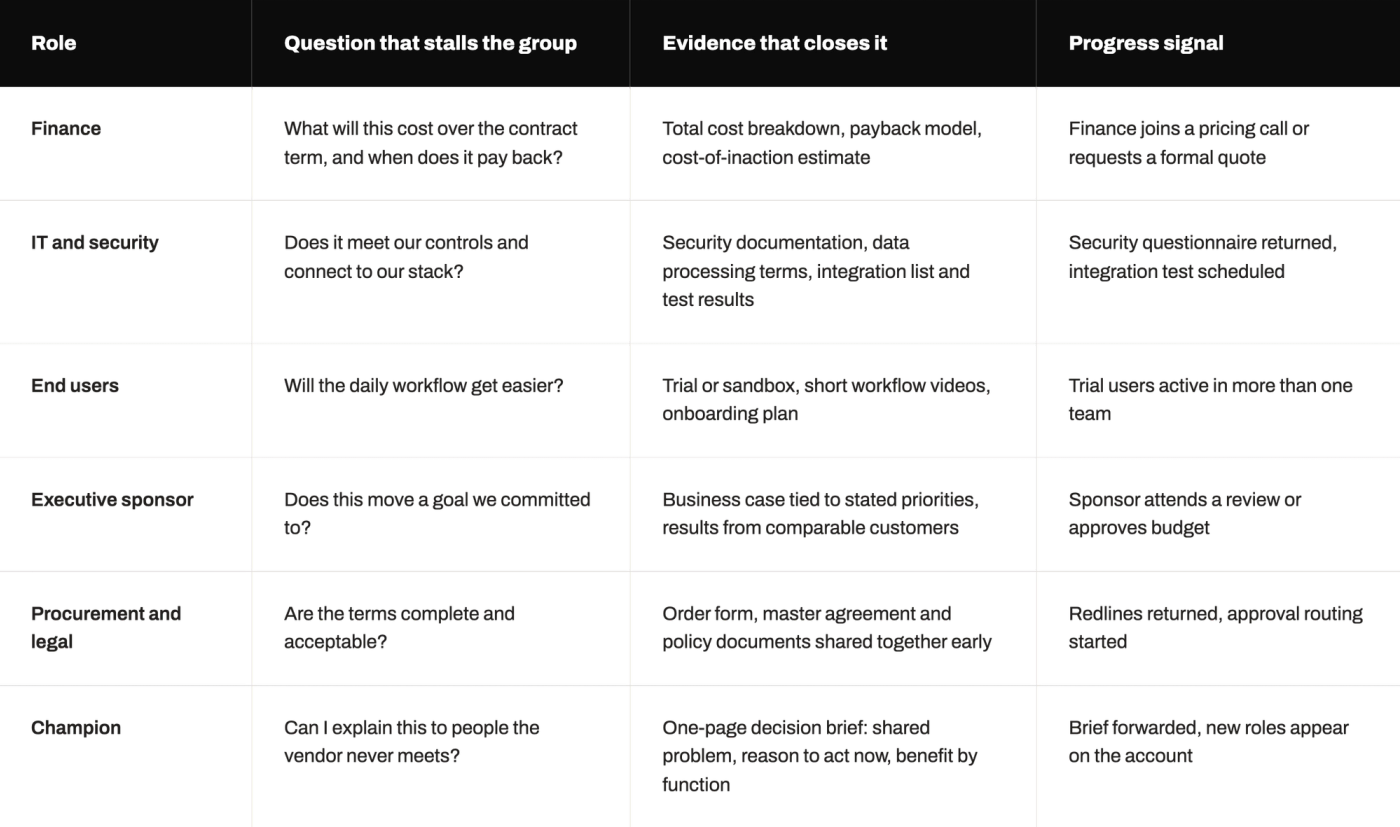
The champion brief deserves the most care, because it travels into meetings the vendor never attends. Keep it to one page, write it in the buyer's terms and link each claim to the role-level evidence behind it, so a finance or security reviewer can check the detail on their own.
How Do You Make Decision Support Self-Serve and Shareable?
Make decision support self-serve by publishing the answers each role checks on crawlable pages and packaging them so a champion can forward them with no edits. Buyers do much of this work alone. The 6sense 2025 Buyer Experience Report found that the balance between independent research and seller engagement has shifted to 60/40, down from 70/30. In the same study, 94% of buying groups ranked their preferred vendors before first contact, and they purchased from that preliminary favorite 77% of the time.
Put pricing structure, security facts, the integration list and a typical implementation timeline in page text, and keep each asset focused on one question. Give every shared document a stable URL, so the whole group reads the current version. The same pages serve AI agents that research vendors on a buyer's behalf, a shift covered in our guide to agentic browser optimization.
“Buyers are moving faster but not taking more risks. In uncertain times, trust and clarity win.” – Kerry Cunningham, Head of Research & Thought Leadership, 6sense
Trials count as decision support too. More than 60% of business buyers now use a trial, according to Forrester, so a trial with a written success checklist answers the end user and the IT reviewer at once. In the late stages, a shared decision plan that lists milestones, owners and dates in one place keeps legal, procurement and security tasks in front of both sides.
What Should a Team Measure in Buyer Enablement Besides Content Views?
Measure buyer enablement at the account level: how many required roles you reached, which open questions closed and whether the opportunity moved to its next stage on time. Asset views can show interest from one person, while these three measures show whether the group is moving toward a decision.
Stakeholder Reach
Count the roles engaged per open opportunity against the roles the deal needs. An account with five engaged contacts from one department has less coverage than an account with three contacts from finance, IT and the business unit. Engagement here means a tracked action tied to a known contact and account, such as a form, a meeting, a trial login or a repeat visit to a pricing or security page that the CRM can match to the account.
Questions Resolved
Report the pending-decision log as a metric: open questions per opportunity, the share closed by their review date and the roles that own the oldest items. A deal with one security question two weeks past due tells a sales leader more than a rising count of downloads.
Stage Progression and Time in Stage
Tie each resolved question to the opportunity stage that followed it. Track time in stage, slipped close dates with a recorded reason and the no-decision rate as its own category, separate from losses to a competitor. When a stage moves soon after a role receives its evidence, that evidence belongs in the standard playbook. These account-level measures sit alongside channel models, which our comparison of MMM, multi-touch attribution and incrementality testing explains.
Data Requirements Behind the Metrics
These metrics hold only when website signals reach the CRM intact. Contacts need to match to accounts, form and trial events need to carry their source, and consent choices need to be respected with the record kept. Teams whose GA4 and CRM disagree can start with our comparison of GA4 and CRM attribution, the marketing analytics governance checklist and the month-end reconciliation playbook.
Where Should a B2B Team Start With Buyer Enablement?
As a first step in this recommended model, start with the five opportunities that have sat in the same stage the longest. For each one, name the roles involved, log the open questions and mark the question that blocks the next stage. Build or fix the evidence for that question, publish it where the role can find it and check two weeks later whether the stage moved. Give one person in marketing or RevOps ownership of the log and the evidence library, and review both with sales in the weekly pipeline meeting.
What Reliable Buyer-Progress Data Looks Like in Practice
Buyer enablement reporting depends on systems that agree with each other. When GA4, the CRM and the warehouse each hold a different version of the account, nobody can say whether a role engaged or a stage moved because of the evidence it received. The warning signs of untrustworthy marketing data usually appear long before anyone tries to measure a buying group.
Cleo, an integration software company, had key marketing data split between GA4, Salesforce and BigQuery, monthly reporting that took two working days and reporting accuracy of about 70%. Darwin built a custom integration that brought those sources into one reporting view in Looker Studio. Reporting accuracy rose to about 90%, the team recovered two working days of manual reporting each month and Cleo removed $50K a year in third-party attribution spend. The Cleo case study has the full breakdown.
The Cleo case measured reporting accuracy, time and cost, and it did not measure buyer progress. Our inference from it is that the same kind of reporting base is what a team needs before it can tie role-level engagement to stage movement with confidence, and before Digital Multi-Channel Marketing programs aimed at a buying group can be judged by the stages they move.
FAQs
Q1. How can B2B teams help a buying group reach a decision?
Find the unresolved question that blocks the group, give the role that owns it evidence it can verify and forward, then track whether the opportunity moves to its next stage. Shared decision criteria help when members disagree on priorities.
Q2. How can a team identify the question stalling buyer progress?
Log every open objection as a pending decision with the question, the owning role, the evidence needed and a review date. The oldest open item tied to the current stage usually marks the blocking question, and the champion can confirm it.
Q3. What proof does each buying-group role need?
Finance needs total cost and payback, IT and security need control and integration evidence, users need a trial of the real workflow and executives need results tied to their goals. The champion needs a one-page brief that connects it all.
Q4. What should a team measure in buyer enablement besides content views?
Measure roles engaged per opportunity, open questions closed by their review date, time in stage and stage movement after evidence was delivered. Report no-decision outcomes separately from competitive losses, so stalls inside the buying group show up in the pipeline.
Q5. Who should own buyer enablement in a B2B company?
One named owner in marketing or RevOps should keep the pending-decision log and the evidence library current. Sales supplies the open questions from live deals, and the owner reviews progress with sales in the weekly pipeline meeting.