
Quick Answer
CRM, ad platform, and finance revenue numbers differ because each system measures a different event in the revenue lifecycle. Reconciliation does not force every platform to show the same figure. It produces one governed, traceable view where finance stays authoritative for recognized revenue, each other system owns the metric it is built for, and every variance can be explained. The month-end workflow consolidates the sources, aligns shared identifiers, matches CRM bookings to recognized revenue, then investigates and documents each exception with a named owner.
TL;DR
- CRM booked revenue, ad-platform conversions, GA4 sessions, and finance recognized revenue diverge because the systems measure different events and periods, so the differences can be legitimate.
- Reconciliation and revenue recognition are separate jobs: recognition sets when revenue is earned, reconciliation proves each number is documented against a source and every variance is explained.
- Decide the source of truth per metric up front: finance owns recognized revenue, CRM owns bookings and lifecycle, ad platforms own spend and platform-attributed conversions, the warehouse or BI layer owns the reported view.
- Establish shared identifiers, set tolerance thresholds once, route exceptions by type to named owners in Marketing Ops, RevOps, Finance, and Data/Analytics.
- Most unexplained variance starts upstream in CRM field mapping, tracking, or definitions. Documented definitions and shared identifiers reduce manual investigation cycle after cycle.
Your accounting system says revenue for the month is $840,000. Your sales tracker reports $910,000. Both teams insist they are right, and both are probably correct. That is the reality of revenue reconciliation when it runs across disconnected systems.
The gap goes past tracking down discrepancies. When revenue reconciliation breaks down, every decision built on that number inherits the error, and that includes board conversations, headcount planning, and even your valuation.
This guide walks you through how to reconcile revenue across your CRM, ad platforms, and finance systems. The goal is not to force every platform to report an identical figure. It is to explain and govern the differences, so leadership can trace each number to its source. You will get a month-end process that holds up under timing gaps, attribution overlap, and the field-definition differences that come with connected reporting.
Reconciliation Runs on Connections and Clarity
Two conditions make a reconciled view trustworthy. Connections link the records that would otherwise stay isolated, so a campaign, a CRM opportunity, and a recognized-revenue entry describe one deal, not three unrelated ones. Clarity defines which metric each system owns and which number leadership should trust. Surface work brings the sources into one place, and Momentum keeps the process running the same way each close. These four pillars sit at the center of the Darwin Flux methodology. Reconciliation improves when Connections and Clarity are treated as design choices, not month-end cleanup.
Why CRM, Ad Platform, and Finance Numbers Don't Match
Three teams run three definitions of revenue at the same time, and each definition is internally correct.
Different Data Capture Points
Marketing, sales, and finance each measure different moments in the revenue lifecycle.
Marketing measures attributed conversions. Your CRM measures opportunities, lifecycle stages, and booked revenue. Finance measures recognized revenue for the period. CRM booked revenue answers what sales closed. Finance recognized revenue answers what the business earned under its accounting policy. Those are different questions, and the numbers answer them correctly even when they do not match.
Consider a B2B SaaS journey. Google Ads reports ten platform conversions on a campaign. Salesforce later shows eight qualified leads, six opportunities, and four closed-won deals. Finance recognizes revenue on three of them this period, because the fourth contract starts next month. Every number is legitimate. Each one describes a different stage of the same funnel.
CRM platforms focus on relationships, opportunities, and pipeline. Finance systems focus on recognized revenue and period close. Salesforce or HubSpot tracks a customer through opportunities and lifecycle stages, and finance recognizes that same customer through its revenue schedule. When a deal moves from sales to finance, small differences in customer names, products, or contract terms create the first reconciliation gap.
For lead-generation businesses, each lifecycle event should be tracked on its own: lead_created, lead_qualified, sales_accepted, opportunity_created, opportunity_won, invoice_paid, revenue_recognized. Only the right downstream outcome should feed your main bidding conversion.
Timing and Period Differences
A single deal can legitimately land in different periods across systems. Marketing may report a conversion in the ad-account time zone. GA4 may use the property time zone. The CRM may run on UTC. Finance recognizes revenue based on its accounting policy and the obligations set in the contract, which may fall in a later period entirely.
For many B2B, SaaS, healthcare, education, and professional-service businesses, the closed deal happens days or weeks after the original form submission. The browser tracks the lead. The CRM tracks the opportunity. Finance recognizes revenue once the contract obligation is met. Google Ads sees only the first form submission.
Sales counts the deal as closed-won. Finance recognizes revenue when its policy and the contract say the obligation is satisfied and earned. That gap between the two events is where reconciliation starts to strain.
Attribution Model Differences
Ad platforms count conversions that follow an ad view even when no click occurred. With view-through attribution enabled, a user who saw an ad and later converted through organic search can be attributed to that campaign. Platform-reported conversions and analytics-tool conversions then disagree, and both are reporting what their own model was built to report.
Privacy laws and consent banners shrink the observed data. Ad platforms lose sight of users who opt out, so Google Ads and similar platforms use modeling to estimate conversions for them. Your CRM or analytics tool captures observed, deterministic conversions. LinkedIn Ads, Google Ads, and Meta each apply their own windows and modeling rules, so their totals will not reconcile to one another by design.
Then there is the overlap problem. A prospect who sees a LinkedIn ad and a Google ad before the moment of conversion can fall inside more than one attribution window. Each platform claims credit for the same deal. Summing platform-attributed revenue produces a total larger than the revenue finance recognized, and that overlap is built into the method.
Currency and Field-Definition Differences
Multi-currency deals add variance that has nothing to do with tracking. When deals originate in local currencies and consolidate to a base currency, a single day's rate difference creates a material gap between what the CRM booked and what finance recognizes at period close. Exchange-rate rules set the rate at the time of sale against the rate at collection, and that difference lands as currency gain or loss. Field definitions add a second layer: two systems can label a field revenue and mean different things, one booked, one recognized. Agreeing those definitions removes more variance than any matching rule.
Decide What Each System Is the Source of Truth For
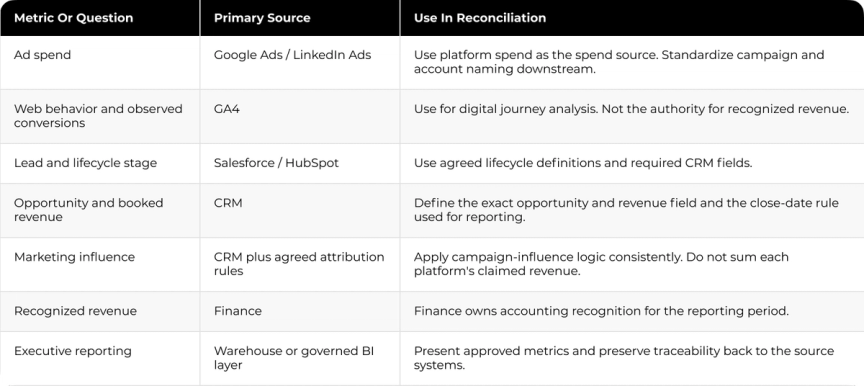
Reconciliation does not mean forcing every platform to show the same number. It means deciding which system owns each business question, then holding every other system accountable to that definition. Each platform answers the question it was built for.
Gartner has made this point directly. “We are not about a single version of the truth. That does not exist in finance.” That is Alex Bant, Chief of Research for CFOs at Gartner. A reconciled view is a governed set of definitions, not one master number every system is forced to display.
Set the reporting contract ahead of any matching run. The table below shows a workable default for a B2B SaaS stack.
Revenue Reconciliation vs. Revenue Recognition
Revenue reconciliation and revenue recognition are easy to confuse, and they solve different problems. One sets when revenue is earned. The other checks that each revenue record is traceable and any differences between systems are explained.
Revenue recognition is about when. It determines when revenue counts as earned under accounting standards like ASC 606. When a customer pays $1,200 upfront for an annual subscription in January, finance recognizes $100 in January, and the remaining $1,100 sits on the balance sheet as deferred revenue, releasing month by month as the service is delivered.
Revenue reconciliation is about whether. It compares revenue records from two or more separate systems to verify each is traceable and every difference is explained. Recognition sets when revenue is earned. Reconciliation confirms each revenue record is traceable and any differences between systems are explained.
The practical split is clean. Revenue is recognized as the relevant performance obligation is satisfied under the company’s accounting policy. Reconciliation happens after the fact, usually at month-end close. Recognition answers to ASC 606 and your accounting policy. Reconciliation answers to your internal controls and your close process.
Recognition fails when the policy is wrong or misapplied. Reconciliation fails when systems disagree and nobody resolves it.
What You're Comparing Across Systems
Reconciliation follows the deal through the systems that record it: CRM opportunity and booked revenue, then the marketing source and touchpoints attached to that opportunity, then the recognized revenue finance reports, then the governed BI view leadership reads. Each handoff is a point where records can drift apart.
Start with the CRM record. Confirm the opportunity, the booked amount, and the close date match the fields your reporting model expects. Then attach the marketing source and campaign influence to that opportunity, so the deal carries its origin. Then compare CRM booked revenue against finance recognized revenue for the period, and expect a legitimate gap wherever recognition timing differs from the close date.
One short finance example makes the gap concrete. A $1,200 annual contract books as $1,200 in the CRM at close, while finance recognizes $100 this period and holds the rest as deferred revenue. Neither number is wrong. The reconciled view records both and explains why they differ.
The reported revenue line, the deferred revenue balance, and the marketing-attributed pipeline all need support that links back to a source system. Presenting a BI number with no lineage to CRM, ad platform, or finance is a frequent gap, and one likely to erode trust in the close.
When Reconciliation Should Happen
Month-end close is the formal checkpoint, when you lock and report top-line financials. Treating it as the only checkpoint is what makes it painful.
Monitor integration health during the month, so a broken sync surfaces in week two, not at close. Run pre-close validation on identifiers and field mappings before the period ends. Reconcile and sign off at month-end. Review exceptions after close to catch the patterns worth fixing upstream. For high-volume businesses, a period-end-only approach concentrates risk and workload at the worst possible moment.
Common Breakdowns in a B2B SaaS Revenue Data Flow
Most reconciliation breakdowns fall into a small number of categories. Checking those categories first makes month-end investigation faster.
A revenue-assurance practitioner frames the root cause well. “Sampling cannot find subscription revenue errors. Those errors come from configuration, so they repeat on every transaction they touch.” That is Kiran Mohan, CMO at xfactrs Inc. The same logic applies to reconciliation: a repeated variance points to a configuration or definition problem upstream, not a one-off mistake at close.
Close Date vs. Recognition Period
Your CRM records revenue the moment a contract is signed. Finance recognizes it once the contract obligation begins. Close a $120,000 annual contract on January 10 with a February 1 start date, and the CRM shows booked revenue in January while finance recognizes nothing until February and then spreads it monthly. The CRM tracks bookings. Finance tracks earned value under its policy. When close dates fall out of step with service-start or usage dates, reconciliation becomes a translation between two calendars.
Missing or Inconsistent CRM Identifiers
Reconciliation depends on records that can be linked. When an opportunity has no campaign ID, no consistent account ID, or a revenue field filled in differently by each rep, the deal cannot be traced from marketing source to recognized revenue. Duplicate or missing opportunity IDs break the chain in the same way. This is a common breakdown in a CRM-to-finance flow, and one automated matching cannot fix on its own.
Lifecycle-Stage and Revenue-Field Inconsistencies
When lifecycle stages mean different things to different teams, or when booked revenue lives in a field some deals populate and others leave blank, the reported numbers drift. Standard stage definitions and one required revenue field remove that drift at the source, before any matching run.
Ad Attribution and Offline Conversion Gaps
An analysis of more than 500 Google Ads account audits in 2025 found that 73% of tracking issues fell into five categories: zero conversions despite confirmed sales, duplicate counting, delayed attribution, cross-platform discrepancies, and failed data imports. Pixel misfires double-count events. Browser restrictions in Safari and Firefox degrade tracking no matter how clean the implementation. Cross-device journeys break the chain when a prospect researches on mobile and converts on desktop. When closed revenue never flows back to the ad platform through an offline conversion, the platform keeps optimizing toward proxy signals in place of real deals.
Campaign Influence and Multi-Touch Overlap
Multi-touch attribution spreads credit to every touchpoint in place of a single click. Ad blockers and consent refusals strip touchpoints from the record. According to Roivenue, some businesses lose up to 50% of their data this way. Each ad platform then claims the conversions it touched, so platform totals sum to more than finance recognized. On the CRM side, campaign influence needs one agreed rule, or the same deal gets counted under several campaigns.
Warehouse and BI Logic Mismatches
The last breakdown hides in the reporting layer itself. A reporting rule that renames a field, filters a status, or joins on the wrong key can make a governed dashboard disagree with the source systems it was built from. When the BI number and the CRM number diverge, check that reporting rule before you blame the source.
Most variance starts upstream, not at close.
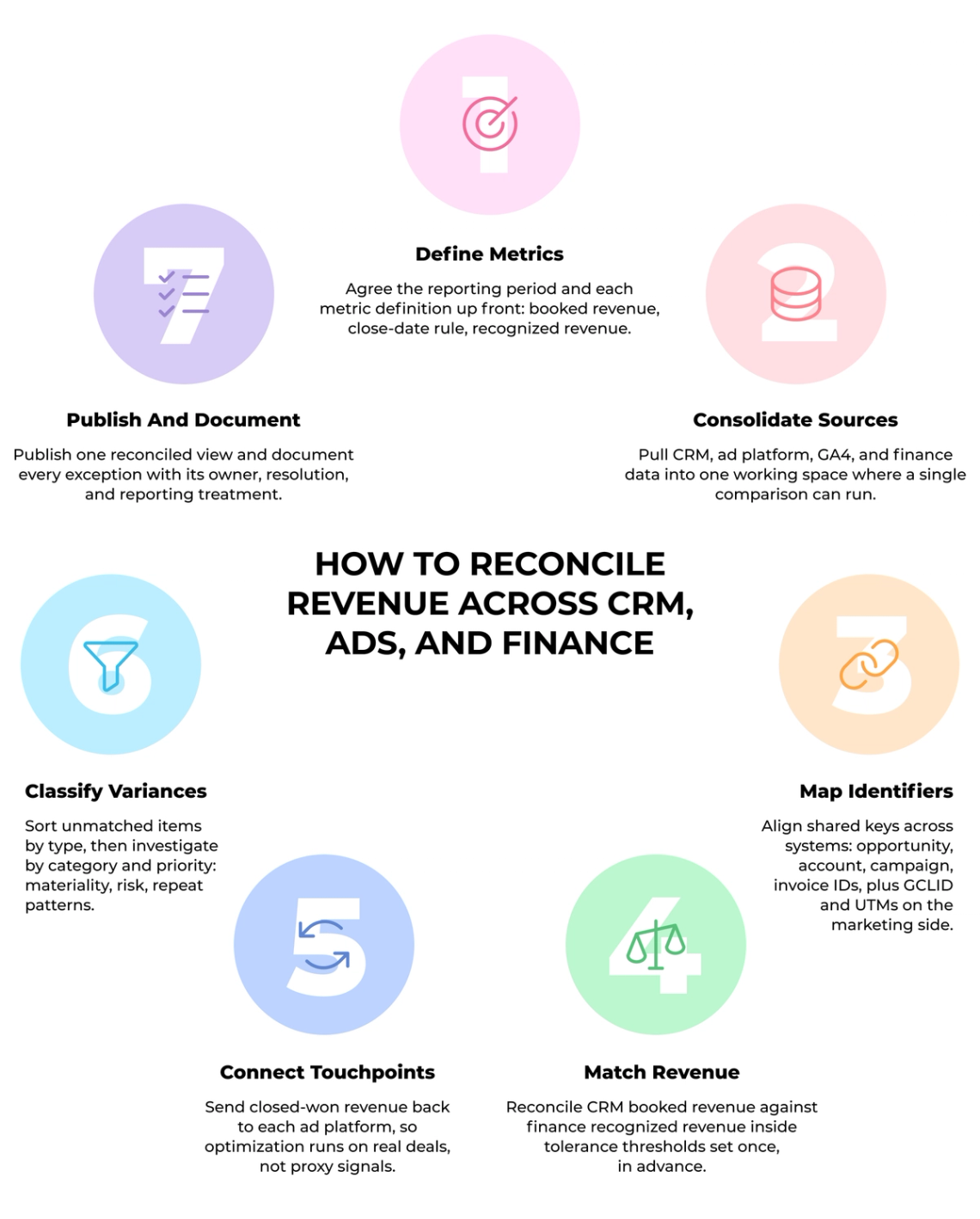
How to Reconcile Revenue Across CRM, Ads, and Finance
A reliable reconciliation process starts with consistent definitions, identifiers and matching rules.
1. Define the Period and Metric Definitions
Agree the reporting period and the definition of each metric ahead of any data movement. Which CRM field represents booked revenue. Which close-date rule applies. Which finance figure represents recognized revenue for the period. Definitions set here prevent most of the variance the later steps would otherwise chase.
2. Consolidate the Source Data
Pull CRM data, ad platform reports, GA4, and finance figures into one working space, usually a data warehouse or governed BI layer, seldom a spreadsheet. A single comparison can only run when the sources sit together. Consistent identifiers matter more than automation at this stage.
3. Establish Shared Identifiers and Mappings
Shared identifiers make reconciliation a repeatable match, not a manual search. The exact key set depends on the stack, and usually includes opportunity ID, account or customer ID, campaign ID, invoice or contract ID, and GCLID or UTMs on the marketing side. Map hidden form fields to CRM fields so identifiers populate automatically on every lead record. Once the mappings are in place, the same identifiers can be used in every close.
4. Match CRM Bookings to Finance Revenue
Match booked revenue to recognized revenue, and keep that reconciliation separate from any payment matching. Three scenarios cover most volume: one-to-one, where a booking maps to a single recognized amount; one-to-many, where an annual booking recognizes across 12 periods; and many-to-one, where several bookings consolidate. Define tolerance thresholds once, up front: zero tolerance on small items, a fixed band for mid-range deals, and percentage bands for large contracts where rounding is expected.
5. Connect Marketing Touchpoints to CRM Opportunities
When a lead closes in the CRM, the record should carry the click identifier from the original ad and the booked revenue value. Send eligible closed-won conversion data back through each platform’s supported offline-conversion workflow, so the algorithm learns which clicks produced real deals. Platform-attributed revenue stays a signal for optimization, and finance remains the source of truth for recognized revenue.
6. Investigate and Classify Unexplained Variances
Sort unmatched items by type: lifecycle-stage mismatch, missing campaign or opportunity link, date or period mismatch, attribution overlap, currency or field transformation, and finance recognition difference. Investigation follows the category. Check CRM field history, opportunity records, campaign influence, tracking IDs, warehouse transformations, finance revenue schedules, and source-system timestamps. Prioritize by materiality, then by risk, then by variances that repeat.
7. Publish the Reconciled View and Document Exceptions
Publish one reconciled view and document each exception before it reaches the reported number. For every variance, record the source systems, the owner, the resolution, and the reporting treatment. Documenting each exception makes repeated issues easier to identify and address upstream.
Build a Repeatable Month-End QA Process
A documented process with clear ownership and a fixed cadence keeps reconciliation from depending on one person's memory. Make it cross-functional across Marketing Ops, RevOps, Finance, and Data/Analytics.
Ownership by System and Metric
Name one owner per metric. Marketing Ops owns tracking and campaign data. RevOps owns CRM definitions and opportunity fields. Finance owns recognized revenue. Data/Analytics owns warehouse and BI transformations. Route each exception by type to its owner: a campaign-tracking gap goes to Marketing Ops, a recognition-timing question goes to Finance. Set resolution SLAs per category so nothing ages silently.
Pre-Close Checks and Deadlines
Run integration health checks during the month, validate identifiers and mappings before the period ends, sign off at month-end, and review exceptions after close. Give each check a named owner and a hard due day, so it gets done on schedule.
Tolerance and Exception Rules
Define tolerance thresholds once and reference them everywhere else. Zero tolerance on small items, fixed bands for mid-range deals, percentage bands for large contracts where rounding occurs. Amount tolerances absorb rounding and currency movement. Date tolerances validate that transaction dates fall inside an agreed range. Guardrails set in advance are what let the process scale.
Automation and Integration Monitoring
Automated reconciliation systems match transactions using configurable rules and flag anomalies before close. HighRadius reports a 95% transaction auto-match rate, lifting match accuracy from roughly 70% to 95%, alongside a 70% productivity increase in one general-ledger reconciliation case. The manual effort shifts from matching to reviewing, which is where finance judgment belongs. Monitoring the integrations themselves matters as much as the matching, since a silent sync failure creates the variance the match later has to explain.
Review Repeated Exceptions
When the same exception appears in multiple close cycles, review the upstream integration, field definition, or transformation rule behind it. Track open exceptions, resolution time, auto-match rate, and post-close adjustment frequency. Repeated variance categories point to a systems or definition problem, not a data-entry slip.
From Conflicting Numbers to a Defensible Revenue View
Unexplained variance rarely starts at close. It starts upstream, in a CRM field filled in three different ways, a tracking pixel that fires twice, a lifecycle stage that means something different to each team. Teams that reconcile at close are resolving symptoms while the source keeps producing new ones.
Cleo faced a related reporting problem: GA4, Salesforce and BigQuery held separate versions of marketing and sales results, and the monthly report took two working days to assemble. Darwin connected the systems, defined metric ownership and reporting logic, and created one automated reporting view. Reporting accuracy improved from roughly 70% to 90%, while the team removed $50K in annual attribution-tool spend. The same principle applies to revenue reconciliation: reliable close work starts with connected records, agreed definitions and a repeatable exception process.
What leadership needs is traceability. When each number ties back to its source and legitimate variances are explained, leadership reads one governed revenue view and stops the argument over whose figure is right. Define the sources and identifiers first, so each close follows the same reporting logic.
You have the process and the proof. The next step is a stack that reconciles by default.
FAQs
Q1. Which system should be the source of truth for revenue?
No single system owns every revenue question. Finance is authoritative for recognized revenue, the CRM owns bookings and lifecycle data, and ad platforms own spend and attributed conversions. Reconciliation assigns each metric to the system built for it and keeps every number traceable to its source.
Q2. What are the main steps in a month-end CRM, ad, and finance reconciliation?
Set the period and metric definitions, consolidate CRM, ad, analytics, and finance data, then align them on shared identifiers. Match bookings to recognized revenue, classify any variances, and publish the reconciled view with documented exceptions.
Q3. Why do CRM, ad platform, and finance revenue numbers differ?
They measure different events and periods. Marketing counts attributed conversions, the CRM counts bookings, and finance counts recognized revenue under its accounting policy. Reconciliation explains those legitimate differences and confirms each number is traceable.
Q4. What is the difference between revenue reconciliation and revenue recognition?
Revenue recognition determines when revenue counts as earned under standards like ASC 606, so it centers on timing and accounting policy. Revenue reconciliation compares revenue records system by system to confirm each is traceable and every variance is explained. Recognition happens when the obligation is met, reconciliation happens at close.
Q5. How often should revenue reconciliation happen?
Month-end close is the formal checkpoint, but the work should run through the month. Monitor integration health continuously, run pre-close validation on identifiers and mappings before the period ends, reconcile and sign off at month-end, and review exceptions after close. For high-volume businesses, spreading the work through the month lowers both risk and workload concentration.