Quick Answer:
Design debt on a B2B marketing website is the accumulated cost of campaign pages built outside the site's design system: duplicate components with small variations, styles hard-coded at page level where a design token should apply, and CMS modules created for one campaign that no other page can reuse. The pages look finished, so the drift stays invisible until an update touches a shared element and every page needs manual attention. AI-assisted and vibe-coded pages do not cause this on their own. They accelerate it when page production runs faster than component reuse, governance and QA can keep the site consistent.
TL;DR
- Design debt on a marketing site is production drift: duplicate components, hard-coded styles, page-level overrides, and one-off CMS modules that no shared update can reach.
- AI-assisted page creation accelerates design debt when output outpaces your component reuse, design-system governance, and QA. The tools are not the cause.
- The cost lands later as extra QA, manual cleanup, repeated frontend work, and slower campaign launches.
- Warning signs are concrete: many versions of the same component, launches that need cleanup, and a single design-system change requiring edits on dozens of pages.
- Prevention is a system job: design tokens, reusable component libraries, CMS module governance, component ownership, and review gates for AI or vibe-coded pages.
AI helps a marketing team ship campaign-page variations much faster than a hand-built workflow once allowed. The launch looks clean, and the pages convert. Weeks later, a brand update changes one shared button, and the team finds that no two pages implement that button the same way. Some use the design-system component, some carry a page-level override, and some were vibe-coded into their own markup. A change that should happen once now requires manual edits across many pages. This article traces how AI-assisted campaign-page production turns into design debt on a marketing website, the warning signs that it is building, and the system changes that keep the cost flat as the number of pages grows.
Where design debt collects on a campaign-driven website
Design debt collects in the distance between what a campaign page looks like and how it is built inside the website. A page can look on-brand and still hold a hard-coded color, a layout no template will reuse, and a form implemented differently from every other form on the site. Three things keep that distance from widening as pages multiply. Surface is the marketing website and campaign-page experience buyers meet. Consistent experience design depends on the components behind it following the same system. Clarity is the set of reusable component rules, design tokens, ownership and governance that make a button, a module, or a responsive state mean the same thing to every team and every tool. Momentum is the ability to keep launching and updating pages while rework stays low. Darwin Flux organizes the work so faster page production does not outrun the system that holds the site together.
How AI-assisted campaign pages accelerate design debt
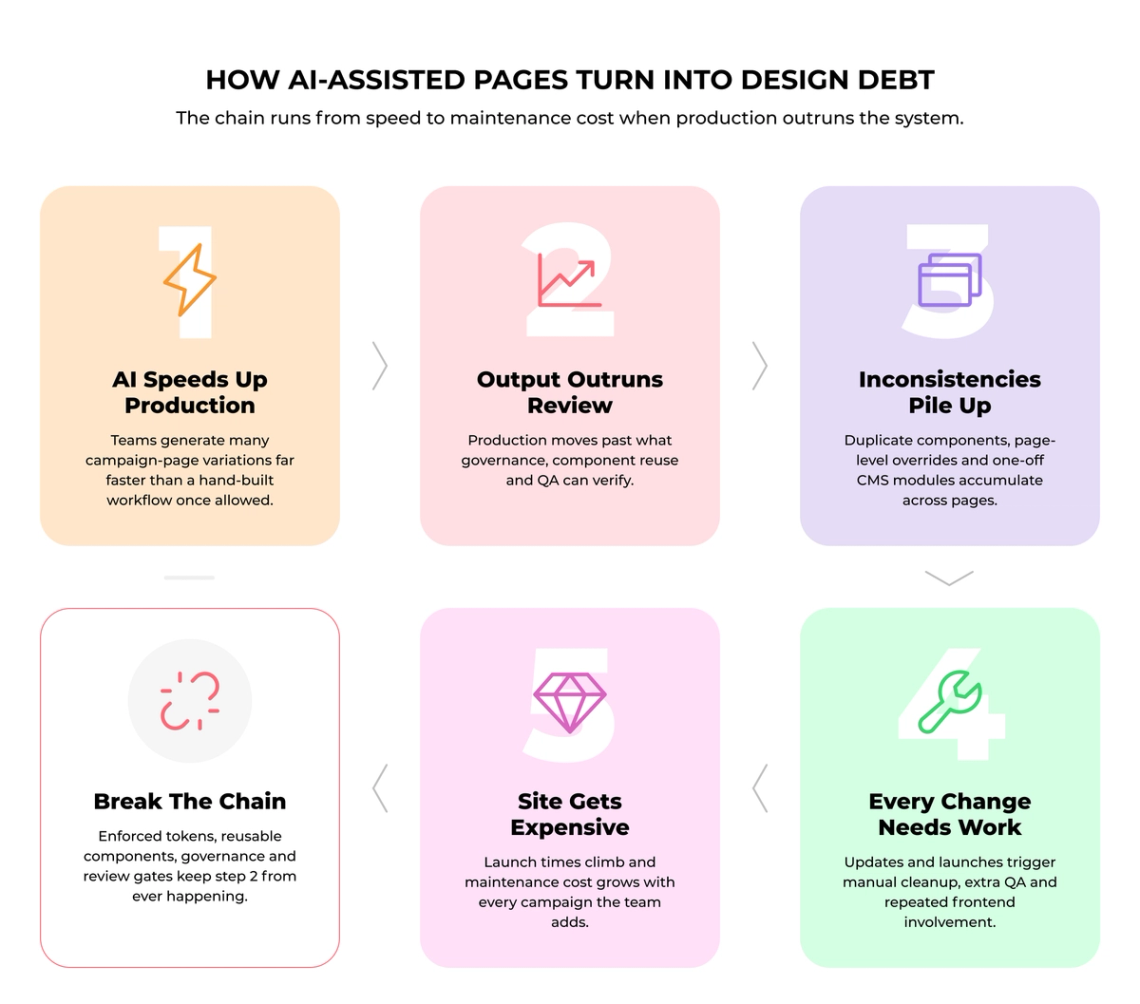
AI-assisted page creation accelerates design debt when page production grows faster than design-system governance, component reuse and QA can support it. The mechanism is speed against structure. The origin of the code matters far less than whether the system can keep pace with it.
Production outpaces governance and QA
Speed turns into debt when generation outruns the checks that keep a site consistent. AI-assisted tools can let teams produce campaign-page variations faster than a conventional workflow, so a team can stand up many at once. The constraint moves from building the page to verifying it: confirming that each one uses the right components, respects the design tokens, and holds its responsive states. When output outpaces that review, the unverified pages ship with small deviations already baked in.
The team then faces one of two outcomes. Approvals slow down to catch the drift, which gives back the speed AI provided. Or pages publish with known gaps, and the gaps become production drift that someone reconciles later. Both paths add maintenance cost to the site.
Vibe-coded pages skip the existing website architecture
AI and vibe-coded pages introduce implementations that do not follow the site's existing web development architecture, which forces reconciliation later. Unless it is connected to and constrained by your CMS, component library, and design tokens, a generated page can introduce patterns outside the existing architecture. It produces markup that looks right in isolation and can sit outside the system that every other page depends on.
For teams new to the term, vibe coding for marketing describes generating pages by prompting them into existence. The result is concrete: a new component variant that duplicates one already in the library, a style hard-coded at page level where a token should apply, a CMS module built for a single campaign that no other page can reuse, and responsive states that behave differently from the site standard. A shared design framework helps maintain this kind of consistency across pages. Each page that ignores it becomes a page someone has to bring back in line by hand.
Small inconsistencies compound as pages multiply
Individual deviations look harmless, and their cost is cumulative. A slightly different button, a spacing value that misses the token, a form wired its own way. On one page none of it matters. Across a growing set of campaign pages, inconsistent design elements disrupt the experience and erode trust, and it multiplies the work of every future change. The site drifts from its own design system one page at a time, and the gap between production and the approved system keeps widening.
What design debt costs your marketing team later
Design debt on a website is paid in future marketing work. The pages that shipped fast make the next round of work slower, and the cost shows up in predictable places.
Every update turns into manual cleanup
When components are not shared, a single change cannot propagate. Updating copy or a style on pages that should pull from one component means editing each page by hand. Simple consistency work adds up quickly when nothing was built for editing at scale. Duplicated CMS modules multiply the effort, since the same edit has to be repeated in every copy.
QA and frontend involvement keep growing
Inconsistent implementations pull design and frontend back into work that should have been finished. Each page-level override is a spot that needs its own QA pass. Inconsistent responsive behavior means desktop and mobile have to be checked separately on pages that should have inherited a tested standard. Without structured quality checks, every page-level exception adds work to future QA, and the regression surface grows with each one-off component added to production.
Campaign launches slow down over time
The clearest business signal is launch time creeping upward. As exceptions accumulate, campaign changes take longer to scope, test and publish. Once design debt compounds, any revision on a conversion-critical page takes work far out of proportion to its size, because the change cannot flow through a shared component and has to be rebuilt in place.
Warning signs your marketing website has design debt
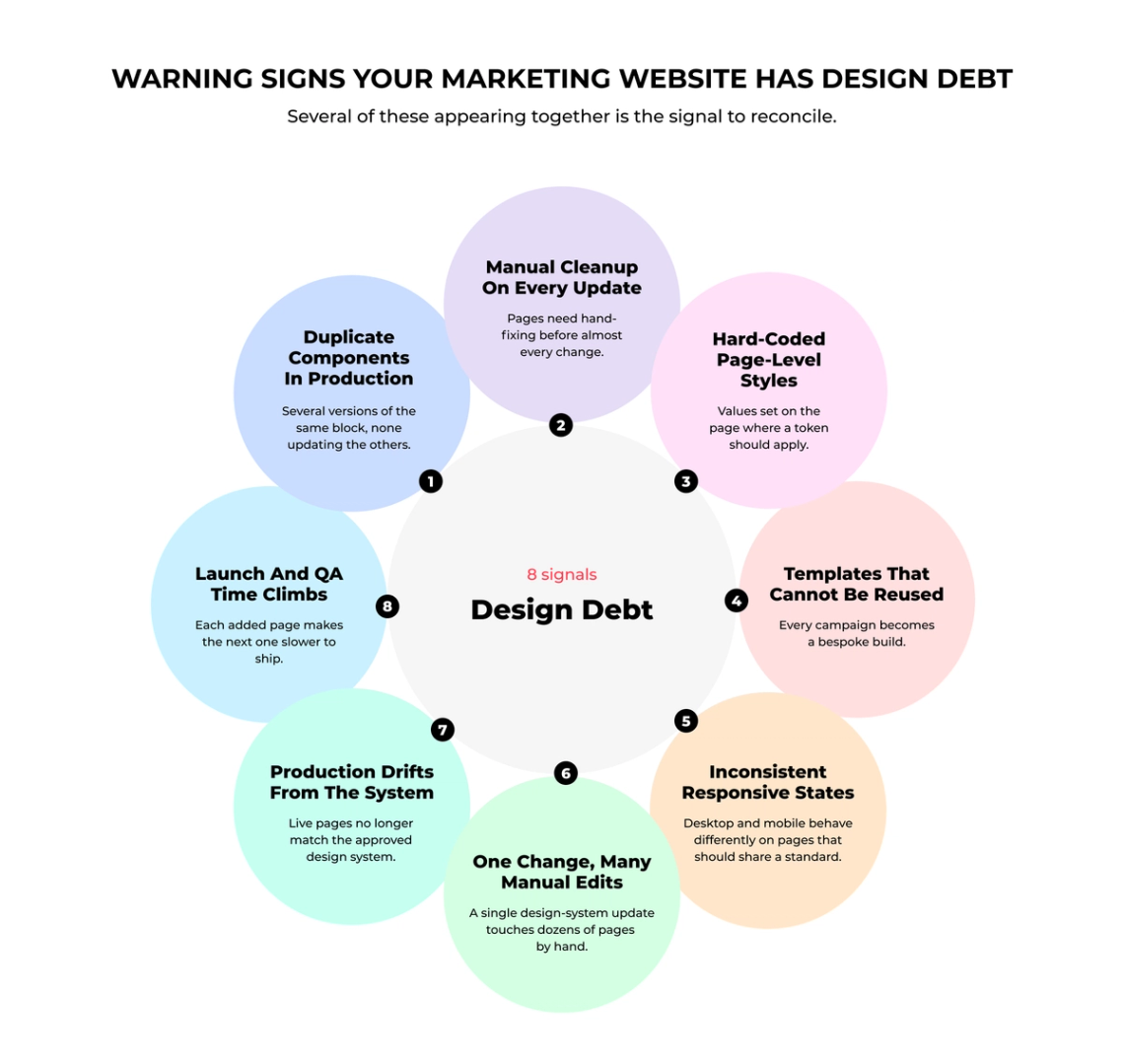
Design debt shows itself in how the site behaves under change, well before customers notice. A few signs are specific enough to act on.
- Multiple versions of essentially the same component live in production, and none of them updates the others.
- Campaign pages need manual cleanup before almost every update.
- Styles and values are hard-coded at page level where a design token should apply.
- Templates and CMS modules cannot be reused, so each campaign is a bespoke build.
- Desktop and mobile states behave inconsistently on pages that should share a standard.
- A single design-system update requires manual changes across many pages.
- Production pages no longer match the approved design system.
- Launch and QA time climbs as more campaign pages are added.
Any one of these is manageable on its own. Several appearing together is the signal that production has moved ahead of the system meant to hold it, and reconciliation is now cheaper than continued drift.
How to prevent and reduce website design debt
Preventing design debt is a matter of the structure around page production, and the work starts before the first campaign page is generated. Marketing AI efforts tend to stall when the workflow around the tools is unclear, so the guardrails below matter more than the choice of generator.
1. Make design tokens the source of truth
Design tokens give every page a fixed target for its visual decisions. A token is the single source of truth for a color, a spacing value, or a type style: change it once, and components that consume the updated token can inherit the change. With tokens enforced, an AI-assisted page has a defined standard to build against. A token that is only documented, with no enforcement, can still be bypassed during fast page generation.
2. Build reusable component libraries and govern CMS modules
Reusable components turn one correct decision into many correct pages. A component library holds modular blocks used across many pages, created once and reused everywhere, which gives consistency and lets one update reach every page that uses the block. CMS modules need the same discipline: a module built for a single campaign should be the exception, and reuse should be the default. Visual editing sits on top of structured content models, so marketers stay in control while the underlying components stay standard.
3. Assign ownership and rules for new variants
A design system holds only when someone owns it and the rules for extending it are explicit. Design-system governance sets how the system evolves, who owns it, and how teams apply it. Documented rules for when a new component variant may be created, and a defined owner who approves it, keep the library from splintering into near-duplicates. Responsive-state requirements belong in the same rules, so every new component ships with tested desktop and mobile behavior, not a per-page guess.
4. Put review gates on AI and vibe-coded pages
Review gates catch drift at the point of publishing. Any AI-assisted or vibe-coded page should pass a check before it reaches production: does it use existing components, does it respect the tokens, does it match the responsive standard, and does it avoid a page-level override where a shared element exists. A defined pre-launch check makes this repeatable. Human review here is a design choice that keeps judgment and accountability with the team, and clear standards cut the rework that drift would otherwise create downstream.
5. Reconcile production against the design system
Prevention also means closing the gap that already exists. Reconciliation compares live pages against the approved design system, flags where production has diverged, and brings the highest-cost pages back onto shared components and tokens. A design system audit can provide a structured way to identify and prioritize this drift. Done on a regular cadence, it keeps the gap between the approved design system and production from widening into the maintenance bill that design debt becomes when it is left alone.
Design debt is a system problem with a system fix
AI gives a marketing team real speed on campaign pages. That speed holds its value only when the site's components, tokens, governance, and QA can keep pace with it. When they cannot, every fast page becomes a slow one to maintain, and the website grows more expensive to change with each campaign.
Darwin helped VTS align website structure, page layouts and content with its new brand, resolving inconsistencies across the digital experience. The work shows why website-wide inconsistency needs a deliberate reconciliation process. See the full VTS website optimization case study for the scope of that work.
For marketing teams, the key constraint is whether AI-assisted page production stays inside the website's component, token, governance, and QA structure as output increases. When it does, teams can raise page-production speed, and the added maintenance work stays modest. When it moves ahead of that structure one page at a time, the maintenance cost grows with it. The structure around the tools decides which one happens.
FAQs
Q1. What does design debt look like on a B2B marketing website?
It is production drift: duplicate components with small variations, styles hard-coded at page level where a token should apply, one-off CMS modules no other page can reuse, and page-level overrides. Minor on one page, costly across many.
Q2. Do AI-built campaign pages create more design debt than hand-built ones?
Not on their own. They accelerate it when production outruns component reuse, governance and QA. A page built outside your CMS, components and tokens sits apart from the system and needs reconciliation later. The structure around production decides the outcome.
Q3. What are the warning signs of website design debt?
Several versions of the same component in production, launches that need manual cleanup, values hard-coded at page level, templates no one can reuse, inconsistent desktop and mobile states, and one design-system change that forces manual edits on many pages.
Q4. How do teams prevent design debt when using AI for campaign pages?
Make design tokens the enforced source of truth, build reusable component libraries, and govern CMS modules so reuse is the default. Set ownership and rules for new variants, add review gates for generated pages, and reconcile production on a cadence.
Q5. Does using AI mean a marketing site will always accumulate design debt?
No. AI adds speed, and speed keeps its value when components, tokens, governance, and QA can match it. A team that enforces the system before generating pages can raise page-production speed, and the added maintenance work stays modest.