
Quick Answer:
AI readiness is a maturity profile across seven dimensions: technology, data, talent, processes, governance, culture, and vendor strategy. You measure each on a one-to-five scale, find the dimensions that block your priority use cases, and fix those first. Data readiness is where analysts and practitioners most often locate the main bottleneck, so a leader who wants a single starting point should confirm that the data behind a use case is trusted, owned, and documented before funding any model work.
TL;DR
- Readiness is multidimensional. Score seven independent dimensions, since AI readiness is not one yes or no decision.
- Data is the usual bottleneck. Gartner expects organizations to abandon 60% of AI projects that lack AI-ready data through 2026, so the data foundation comes before model selection.
- Use a scorecard, then an audit. A 30-question scorecard gives a fast read; a structured audit turns gaps into a prioritized remediation plan.
- Prioritize by impact and feasibility. Pick the use cases that pay off and are buildable with the data and skills you have.
- Governance is ongoing. Model documentation, bias checks, and monitoring have to run continuously, since assurance bodies now ask for upstream evidence.
Every executive faces the same question. Can our company get real value from AI, or are we funding a pilot that never reaches production? The honest answer sits on a spectrum. Readiness covers your technology infrastructure, data foundations, team skills, operating processes, governance, and culture, and each of those can be strong or weak on its own.
Most AI projects stall for reasons that have little to do with the model. Messy data, unclear ownership, and thin governance are the usual causes. Gartner found that 63% of organizations either lack the right data-management practices for AI or are unsure whether they have them, and it expects organizations to abandon 60% of AI projects that are not supported by AI-ready data through 2026.
The upside is just as concrete when the groundwork is done. McKinsey's 2025 State of AI survey reports that 88% of organizations now use AI in at least one function, up from 78% a year earlier, while 39% attribute any enterprise-level EBIT impact to AI and most of those put it below 5%. The gap shows that widespread adoption does not automatically translate into measurable enterprise value. This playbook gives you a framework to assess readiness, find the gaps that matter, and build a 90-day roadmap to production AI that earns its budget.
What Has to Be True Before AI Reaches Production
A readiness score is only useful if it points at the specific things that would break in production. Four conditions decide whether an AI use case survives contact with real systems. First, the signals it depends on have to reach the surface, so tracking, events, and source records are captured and visible, so they are not scattered or missing. Second, those signals need working connections, so data moves between your CRM, analytics, automation, and model without manual patching. Third, the numbers need clarity, so the definitions behind a metric agree across every report and everyone reads the same figure the same way.
Fourth, the work needs momentum, so a use case that clears a pilot keeps running with owners, monitoring, and a way to roll back when quality drops. Darwin organizes this operating model as Darwin Flux, and the same four conditions map onto the readiness dimensions below. Surface and connections live mostly in the data and technology dimensions, clarity lives in data and process, and momentum lives in governance and culture. If any one of the four is missing for a given use case, that is where your readiness work starts.
Why AI Readiness Is a Practical Question Right Now
For most leaders the real question is whether the company can turn AI interest into reliable results. What matters is whether your organization can run AI in production, and that depends far more on data infrastructure and governance than on which model you pick.
This is not a theoretical worry. Analysts and practitioners keep pointing to the same failure causes: messy data, unclear ownership, and weak governance. MIT's 2025 study of enterprise AI, summarized in its State of AI in Business report, reported that 95% of enterprise generative AI pilots showed no measurable profit-and-loss impact, a headline figure the authors define narrowly and that rests on a single study, and attributed the shortfall to scoping and integration more than to the models. Careful preparation is what separates the pilots that pay off from the ones that get shelved.
Main idea. Do not treat readiness as one checkbox. It is a maturity profile across several independent dimensions. Assess every dimension, find the bottlenecks that block value for the use cases you care about, and fix the highest-impact gaps first.
The Seven Dimensions You Must Evaluate
Each dimension can score high or low on its own, so read them as a profile, not a single grade.
Technology and Infrastructure
Compute architecture, cloud and on-premises capacity, and model-serving capability. For teams that train or run custom predictive models, this also covers MLOps pipelines such as CI/CD for model code, feature stores, and reproducible builds. Those requirements are conditional and mainly apply to teams that own and operate models in production.
Data Readiness
Availability, labeling, cleanliness, freshness, lineage, privacy controls, and whether the data fits the use case you plan to run. It is where readiness work tends to pay off first.
Talent and Skills
Whether you have the data engineers, analysts, product owners, and where relevant ML engineers who can turn model output into business action, and whether you can hire and keep them.
Processes and Operations
Experimentation practices, model-testing protocols, operational runbooks, monitoring, and incident response. These decide whether a working pilot can run reliably every day.
Governance and Risk Management
Model documentation, validation, bias testing, third-party model controls, and alignment with recognized frameworks. The NIST AI Risk Management Framework and ISO/IEC 42001 are widely used reference points for structuring AI governance and risk management.
Culture and Change Management
Executive sponsorship, clear cross-functional decision rights, and incentives that reward measurement and iteration over vanity metrics.
Vendor and Partner Strategy
How you evaluate external models and firms, avoid lock-in, and structure hybrid teams that balance internal expertise with outside capability.
Darwin's AI Readiness & Enablement review scores the systems behind your priority use cases and names what needs to change before you build.
How to Assess Readiness: A Maturity Model and Scorecard
You do not need a 200-page report to begin. A five-level maturity ladder plus a compact scorecard turns subjective conversations into an actionable plan.
Five Levels of AI Maturity
Level 1: Unaware. No organized AI activity. Decisions are manual and ad hoc, with no data infrastructure or governance in place.
Level 2: Exploring. Teams run pilots but deploy nothing to production. Data hygiene is limited and tracking is inconsistent across systems.
Level 3: Experimenting. Several pilots run with reproducible experiments. Initial model versioning and limited monitoring exist.
Level 4: Operational. Models run in production with service objectives, monitoring, retraining pipelines, and clear cross-functional ownership.
Level 5: Embedded. AI is embedded in products and operations, business KPIs have measurably improved, and governance and data practices are mature and repeatable. A high maturity level does not require every organization to operate custom machine-learning infrastructure; many mature teams rely on managed services and vendor models.
Map each of the seven dimensions to a one-to-five score, then average them for a headline number. The per-dimension profile matters more, because it shows where to invest. Microsoft's AI readiness guidance uses a similar multi-pillar approach covering strategy, governance, data, and infrastructure.
Designing a Practical Scorecard
Keep the scorecard to about 30 questions and phrase them so a non-technical leader can answer. Use a yes/no or one-to-five scale, and mark any question not applicable when it describes a model-specific requirement your use case does not involve. The set below covers all seven dimensions.
Technology and infrastructure
● Do we have enough compute and serving capacity for the use case we plan to run?
● Can we deploy a model into production without a one-off manual setup?
● Do we have CI/CD and reproducible builds for model code? (N/A if we run no custom models.)
● Do we have a feature store or an equivalent way to keep features consistent? (N/A for off-the-shelf models.)
Data readiness
● Do we have trusted, documented data sources for this use case, with clear lineage?
● Is the data refreshed often enough to support accurate predictions?
● Does our historical data cover the populations, seasons, and edge cases the model will meet?
● Do we have enough trustworthy labeled examples? (N/A for unsupervised or generative use cases.)
● Are there documented policies for personal data, redaction, retention, and consent?
● Can we build a holdout test set that behaves like production? (N/A for use cases with no predictive model.)
Talent and skills
● Do we have data engineers and analysts who can prepare data and read model output?
● Do we have access to ML engineering skills where the use case needs them? (N/A for no-code or vendor tools.)
● Is there a product owner who can turn model output into a business decision?
● Can we hire and keep the people needed to run this in production?
Processes and operations
● Is a named engineer or team responsible for running models in production?
● Do we have automated tests for model or pipeline code before release?
● Do we monitor inference behavior and watch for prediction drift and data-quality changes?
● Do we have an incident runbook that says how to roll a model back?
Governance and risk management
● Do we publish a short model card describing intended use, limitations, and evaluation?
● Do we run bias or fairness checks where a decision affects individuals? (N/A where no individual is affected.)
● Do we keep upstream evidence such as data snapshots, preprocessing code, and labeling guides?
● Do we control and document third-party models and datasets for licensing and provenance?
Culture and change management
● Is executive sponsorship in place, with defined success metrics for this use case?
● Are cross-functional decision rights clear when a model output conflicts with a business rule?
● Do incentives reward measurement and iteration over vanity metrics?
● Are the affected teams prepared to change how they work once the model ships?
Vendor and partner strategy
● Do we have criteria for evaluating external models and firms?
● Have we checked for lock-in and confirmed we can move off a vendor if needed?
● Is it clear which parts we build in-house and which a partner runs?
● Do our vendor contracts state service levels and audit rights?
Convert answers to numbers and flag any item under three as a gap. Allow a not-applicable option where a question describes a model-specific requirement your use case does not involve, and count blockers separately from the average so a single hard stop does not hide behind a decent overall score. If data readiness is low for a lead-scoring use case, fixing tracking and pipelines outranks buying more compute.
Running an AI Audit: A Practical Framework
If a scorecard is the quick check, an audit is the real work. A focused audit usually runs two to six weeks depending on scope, and the goal is a prioritized remediation plan and an illustrative roadmap for a limited-scope pilot. The week-by-week structure below is an educational framework you can adapt, not a fixed commercial engagement.
Weeks 0 to 1: Scope and Stakeholders
Choose up to three use cases to assess. Gather the business owner, product manager, data engineer, an ML engineer where relevant, a security or legal contact, and an operations lead. Confirm the deliverables: a gap map, a prioritized backlog, and rough effort estimates.
Weeks 1 to 2: Discovery and Inventory
Inventory systems, data sources, pipelines, dashboards, current models including spreadsheet heuristics, and vendor contracts with their service levels. Build a source-to-outcome map that links data and models to business metrics. This step usually exposes missing traceability. If nobody can answer who owns a dataset, that is a governance hole that will slow any production project.
Weeks 2 to 3: Technical Checks
Profile data for completeness, missing values, distribution skew, class balance, and timestamp freshness. Trace model features back to source systems. For teams running custom models, test whether a training run can be recreated from its commits and artifacts, check feature-serving consistency, and set up basic monitoring that collects inference logs and prediction distributions, with drift and outlier detection.
Weeks 3 to 4: Security, Privacy, and Vendor Checks
Check for personal data and data-classification controls, verify access controls plus encryption in transit and at rest, and confirm licensing and provenance for any third-party model or dataset. Assurance bodies now ask for upstream evidence, not model output alone, so expect security and compliance reviewers to request the artifacts behind a result.
Weeks 4 to 5: Organizational and Process Checks
Identify who decides when a model's output conflicts with a business rule. Document the runbook: who responds when prediction quality drops and how you roll a model back. Where answers are missing, write simple procedures and service levels. That step often marks the shift from pilot to production.
Weeks 5 to 6: Deliverable and Roadmap
Produce a prioritized backlog where each finding lists the problem, the remediation step, an effort estimate in engineering weeks, and the residual risk. Present a 90-day roadmap for a limited-scope pilot with clear, measurable success criteria.
Data Readiness: A Critical Predictor of AI Success
Analyst reports and client engagements keep landing on the same point. Gartner frames well-governed, use-case-aligned data as AI-ready data and recommends better metadata practices, aligning data with specific use cases, and more observability to avoid costly failures. A few checks you can run in a day or two:
- Label availability. For supervised problems, do you have enough labeled examples, and are the labels trustworthy?
- Freshness. Is the data refreshed often enough to support accurate predictions?
- Coverage. Does your historical data reflect the populations, seasons, and edge cases the model will meet?
- Privacy and consent. Are there documented policies for personal data, redaction, and retention, and does the basis you collected the data under permit this use?
- Testability. Can you build a holdout test set that behaves like production?
Most teams get the quickest wins by fixing missing instrumentation, adding basic validations, and making one person accountable for data quality. Connecting the systems that hold those signals is usually the precondition, which is what Darwin's integrations and automations work addresses.
Prioritizing AI Projects: Impact Versus Feasibility
After the audit you will have a list of candidate projects. Do not pick by enthusiasm. Score each on impact, using expected dollar benefit, time saved, and conversion lift, and on feasibility, using estimated engineering effort, data maturity, and any compliance constraints. The projects that sit high on both are your first candidates, though none of them is a guaranteed quick win until the data supports it.
Common Early Candidates for Marketing and Product Teams
- Predictive lead scoring. When tracking is solid and you have historical conversion labels, this often delivers strong impact for modest engineering effort.
- Personalized subject lines or content blocks. Lower risk and easy to A/B test, so they suit teams that are disciplined about experimentation.
- Automated tagging or routing of support tickets. Reduces time to resolution with a straightforward build.
Hire or Partner: A Practical Decision Framework
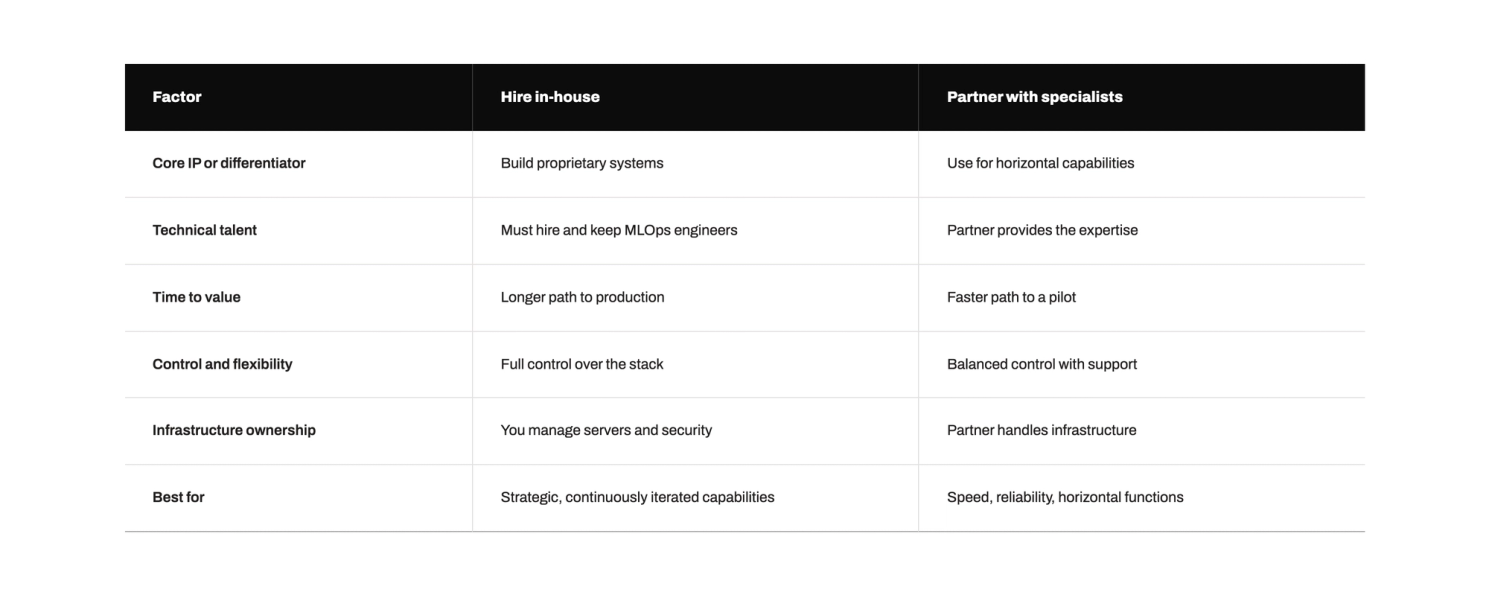
Most companies use a mix of in-house skills and partners. The right split turns on three questions:
- Is the capability core intellectual property or a real differentiator?
- Can you hire and keep the engineers needed to run production systems?
- Do you need fast time to value?
If a capability is core to your product and you expect to iterate on it continuously, build in-house. If it is a horizontal capability and speed matters, partner with a trusted firm or platform. If you lack MLOps expertise but need production reliability, an embedded model works well: a retained partner runs the stack under a clear service level while your team builds the skills. A short checklist to decide:
- Does the project need custom models, or will off-the-shelf models do?
- Is low latency and tight infrastructure control required?
- Is audit and compliance capability a core requirement, as in finance, healthcare, or legal?
If you answered yes to two or more, lean toward hiring or engaging a managed partner with proven compliance experience.
Practical Guardrails for Governance, Ethics, and Compliance
Put these guardrails in place before you scale. They protect stability and reputation, and assurance bodies increasingly expect them.
Model Documentation
Publish a short model card for each production model that explains intended use, limitations, and evaluation results, following the model cards framework. Focus documentation effort where a model materially affects people or money.
Datasheets for Datasets
Record metadata for training datasets covering provenance, collection details, and known limitations.
Bias and Fairness Tests
Run slice tests where a model's decisions affect individuals, and publish thresholds for acceptable variance.
Monitoring and Explainability
Collect prediction logs, watch for feature and label drift, and keep an explainability checklist for higher-risk models. Keep upstream evidence such as raw data snapshots, preprocessing code, and labeling guides. The NIST AI RMF and ISO/IEC 42001 both point toward this kind of documented, repeatable practice, and auditors are more likely to ask for the artifacts behind a result than to accept an output summary.
Measuring Success: KPIs and Operational Health
Track business and technical KPIs together, and do not confuse model loss with business impact.
- Business KPIs. Revenue growth, higher conversion, cost savings, and time saved per task.
- Model KPIs. Precision, recall, and calibration where applicable, plus how model decisions translate into outcomes.
- Operational KPIs. Inference latency, uptime against service objectives, and mean time to detect and remediate incidents.
- Governance KPIs. Share of models with model cards, bias tests run, and audit requests completed.
Set a target for each and a reporting cadence: weekly for operations, monthly for business outcomes, and quarterly for governance.
Tooling and Templates
A few reliable tools cover most needs. Each category below applies when you run the corresponding workload, so treat them as conditional, and mandatory only for the teams running that workload.
- Data quality and testing. Assertion frameworks such as Great Expectations, for readable data checks.
- Model lifecycle and registry. MLflow, for tracking, versioning, and a model registry, when you train your own models.
- Feature store. Feast, to keep training and inference features consistent.
- Monitoring and drift detection. Alibi-Detect or Seldon, for drift and outlier detection on live models.
- Pipeline management. Kubernetes with Kubeflow, or a managed cloud service, for teams operating production pipelines.
These are starting points. Each company blends open-source tools, managed services, and vendor offerings based on budget and risk appetite.
Three Short Playbooks: Marketing, Operations, and Product
Concrete examples turn readiness into action. Each outlines a common problem and a straightforward path to a pilot.
Marketing: Predictive Lead Scoring
Problem. Marketing runs on messy attribution and the sales team reports poor lead quality.
Data. Event tracking, CRM history, and opportunity outcomes.
First moves. Fix event instrumentation, centralize events into one pipeline, de-duplicate contacts, assemble a clean training set with win and loss labels, train a simple model, and run it in shadow mode for four weeks.
Expected outcome. Higher conversion of qualified leads when the model meaningfully cuts time spent on bad leads.
Operations: Automated Ticket Triage
Problem. Support volume spikes slow response times.
Data. Historical tickets, tags, and resolution times.
First moves. Build a classifier that routes tickets by topic and priority, A/B test it on a subset of incoming traffic, and measure time to first response.
Expected outcome. Shorter resolution times and better service-level compliance.
Product: Recommendation System
Problem. Low personalization and engagement, with data fragmented across sessions and purchases.
Data. Session events, purchase history, and product metadata.
First moves. Standardize event tracking and deploy a baseline collaborative or hybrid recommender in an opt-in A/B test.
Expected outcome. A measurable engagement lift and a clear path to full rollout.
Common Mistakes and How to Avoid Them
- Chasing the newest model before fixing data and instrumentation. The latest model will not help if the pipeline feeding it is broken.
- Skipping reproducibility and a model registry. This bites at scale, when you cannot recreate a result or roll back a broken deployment.
- Treating governance as a one-time checkbox. Auditors want upstream evidence, and drift keeps changing model behavior over time.
- Building everything in-house because outsourcing feels risky. A managed partner with a strong operations record is sometimes the faster route to reliability.
Comparison Table: Hire Versus Partner
How Darwin Approaches AI Readiness
The pattern behind most stalled AI work is the same. The model is not the problem. The systems around it are not ready, so segmentation runs on incomplete CRM fields, reports disagree on what a conversion is, and no one owns the handoffs between tools.
Darwin's AI Readiness & Enablement review is a fixed two-week engagement that looks at four areas behind a use case: CRM data, the handoffs as data moves between marketing, sales, analytics, and automation, the reporting logic behind campaign and revenue numbers, and ownership. You leave with a readiness scorecard for each area, a list of the blockers affecting your priority use cases, and a 90-day plan that names an owner for every task.
One example shows the shape of the work. A kitchen and interior design company had lead signals spread across several systems. Darwin connected them and built an AI-assisted qualification workflow on top of the team's existing process, reaching 95% lead-identification accuracy, a 30% lift in conversion, and 80% of early-stage interactions automated. The anonymized case study describes one implementation project, so read the numbers as an illustration, not a promise. The point holds across engagements: connect and clarify the data first, and the model work that follows has something reliable to stand on.
FAQs
Q1. How long does an AI readiness audit take?
A minimal scorecard review takes a few days. A focused audit with technical checks usually runs two to six weeks, depending on how many use cases and systems are involved. The point is a prioritized plan, not a report nobody reads.
Q2. What is the strongest predictor of success?
Data readiness. Clean, representative, well-governed data with clear ownership and lineage is the main bottleneck, the same gap behind Gartner's projection above. Fix data foundations before chasing models.
Q3. Can small teams adopt AI safely?
Yes. Start with modest, measurable pilots where data ownership is clear and monitoring stays simple. You do not need a full MLOps stack to get a result. Run basic tests and keep models in shadow mode until you are ready for a full rollout.
Q4. What proves ROI?
Business KPIs tied to a defined attribution window and a controlled experiment, such as revenue lift, conversion improvement, or time saved. Model accuracy on its own does not prove business value.
Q5. When should we hire versus partner?
If the capability is strategic and you will refine it over time, hire. If it is a horizontal function where speed and reliability matter, partner. A hybrid split is common: a partner scales the stack quickly while your team focuses on product differentiation.