
Quick Answer:
A marketing operations service level agreement (SLA) for detection speed should classify breaks by severity. Critical failures: form submission errors and complete routing breakdowns. These require real-time to one-hour detection with a 15-minute response target. High-priority breaks such as UTM parameter failures allow four to eight hours. Medium-priority reporting inconsistencies allow 24 to 48 hours. Weekly monitoring covers cosmetic and legacy issues. Speed alone does not prevent repeat failures; the detection system needs to feed a break log that drives structural fixes.
TL;DR:
- Detection speed. Critical tracking and routing breaks require real-time monitoring; most teams only measure campaign build time, not failure response time.
- Financial exposure. Poor data quality costs organizations an average of $12.9 million annually. Delayed detection turns a fixable system error into compounding attribution waste.
- Severity tiers. A working marketing operations SLA separates critical, high-priority, medium-priority, and low-priority breaks with specific response and resolution windows.
- Monitoring architecture. Automated alerts, escalation paths, documented procedures, and a tracking break log form the operational backbone.
- Systemic fixes. Catching the same routing error three times signals a structural problem. Detection speed matters; learning from breaks matters more.
A marketing operations team spends six months building attribution logic, connecting GA4, HubSpot, and ad platforms into a coherent reporting stack. Then a single pixel misfires. The form stops routing leads. The CRM sync drifts. Nobody notices for three weeks. The reason is simple: nobody defined how quickly those failures should be detected. By the time someone pulls the attribution report, the damage is done.
Marketing teams often know how long it takes to launch a campaign. Far fewer know how quickly they should detect a broken form, a failed routing rule, or missing attribution data. That gap is where attribution breaks, pipeline disappears, and reporting loses credibility.
Detection speed determines whether a break costs an hour or a month of clean data. This article covers the detection timeframes that belong in every marketing operations SLA, the factors that shape them, and the monitoring system that makes them enforceable.
In Darwin Flux terms, this is where Connections either create Clarity or quietly destroy it. Tracking and routing breaks are rarely isolated technical failures. They are failures between systems, ownership, and reporting trust.
What Are Tracking and Routing Breaks in Marketing Operations?
Tracking and routing breaks occur when the systems that capture marketing data or assign leads to sales representatives stop working. A broken pixel or a failed routing rule rarely surfaces immediately. It surfaces weeks later, in a report that cannot reconcile, in a pipeline number that sales and marketing cannot agree on, or in a budget decision made on numbers nobody can verify.
How Do Tracking Breaks Corrupt Attribution Data?
Tracking breaks happen when your marketing attribution monitoring fails to capture conversion events or customer touchpoints. Pixel firing issues sit at the top of the list. A tracking pixel might be installed on the homepage but missing from the confirmation page, or firing twice, inflating conversion numbers. The entire pixel tracking system depends on a chain of events executing correctly. Conversion data disappears if JavaScript does not load, if the browser blocks cookie storage, or if the network request times out.
Browser restrictions have made browser-based tracking significantly less reliable. Tracking pixels can undercount conversions by 20 to 40% because of ad blockers and Safari's Intelligent Tracking Prevention (ITP). Safari's ITP limits JS-set first-party cookies to seven days of storage, meaning returning visitors outside that window lose their tracking connection. Ad blockers compound this further: many businesses discover their pixel captures only 60 to 70% of actual conversions, and that percentage continues declining.
Data capture problems create breaks before pixels enter the picture. Missing hidden UTM fields, incomplete form mappings, and forms that create contacts without campaign context all break attribution at the point of entry. UTM governance failures mean one campaign uses "linkedin," "LinkedIn," "li-paid," and "paid-social" across different links, fragmenting reporting entirely.
How Do Routing Breaks Affect Lead Assignment and Pipeline?
Routing breaks when data breaks. Duplicate records cause leads to get assigned to multiple representatives or fall through entirely. The same person exists twice in the CRM with different data, and routing rules fire inconsistently. One record triggers territory-based routing, the other triggers round-robin. Both representatives reach out. The buyer gets confused.
Missing fields cause leads to fall into default queues or get misrouted. No industry value means segment routing cannot fire. No territory field means geo-routing fails. No employee count means the system cannot distinguish SMB from enterprise. Sales teams signal routing problems through specific complaints: representatives receiving leads outside their territory, leads sitting unassigned for 48 hours because a workflow failed silently, no notification to take action after a prospect submits a request.
What is the cost of undetected breaks?
Inaccurate tracking creates budget misallocation. A pixel showing 100 conversions when actual sales hit 180 means budget decisions run on incomplete data. Spend flows into channels that are not working while high-performing campaigns get cut. Modern ad platforms use machine learning to optimize delivery, and algorithms cannot identify converting users when conversion data is incomplete.
Routing breaks damage conversion rates in a different way. Manual rerouting introduces human error. Someone forgets to notify the new assignee. The right representative makes contact after the buyer has moved on. Campaign association gaps mean marketing activity cannot connect to revenue objects, making campaign influence impossible to measure.
Why Does Detection Speed Matter for Marketing Operations SLAs?
Gartner estimates poor data quality costs organizations an average of $12.9 million per year. Wait days or weeks to detect tracking breaks, and the team is not just missing data points. It is burning budget while making decisions based on information that is fundamentally wrong.
What is the revenue effect of delayed detection?
Industry analysis estimates up to 47% of marketing spend is wasted due to attribution failures. Misdirected budgets, analyst time spent cleaning data, and decisions made on unverifiable numbers all compound over time. Every week a break goes undetected adds to that total.
“There's just really no connective tissue holding it all together. People are investing a lot of money into marketing and a lot of marketing is getting done. To me, it amounts to a lot of random acts of marketing.” Priscilla McKinney, CEO, Little Bird Marketing
How do data quality issues affect reporting accuracy?
Data quality issues lead to poor segmentation and targeting. They create a complete lack of understanding of where prospects are in the buyer experience. These problems multiply every day tracking breaks go undetected. Each hour of broken tracking corrupts the attribution baseline a little more.
Marketing operations monitoring needs continuous validation, not quarterly cleanups. Reactive data quality models cannot keep up. New errors return as soon as cleanup sprints end. The gold standard for data quality is predictability. Prediction becomes impossible without fast detection.
How does slow detection affect stakeholder trust?
Slow detection alters team behavior beyond financial waste. Marketing teams become defensive when performance is questioned. Sales blames lead quality. Agencies focus on surface metrics because deeper attribution is unavailable. Internal alignment suffers without shared visibility.
Decision-making moves from analysis to reaction. Teams stop using dashboards they cannot trust. Gut feelings take over. A clear marketing operations SLA prevents this erosion. Teams trust the data feeding their decisions when the monitoring system gives them a consistent answer on how quickly failures get resolved.
Tracking and routing failures reach reporting at the end of a longer chain. Systems stop communicating, ownership becomes unclear, and operational issues accumulate invisibly until they surface in attribution, pipeline, or forecasting. Detection speed matters because it shortens the gap between failure and action.
This operational challenge extends beyond monitoring and reporting. In a recent conversation on What Keeps Marketers Up at Night, Priscilla McKinney, CEO of Little Bird Marketing, discussed why marketing teams become reactive when systems, ownership, and repeatable processes are not clearly defined.

What Are the Recommended Detection Timeframes for a Marketing Operations SLA?
A marketing operations SLA needs different detection windows for different severity levels. Not every tracking break demands the same urgency. A broken form that captures demo requests requires a faster response than a misaligned dashboard widget.
Critical breaks: real-time to one hour
Real-time monitoring catches breaks that bleed revenue immediately. This category includes form submission failures, complete routing rule breakdowns, payment or checkout tracking failures, and high-value account tracking issues. Every minute costs pipeline when an enterprise demo form stops sending leads to Salesforce.
Response time for critical issues should hit 15 minutes maximum. Resolution targets should sit around two hours. Real-time monitoring and automated alerts are non-negotiable at this tier.
High-priority breaks: four to eight hours
High-priority breaks affect campaign performance but do not completely halt lead capture. UTM parameter tracking failures, secondary form routing issues, campaign attribution gaps, and pixel tracking degradation sit in this bucket. Lead capture continues, but attribution accuracy deteriorates.
Target a one-hour response time with eight-hour resolution windows for these issues. Set up alerts that notify the team when conversion volumes drop unexpectedly or when specific tracking parameters stop populating.
Medium-priority breaks: 24 to 48 hours
Medium-priority monitoring covers reporting inconsistencies, non-critical field mapping errors, dashboard display issues, and historical data sync problems. These breaks do not corrupt real-time data collection but create friction in analysis and reporting.
Response times can stretch to four hours with 48-hour resolution targets. Daily monitoring catches most of these issues before they compound. Morning health checks on key reports often surface medium-priority breaks early enough to prevent stakeholder confusion.
Low-priority breaks: weekly monitoring
Weekly monitoring handles cosmetic issues, archived campaign tracking, legacy system inconsistencies, and documentation gaps. These breaks have minimal business effect. Document them in the tracking break log, batch fixes together, and address them during maintenance windows.
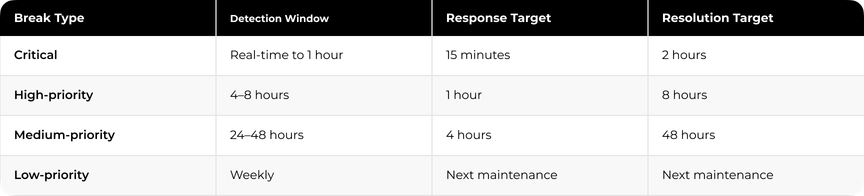
These timeframes are examples of a severity-based operating model. Actual detection and response targets depend on campaign complexity, team capacity, automation maturity, and business risk.
What Factors Determine Your Detection SLA Timeframes?
Detection SLA requirements vary significantly across organizations because campaign complexity, team capacity, automation maturity, and business risk differ from one company to another. Copying another company's timeframes without understanding these factors leaves teams either overwhelmed or underprotected. The right window depends on variables specific to each marketing operations setup.
Campaign volume and complexity
Running five campaigns annually versus fifty changes everything. Higher volume creates more failure points. A simple email blast to one list carries less risk than a multi-touch campaign spanning six channels with dynamic content and territory-based routing. As campaigns become more connected, a single failure can affect multiple systems at once. Breaks cascade faster as campaigns grow more interconnected.
Team size and available resources
Smaller marketing operations teams may have one manager handling tech, data, planning, and campaign execution simultaneously. Mid-sized organizations see the function grow to include specialists for MarTech and analytics, allowing monitoring to handle more work without sacrificing quality. Large enterprises may have separate teams for tech, data, planning, and enablement, each with its own manager. Team capacity determines how often systems can be checked.
Tools and automation capabilities
Manual monitoring does not scale. Problems compound before detection if the monitoring system refreshes too slowly. High-performing teams start each day with a structured check that reviews overnight alerts, scans performance scorecards, and triages issues. Tools like MetricsWatch check analytics every five to ten minutes. Platforms like Adzooma support monitoring every 15 minutes for higher-tier plans. This routine becomes impossible without automation.
Business impact and risk tolerance
Risk tolerance sets minimum and maximum limits for each risk category. A publicly traded company prioritizing steady returns might set tighter detection windows than a startup that accepts volatility for growth. Higher business stakes demand faster detection.
“For the first time in our annual research report, the top success measure for a marketing operations professional has now shifted from pipeline as a core KPI to our ability to create operational enablement and scalability.” Mike Rizzo, CEO, MarketingOps.com
How Do You Build an Effective Monitoring System for Tracking and Routing?
Manual checks will not catch breaks fast enough. Configure alerts for conversion drops, traffic anomalies, and tracking failures across all channels: email for non-urgent issues, Slack and SMS for major breaks.
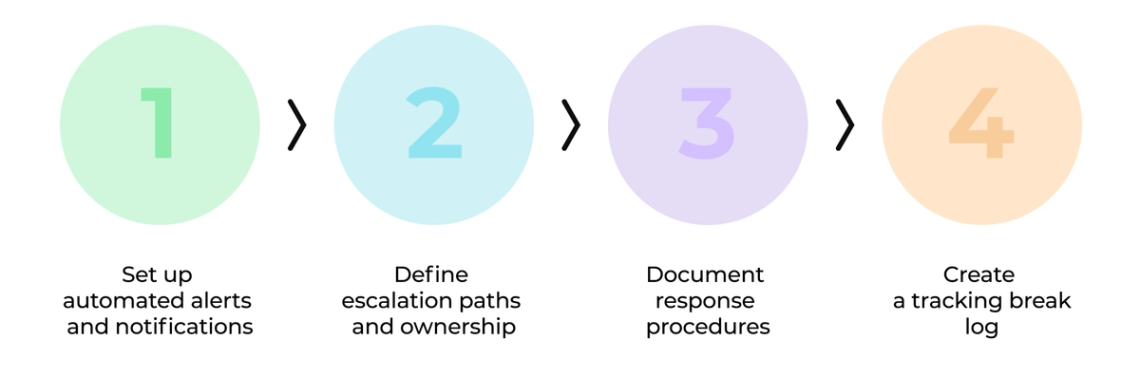
1. Set up automated alerts and notifications
A monitoring tool needs multi-channel notification capability. Send conversion alerts to the marketing lead and traffic drops to the dev team's Slack channel. Schedule different thresholds for weekdays versus weekends. Campaign-specific alert windows match actual traffic patterns instead of triggering false alarms.
2. Define escalation paths and ownership
Escalation paths define who handles what when things break. Structure the response in tiers. Primary on-call handles initial triage within five minutes. If unresolved within 15 minutes, escalate to subject matter experts with ten-minute response windows. Management gets involved when incidents hit the one-hour mark or affect revenue substantially. Document specific conditions that trigger each escalation level.
3. Document response procedures
Written procedures prevent confusion during incidents. Detail containment steps, diagnostic workflows, and mitigation actions for common break types. Pre-approve fixes for predictable scenarios so responders can act without waiting for authorization.
4. Create a tracking break log
Document every incident. Capture symptoms, affected systems, resolution steps, and timeline data. This log reveals patterns. Repeated breaks in the same workflow signal deeper problems that require structural fixes. Once the same routing error appears three times, the monitoring system has identified where to strengthen the underlying infrastructure.
How Darwin Builds Marketing Operations Monitoring Infrastructure
When Darwin audits a marketing operations stack, detection time for tracking and routing failures is rarely defined anywhere. Teams know their campaign build SLAs. They know how long a form takes to launch or an email to deploy. What they do not know is how long a broken routing rule has been silently misfiring, or when their UTM parameters stopped populating correctly.
Darwin works with B2B SaaS marketing and revenue teams to build the data and workflow infrastructure that makes monitoring enforceable. That means defining ownership, detection thresholds, and escalation logic across the full marketing and revenue stack, including GA4, HubSpot, Salesforce, and the automation layer connecting them, then building the operating loop that prevents the same failure from appearing twice.
A detection SLA is only enforceable when the infrastructure underneath it is built to surface breaks at the moment they occur.
FAQs
Q1. What is a marketing operations SLA for detection speed?
A marketing operations SLA for detection speed is a formal definition of how quickly a team must identify and respond to tracking or routing failures, classified by severity. It specifies response time targets: 15 minutes for critical breaks, one hour for high-priority. It assigns ownership for each tier. Without defined detection time, failures stay invisible until they surface in reporting.
Q2. How fast should critical tracking breaks be detected?
Critical tracking breaks that directly affect revenue: form submission failures, complete routing breakdowns, payment tracking issues. These should be detected in real time to within one hour. The recommended response time is 15 minutes maximum, with a resolution target around two hours. Automated alerts and real-time monitoring are non-negotiable at this tier.
Q3. What is the difference between a tracking break and a routing break?
A tracking break occurs when systems fail to capture marketing data or customer touchpoints: pixel firing issues, missing UTM parameters, browser-blocked scripts. A routing break occurs when leads are not assigned correctly to sales representatives due to duplicate CRM records, missing field values, or failed workflow logic. Both corrupt data quality and damage pipeline performance, but they require different detection methods and fixes.
Q4. Why does detection speed matter for marketing attribution?
Fast detection prevents compounding attribution waste. When a tracking break goes undetected for weeks, budget decisions run on corrupted data, high-performing channels get cut, and the team has no reliable baseline to optimize from.
Q5. What factors determine the right detection SLA timeframes for a team?
Detection speed requirements depend on campaign volume and complexity, team size and available resources, the automation capabilities of the monitoring tools in use, and the organization's business impact and risk tolerance. High-volume operations with multi-channel campaigns require faster detection windows than simpler, lower-volume programs. The SLA should be calibrated to each organization. The SLA should not be copied from a generic template.