
Quick Answer
A working B2B attribution stack in 2026 is a connected system for capturing first-party data, resolving identity, syncing CRM records, comparing attribution models, and tying campaign influence to pipeline and closed-won revenue. Tools produce reliable output only when the tracking, taxonomy, CRM logic, and reporting foundation underneath them are clean.
TL;DR
- Platform bias. Meta, Google, and LinkedIn each claim credit for the same conversion. Without an independent attribution system, ROAS calculations are built on double-counted data.
- Identity gaps. Attribution accuracy degrades when CRM, MAP, and warehouse records cannot be matched consistently. Teams should define a target match rate before trusting model output.
- Model selection. No single attribution model tells the full story. Revenue teams that compare multiple models side-by-side make better budget decisions.
- Stack audit first. The average enterprise runs 900+ applications with only one-third integrated. Audit before adding anything new.
- Migration approach. Run parallel systems during migration to validate attribution accuracy before removing legacy tools.
- Tool selection. Attribution tools reflect your data quality. They do not fix it.
B2B buyers interact with a brand 8–12 times before converting on average. Most attribution dashboards still credit the final click. That gap explains why many marketers struggle to answer basic attribution questions accurately, and why board meetings get tense when different reports show different ROI numbers.
Tool recommendations below are organized by sales cycle complexity and company stage.
Where Attribution Fits in the Marketing System
Attribution disputes in leadership meetings are a reporting problem. The cause sits one step earlier, in how systems connect.
When a CRM, marketing automation platform, and ad channels operate without a unified identity foundation, each system counts what it can see. The result is three different conversion numbers from three platforms, all technically accurate within their own tracking logic.
Darwin works at the Connections pillar first: auditing how data moves between systems, where identity resolution drops below the target match threshold, and where UTM governance breaks down. Consistent, trustworthy attribution numbers follow from that infrastructure work. Budget decisions move faster when marketing and sales trust the same numbers.
What Breaks First in a B2B Attribution Stack
Most attribution stacks fail before a report is ever opened. The breaks happen at the data collection and system connection level.
- Ad platforms double-count conversions. Each ad platform uses its own attribution window and event logic, so the same conversion can be claimed by multiple systems.
- UTM parameters fragment campaign reporting. Different team members create their own naming conventions. One campaign appears as three separate sources in the CRM.
- CRM lifecycle stages are inconsistent. Marketing and sales define MQL, SQL, and opportunity differently. Attribution models built on top produce conflicting pipeline numbers.
- HubSpot and Salesforce objects do not always map cleanly. Contact-level and account-level data live in separate objects with no automatic reconciliation.
- Offline events and sales touches disappear. Phone calls, in-person demos, and executive conversations never enter the attribution system.
- GA4 and CRM disagree on source and revenue. Session-based and contact-based attribution count differently by design. The GA4 and CRM attribution gap compounds when neither system is the defined source of truth.
- No one owns the attribution model logic. Rules change between quarters. Historical data becomes incomparable.
Why Attribution Data Conflicts in B2B Stacks
Attribution stacks fail because the data never agrees with itself.
How platform-reported conversions conflict
Each ad platform uses its own attribution window and event logic, which means the same conversion can be claimed by multiple systems simultaneously. Sum up the conversions reported by each platform and you’ll find you’ve supposedly generated 150–200% of your actual conversions. Budget decisions start to rely on inflated numbers when the same conversion is counted multiple times.
The same user sees an influencer post, clicks a Meta ad, then a Google ad, then converts. Each platform claims that conversion. Without an independent attribution system outside your ad platforms, total attributed conversions routinely exceed actual closed deals.
Disconnected tools creating data silos
Marketing stacks can run 10–20+ platforms with different data formats, APIs, tracking methodologies, and attribution windows. When tools do not share data automatically, decisions get made on incomplete information. The average enterprise runs nearly 900 applications with only one-third integrated, leaving data fragmented across departments where it never gets used.
Attribution models that mislead budget decisions
Last-click attribution assigns full credit to the final touchpoint. Paid search and branded search capture that credit, while SEO, LinkedIn, and email, the channels that educated the buyer over weeks, show zero contribution. A 2025 marketing attribution analysis found that proper attribution reduces wasted ad spend by 27% on average, because teams stop cutting channels that drive pipeline but never get credit.
Mature teams compare MMM, MTA, and incrementality testing and assign each model a defined role in budget decisions.
Missing dark social and untracked touchpoints
Buying committees discuss and confirm solutions in private channels before any tracked click occurs. This activity gets misclassified as direct traffic and strips credit from channels that generated awareness. Offline events, sponsorships, and word-of-mouth referrals look non-contributory in standard attribution reports. Channels that generate awareness lose budget because the model cannot see what they started.
What a Working B2B Attribution Stack Includes
An attribution stack works with a defined set of components. The infrastructure captures the full buyer journey and records how each touchpoint contributes.
First-party data collection infrastructure
First-party data anchors attribution in identifiable user actions. Website behavior, email engagement, SMS response rates, offline forms, and mobile interactions all generate signals tied to real users in your systems.
Before choosing attribution software, teams need to decide whether the next data foundation should be a CDP, data warehouse, or CRM cleanup. A solid first-party data foundation pinpoints exactly where prospects are in the decision-making process without relying on inferred signals from ad platforms.
Cross-device identity resolution
Customers switch devices throughout the buyer’s journey. Cross-device tracking solutions identify and connect customer interactions using deterministic or probabilistic matching. Deterministic matching uses verified data points like email or login credentials and can achieve high accuracy. Probabilistic methods complement this to build a fuller picture.
For teams losing browser-side signal due to privacy restrictions, server-side tracking can improve first-party signal delivery.
“Tying pipeline and revenue to marketing efforts has never been easier. This is a huge improvement from all attribution tools I’ve used,” — Elsa Giraudineau, Director of Demand Generation, Telnyx
Multi-model attribution engine
Multi-touch attribution (MTA) assigns credit to multiple touchpoints along the customer journey. 41% of marketing organizations currently use attribution modeling as a measure of return on investment. Different models surface different insights: linear attribution assigns equal weight to each touchpoint, position-based models give more weight to first and last touches, and time decay models weight touches closest to conversion more heavily.
Revenue and pipeline attribution
75% of companies using attribution models to track return on investment see efficiency gains when attribution connects to planning and execution. Revenue attribution tracks through to closed-won revenue and expansion.
Automated insights and reporting
Automated reporting surfaces patterns in conversion paths and channel interactions that manual analysis misses. When attribution data flows automatically into dashboards, teams spend time on decisions.
AI-based attribution workflows depend on marketing data readiness for AI agents: clean CRM fields, consistent UTMs, reliable consent signals, and governed reporting logic.
Integration across your tech stack
Server-side tracking bypasses browser-based limitations from iOS privacy updates and cookie deprecation. When evaluating attribution platforms, prioritize cross-platform support, CRM integration depth, and bidirectional sync. Reverse ETL tools become useful when warehouse-quality data needs to move back into CRMs, ad platforms, and campaign systems.
B2B Attribution Stack Audit Checklist
Run this checklist before adding any new attribution tool. Each item maps to a specific failure point in B2B attribution stacks.
- UTM standardization. Are UTM parameters consistent in all campaigns, channels, and team members?
- Form field mapping. Are form fields mapped correctly into CRM contact and company records?
- Lifecycle stage agreement. Do marketing and sales share the same definitions for MQL, SQL, and opportunity?
- Source preservation. Is original source data preserved from first touch through to closed-won revenue?
- Cross-system reconciliation. Can GA4, CRM, and ad platform numbers be reconciled within 5% variance?
- Revenue separation. Can reports separate lead influence from pipeline and closed-won revenue?
- Model ownership. Is someone responsible for attribution model logic and change documentation?
What to Keep and Replace in an Attribution Stack
Running an audit means comparing what you have against what produces results.
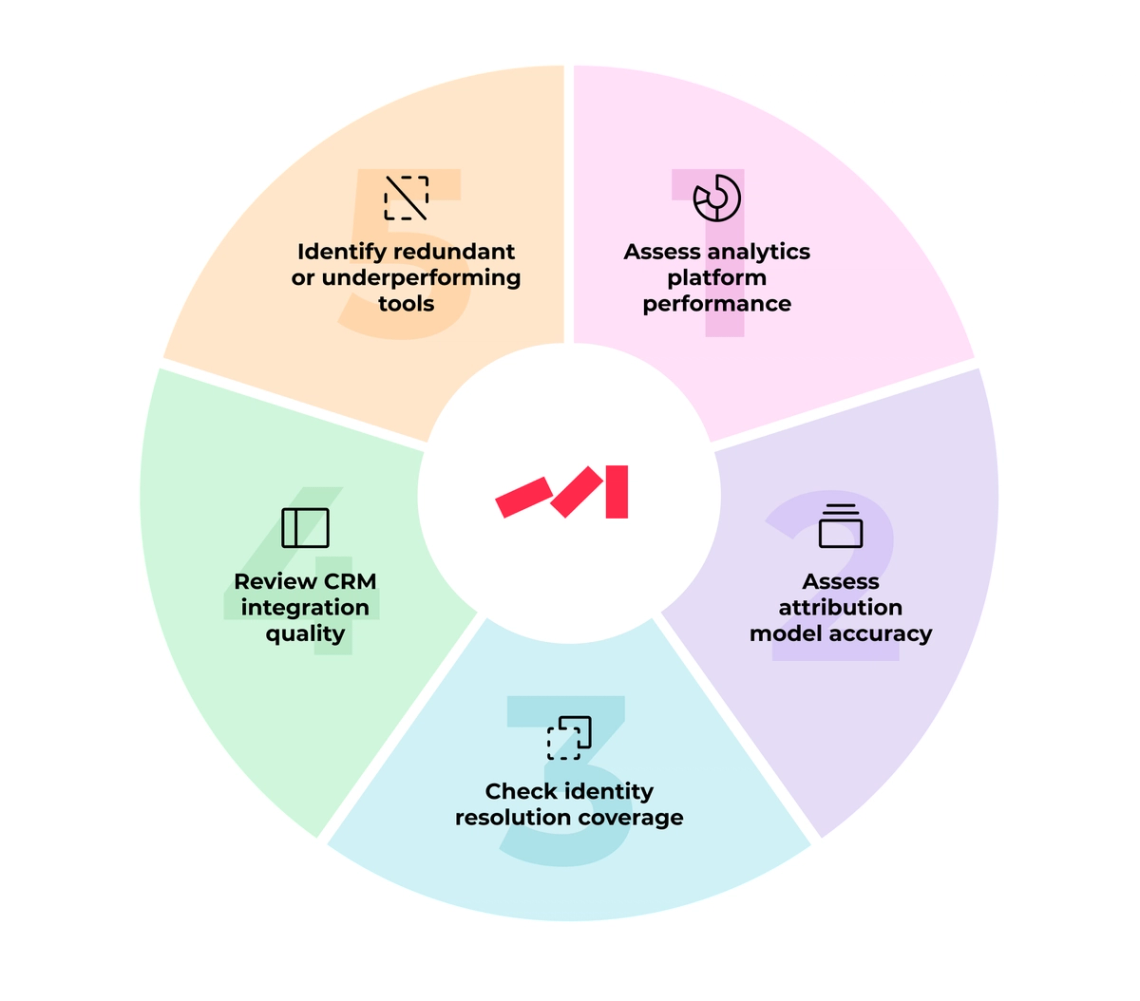
1. Assess your analytics platform performance
Your analytics platform should pull data from ads, social, email, CRM, and offline sources without manual exports. It needs to clean duplicates automatically so decisions are based on consistent data. Check whether your setup provides current data or if decisions are being made on yesterday’s numbers.
2. Assess your attribution model accuracy
Attribution accuracy starts with identity resolution. People and accounts need stable IDs in all devices and systems. Your touch capture rate should reach 85% or higher. Pipeline reconciliation between your attribution system and CRM should stay within 5% variance for qualified opportunities.
Back-test your model in historical windows and segments. When you scale a campaign your model identifies as high-performing, does revenue scale proportionally? Doubling budget on a campaign with a strong reported return that drops significantly after scaling means your model was crediting conversions it did not drive.
3. Check your identity resolution coverage
Define a target match rate for active records in your marketing automation platform, CRM, and data warehouse. Deterministic matching based on verified identifiers like email or login credentials produces the highest accuracy. Probabilistic methods complement this but introduce accuracy risk for direct customer actions.
4. Review your CRM integration quality
Proper integration creates bidirectional data flow. Marketing touchpoints should appear in your CRM so sales sees exactly how each lead found you. Revenue data needs to flow back to your attribution platform so you know which channels generate deals.
5. Identify redundant or underperforming tools
Calculate cost-per-function for each tool and compare against alternatives. The average enterprise uses 90+ marketing tools with overlapping capabilities. Single-use tools with low adoption and licenses teams cannot explain are candidates for removal.
Steps to Replace Legacy Attribution Tools
Migration is a validation process where each phase confirms data consistency before systems are replaced.
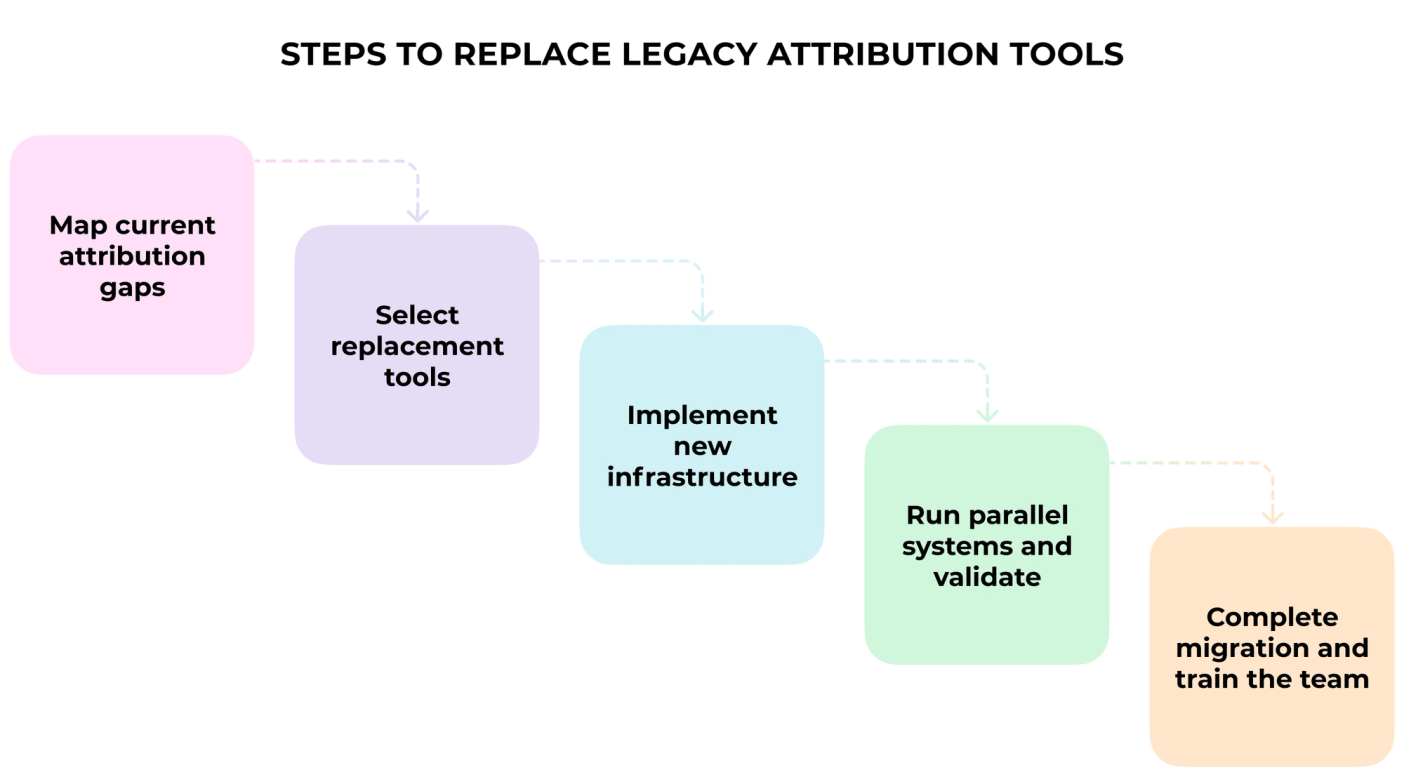
Phase 1: Map current attribution gaps
Document every tracking pixel, tag, and analytics tool installed on your website. Audit UTM parameter usage in the team. Identify where cross-device tracking breaks down and document which systems communicate and which operate independently.
Phase 2: Select replacement tools
Sales cycle length should guide tool selection. Short cycles with minimal touchpoints work with simpler models. Multi-month cycles with 8–12 touchpoints need analytical attribution that weights actual behavioral signals.
Phase 3: Implement new infrastructure
Connect platforms one at a time. Start with one channel, verify data flows correctly, then add the next. Sequential testing makes troubleshooting simpler than debugging multiple integrations at once.
Phase 4: Run parallel systems and validate
Run controlled test conversions through each major channel. Compare attribution data against CRM conversions. Most migrations reach 90–95% accuracy. Perfect matching is rare due to attribution windows and timing discrepancies.
Phase 5: Complete migration and train the team
Establish a weekly validation routine where you spot-check recent conversions by tracing them through your systems. Build dashboards that match how your team makes decisions: channel performance views for media buyers, return on investment summaries for leadership.
Top B2B Marketing Attribution Software for 2026
The marketing attribution software market reached USD 5.40 billion in 2026, up from USD 3.10 billion in 2021. The right tool depends on your sales cycle, budget, and stack. Before selecting a platform, review the marketing measurement tools that support it: the tracking, CRM sync, campaign taxonomy, and revenue reporting logic underneath determine whether any tool produces reliable results.
Best overall attribution platforms
HubSpot Attribution works best for teams already running CRM and marketing automation inside HubSpot. Marketing Hub Professional starts at USD 890/month (3 seats, annual billing), Enterprise at USD 3,600/month for full multi-touch revenue attribution. Dreamdata takes an account-based approach for B2B companies with complex sales cycles; pricing is quote-based. HockeyStack unifies go-to-market data with AI agents that analyze touchpoint contributions to pipeline; pricing is quote-based and scales with data volume.
Specialized B2B SaaS attribution tools by stage
Teams under USD 5M ARR: HubSpot's native attribution plus self-reported fields Teams under USD 5M ARR: HubSpot’s native attribution plus self-reported fields covers most needs. Mid-market (USD 5–20M ARR): HockeyStack or Dreamdata with account-level tracking, both offering Salesforce and HubSpot integration. Enterprise above USD 20M ARR: SegmentStream, Adobe Marketo Measure (formerly Bizible), or custom CDP stacks.
Solutions for account-based marketing attribution
Dreamdata tracks all touchpoints for every stakeholder and attributes revenue at the account level. The platform integrates with Salesforce and HubSpot, pulling pipeline data and deal stages automatically, which makes it suitable for multi-stakeholder B2B sales cycles.
Tools for complex multi-stakeholder journeys
Ruler Analytics connects marketing touchpoints to closed revenue in CRMs, tracking phone calls, form submissions, and offline events in multi-touch journeys. Pricing is traffic-based and quote-driven.
Budget-friendly options by company stage
Teams spending under USD 50K monthly on 1–2 channels often find native Teams spending under USD 50K monthly on one or two channels often find native analytics with disciplined UTM tracking sufficient. A low-cost attribution tool without CRM integration rarely solves the reporting problem. Match tool sophistication to actual sales cycle complexity.
Attribution tools reflect your data quality. They do not fix it.
How Darwin Helps B2B SaaS Teams Fix Attribution
Attribution breaks down at the infrastructure level. When CRM data does not sync with your marketing automation platform, when identity resolution sits below target thresholds, or when teams use four different UTM naming systems, no attribution model fixes that. The issue sits in how systems collect and pass data.
Darwin works with mid-market SaaS teams to audit attribution infrastructure, identify where tracking breaks, and implement first-party data foundations that connect marketing touchpoints to closed-won revenue. The work focuses on what drives pipeline decisions.
For Wizehire, Darwin cleaned and enriched the tracking setup, expanding tracked conversion-relevant events from four to nine. With better channel visibility, the team identified high-cost, low-ROI paid channels and reallocated budget toward stronger opportunities. Within four months, Wizehire reduced cost per lead by 26%, increased funnel volume by 60%, and shortened lead response time from 2–4 hours to 15 minutes.
Darwin covers data and analytics infrastructure, marketing analytics including attribution modeling and UTM governance, and AI readiness for teams moving toward automated attribution workflows.
FAQs
Q1. Why do different marketing platforms show conflicting conversion numbers?
Each ad platform uses its own attribution window and event logic, which means the same conversion can be claimed by multiple systems. Without an independent attribution system, summing platform-reported conversions can result in 150–200% of actual conversions. ROAS calculations built on this data are unreliable.
Q2. Why does my attribution data show more conversions than my CRM?
Attribution tools count touchpoints your CRM never sees. Buying committees validate vendors in private channels before any tracked click occurs. This activity gets misclassified as direct traffic and strips credit from channels that generated awareness earlier in the buying cycle.
Q3. What match rate should I target for identity resolution?
Define a target match rate for active records in your marketing automation platform, CRM, and data warehouse before selecting an attribution model. Deterministic matching using verified identifiers like email or login credentials produces the highest accuracy. Probabilistic methods complement this but introduce accuracy risk.
Q4. How much should early-stage companies spend on attribution software?
Teams under USD 5M ARR need HubSpot’s native attribution combined with disciplined UTM tracking. A low-cost attribution tool without proper CRM integration rarely solves the reporting problem. Tool sophistication should match actual sales cycle complexity.
Q5. What is the recommended approach when migrating to new attribution tools?
Run parallel systems during migration to validate accuracy before removing legacy tools. Connect platforms sequentially, verifying one channel fully before adding the next. Most migrations reach 90–95% accuracy when comparing attribution data against CRM conversions.