DarwinApps BlogWe create reliable marketing systemshttps://www.darwinapps.com/2026-06-08T09:56:21.000ZDarwinAppsThe Marketing Ops SLA: How Fast Should Teams Detect Tracking and Routing Breaks?https://www.darwinapps.com/blog/the-marketing-ops-sla-how-fast-should-teams-detect-tracking-and-routing-breaks/2026-06-05T10:30:00.000Z2026-06-08T09:56:21.000ZMost marketing operations SLA frameworks focus on campaign build times. This guide covers detection time for tracking and routing breaks, and how to build the monitoring system your team actually needs.
Quick Answer:
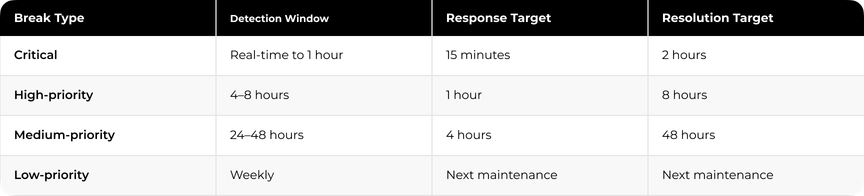
A marketing operations service level agreement (SLA) for detection speed should classify breaks by severity. Critical failures: form submission errors and complete routing breakdowns. These require real-time to one-hour detection with a 15-minute response target. High-priority breaks such as UTM parameter failures allow four to eight hours. Medium-priority reporting inconsistencies allow 24 to 48 hours. Weekly monitoring covers cosmetic and legacy issues. Speed alone does not prevent repeat failures; the detection system needs to feed a break log that drives structural fixes.
TL;DR:
Detection speed. Critical tracking and routing breaks require real-time monitoring; most teams only measure campaign build time, not failure response time.
Financial exposure. Poor data quality costs organizations an average of $12.9 million annually. Delayed detection turns a fixable system error into compounding attribution waste.
Severity tiers. A working marketing operations SLA separates critical, high-priority, medium-priority, and low-priority breaks with specific response and resolution windows.
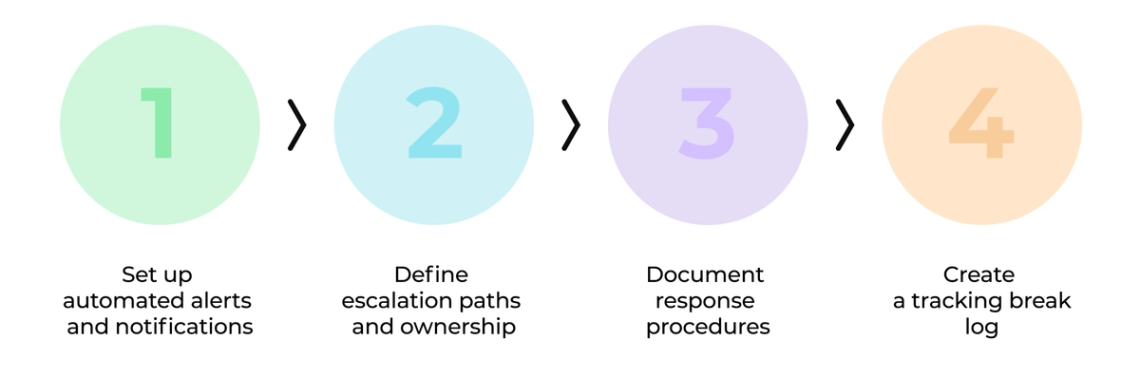
Monitoring architecture. Automated alerts, escalation paths, documented procedures, and a tracking break log form the operational backbone.
Systemic fixes. Catching the same routing error three times signals a structural problem. Detection speed matters; learning from breaks matters more.
A marketing operations team spends six months building attribution logic, connecting GA4, HubSpot, and ad platforms into a coherent reporting stack. Then a single pixel misfires. The form stops routing leads. The CRM sync drifts. Nobody notices for three weeks. The reason is simple: nobody defined how quickly those failures should be detected. By the time someone pulls the attribution report, the damage is done.
Marketing teams often know how long it takes to launch a campaign. Far fewer know how quickly they should detect a broken form, a failed routing rule, or missing attribution data. That gap is where attribution breaks, pipeline disappears, and reporting loses credibility.
Detection speed determines whether a break costs an hour or a month of clean data. This article covers the detection timeframes that belong in every marketing operations SLA, the factors that shape them, and the monitoring system that makes them enforceable.
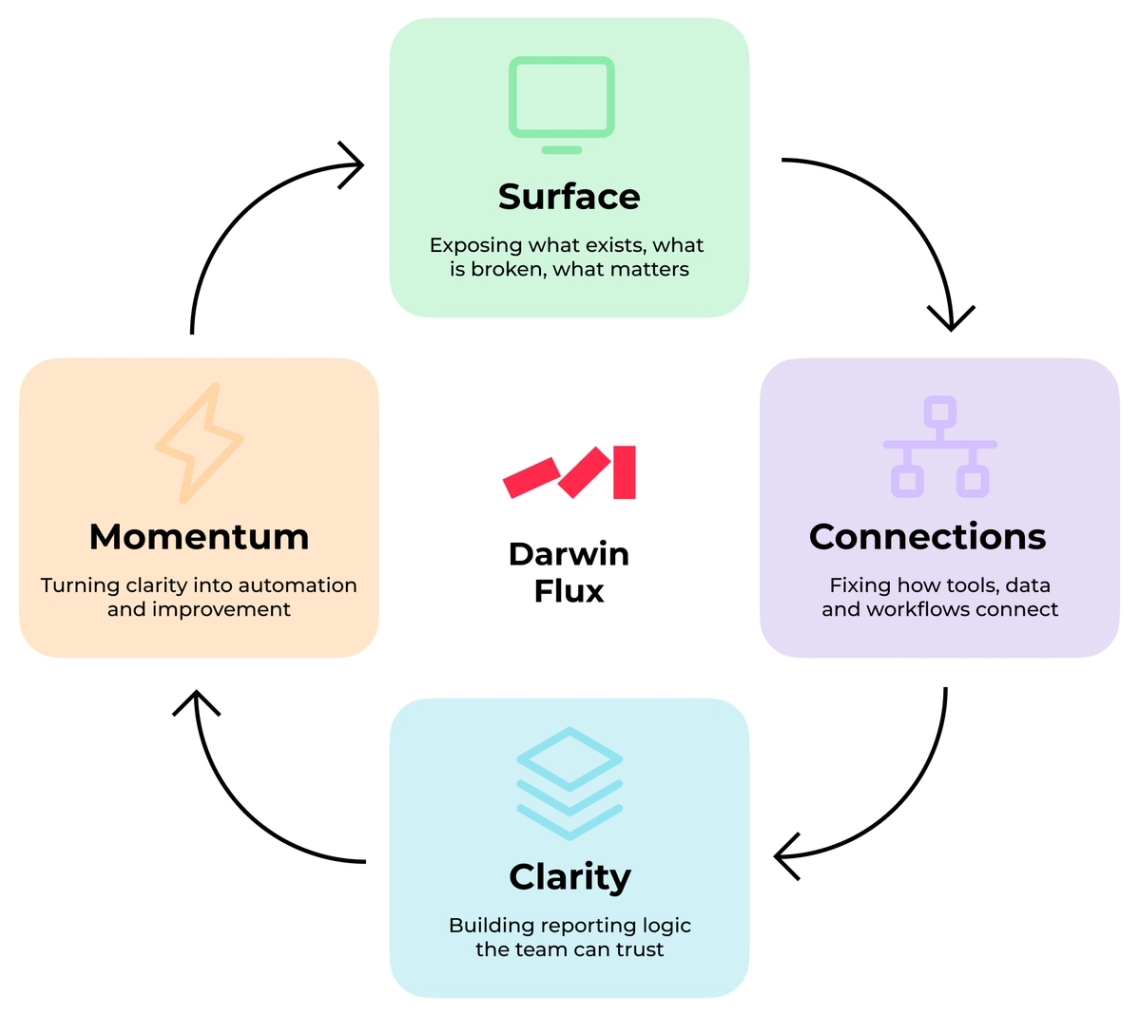
In Darwin Flux terms, this is where Connections either create Clarity or quietly destroy it. Tracking and routing breaks are rarely isolated technical failures. They are failures between systems, ownership, and reporting trust.
What Are Tracking and Routing Breaks in Marketing Operations?
Tracking and routing breaks occur when the systems that capture marketing data or assign leads to sales representatives stop working. A broken pixel or a failed routing rule rarely surfaces immediately. It surfaces weeks later, in a report that cannot reconcile, in a pipeline number that sales and marketing cannot agree on, or in a budget decision made on numbers nobody can verify.
How Do Tracking Breaks Corrupt Attribution Data?
Tracking breaks happen when your marketing attribution monitoring fails to capture conversion events or customer touchpoints. Pixel firing issues sit at the top of the list. A tracking pixel might be installed on the homepage but missing from the confirmation page, or firing twice, inflating conversion numbers. The entire pixel tracking system depends on a chain of events executing correctly. Conversion data disappears if JavaScript does not load, if the browser blocks cookie storage, or if the network request times out.
Browser restrictions have made browser-based tracking significantly less reliable. Tracking pixels can undercount conversions by 20 to 40% because of ad blockers and Safari's Intelligent Tracking Prevention (ITP). Safari's ITP limits JS-set first-party cookies to seven days of storage, meaning returning visitors outside that window lose their tracking connection. Ad blockers compound this further: many businesses discover their pixel captures only 60 to 70% of actual conversions, and that percentage continues declining.
Data capture problems create breaks before pixels enter the picture. Missing hidden UTM fields, incomplete form mappings, and forms that create contacts without campaign context all break attribution at the point of entry. UTM governance failures mean one campaign uses "linkedin," "LinkedIn," "li-paid," and "paid-social" across different links, fragmenting reporting entirely.
How Do Routing Breaks Affect Lead Assignment and Pipeline?
Routing breaks when data breaks. Duplicate records cause leads to get assigned to multiple representatives or fall through entirely. The same person exists twice in the CRM with different data, and routing rules fire inconsistently. One record triggers territory-based routing, the other triggers round-robin. Both representatives reach out. The buyer gets confused.
Missing fields cause leads to fall into default queues or get misrouted. No industry value means segment routing cannot fire. No territory field means geo-routing fails. No employee count means the system cannot distinguish SMB from enterprise. Sales teams signal routing problems through specific complaints: representatives receiving leads outside their territory, leads sitting unassigned for 48 hours because a workflow failed silently, no notification to take action after a prospect submits a request.
What is the cost of undetected breaks?
Inaccurate tracking creates budget misallocation. A pixel showing 100 conversions when actual sales hit 180 means budget decisions run on incomplete data. Spend flows into channels that are not working while high-performing campaigns get cut. Modern ad platforms use machine learning to optimize delivery, and algorithms cannot identify converting users when conversion data is incomplete.
Routing breaks damage conversion rates in a different way. Manual rerouting introduces human error. Someone forgets to notify the new assignee. The right representative makes contact after the buyer has moved on. Campaign association gaps mean marketing activity cannot connect to revenue objects, making campaign influence impossible to measure.
Why Does Detection Speed Matter for Marketing Operations SLAs?
Gartner estimates poor data quality costs organizations an average of $12.9 million per year. Wait days or weeks to detect tracking breaks, and the team is not just missing data points. It is burning budget while making decisions based on information that is fundamentally wrong.
What is the revenue effect of delayed detection?
Industry analysis estimates up to 47% of marketing spend is wasted due to attribution failures. Misdirected budgets, analyst time spent cleaning data, and decisions made on unverifiable numbers all compound over time. Every week a break goes undetected adds to that total.
“There's just really no connective tissue holding it all together. People are investing a lot of money into marketing and a lot of marketing is getting done. To me, it amounts to a lot of random acts of marketing.”Priscilla McKinney, CEO, Little Bird Marketing
How do data quality issues affect reporting accuracy?
Data quality issues lead to poor segmentation and targeting. They create a complete lack of understanding of where prospects are in the buyer experience. These problems multiply every day tracking breaks go undetected. Each hour of broken tracking corrupts the attribution baseline a little more.
Slow detection alters team behavior beyond financial waste. Marketing teams become defensive when performance is questioned. Sales blames lead quality. Agencies focus on surface metrics because deeper attribution is unavailable. Internal alignment suffers without shared visibility.
Decision-making moves from analysis to reaction. Teams stop using dashboards they cannot trust. Gut feelings take over. A clear marketing operations SLA prevents this erosion. Teams trust the data feeding their decisions when the monitoring system gives them a consistent answer on how quickly failures get resolved.
Tracking and routing failures reach reporting at the end of a longer chain. Systems stop communicating, ownership becomes unclear, and operational issues accumulate invisibly until they surface in attribution, pipeline, or forecasting. Detection speed matters because it shortens the gap between failure and action.
This operational challenge extends beyond monitoring and reporting. In a recent conversation on What Keeps Marketers Up at Night,Priscilla McKinney, CEO of Little Bird Marketing, discussed why marketing teams become reactive when systems, ownership, and repeatable processes are not clearly defined.
Watch the full episode with Priscilla McKinney on Darwin’s YouTube channel (Link HERE)
What Are the Recommended Detection Timeframes for a Marketing Operations SLA?
A marketing operations SLA needs different detection windows for different severity levels. Not every tracking break demands the same urgency. A broken form that captures demo requests requires a faster response than a misaligned dashboard widget.
Critical breaks: real-time to one hour
Real-time monitoring catches breaks that bleed revenue immediately. This category includes form submission failures, complete routing rule breakdowns, payment or checkout tracking failures, and high-value account tracking issues. Every minute costs pipeline when an enterprise demo form stops sending leads to Salesforce.
Response time for critical issues should hit 15 minutes maximum. Resolution targets should sit around two hours. Real-time monitoring and automated alerts are non-negotiable at this tier.
High-priority breaks: four to eight hours
High-priority breaks affect campaign performance but do not completely halt lead capture. UTM parameter tracking failures, secondary form routing issues, campaign attribution gaps, and pixel tracking degradation sit in this bucket. Lead capture continues, but attribution accuracy deteriorates.
Target a one-hour response time with eight-hour resolution windows for these issues. Set up alerts that notify the team when conversion volumes drop unexpectedly or when specific tracking parameters stop populating.
Medium-priority breaks: 24 to 48 hours
Medium-priority monitoring covers reporting inconsistencies, non-critical field mapping errors, dashboard display issues, and historical data sync problems. These breaks do not corrupt real-time data collection but create friction in analysis and reporting.
Response times can stretch to four hours with 48-hour resolution targets. Daily monitoring catches most of these issues before they compound. Morning health checks on key reports often surface medium-priority breaks early enough to prevent stakeholder confusion.
Low-priority breaks: weekly monitoring
Weekly monitoring handles cosmetic issues, archived campaign tracking, legacy system inconsistencies, and documentation gaps. These breaks have minimal business effect. Document them in the tracking break log, batch fixes together, and address them during maintenance windows.
These timeframes are examples of a severity-based operating model. Actual detection and response targets depend on campaign complexity, team capacity, automation maturity, and business risk.
What Factors Determine Your Detection SLA Timeframes?
Detection SLA requirements vary significantly across organizations because campaign complexity, team capacity, automation maturity, and business risk differ from one company to another. Copying another company's timeframes without understanding these factors leaves teams either overwhelmed or underprotected. The right window depends on variables specific to each marketing operations setup.
Campaign volume and complexity
Running five campaigns annually versus fifty changes everything. Higher volume creates more failure points. A simple email blast to one list carries less risk than a multi-touch campaign spanning six channels with dynamic content and territory-based routing. As campaigns become more connected, a single failure can affect multiple systems at once. Breaks cascade faster as campaigns grow more interconnected.
Team size and available resources
Smaller marketing operations teams may have one manager handling tech, data, planning, and campaign execution simultaneously. Mid-sized organizations see the function grow to include specialists for MarTech and analytics, allowing monitoring to handle more work without sacrificing quality. Large enterprises may have separate teams for tech, data, planning, and enablement, each with its own manager. Team capacity determines how often systems can be checked.
Tools and automation capabilities
Manual monitoring does not scale. Problems compound before detection if the monitoring system refreshes too slowly. High-performing teams start each day with a structured check that reviews overnight alerts, scans performance scorecards, and triages issues. Tools like MetricsWatch check analytics every five to ten minutes. Platforms like Adzooma support monitoring every 15 minutes for higher-tier plans. This routine becomes impossible without automation.
Business impact and risk tolerance
Risk tolerance sets minimum and maximum limits for each risk category. A publicly traded company prioritizing steady returns might set tighter detection windows than a startup that accepts volatility for growth. Higher business stakes demand faster detection.
“For the first time in our annual research report, the top success measure for a marketing operations professional has now shifted from pipeline as a core KPI to our ability to create operational enablement and scalability.” Mike Rizzo, CEO, MarketingOps.com
How Do You Build an Effective Monitoring System for Tracking and Routing?
Manual checks will not catch breaks fast enough. Configure alerts for conversion drops, traffic anomalies, and tracking failures across all channels: email for non-urgent issues, Slack and SMS for major breaks.
1. Set up automated alerts and notifications
A monitoring tool needs multi-channel notification capability. Send conversion alerts to the marketing lead and traffic drops to the dev team's Slack channel. Schedule different thresholds for weekdays versus weekends. Campaign-specific alert windows match actual traffic patterns instead of triggering false alarms.
2. Define escalation paths and ownership
Escalation paths define who handles what when things break. Structure the response in tiers. Primary on-call handles initial triage within five minutes. If unresolved within 15 minutes, escalate to subject matter experts with ten-minute response windows. Management gets involved when incidents hit the one-hour mark or affect revenue substantially. Document specific conditions that trigger each escalation level.
3. Document response procedures
Written procedures prevent confusion during incidents. Detail containment steps, diagnostic workflows, and mitigation actions for common break types. Pre-approve fixes for predictable scenarios so responders can act without waiting for authorization.
4. Create a tracking break log
Document every incident. Capture symptoms, affected systems, resolution steps, and timeline data. This log reveals patterns. Repeated breaks in the same workflow signal deeper problems that require structural fixes. Once the same routing error appears three times, the monitoring system has identified where to strengthen the underlying infrastructure.
When Darwin audits a marketing operations stack, detection time for tracking and routing failures is rarely defined anywhere. Teams know their campaign build SLAs. They know how long a form takes to launch or an email to deploy. What they do not know is how long a broken routing rule has been silently misfiring, or when their UTM parameters stopped populating correctly.
Darwin works with B2B SaaS marketing and revenue teams to build the data and workflow infrastructure that makes monitoring enforceable. That means defining ownership, detection thresholds, and escalation logic across the full marketing and revenue stack, including GA4, HubSpot, Salesforce, and the automation layer connecting them, then building the operating loop that prevents the same failure from appearing twice.
A detection SLA is only enforceable when the infrastructure underneath it is built to surface breaks at the moment they occur.
FAQs
Q1. What is a marketing operations SLA for detection speed?
A marketing operations SLA for detection speed is a formal definition of how quickly a team must identify and respond to tracking or routing failures, classified by severity. It specifies response time targets: 15 minutes for critical breaks, one hour for high-priority. It assigns ownership for each tier. Without defined detection time, failures stay invisible until they surface in reporting.
Q2. How fast should critical tracking breaks be detected?
Critical tracking breaks that directly affect revenue: form submission failures, complete routing breakdowns, payment tracking issues. These should be detected in real time to within one hour. The recommended response time is 15 minutes maximum, with a resolution target around two hours. Automated alerts and real-time monitoring are non-negotiable at this tier.
Q3. What is the difference between a tracking break and a routing break?
A tracking break occurs when systems fail to capture marketing data or customer touchpoints: pixel firing issues, missing UTM parameters, browser-blocked scripts. A routing break occurs when leads are not assigned correctly to sales representatives due to duplicate CRM records, missing field values, or failed workflow logic. Both corrupt data quality and damage pipeline performance, but they require different detection methods and fixes.
Q4. Why does detection speed matter for marketing attribution?
Fast detection prevents compounding attribution waste. When a tracking break goes undetected for weeks, budget decisions run on corrupted data, high-performing channels get cut, and the team has no reliable baseline to optimize from.
Q5. What factors determine the right detection SLA timeframes for a team?
Detection speed requirements depend on campaign volume and complexity, team size and available resources, the automation capabilities of the monitoring tools in use, and the organization's business impact and risk tolerance. High-volume operations with multi-channel campaigns require faster detection windows than simpler, lower-volume programs. The SLA should be calibrated to each organization. The SLA should not be copied from a generic template.
]]>Top 10 n8n Workflows for Marketing Operations in 2026https://www.darwinapps.com/blog/n8n-workflows-marketing-operations-2026/2026-02-26T00:00:00.000Z2026-06-06T11:12:03.000ZTen n8n workflows for marketing operations: lead routing, attribution, content ops, and sales handoff. Integration details and measurable outcomes included.
Quick Answer:
n8n is an open-source automation platform that connects marketing tools through pre-built integrations. Teams use it to automate lead scoring, content publishing, attribution reporting, competitor monitoring, email sequences, and sales handoff. Each workflow runs on a defined trigger, applies logic or AI processing, and routes outputs to CRM systems, Slack, or reporting tools without manual steps.
TL;DR
n8n is an open-source automation platform with 400+ integrations and 7,264+ pre-built templates. This article covers ten workflows for the most common marketing operations scenarios in 2026.
Lead routing and qualification. Inbound leads are scored using BANT logic and routed to CRM or nurture sequences automatically, without manual review.
Email sequences. Lead records are enriched before drafting. Messages are generated from structured context, not template variables.
Competitor and review monitoring. Pricing pages and review platforms are checked on a schedule. Material changes trigger alerts automatically.
Content operations. Assets from WordPress or RSS feeds are transformed into channel-specific formats and distributed without manual coordination.
Attribution and reporting. Closed deals are matched to originating lead sources. Revenue per channel is calculated and delivered to stakeholders automatically.
A/B testing and optimization. Conversion data from Google Analytics is retrieved and analyzed on a schedule. Recommendations are routed without manual spreadsheet work.
Sales handoff. Qualified leads are compiled into structured briefs and routed to sales with CRM task creation and escalation logic built in.
Marketing dashboard. Metrics from ad platforms, CRM, and analytics tools are centralized into one reporting layer that updates on schedule.
Marketing operations teams lose dozens of hours each week to repetitive coordination tasks. Email sends, post scheduling, lead routing and attribution reporting each take only minutes, yet together they consume a significant part of weekly capacity.
The 10 workflows below reflect common operational scenarios for marketing teams in 2026. Each example explains how the tools are connected, what decisions happen inside the workflow and how teams reduce routine work.
1. How Does n8n Automate Cross-Platform Social Media Scheduling And Publishing?
n8n connects content planning, AI generation and publishing APIs into one coordinated workflow. A shared calendar becomes the control point for distribution across platforms, with approval and status tracking embedded into the same flow.
How the n8n Workflow Orchestrates Multi-Channel Publishing
A scheduled trigger reads planned posts from Google Sheets and sends them to OpenAI’s GPT-4, which generates platform-specific versions in a single request. Posts are adapted for Twitter, LinkedIn and Instagram without manual reformatting.
DALL-E generates supporting visuals, which are stored in a connected asset repository such as Cloudinary before publishing. Before publishing, formatted previews are routed for approval. Once confirmed, posts are scheduled through Buffer. The spreadsheet updates with publishing status, previews and URLs to keep activity aligned.
This workflow connects Google Sheets for planning, OpenAI’s GPT-4 and DALL-E for content and asset generation, and Buffer for scheduled publishing. Each social platform connects through its API credentials, including LinkedIn OAuth2 and the Facebook Graph API. These integrations run content creation, approval and distribution inside one coordinated flow.
Who This Workflow Fits Best
Teams managing shared content calendars and approval dependencies reduce coordination overhead. Agencies gain clearer publishing status tracking across client accounts.
Measurable Results and ROI
A documented case study shows more than 20 hours per week recovered after moving scheduling and follow-up processes to n8n workflows. The workflow reduced coordination time and stabilized publishing cadence.
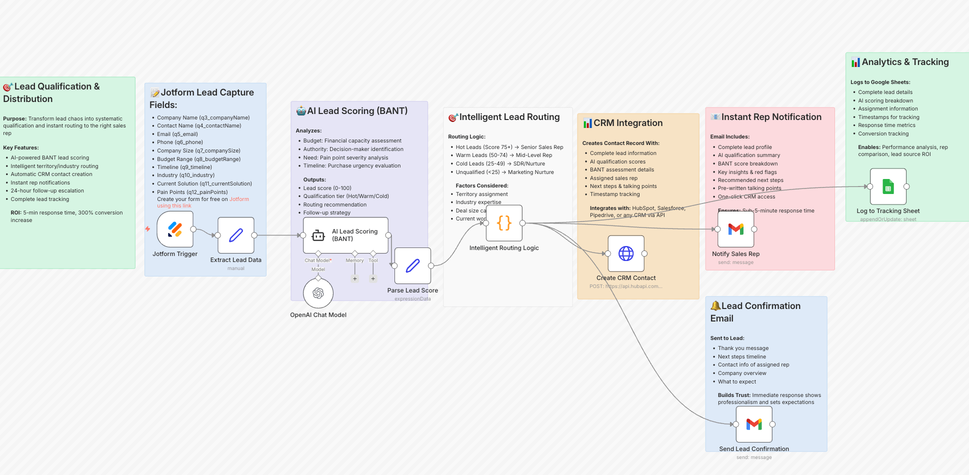
n8n scores and routes inbound leads immediately after submission. Qualification logic assigns priority based on defined criteria before records reach the CRM.
How the n8n Workflow Handles Lead Scoring and Routing
Inbound form submissions enter n8n through a webhook. The workflow applies BANT scoring using structured inputs such as budget, authority level, business need and timeline. Each prospect receives a score between 0 and 100, which determines routing logic.
High-score prospects are pushed directly into the CRM with predefined ownership rules and trigger instant notifications for the sales team. Mid-range scores enter a nurture sequence with AI-generated follow-up drafts prepared for review. Low-score submissions remain outside the active pipeline until additional signals are captured.
The workflow can also enrich records using website and company data to add context before scoring, improving assignment accuracy at the first routing stage.
B2B SaaS companies, enterprise sales teams and professional services firms handling high inbound volume benefit from structured qualification and faster routing decisions.
Measurable Results and ROI
A documented B2B SaaS case study shows response time reduced from more than 48 hours to minutes after implementing automated scoring in n8n. Routing accuracy improved and qualified prospects were assigned without manual review.
"Activities need to have a revenue outcome. Otherwise, you run out of money." — Steffen Hedebrandt, CMO & Co-founder, Dreamdata
3. How Does n8n Build Context-Aware Email Sequences?
n8n builds enriched email sequences by connecting lead sourcing, profile enrichment and AI drafting inside one coordinated workflow. Each message is generated from structured context rather than template variables.
How the n8n Workflow Builds Context Into Each Message
Lead records enter n8n from sourcing tools and are enriched before drafting begins. Profile attributes such as role, company context and recent activity are parsed and stored in the CRM to create a unified prospect view.
The workflow then generates subject lines and email bodies using the enriched dataset. Messages reflect individual context, avoiding static template fields. Delivery timing, reply detection and follow-up sequencing are managed within the same workflow, ensuring outreach logic stays consistent.
This workflow connects sourcing platforms via API, profile enrichment services, OpenAI’s GPT-4 or Claude for content generation, CRM systems such as HubSpot or Salesforce, and email delivery tools including Smartlead or similar platforms. Optional verification services validate addresses before sending.
Who This Workflow Fits Best
Sales development teams, agencies running outbound campaigns and companies executing account-based outreach benefit from structured enrichment and consistent sequencing logic.
Measurable Results and ROI
Outbound preparation shifts from manual research and drafting to structured automated processing, increasing daily outreach capacity without additional headcount.
4. How to Monitor Competitor Pricing and Website Changes with n8n
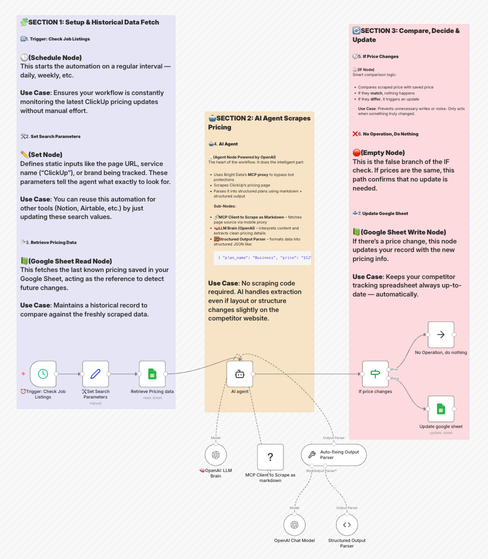
n8n monitors competitor websites and tracks pricing pages, feature updates and positioning changes automatically. The workflow compares current and previous versions and triggers alerts when pricing, feature sets or messaging change.The example below illustrates pricing monitoring logic implemented in n8n.
How the Workflow Detects Relevant Changes
Website data is collected on a defined schedule through scraping or API access. Each new version is stored and compared with historical records to identify specific differences.
Detected updates are evaluated before notification. Pricing adjustments, new feature releases and messaging updates are flagged, while minor formatting edits are ignored. Structured records are stored for reference and trend tracking.
Web scraping tools or APIs connect external pages to n8n. OpenAI GPT-4o helps evaluate whether detected updates represent material changes. Google Sheets or PostgreSQL store structured records. Slack or similar tools deliver notifications.
Who This Workflow Fits Best
Product teams tracking competitor releases, sales teams monitoring pricing shifts and marketing teams reviewing positioning benefit from automated change detection. Business intelligence teams gain structured historical records without maintaining manual tracking files.
Measurable Results and ROI
Manual site checks are replaced with event-based monitoring. Material updates surface automatically, allowing teams to react without maintaining separate tracking spreadsheets.
5. How to Automate Customer Review Monitoring and Response with n8n
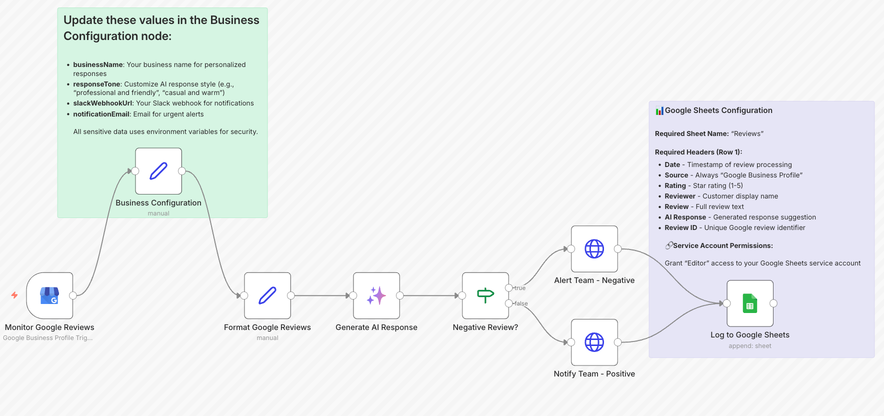
n8n collects reviews from multiple platforms, analyzes them and routes feedback automatically. Reviews are analyzed, categorized and assigned without manual checks.
Each review is analyzed, scored and tagged before routing. Negative reviews trigger immediate Slack or email alerts with full context. Positive reviews can be formatted for reuse on websites. All entries are logged with timestamps and sentiment data.
What Integrations Does This Workflow Use?
Google Business Profile API, Trustpilot data integration, Google Play Console API, OpenAI GPT-4o or Google Gemini for analysis, and Slack or email routing tools.
Who This Workflow Fits Best
E-commerce businesses managing multiple listings, local companies monitoring reputation and app developers tracking store feedback benefit from centralized monitoring and automated routing.
Measurable Results and ROI
Manual review checks are removed from daily operations and response time improves once alerts are automated. Feedback becomes structured and traceable instead of platform-dependent.
6. How to Orchestrate Multi-Channel Content Operations with n8n
n8n centralizes routing, formatting and distribution across channels inside one operational workflow. Assets are transformed, scheduled and tracked without manual coordination between tools.
How the Workflow Routes Content Across Channels
The workflow pulls content from WordPress or RSS feeds and transforms it into channel-specific formats. A single source asset becomes LinkedIn posts, newsletter summaries, short social updates or blog excerpts, each adapted for its destination.
Distribution runs on schedule and outputs are logged for tracking. The team sees what is published, pending or under review from one control layer.
For video content, YouTube URLs are retrieved and transcripts extracted before AI generates derivative formats. Engagement signals collected after publishing can trigger follow-up workflows or reporting updates.
WordPress or RSS feeds for content input, OpenAI GPT-4 or Gemini for content transformation, transcription APIs for video, publishing tools such as Buffer or SocialBu for distribution, and Airtable for tracking and status management.
Who This Workflow Fits Best
Agencies managing multiple client accounts and teams maintaining cross-channel consistency benefit from centralized orchestration. It is effective when content volume makes manual coordination inefficient.
Measurable Results and ROI
Publishing logic runs from a single source, reducing channel drift and eliminating the need for parallel coordination across tools.
7. How to Automate Marketing Attribution and ROI Tracking with n8n
n8n connects lead sources, deals and revenue data inside one workflow. Closed revenue is matched back to original acquisition channels automatically.
How Closed-Won Deals Are Matched to Original Lead Sources
The workflow retrieves closed deals on a defined schedule and matches each deal to its originating lead source. Revenue per source, cost per lead, conversion rate and return on investment are calculated and stored.
A separate process aggregates UTM-based leads by channel and aligns advertising spend with revenue outcomes. Reporting outputs are generated automatically and delivered to stakeholders without manual consolidation.
CRM systems for deal data, Google Sheets or Airtable for lead tracking, advertising platform APIs for spend data, OpenAI GPT-4o for report generation, and Slack or email for distribution.
Who This Workflow Fits Best
Marketing teams running multi-channel campaigns and agencies building client attribution reports benefit from centralized revenue mapping. It is relevant when manual spreadsheet reconciliation becomes unreliable.
"Attribution is an input, not the gospel truth." — Kyle Lacy, CMO at Docebo
8. How to Automate Landing Page A/B Testing and Optimization with n8n
A/B tests generate page-level conversion data. n8n collects, evaluates and routes those results into structured recommendations automatically.
How Test Results Become Actionable
The workflow retrieves page views and conversions from Google Analytics on a defined schedule. Conversion rates are calculated and logged per variant.
When thresholds are met, automated analysis evaluates UX structure, messaging clarity, technical performance and conversion flow. Recommendations are stored and shared without manual spreadsheet work.
Test results append to Google Sheets. Slack notifications trigger when a variant outperforms the baseline.
Google Analytics for performance data, Google Sheets for logging, OpenAI models for structured analysis, and Slack for notifications.
Who This Workflow Fits Best
E-commerce teams optimizing product pages, SaaS companies testing signup flows and agencies managing multiple landing pages benefit from automated evaluation and faster decision cycles.
Measurable Results and ROI
Variant performance is calculated automatically and stored in a structured format. Optimization decisions are based on logged conversion data instead of manual comparison across tools.
A qualified lead in the CRM is only valuable if the assigned rep has full context. n8n structures the handoff automatically once a lead reaches the defined qualification threshold.
How the Handoff Is Structured and Routed
When a lead meets scoring criteria, the workflow retrieves its full record, including UTM parameters, form responses, page activity, email engagement and qualification score. This data is compiled into a structured brief before assignment.
The brief is routed to the responsible rep via Slack and a follow-up task is created in HubSpot or Salesforce with a defined due date.
If no action is taken within a configured window, an escalation notification is sent to the sales manager. Each handoff is logged with timestamp, assigned rep and status.
For account-based campaigns, the workflow can append recent company updates or relevant talking points so the first outreach is informed by current context.
CRM platforms such as HubSpot or Salesforce for triggers and task creation, Slack for routing and escalation alerts, Google Sheets or Airtable for logging, and optional enrichment services for company-level context. OpenAI models generate the structured brief.
Who This Workflow Fits Best
B2B teams with defined sales cycles and shared ownership of inbound leads benefit most. It is relevant when marketing and sales operate in separate systems and handoff quality varies by rep.
Operational Impact
The time between lead qualification and first contact is reduced. Sales receives structured context instead of raw lead data. Lead-to-opportunity tracking becomes consistent because every handoff is logged and timestamped.
10. How to Build a Marketing Operations Dashboard with n8n
Marketing data often lives across advertising platforms, CRM systems, finance tools and social channels. n8n centralizes these inputs into one structured reporting workflow.
Scheduled workflows retrieve performance data from advertising platforms, CRM systems and analytics tools on a defined interval. Metrics such as spend, conversions, revenue and campaign performance are normalized and stored in a central data layer.
Incoming signals such as social mentions or campaign alerts can be categorized automatically and appended to the same reporting structure.
The dashboard reflects updated metrics without manual data exports or spreadsheet reconciliation.
Advertising platform APIs for campaign performance, CRM systems for pipeline data, Google Sheets or databases for structured storage, and OpenAI models for categorization or summary generation. Dashboard visualization tools consume the normalized dataset.
Who This Workflow Fits Best
Marketing leaders managing multi-channel performance, operations teams responsible for reporting accuracy and product teams tracking growth signals benefit from centralized data aggregation.
Operational Impact
Reporting cycles move from manual data consolidation to automated updates. Dashboards remain current between reporting periods, and teams make decisions based on synchronized data instead of fragmented exports.
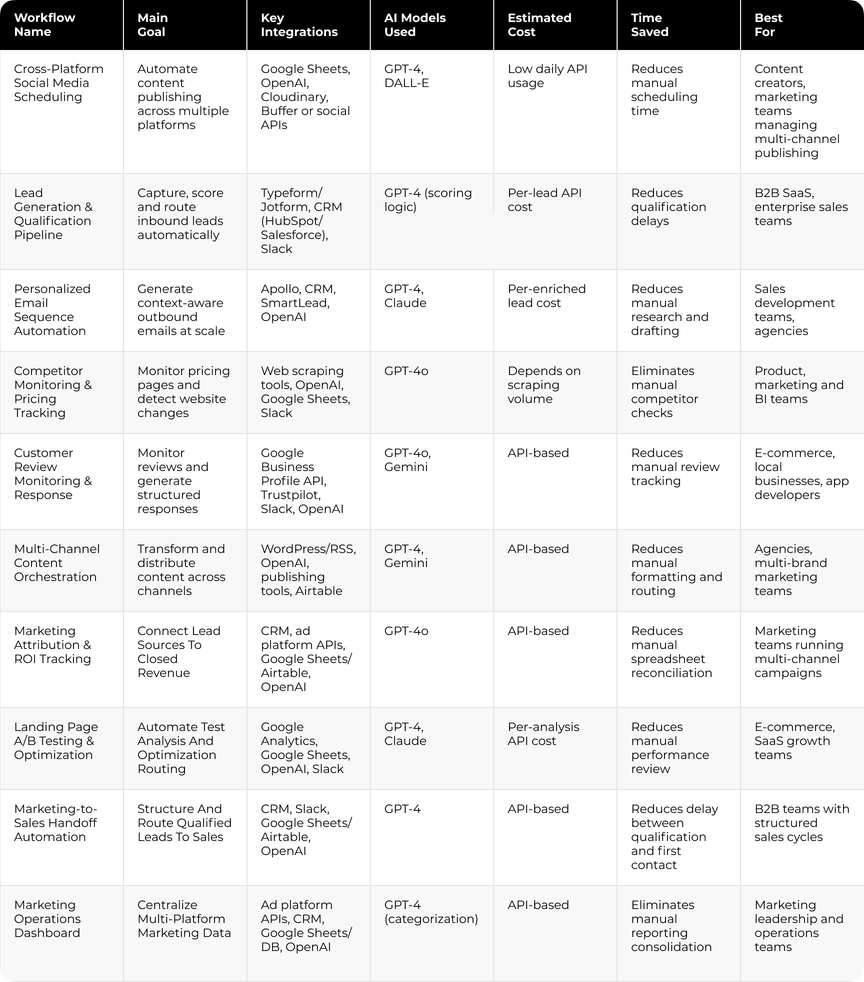
Comparison Table
If you have never set up an n8n workflow before, this beginner tutorial walks you through installation, setup, and first use in one walkthrough.
AI Orchestration Layer for Scaled Workflow Systems
The workflows described above automate individual processes: lead routing, attribution, reporting, content distribution and sales handoff. As these systems grow, coordination becomes more complex than execution.
Automation at scale requires structured control over how workflows interact, how AI outputs are routed, and how performance is monitored across teams.
Cross-workflow coordination. Outputs from qualification, attribution or optimization workflows can trigger validated downstream actions based on shared business logic.
System-level visibility. Execution status, dependencies and escalation paths are monitored across workflows, not inside isolated tools.
AI model governance. Prompt structures, model versions and output formats are managed centrally, allowing updates without destabilizing existing automation flows.
Operational rule enforcement. Approval logic, routing standards and prioritization criteria remain consistent as automation expands across marketing and sales.
Infrastructure stability. As new workflows are introduced, they integrate into an existing orchestration structure instead of creating parallel automation silos.
Darwin enables automation systems to operate as coordinated infrastructure rather than disconnected task automation.
FAQs
Q1. What are the main benefits of using n8n for marketing automation? n8n centralizes integrations, automates repetitive tasks and connects AI models with operational workflows. Teams reduce manual coordination and gain structured control over marketing processes.
Q2. How much time can marketing teams save with n8n workflows? Time savings depend on the use case. Lead routing, reporting and social publishing automation can eliminate hours of manual coordination each week.
Q3.Do I need coding skills to set up n8n marketing workflows? Most workflows can be built using the visual editor. Basic API understanding helps, but advanced coding is not required for standard marketing automation.
Q4. What is the typical cost of running AI-powered workflows in n8n? Costs are usage-based and tied to API calls. AI generation and analysis incur model fees, while many integrations run on low or free tiers.
Q5. Which workflow should marketing teams implement first? Start with the process that consumes the most manual time, such as lead qualification, reporting consolidation or multi-channel publishing.
]]>9 Best Reverse ETL Tools for CRM & Ad Platform Sync in 2026https://www.darwinapps.com/blog/9-best-reverse-etl-tools-for-crm-and-ad-platform-sync-in-2026/2026-06-03T10:30:00.000Z2026-06-04T16:26:02.000ZCompare the 9 best reverse ETL tools for syncing warehouse data to CRMs and ad platforms. Covers pricing, integrations, warehouse support, and GTM use cases for B2B SaaS teams.
Quick Answer:
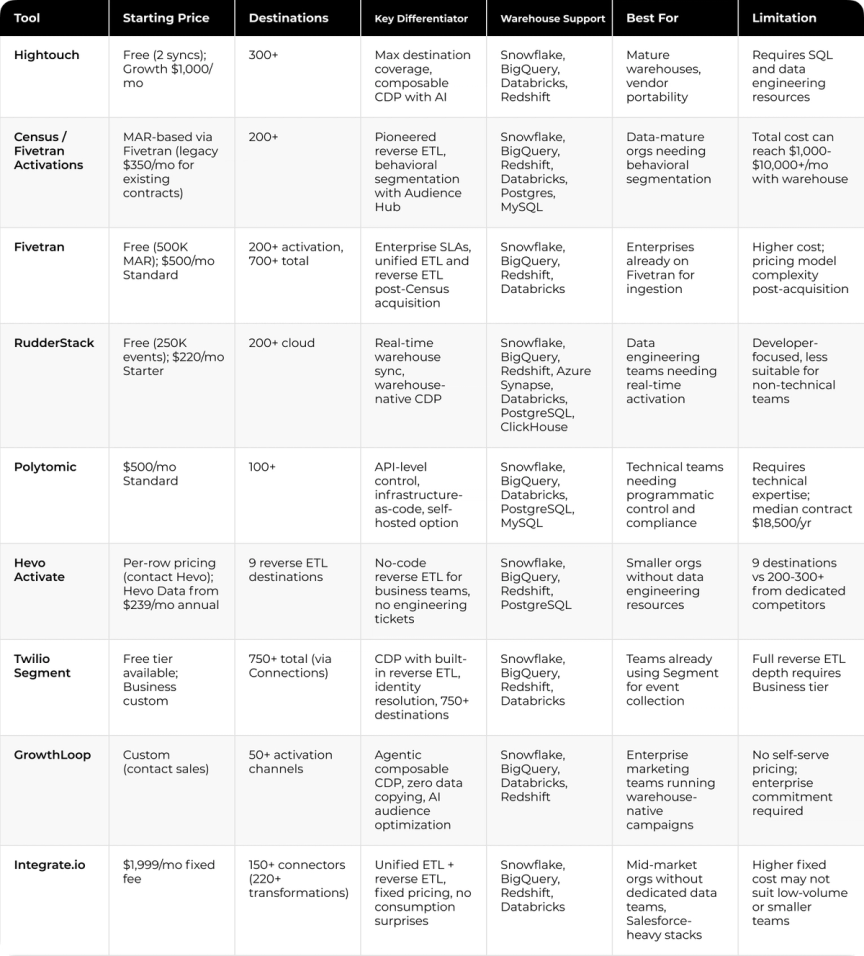
The right reverse ETL tool depends on three decisions: which destinations your go-to-market (GTM) stack requires, whether your team has SQL-capable engineers to manage data models, and how frequently campaigns need audience updates. Hightouch leads on destination breadth with 300+ integrations. Census / Fivetran Activations stands out for behavioral segmentation. Fivetran consolidates extract, transform and load (ETL) and reverse ETL under one vendor after acquiring Census in May 2025. RudderStack delivers real-time sync for teams that need immediate audience updates. Twilio Segment combines event collection and warehouse activation in one platform across 750+ destinations. GrowthLoop runs natively on your warehouse without copying data. For teams without data engineers, Hevo Activate and Integrate.io offer no-code and fixed-fee options respectively.
TL;DR
Hightouch. 300+ destinations, composable customer data platform (CDP) with AI, best for mature warehouse setups needing broad activation coverage
Census / Fivetran Activations. Behavioral segmentation, Audience Hub, pioneered the reverse ETL category, now part of Fivetran ecosystem
Fivetran. Enterprise-grade, unified ETL and reverse ETL after Census acquisition in May 2025
Twilio Segment. 750+ destinations via Connections, CDP plus reverse ETL in one platform, identity resolution included
GrowthLoop. Agentic composable CDP, no data copying, AI-driven audience optimization for enterprise marketing
Integrate.io. Fixed-fee pricing at $1,999/mo, unified ETL and reverse ETL, strong for bidirectional Salesforce workflows
Reverse ETL tools help marketing and RevOps teams sync warehouse data into customer relationship management (CRM) systems, ad platforms, and other go-to-market systems. Instead of relying on manual CSV exports or delayed audience updates, teams can automate customer data activation across the revenue stack.
For B2B SaaS companies, this affects more than operational efficiency. CRM field consistency, audience freshness, lifecycle stage alignment, and reporting accuracy all depend on how reliably warehouse data moves between systems.
The tool choice matters, but the bigger risk is operational: unclear field ownership, inconsistent lifecycle definitions, and sync logic that does not match campaign cadence. This guide compares nine reverse ETL platforms based on destination coverage, sync reliability, governance controls, warehouse compatibility, and GTM use cases.
Where Reverse ETL Fits in the Darwin Flux Framework
Reverse ETL sits primarily in the Connections and Clarity layers of Darwin Flux.
Connections: Warehouse data has to move reliably into CRM, ad platforms, and marketing automation tools. Without that, audience freshness and CRM field consistency break the moment a sync fails silently.
Clarity: teams need to know which fields sync, which definitions are trusted, and whether campaign audiences reflect the same source of truth across marketing, sales, and finance.
1.Hightouch: Maximum Destination Coverage for CRM and Ad Platforms
Hightouch has evolved into a composable CDP and AI platform built for marketers, though the reverse ETL engine remains at its core. The most extensive part of that engine is integration support for 300+ destinations spanning advertising platforms, marketing automation, CRMs, and customer success tools.
Overview and Key Features
The platform syncs governed warehouse data into operational tools without creating duplicate sources of truth. You get SQL-based interfaces for technical teams and a no-code audience builder called Customer Studio for marketers who prefer not to write queries. According to Hightouch documentation, the setup process takes under 20 minutes, and you can run your first sync shortly after.
Change Data Capture (CDC) optimization means Hightouch does not send full query results on every sync run. It compares current results to previous runs and sends only new, changed, or removed rows. You can enable the Lightning sync engine to compute CDC in your warehouse for higher performance at scale.
The platform includes Customer Studio for no-code segmentation, AI Decisioning for campaign optimization, Identity Resolution for profile stitching, and Match Booster for improving ad platform match rates.
Pricing Structure
Hightouch pricing is sync-based, not destination-based. The free tier has up to 2 active syncs with unlimited destination count and unlimited user seats. The Growth plan starts at $1,000 per month. Business pricing is custom-quoted. The median annual contract is $15,000, with discounts of 25-35% common through negotiation.
Integration Capabilities
The 300+ integration catalog covers advertising (Google Ads, Meta Ads, LinkedIn, TikTok), CRMs (Salesforce, HubSpot), marketing automation (Braze, Iterable, Marketo), support tools (Zendesk, Intercom), and analytics platforms (Amplitude, Mixpanel). Hightouch ships new integrations weekly.
Best For
Hightouch fits organizations with mature cloud data warehouses like Snowflake, BigQuery, Databricks, or Redshift. Teams running batch-oriented use cases, daily audience syncs, CRM enrichment, and segment-based campaigns that tolerate latency will get the most out of it.
Census pioneered the reverse ETL category and remains a reference point for teams evaluating data activation platforms. Since the Fivetran acquisition in May 2025, the product is available as Fivetran Activations inside the Fivetran ecosystem. The platform syncs data from cloud data warehouses to 200+ business tools, targeting use cases where understanding customer behavior guides marketing and sales decisions.
Overview and Key Features
The platform architecture centers on three building blocks: models, segments, and syncs, all surrounded by governance layers. Data teams can write SQL models directly. Marketing teams use the visual model builder and Audience Hub to create behavioral segments without touching code.
Behavioral segmentation capabilities include Customer 360 profile creation, dynamic account-based marketing (ABM), and granular audience building based on customer behavior metrics. You can create lead scoring models with first-party data, sync product-qualified leads across channels, and trigger campaigns based on calculated behavioral metrics. The AI Columns feature uses large language models (LLMs) to generate enriched fields before they reach downstream tools.
Native integrations with dbt for model management and Looker for metrics layer support mean you are not rebuilding data definitions across tools. The smart alerting system notifies you when syncs fail or data quality drops.
“The quest for a single source of truth has always been the holy grail of marketing. A Customer 360 built on top of a cloud data platform does not generate revenue by itself. It has to be used to run better campaigns and experiments.” – Boris Jabes, Co-founder and CEO, Census (now Fivetran)
Pricing Structure
Important: Census was acquired by Fivetran in May 2025. New customers are now onboarded to Fivetran Activations under a consumption-based Monthly Active Rows (MAR) model. Legacy Census flat-fee pricing (Professional at $350/month) still applies to some existing contracts but is no longer the default for new buyers. For current pricing, use the Fivetran pricing estimator.
Total ownership costs, including warehouse expenses ($500-$5,000+/month for Snowflake or BigQuery), data engineering time, and MAR overages, typically run $1,000-$10,000+ monthly for production workloads.
Integration Capabilities
Census connects to operational databases like Postgres and MySQL, as well as warehouses like Snowflake, BigQuery, Redshift, and Databricks. The 200+ destination catalog covers CRMs (Salesforce, HubSpot), advertising platforms (LinkedIn, Facebook, Google Ads), marketing automation (Marketo, Intercom), and analytics tools (Amplitude). The Salesforce integration allows upsert or append-only sync behaviors with field mapping from warehouse columns to Salesforce objects.
Best For
Census / Fivetran Activations is the right fit for data-mature organizations with existing cloud data warehouses who want to operationalize modeled data across their GTM stack. Companies like Canva, Figma, Mixpanel, and Notion rely on it. Once SQL models exist, marketing teams can self-serve audience creation without opening tickets.
3.Fivetran: Enterprise-Grade Reverse ETL with SLA Guarantees
Fivetran acquired Census in May 2025 and became one of the first platforms to handle both traditional ETL and reverse ETL under one roof. The integration created Fivetran Activations, which combines fully managed data ingestion with data activation capabilities that share the same connectors, governance controls, and data lineage.
Overview and Key Features
Fivetran Activations delivers 200+ pre-built reverse ETL destinations that sync transformed warehouse data back into business applications. The Audience Hub lets marketing teams build target audiences without SQL knowledge, building directly in your warehouse.
AI Columns use LLMs like ChatGPT, Claude, and Gemini to generate new fields that boost datasets before activation. Fivetran supports over 700 connectors for data ingestion, handles schema drift and incremental syncs without manual intervention, and backs everything with enterprise-grade security.
Pricing Structure
Fivetran uses usage-based pricing built around Monthly Active Rows (MAR). You only pay for distinct rows inserted, updated, or deleted each month. Standard plan examples show $198-$202 monthly for around 10,000-12,000 activation MAR. Four tiers: Free (up to 500K MAR for connections, 3,500 MAR for activations), Standard ($500 per million MAR), Enterprise ($667 per million MAR), and Business Critical (custom). Annual contracts discount pricing by 5% to 22%+.
Integration Capabilities
The 200+ activation destinations cover CRMs like Salesforce and HubSpot, advertising platforms including Google Ads, Facebook, LinkedIn, and TikTok, plus marketing automation tools like Braze and Intercom. Fivetran supports Snowflake, BigQuery, Redshift, and Databricks as warehouse sources.
Best For
Fivetran makes the most sense for enterprises already invested in the Fivetran ecosystem for data ingestion who want to consolidate vendors. This delivers if you need SLA-backed reliability, formal compliance certifications (SOC 2, HIPAA, GDPR), and unified lineage across both inbound and outbound data movement.
4.RudderStack: Real-Time Data Warehouse Sync for Marketing
RudderStack operates as a warehouse-native CDP. You are building your customer data infrastructure on top of Snowflake, BigQuery, Databricks, or Redshift, not adding a separate data silo to manage.
Overview and Key Features
The architecture spans three distinct pipelines. Event Stream connects your event data to marketing tools and your warehouse. Cloud ETL brings data from your existing tools into the warehouse. Reverse ETL pushes custom audiences, profiles, and conversions from your warehouse back out to operational systems.
Cart abandonment campaigns, propensity modeling, frequency caps, and return on ad spend (ROAS) optimization all run on the same infrastructure.
Pricing Structure
The pricing model is volume-based. Starter plans begin at $220 monthly for 1 million events and scale to $660 for 3 million, $990 for 7 million, and $1,360 for 10 million events. The free tier includes 250,000 monthly events and reverse ETL with 10 connections.
RudderStack is the right choice for data engineering teams who prefer code-first workflows over visual interfaces. The open-source core (AGPL-3.0) and Segment API compatibility make it a natural fit for organizations migrating from Segment who want more control and lower costs.
Polytomic gives developers API-level control over data syncing while keeping the experience practical for non-technical users. The platform unifies ETL, ELT, reverse ETL, and CDC streaming in one system. Technical teams get both point-and-click interfaces for quick setups and full programmatic access when they need it.
Overview and Key Features
The defining feature is Polytomic Connect, a standalone API that manages data syncing between your systems and your customers' systems. You get native client SDKs in Python, TypeScript, Go, and Java, plus first-class Terraform integration to manage everything as code. The sync engine detects changes at the source and only moves what has changed, saving on API calls and database load.
Security compliance covers SOC 2, GDPR, CCPA, and HIPAA. Self-hosted deployment via Docker lets you run Polytomic in your private cloud.
Pricing Structure
Pricing begins at $500 monthly for the Standard tier, which includes syncing between databases, warehouses, spreadsheets, apps, and APIs, plus unlimited users and connections, and live chat support with engineers. The median annual contract runs around $18,500.
Integration Capabilities
The connector library has 100+ integrations spanning data warehouses (Snowflake, BigQuery, Databricks), databases (PostgreSQL, MySQL with CDC streaming), SaaS tools (Salesforce, HubSpot, Marketo, NetSuite), ad platforms (Google Ads, Facebook Ads, LinkedIn Ads), and general HTTP APIs.
Best For
Polytomic is purpose-built for technical teams who prefer infrastructure-as-code workflows and need programmatic control. Organizations requiring self-hosted deployment for compliance or data sovereignty will find the on-premise option relevant.
6.Hevo Activate: No-Code Reverse ETL for Business Teams
Hevo Activate is built so business teams can sync warehouse data to operational tools without writing code or opening engineering tickets. Launched as part of Hevo Data's broader offering in 2017, it handles warehouse-to-business-app synchronization through simplified workflows that marketing, sales, and support teams can manage themselves.
Overview and Key Features
The core architecture revolves around SQL queries that pull data from your warehouse, but execution does not require database expertise. The SQL Query Editor includes built-in validation checks that prevent you from saving broken queries. The schema mapper provides an accessible interface to match warehouse fields to destination objects.
Hevo Activate operates on incremental updates after the original sync. It identifies only new and changed records since the last run instead of resending entire datasets. Data recovery mechanisms resume where things left off if connectivity drops mid-sync.
Pricing Structure
Note: the connector counts in the pricing table above refer to the full Hevo Data platform (150+ connectors for ETL). Hevo Activate specifically supports 9 reverse ETL destinations including Salesforce, HubSpot, Mailchimp, and Slack. The $239/month Starter price is for the full Hevo Data platform on annual billing. Hevo Activate (reverse ETL) is a separate add-on with per-row pricing. Contact Hevo for current Activate-specific rates.
Integration Capabilities
Warehouse sources include Snowflake, BigQuery, Redshift, and PostgreSQL. Hevo Activate supports 9 business application destinations. This is much smaller than the 200-300+ destination catalogs offered by Hightouch or Census / Fivetran Activations, which matters if your GTM stack spans multiple ad platforms or CRMs.
Best For
Hevo Activate is a practical option for organizations that need reverse ETL but lack dedicated data engineering resources. Companies already using Hevo for traditional ETL can extend into activation without adding another vendor.
“Marketers fundamentally need to do three things: understand their customers deeply, activate data to engage their customers through campaigns, and measure the impact and performance of those campaigns.” – Darrell Alfonso, Director of Marketing Strategy and Operations, Indeed
7.Twilio Segment: CDP with Built-In Reverse ETL for Unified Activation
Twilio Segment builds reverse ETL into a broader CDP, not as a standalone sync tool. The platform combines event collection, identity resolution, and warehouse activation in one system. Used by over 25,000 companies and processing trillions of API calls annually, Segment connects to 750+ destinations through its Connections layer.
Overview and Key Features
Segment's reverse ETL capability sits inside a four-module architecture: Connections for the customer data pipeline, Protocols for data governance and schema enforcement, Unify for real-time identity resolution, and Engage for audience building and journey orchestration. Reverse ETL and Profiles Sync extend this to warehouse-centric workflows.
The Profiles Sync feature pulls identity-resolved profiles from the warehouse and activates them across downstream tools without duplicating data. Unify builds unified customer profiles that combine real-time event streams with warehouse-modeled attributes. Consent management and data classification run across all flows, which matters for B2B SaaS teams operating under GDPR or CCPA requirements.
Pricing Structure
Segment offers three primary tiers: Free, Team, and Business. The free plan includes a limited volume of reverse ETL records and access to the full destination catalog. Team and Business pricing requires a custom quote based on Monthly Tracked User (MTU) volume and feature requirements. Full reverse ETL depth (including governance controls and Profiles Sync) requires the Business tier. Pricing scales with MTU volume, so costs grow as your tracked audience grows. See segment.com/pricing for current details.
Segment fits teams that want event collection and reverse ETL in one platform. Organizations already running Segment for behavioral data collection get the clearest return, since warehouse activation builds on the same identity graph and connector ecosystem.
8.GrowthLoop: Agentic Composable CDP for Warehouse-Native Marketing
GrowthLoop is a composable CDP built to operate entirely on data warehouses. Founded in 2015 by two former Google employees and rebranded from Flywheel in 2023, the platform positions itself as an intelligence layer on top of your existing warehouse. All segmentation, orchestration, measurement, and AI run directly on live, governed warehouse data with no ingestion pipelines, normalization, or vendor-managed storage.
Overview and Key Features
The platform connects directly to BigQuery, Snowflake, Databricks, and Redshift without copying data into a separate vendor environment. Marketing teams build audience segments visually, then activate those segments across ad platforms, CRM systems, and email tools.
GrowthLoop includes an Audience Hub for visual segment building, a Journeys layer for multi-step campaign orchestration, and an Insights component for closed-loop performance analysis. Two AI assistants, Marve and The Loop, help marketing teams optimize audiences and adapt campaign strategy based on live performance data. Enterprise teams typically deploy in under 60 days.
Pricing Structure
GrowthLoop does not publish self-serve pricing. Pricing is based on activated records and products with no usage-based or consumption-per-row fees. Contact sales for a custom quote based on warehouse size and activation destinations.
Integration Capabilities
Warehouse sources include BigQuery, Snowflake, Databricks, and Redshift. Activation destinations span 50+ channels including advertising platforms (Google Ads, Meta, LinkedIn, TikTok, Microsoft Ads), CRMs (Salesforce, Salesforce Marketing Cloud, HubSpot), and email tools (Iterable, Braze, Klaviyo).
Best For
GrowthLoop is built for enterprise marketing teams with existing warehouse infrastructure on BigQuery, Snowflake, or Databricks who want to give non-technical marketers self-serve audience activation. Teams without a warehouse or with limited data engineering capacity will find the setup requirements high relative to the platform's enterprise scope.
9.Integrate.io: Unified ETL and Reverse ETL Platform
Integrate.io handles traditional ETL, ELT, CDC, and reverse ETL in one platform. Founded in 2012 and built for operational use cases, it is particularly well-suited for organizations with complex bidirectional Salesforce workflows.
Overview and Key Features
The platform delivers 220+ low-code transformations through a drag-and-drop interface that non-technical users can operate. Business analysts build production pipelines without opening SQL editors. CDC replication keeps operational systems current with 60-second updates. The bidirectional Salesforce connector extracts data, transforms it, and loads it back into Salesforce without custom API work.
Pricing Structure
Fixed-fee pricing at $1,999 monthly eliminates consumption surprises. You get unlimited data volumes, unlimited pipelines, and unlimited connectors. Teams switching from consumption-based platforms save 34-71% on average according to Integrate.io data.
Most reverse ETL implementations stall at the same point: the platform is configured, but data models are not ready, field mapping does not match the destination schema, and sync frequency does not align with campaign cadence. The tool is running. The connection between warehouse and revenue system is not.
Darwin treats reverse ETL as part of the marketing operating system: the connection layer that determines whether CRM fields, audiences, and reporting logic can be trusted. That means configuring the platform, modeling the data correctly for each destination, and making sure CRM fields, ad audiences, and lifecycle triggers reflect what your warehouse actually knows about each account.
Connections: Darwin connects your warehouse to the CRM, ad platform, and marketing automation tools your team relies on, with field-level governance built in from day one.
Clarity: Darwin gives RevOps and marketing teams a clear view of what data is syncing, when it synced, and whether destination fields match the source model. When data quality drops, you know before the campaign fires on bad segments.
Momentum: Darwin maintains sync reliability as your data model evolves, so audience definitions and CRM enrichment stay current without engineering tickets.
For Cleo, Darwin connected BigQuery, GA4, and Salesforce into a unified marketing analytics layer. The work helped remove costly third-party attribution tools, improve reporting accuracy, and cut two days of manual reporting each month, saving $50K annually.
Q1. What are the most popular reverse ETL tools in 2026?
The leading reverse ETL platforms in 2026 include Hightouch, Census / Fivetran Activations, RudderStack, Polytomic, Hevo Activate, Twilio Segment, GrowthLoop, and Integrate.io. Each offers different strengths in destination coverage, pricing models, and technical requirements.
Q2. Which reverse ETL tool offers the most integration options?
Twilio Segment leads with 750+ destinations via its Connections layer. Hightouch follows with 300+ reverse ETL-specific destinations. Census / Fivetran Activations covers 200+ destinations. The right choice depends on which specific CRM, ad platform, and marketing automation tools your team uses.
Q3. Are there affordable reverse ETL options for smaller teams without data engineers?
Hevo Activate is specifically designed as a no-code reverse ETL solution for business teams without dedicated data engineering resources. It allows marketing, sales, and support teams to sync warehouse data to operational tools through simplified workflows, though it supports fewer destinations (9 applications) compared to enterprise-focused alternatives. For current Activate-specific pricing, contact Hevo directly.
Q4. What is the difference between traditional ETL and reverse ETL?
Traditional ETL moves data from various sources into a centralized data warehouse for analysis. Reverse ETL does the opposite: it syncs transformed data from your warehouse back out to operational business applications like CRMs, marketing platforms, and ad tools. Some platforms like Fivetran and Integrate.io now offer both capabilities in a unified solution.
Q5. Which reverse ETL platform is best for real-time data synchronization?
RudderStack excels at real-time data warehouse synchronization, enabling behavioral events to populate marketing tools like Klaviyo, Salesforce Marketing Cloud, and Marketo instantly, not through batch processing. GrowthLoop also supports real-time activation with its agentic AI layer that continuously learns from live campaign outcomes.
]]>Marketing Analytics in 2026: Trends, Tools, and Strategieshttps://www.darwinapps.com/blog/marketing-analytics-2026/2026-02-24T00:00:00.000Z2026-06-04T15:58:17.000ZAI is reshaping how marketing teams measure performance. Learn which analytics trends, tools, and measurement frameworks matter most in 2026.
Quick Answer:
Marketing analytics in 2026 is shifting from reporting to operating control. MMM, attribution and incrementality testing work together because last-click models and static dashboards cannot explain AI-influenced buying paths. The teams that win are the ones with clean data architecture, governed KPI definitions and reporting logic that finance, sales and marketing can trust.
TL;DR
AI moves into campaign execution. Capital deployment, bid logic, and workflow triggers increasingly run through automated systems.
Last-click attribution distorts channel contribution. MMM, attribution, and incrementality testing operate as a coordinated measurement system.
Static dashboards slow response time. Live reporting and conversational analytics support same-cycle adjustments.
Privacy restrictions limit cross-platform tracking. Data clean rooms and first-party signals support compliant collaboration.
Legacy analytics infrastructure was built for batch reporting. AI-driven execution requires governed KPIs, integrated systems, and operational discipline.
Technical configuration is baseline capability. Interpretation, ownership, and governance determine impact.
Most marketing teams in 2026 are not losing to competitors with better tools. They are losing credibility in the room where budget decisions happen. The CMO presents channel performance. Finance questions the numbers. Sales disputes attribution. The dashboard is technically correct and operationally useless.
The problem is not data volume. Marketing teams have more data in 2026 than at any point before. The problem is that the data does not hold up when someone asks a hard question: which channel actually drove revenue last quarter, and how do we know?
Analytics in 2026 is not a reporting function. It is a control system. The teams that use it well are not running more reports. They are operating from a single governed source of truth that connects spend to pipeline to revenue, and they can defend every number when it matters.
This article outlines what that control system looks like in practice: the measurement frameworks, infrastructure decisions, and governance requirements that separate teams who can explain performance from teams who are still reconciling numbers manually.
Analytics as a Control System: Where Darwin Flux Fits
Marketing analytics fails in a specific sequence. Teams collect data but the signals are incomplete. Systems are connected but the definitions do not match. Reports are built but no one agrees on the numbers. Automation runs on top of that foundation and scales the inconsistency.
Darwin Flux addresses this as a sequence problem, not a tool problem. The four pillars map directly to where analytics breaks down:
Surface tracks where customer behavior starts: website events, form fills, conversion actions. If signal collection is incomplete here, every downstream system is working from partial data.
Connections governs how data moves: CRM, GA4, ad platforms, data warehouse. A CRM and GA4 that count conversions differently produce two versions of performance. Neither is the source of truth.
Clarity is the governed reporting layer: KPI definitions with documented logic, owned metrics, dashboards that finance and marketing read the same way. This is where reporting trust is either established or lost.
Momentum is where AI and automation operate: bidding optimization, predictive analytics, campaign orchestration. It works only when the three layers before it are clean. AI bidding on bad conversion signals does not optimize campaigns. It scales the wrong behavior.
The trends in this article follow the same logic. Each one addresses a different layer of the system. Understanding which layer you are in helps prioritize where to act first.
AI is changing marketing analytics in two ways: how brands get discovered and how campaigns execute without human input.
First, search and discovery no longer happen only in traditional search engines. AI-driven platforms generate answers, summarize content, and surface brands in new formats. This changes how traffic is distributed and how attribution is tracked.
Second, AI systems now participate directly in execution. They allocate budget, adjust bids, trigger workflows, and support campaign coordination. In some cases, they complete tasks without manual approval.
Many teams still rely on reporting models that were built for slower, human-driven processes. As execution accelerates, reporting logic must adapt as well.
1.AI Moves Into Execution Workflows
Early AI adoption in marketing focused on tools like ChatGPT that supported content creation, including blog drafts and email subject lines. The focus has expanded. AI systems now participate in campaign execution, budget allocation, and optimization workflows.
By 2028, 33% of enterprise software applications are expected to include agentic AI, and 15% of daily work decisions may be handled autonomously. Programmatic platforms already adjust bids in milliseconds. AI systems increasingly influence orchestration and planning tasks that previously required coordinated team effort.
For marketing teams, the discussion now centers on responsibility and control. High-frequency, low-risk tasks align well with automation. Brand-sensitive content benefits from review layers. Strategic decisions require human context. Compliance and ethics demand structured oversight. Creative direction remains human-led.
Search behavior is shifting toward AI-driven platforms, and referral patterns are changing. ChatGPT reaches over 900 million weekly users. Google’s Gemini app has surpassed 750 million monthly users. AI Overviews appeared in at least 16% of searches as of late 2025, with the rate continuing to climb. In some cases, brands already receive meaningful referral traffic directly from AI-generated responses.
At the same time, this traffic is harder to forecast. When models update how they generate answers, the sources they reference can shift. Referral volumes may increase or decline within a short period, which complicates channel planning and capital efficiency.
To remain discoverable, brands need clear entity definitions, content structured for extraction, and presence on multiple platforms. Large language models reference Reddit threads, YouTube videos, review platforms, and industry publications. Content must function as standalone, extractable sections. Clear headings help models connect answers to specific questions.
3.AI Agents Influence Campaign Execution and Budget Allocation
AI agents participate directly in campaign execution. They evaluate inputs, allocate budgets, trigger workflows, and adjust targeting logic without constant manual review.
These systems break tasks into defined steps, execute them, and adjust based on new signals. This shortens reaction time and improves coordination between channels.
In practice, this affects customer engagement, campaign management, and performance tracking. AI-driven processes personalize messaging, update targeting parameters, and reallocate spend in near real time. Thousands of micro-decisions can run simultaneously, reducing manual workload for marketing teams.
Not sure your analytics infrastructure is ready for AI-driven execution? Darwin can assess and fix that.
Sixty-five percent of CMOs expect AI to significantly reshape their role within the next two years. Yet only 32% believe major updates to their skill set are required. By 2027, limited AI literacy is projected to become one of the leading factors behind CMO turnover in large enterprises.
Skills are only part of the issue. Many marketing infrastructures rely on monthly reporting cycles and delayed data consolidation, limiting real-time orchestration. Information often remains fragmented between CDPs, CRMs, and automation platforms. Inconsistent definitions, incomplete customer records, and compliance gaps reduce reliability.
When foundational systems lack alignment, AI adoption slows. Advanced analytics cannot operate effectively on fragmented infrastructure. The constraint lies in system design, integration, and governance.
Which Marketing Analytics Tools and Technology Shifts Matter in 2026?
In 2026, marketing analytics tooling shifts from periodic reporting to live execution support. Teams prioritize dashboards that update from ad platforms and GA4, natural language querying in BI, integration standards like MCP, and privacy-safe collaboration through data clean rooms.
1.Dynamic Insights Replace Static Dashboards
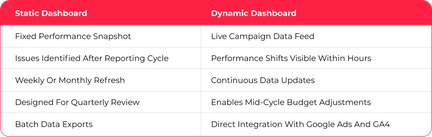
Static dashboards reflect performance at the time of report generation. When budgets shift mid-cycle or targeting changes during the week, issues surface only in the next reporting cycle.
Dynamic dashboards connect directly to ad platforms and GA4, showing spend and conversion changes the same day.
If a paid search campaign loses conversion rate on Wednesday, a weekly report reveals it the following Monday. A live dashboard surfaces the drop immediately, allowing the team to pause the ad group and intervene before inefficiency compounds.
2.Conversational Analytics and Natural Language Queries
Conversational analytics enables teams to query reporting systems in natural language instead of writing SQL or navigating BI filters. This reduces analyst dependency and shortens the time between question and decision.
Metric consistency is the prerequisite, not an afterthought. If revenue or customer acquisition cost are defined differently in GA4 and the CRM, conversational analytics does not solve the problem. It surfaces the conflict faster and at higher volume. A natural language interface on top of inconsistent data produces confident-sounding wrong answers.
When the underlying definitions are governed and owned, conversational interfaces reduce analyst dependency significantly. A media buyer can ask which campaigns drove the most revenue last month and receive a ranked breakdown without opening a BI tool or waiting for analyst support. That only works when the number being returned means the same thing in every system it touched.
3.Model Context Protocol (MCP) and Integration Standards
For marketing teams, this means AI systems can access CRM stages, campaign data, brand assets, and support history without building a custom integration for every new tool.
Examples:
Brand guidelines from a DAM apply automatically when generating ad copy.
A shared protocol reduces the need for repeated custom integrations.
4.Data Clean Rooms for Privacy-Compliant Measurement
Data clean rooms enable companies to analyze shared datasets without exposing personally identifiable information. Access rules define who can combine data, what can be analyzed, and which outputs can be exported.
They are used when direct cross-platform tracking is limited. Instead of sharing raw user-level data, partners compare aggregated signals in a controlled environment.
They are commonly used to:
match ad exposure with conversion events to validate attribution
compare first-party CRM data with platform-reported results
measure cross-channel impact without exposing customer-level records
support joint measurement between brands, publishers, and platforms
Clean rooms strengthen first-party measurement and reduce reliance on third-party identifiers. They formalize collaboration under shared governance and make privacy-compliant analytics part of long-term infrastructure.
5.Platform-Controlled Measurement and the Expansion of Analytics Tools
Platforms such as Google Ads, Meta Ads, and Amazon Ads operate within their own ecosystems. Targeting, delivery, and reporting stay inside platform infrastructure, limiting cross-channel transparency.
To build consistent reporting, teams reconcile platform-reported metrics with CRM data and warehouse environments such as BigQuery or Snowflake. Independent attribution and a validation layer help confirm impact beyond platform dashboards.
"Brands can't afford fragmented decision-making. When your media, CRM, and analytics engines are working from different truths, you lose speed, efficiency, and relevance." Jed Hartman, President of Activation Partnerships, Zeta Global
Standalone dashboards such as Google Analytics do not provide full cross-channel reconciliation. Teams consolidate first-party signals, media platform exports, and revenue data into warehouse models, then visualize results in tools such as Looker, Tableau, or Power BI for finance review.
What Replaces Last-Click Attribution in 2026?
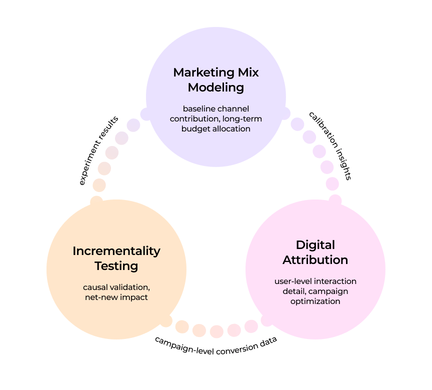
Last-click attribution is replaced by a composite approach that combines Marketing Mix Modeling, user-level attribution, and incrementality testing. This combination distributes credit across the funnel and validates causal impact instead of assigning full value to the final touchpoint.
A customer may see a LinkedIn ad, click a Google search result, watch a YouTube video, and convert after receiving an email. Last-click assigns full credit to the final interaction, leaving earlier influences unmeasured.
More than 70% of customers interact with a brand several times before converting. They move between devices, channels, and sessions. A single-touch model compresses this sequence into one event, which distorts channel comparisons and skews budget allocation.
What Is the Role of Marketing Mix Modeling (MMM) in 2026?
Marketing Mix Modeling in 2026 quantifies long-term channel contribution and incremental revenue impact using aggregated time-series data. It supports strategic budget allocation when user-level tracking becomes less reliable due to privacy restrictions.
Signal loss and privacy restrictions reduce the reliability of user-level attribution. Marketing teams respond by increasing investment in Marketing Mix Modeling. Nearly half of US marketing professionals, 46.9%, plan to increase investment in Marketing Mix Modeling in 2026.
"Marketing measurement has evolved beyond answering 'what worked' to an always-on capability linking marketing and operational investments to create measurable enterprise value." Doug Brooks, Chief Client Officer, Ipsos MMA
Organizations combine MMM with first-party analytics and attribution systems. Attribution supports campaign-level optimization. MMM informs longer-term budget planning and channel mix decisions. Used together, these approaches reduce reliance on platform-reported metrics and clarify revenue drivers.
Experimentation and Incrementality Testing
Incrementality testing divides audiences into test and control groups to isolate the effect of a campaign. The test group is exposed to the marketing activity. The control group is not. Comparing outcomes between these groups reveals the incremental impact.
This approach addresses a known limitation of platform attribution. Platform-reported conversions often include outcomes that would have occurred without paid exposure.
A well-known example comes from Uber. A three-month incrementality test found that Meta ads generated little incremental lift, leading the company to reduce spend and avoid approximately $35 million in wasted investment.
Incrementality testing provides causal validation. It clarifies which channels generate net-new results and which primarily capture existing demand.
Triangulation combines Marketing Mix Modeling, attribution, and incrementality testing into one coordinated measurement system. Each method answers a different question, and together they reduce reliance on platform-reported metrics.
No single method answers every strategic and tactical question. MMM supports long-term budget allocation. Attribution maps user-level paths. Incrementality testing confirms causal lift through controlled experiments.
Each approach has limits when used independently. MMM operates at an aggregate level. Attribution provides interaction detail but may overstate contribution. Incrementality testing delivers causal validation but does not scale across all campaigns.
Triangulation connects these approaches into a coordinated system. MMM defines baseline channel contribution. Incrementality experiments validate net-new impact. Attribution models are calibrated using insights from MMM and experimental results.
Marketing analytics in 2026 requires KPI ownership, governed reporting logic, and infrastructure designed for decision-layer validation.
Define Success Metrics and KPIs Early
Business questions determine metric selection. Revenue, retention, and margin impact take priority over engagement indicators. CAC, marketing ROI, and customer lifetime value reflect financial contribution more directly than traffic or click-through rates.
KPI definitions require documented calculation logic, data source alignment, and ownership. Time horizon and review cadence must match budgeting cycles. Metrics that do not influence operating decisions are removed from core reporting.
Only 23% of marketers report confidence in their KPI selection. Ambiguous definitions often lead to reporting misalignment later.
Align Stakeholders Before Dashboard Development
Dashboard design follows stakeholder alignment. Metric priorities, reporting frequency, and decision triggers are defined before infrastructure is built. Reporting gaps frequently originate in misalignment around metric logic and decision use.
Over-automation often occurs when boundaries are not defined in advance. Decisions about which workflows remain manual determine long-term brand consistency and customer trust.
AI increases the speed and volume of campaign decisions. Human judgment defines context, prioritization, and trade-offs. Strategic oversight and customer experience perspective remain central in budget and messaging decisions. Data outputs require interpretation before allocation changes are made.
Optimizing for Answer Engines and AI Search
Answer Engine Optimization focuses on brand visibility inside AI-generated responses. Visibility is reflected in brand mentions, citations, and entity references across AI systems.
Key signals include:
Brand citation frequency in AI answers
Entity consistency across platforms
Structured content with extractable headings and FAQ sections
Schema markup applied to product, guide, and FAQ pages
The Trend Behind the Trends
Every trend in this article, whether MMM, conversational analytics, data clean rooms, or AI-driven execution, points to the same underlying shift. Marketing analytics is no longer a reporting function. It is moving toward an operating system: a governed infrastructure that connects data collection to decision-making to automation in a continuous loop.
The teams that struggle in 2026 are not struggling because they lack tools. They struggle because their tools are not connected in a way that produces a single defensible number. GA4 says one thing. The CRM says another. Finance uses a third source. The analytics infrastructure was built for periodic reporting, not for real-time operating decisions.
The teams that operate well have stopped treating analytics as a layer on top of execution. They treat it as the foundation underneath. KPI definitions are documented and owned. Reporting logic is consistent across GA4, CRM and BI. AI and automation run on top of clean inputs. The measurement system tells you something is wrong before the next budget conversation does.
That is the real trend. Not MMM or GEO or conversational BI in isolation. The shift is toward marketing analytics as infrastructure, not reporting.
What Marketing Analytics Teams Need in 2026
In 2026, marketing analytics teams need full ownership of how performance is defined, validated, and used in decision-making.
Hiring for Analytical Judgment and Communication
Dashboard configuration and query writing are baseline capabilities. The differentiator is interpretation.
Strong analysts evaluate data reliability, identify methodological gaps, and articulate trade-offs relevant to risk and resource prioritization.
Analytical reasoning and communication enable teams to interpret AI-generated outputs and translate them into clear operational direction.
Defining Ownership and Governance
Metric definitions require named ownership and documented calculation logic. Version control, assumption tracking, and periodic review maintain consistency across reporting cycles. Unmanaged KPI shifts introduce ambiguity and distort performance evaluation.
Designing for Adaptation
Channel mix and bidding models change throughout the year.
Analytics processes must support KPI refinement, scenario analysis, and validation without rebuilding infrastructure.
Review cadence ensures measurement evolves with execution conditions.
How Darwin Builds Marketing Analytics Infrastructure
If analytics reports are still manually assembled, the issue is probably system architecture, not reporting frequency. Darwin works through the Darwin Flux methodology to fix the underlying sequence: signal collection, system connections, reporting governance, and automation readiness.
The engagement starts with a review of tracking architecture, attribution logic, and KPI definitions. Where GA4 and CRM data conflict, Darwin identifies which system owns the number and why. Misaligned definitions are resolved before any advanced modeling or automation is layered on top.
Engagement scope covers:
validation of event tracking and channel attribution logic
configuration of GA4, CRM integrations, and warehouse architecture
alignment of KPI definitions with operating model requirements
consolidation of paid media, CRM, and BI data into consistent reporting structures
support for MMM implementation and incrementality validation
When tracking and KPI logic are governed, analytics becomes a control system that sustains operating control.
FAQs
Q1. What are the main marketing analytics trends in 2026? In 2026, marketing analytics centers on AI-driven execution, composite measurement models, conversational BI, privacy-safe collaboration, and KPI governance.
Q2. What replaces last-click attribution in 2026? Last-click is supplemented by multi-touch attribution, Marketing Mix Modeling, and incrementality testing. These approaches distribute credit across interactions and validate true channel impact.
Q3. Why is Marketing Mix Modeling gaining importance? Signal loss and privacy restrictions reduce user-level tracking reliability. MMM quantifies channel contribution using aggregated spend and outcome data.
Q4. What is triangulation in marketing measurement? Triangulation combines MMM, attribution models, and incrementality testing. Each method answers a different measurement question, reducing dependence on platform-reported metrics.
Q5. How does AI change marketing analytics? AI increases execution speed in bidding, targeting, and workflow automation. Analytics shifts from reporting to monitoring, validation, and allocation oversight.
]]>Agentic AI in Marketing Analytics: What Salesforce, HubSpot and Adobe Are Changing for SaaS Teamshttps://www.darwinapps.com/blog/agentic-ai-in-marketing-analytics-what-salesforce-hubspot-and-adobe-are-changing-for-saas-teams/2026-05-26T10:30:00.000Z2026-05-31T22:29:43.000ZSalesforce, HubSpot and Adobe now ship AI agents that act on marketing data on their own schedule. Here is what SaaS teams need to know before deploying them.
Quick Answer:
Salesforce, HubSpot and Adobe now ship AI agents that measure, score and act on marketing data on their own schedule. These agents work reliably when the underlying data foundation is clean: UTM governance in place, CRM lifecycle events mapped and attribution logic consistent. Without that foundation, agents amplify the same errors faster.
TL;DR
Salesforce Agentforce uses the Atlas Reasoning Engine to execute revenue intelligence, lead scoring and cross-channel budget decisions autonomously
HubSpot Breeze embeds agentic AI directly into the CRM so agents act where contact and deal data already lives
Adobe Experience Platform Agent Orchestrator connects agents spanning marketing, content and experience workflows into one governed system
AI agents deliver measurable ROI when data governance, CRM quality and attribution logic are already in order
SaaS marketing teams that pilot one high-impact workflow now build the operational advantage that scales
A B2B SaaS marketing team runs three ad platforms, two nurture tools and a CRM that does not agree with any of them. Campaign reports arrive on Friday. By Monday, the budget decisions those reports were supposed to inform are already made on gut feel. This is the problem agentic AI is built to solve, and the reason Salesforce acquired Qualified and Adobe acquired Semrush for $1.9 billion. This article covers what each platform is building, what it requires to work and what SaaS marketing teams need to do before deploying agents.
Why Did 2026 Become the Turning Point for Agentic AI in Marketing Analytics?
Marketing teams spent 2024 and 2025 testing generative AI for content creation. That phase is over. The market shifted when organizations realized speed alone does not win customers. The shift now is from AI that assists human decisions to AI that makes and executes decisions within governed workflows.
Where This Fits in Darwin Flux
In Darwin Flux, agentic AI sits at the Momentum layer, but it depends on everything beneath it. Surface captures the first signal: website behavior, form submissions and campaign touchpoints. Connections move that signal cleanly through GTM, CRM, ad platforms and data warehouses. Clarity establishes consistent attribution logic and a reporting source of truth. Momentum is where agents operate: optimizing budgets, scoring leads and orchestrating journeys based on signals that are already clean. Without the Surface-to-Clarity foundation, agents have no reliable signal to act on.
What Makes an AI Agent Different from Rules-Based Automation?
Rules-based marketing automation executes conditional logic set up months in advance: if a lead reaches a certain score, the system sends the next email in sequence. Agentic AI makes judgment calls based on what it observes right now: funnel position, campaign data, revenue targets and behavioral signals combined.
“SaaS platforms provide infrastructure that takes years to build right: compliance, governance, scalability, integrations; these challenges don’t just disappear because of AI.” Jon Miller, co-founder of Marketo, founder of Phave
The agent reads what is happening in the funnel right now, acts on it and refines its logic from each outcome. The next step is determined by the data, not a scheduled human review. McKinsey estimates agentic workflows can accelerate campaign creation and execution by 10 to 15 times. Organizations that implement them can expect 10 to 30 percent revenue growth from hyperpersonalized marketing. Agentic AI is projected to create between $450 billion and $650 billion in annual value by 2030.
Salesforce fused Agentforce with Marketing Cloud as a system where agents support campaign, customer and revenue workflows. The architecture connects three elements: unified customer data in Data Cloud, engagement coordination and intelligence that plans, creates and adjusts as campaigns run.
How Do Revenue Intelligence Agents Replace Manual Attribution?
Revenue intelligence in Salesforce pulls together sales data to surface trends, projections and campaign insights for quarterly strategy. The system monitors KPIs, spots red flags in pipeline before quotas slip and describes individual deal health, supplemented by AI predictions of whether a deal will stall, close or get pushed. Coaching dashboards alert reps when amounts change, then recommend next steps like identifying an executive sponsor.
Revenue intelligence agents surface what is happening in pipeline right now. When a deal shows signs of stalling, the agent identifies the specific reason, such as a key decision-maker who has not been contacted, and flags it for action.
What Does Predictive Pipeline Scoring Do for Active Campaigns?
Einstein Lead Scoring runs automatically every 10 days to refresh scores based on current data. A survey of sales teams using AI revealed that 98% think it improves lead prioritization. Machine learning models trained on both anonymous aggregate data and company-specific records mean predictions improve over time. Einstein Behavior Scoring works in parallel, predicting when prospects are ready to buy based on live behavioral signal.
Agentforce and Cross-Channel Budget Execution
Agentforce Marketing agents handle campaign creation, personalization, journey management and spend decisions. They pause low-performing ads with marketer approval and shift contacts to optimal journeys based on engagement data. Built-in agents surface campaign insights in Slack so teams act directly from one place. Marketers define the strategy and agents handle execution. The result is time back for decisions that require human judgment.
What Is Data Cloud's Role as a Unified Identity Layer?
A single customer often appears across CRM, marketing automation, service desk and loyalty programs, each holding its own version of the record. Identity Resolution in Data Cloud connects those records without collapsing them. The keychain approach links records, preserving each system's version under a single resolved identity. A contact may appear with different emails, billing addresses and account IDs across systems. The keychain approach links all records to the same resolved identity without collapsing them into one.
“The number one challenge they cited was data. The AI engines themselves are becoming commodities. Anyone can buy a seat or get API access. Differentiation comes from the data you feed into it.” Scott Brinker, VP Platform Ecosystem at HubSpot, founder of chiefmartec.com
How Does HubSpot Breeze Embed Agentic AI Into the Growth Stack?
HubSpot took a different path. The company embedded agentic AI directly into its CRM through Breeze, expanded in Spring 2026, so decisions and actions happen where the data already lives. The principle: AI should operate inside the system where contact records, deal history and engagement data are stored.
How Do Behavioral Triggers Drive Engagement Decisions?
Behavioral triggers deliver messaging when contacts demonstrate intent. Timing follows buyer behavior. Open rates for behavioral trigger emails reach 45 to 65 percent compared to 25 percent for broadcast campaigns. Click-through rates reach 15 to 25 percent versus 3 to 5 percent for generic messaging. Conversion rates land between 8 and 15 percent, above the 2 to 3 percent from non-triggered workflows.
HubSpot lifecycle stages advance contacts automatically based on predefined behavioral triggers and engagement thresholds. Custom properties track industry-specific behaviors like demo requests, pricing page visits and competitor comparison downloads, revealing which touchpoints predict purchase intent most reliably.
AI Agents and Lead Qualification at Scale
The Prospecting Agent monitors buying signals, researches accounts using CRM and external data, drafts personalized outreach and recommends timing based on real activity. Darwin applied this approach for Wizehire, combining funnel optimization, cleaner tracking and AI-supported lead handling. The engagement reduced CPL by 26% and cut lead response time from 2 to 4 hours to 15 minutes.
Adaptive lead scoring updates with each new deal, refining how future leads are scored based on verified conversion data. The system predicts probability that a contact will convert within 90 days through properties like Likelihood to Close and Contact Priority Tier. Customer Agent handles Tier 1 support and reduced first-response time by 76 percent for one SaaS provider, with CSAT scores rising from 82 to 91 percent within three months.
HubSpot Connections to Third-Party Agentic Systems
Agent.ai, the agentic platform built by HubSpot's CTO, surged past 500,000 users in early 2026. Tools like Segment or Amplitude capture in-app events as they happen. Reverse ETL platforms like Census or Hightouch push this data from product databases into HubSpot CRM and Marketing Hub, making product signals available for segmentation, scoring and automated workflows.
Salesforce and HubSpot built agents that act inside CRM and revenue data. Adobe built agents that coordinate the full buyer journey: content, buying group assembly, webinar follow-up and chat, all governed through one reasoning layer. Experience Platform Agent Orchestrator serves as the reasoning engine, using large language models and a comprehensive knowledge base to generate responses and execute tasks.
Marketo nurture programs before Agent Orchestrator ran on fixed cadences: one email per week, two per week, regardless of what the buyer was doing. Adobe Experience Platform Agents drop the calendar logic entirely. They push contacts toward the next stage at every touchpoint, adjusting journeys based on what the buyer actually does. Agents act autonomously or flag decisions for human review depending on stakes and policy.
What Role Does AI Play in Marketo Webinars and Chat?
Interactive Webinars in Marketo Engage uses generative AI to create summaries and video chapters for on-demand viewers. One agency cut webinar build time by 30 percent and saw two times higher attendee retention. Dynamic Chat delivers conversation automation using generative AI trained on sales, marketing and product knowledge. Conversation summaries give sales agents key discussion topics before meetings, cutting prep time.
What Should SaaS Marketing Teams Do Now?
Nearly 90 percent of CMOs are experimenting with AI use cases, but less than 10 percent have captured value at the workflow level. The gap between testing and production deployment defines who wins.
Start with one use case that delivers visible ROI within weeks. Pick workflows that are repetitive, data-intensive and impact broad audiences. McKinsey tracked one organization that introduced agentic marketing in three waves, with content creation pilots running four times faster. The first wave should prove value within weeks, not quarters.
The architecture decision matters early. MCP enables autonomous tool discovery and iterative reasoning, suited for flexible operations. Direct APIs deliver deterministic results with lower latency for workflows that require strict policy enforcement. Effective agent systems use both.
What Does AI Governance Look Like in Practice?
AI governance frameworks help organizations scale agentic AI while aligning adoption with company values. Without governance, teams face model drift, privacy liabilities and agents releasing poor decisions at scale. Governance covers four areas: risk management controls, ethical use policies, data quality standards and lifecycle oversight. It should be built into deployment pipelines so checks happen automatically.
Most B2B SaaS marketing stacks were not built to support agents. Attribution logic conflicts between GA4, CRM and ad platforms. Lifecycle events are missing or mislabeled in the CRM. UTM governance breaks at the campaign level. When agents run on this foundation, they scale the wrong decisions faster.
Darwin works with B2B SaaS marketing and revenue teams to build the data and workflow infrastructure that makes agentic AI reliable. That includes CRM data audit and lifecycle event mapping, UTM governance and attribution logic alignment, server-side tagging and signal enrichment, AI readiness assessment before deployment, and ongoing governance once agents are live.
Darwin worked the problem in sequence: identified which lead signals mattered, connected them to the qualification workflow, defined what a conversion looked like, and only then let automation run. That order is what made the 30% result repeatable.
FAQs
Q1. Does HubSpot support agentic AI capabilities?
Yes. HubSpot integrated agentic AI through its Breeze platform, expanded in Spring 2026. Agents are embedded directly into the CRM, where they analyze customer context, make decisions and execute actions within workflows using current contact and deal data. The Prospecting Agent and Customer Agent are two production-ready examples available to HubSpot customers now.
Q2. Has Salesforce implemented agentic AI in its marketing platform?
Yes. Salesforce deployed Agentforce, which uses the Atlas Reasoning Engine to understand user intent, determine required data and actions, and autonomously execute tasks across workflows and integrations. Salesforce customers on Enterprise Edition and above can access Agentforce through Salesforce Foundations, which includes 200,000 Flex Credits at no additional charge.
Q3. What agentic AI solutions does Adobe provide for B2B marketing teams?
Adobe offers agentic AI through Experience Platform Agent Orchestrator, which connects agents spanning marketing, content and experience operations into one governed system. Key capabilities include Audience Agent for buying group assembly and Dynamic Chat for AI-powered conversation automation within Marketo Engage.
Q4. How does agentic AI differ from rules-based marketing automation?
Rules-based marketing automation executes predefined conditional logic: if score reaches X, send Y. Agentic AI makes judgment calls based on current data in CRM, behavioral signals, campaign results and revenue targets. It reads live funnel signals, acts on them and refines its logic from each outcome. The next step is set by what the data shows at that moment.
Q5. What does a marketing team need before deploying AI agents?
Clean data foundations come first. That means consistent UTM governance, mapped CRM lifecycle events, aligned attribution logic across GA4 and ad platforms and a defined reporting source of truth. Agents deployed without these in place will automate on incorrect signals. The operational gains from agentic AI are proportional to the quality of the data the agents run on.
]]>AI Agents Are Redrawing E-Commerce: What Retailers Must Knowhttps://www.darwinapps.com/blog/ai-agents-ecommerce/2026-02-04T00:00:00.000Z2026-05-31T22:29:17.000ZAI agents are reshaping e-commerce by automating the shopping journey. Learn what retailers need to survive in the agentic era.
The New War for the Customer: How AI Agents Are Redrawing E-Commerce
Quick Answer:
AI agents are changing e-commerce by moving product discovery, comparison, and purchasing decisions away from human-led browsing and toward machine-mediated evaluation. Instead of navigating websites, customers increasingly delegate intent to AI assistants that assess structured product data, availability, pricing, and relevance on their behalf.
For retailers, product discoverability is no longer determined by interface design or traditional SEO alone. It depends on whether product catalogs, pricing, and systems are structured for AI interpretation. Retailers that adapt their data, infrastructure, and integrations for agent-driven commerce gain earlier access to AI-mediated demand. Those that do not risk becoming invisible within agent-based shopping workflows.
TL;DR
AI agents mediate product decisions. Discovery, evaluation, and purchasing increasingly happen through agent workflows.
Shopping funnels collapse. Conversational, agent-led interactions replace traditional browse-compare-buy sequences.
Visibility requires machine-readable data. Product catalogs must use structured specifications, not marketing copy.
Retailers serve two audiences. Systems must work for both human customers and AI decision systems.
Early adoption shapes agent behavior. How AI agents rank, recommend, and transact products is influenced by first movers.
GEO replaces traditional SEO. Generative Engine Optimization focuses on AI legibility rather than human search.
Infrastructure choices determine positioning. Agent-ready systems affect long-term visibility and operational flexibility.
Traffic from generative AI shopping assistants to retail sites has grown 1,300% year over year. Product evaluation is increasingly happening inside AI systems before a customer reaches a store.
Chatbots and recommendation engines were early signals. What is changing now is the decision layer. AI agents increasingly mediate what gets evaluated, compared, and selected, not just how products are discovered.
Retailers that align systems early tend to see stronger performance over time. The practical question is readiness.
How are AI agents changing commerce, and what does this mean for retailers?
How AI Agents Are Changing the Way We Shop
Shopping behavior is shifting at the interaction level. Customers no longer type simple keywords like "best kids snacks." Instead, they ask detailed questions: "What are some nutritious snack options for a 7-year-old's birthday party?" This changes how people interact with online stores.
The traditional e-commerce funnel of search, browse, compare, add to cart, and checkout is increasingly compressed into conversational interactions.
Shopping used to require multiple steps. Customers navigated categories, applied filters, compared specifications, and repeated this across multiple sites before purchase decisions.
Conversational interfaces replace this workflow. Users describe what they need, and AI agents handle the research and comparison automatically.
AI agents as personal shoppers
AI shopping agents go beyond keyword matching. They understand context, preferences, and shopping behavior patterns using multimodal AI models that process visual data, purchase history, and stated needs.
These systems analyze multiple factors simultaneously: body measurements, style preferences, existing wardrobe items, household budgets, and real-time promotions. For grocery shopping, agents suggest recipes based on pantry inventory and dietary preferences while checking for relevant discounts.
As users interact with these systems over time, agents handle increasingly complex tasks. They verify delivery timelines, apply stored payment credentials, and complete purchases with minimal user input. The multi-step shopping process condenses into brief conversations.
Examples of agentic commerce in action
Major retailers and tech platforms are deploying AI agents that are reshaping how commerce functions.
Perplexity launched its "Buy with Pro" shopping tool in late 2024, integrating with PayPal for secure checkout directly within the chat interface. The transaction is completed directly within the conversational interface.
OpenAI introduced Operator in January 2025, now integrated into ChatGPT, helping users book travel and restaurant reservations. They recently announced an Agentic Commerce Protocol with Stripe, allowing users to complete purchases without leaving the chat.
Google is expanding its AI Mode shopping interface with advanced agentic capabilities for price tracking and purchase confirmation. "We're moving from a one-to-many pricing strategy to a dynamic, one-to-one model where the negotiation happens between two machines before a human even sees the final offer," notes Toby Brown, Global Managing Director at Google Cloud.
Meta's customer support AI agents show results in a different area. These agents understand context, provide personalized solutions, and escalate complex issues when necessary. Resolution time dropped by 30%, with corresponding improvements in customer satisfaction and retention.
Beyond customer-facing commerce, agent-based approaches are also influencing internal content operations.
In its work with Tech.co, Darwin helped implement AI-supported content workflows that streamlined research, drafting, and publishing processes. These workflows increased content production capacity by eight times while reducing monthly operational costs. The system illustrates how AI can coordinate complex workflows at scale while keeping human decision-making in place.
Customer personalization in AI-driven commerce extends beyond surface-level tactics such as name-based messaging. Modern platforms analyze behavioral and contextual data to support individualized decision-making across the shopping journey.
When AI Gets Personal
Modern AI systems analyze granular data points like browsing behaviors, location, preferences, and contextual factors such as time of day or weather to support individualized interactions. These systems interpret contextual signals to predict needs before customers explicitly state them.
Discovery in Agent-Driven Commerce
AI-powered discovery tools transform how customers find products by handling complex, contextual queries instead of keyword matching.
Google Cloud outlines how this works in practice. A customer needing a jacket for Honolulu can specify requirements conversationally: warm when windy but breathable in the sun, with pockets, packable, under $100. An AI agent returns curated options with virtual try-on visualizations, compression demonstrations, and delivery confirmation, while simultaneously negotiating with brand agents for personalized promotions.
This shifts product discovery away from browse-and-filter workflows toward conversational, agent-led evaluation.
Checkout Without the Hassle
OpenAI's "Instant Checkout" allows purchases to be completed directly within a ChatGPT conversation. The system uses secure payment tokens for data transfer without exposing card numbers.
User control is maintained through explicit confirmation at each step, with minimal data shared only with permission.
AI-powered platforms extend agent involvement beyond checkout into post-purchase workflows. Real-time data is used to support operational adjustments, feedback collection, and targeted follow-up based on customer context.
What Retailers Need to Survive the AI Shopping Revolution
Retailers must optimize for two audiences: human shoppers and AI agents. Most current systems serve only humans.
AI agents evaluate products using structured data specifications. They don't browse pages or interpret marketing language. Visual design has no impact on their assessments.
Your Product Catalog Needs to Speak Machine
Traditional product descriptions target human readers with promotional copy. An example: "Waterproof running headphones with secure fit."
AI agents require structured specifications formatted as machine-readable data:
Water resistance: IPX7 (enumerated standard)
Fit type: ear_hook (categorical value)
Weight: 15 (integer, grams)
Machine-readable specifications have become essential for competitive commerce. The same approach applies to AI-driven supply chain and operational systems. Proper data structure enables AI systems to identify regional demand spikes and redistribute inventory for optimal delivery.
Cleo implemented custom data integration to structure user information for AI-driven personalization while maintaining GDPR compliance. The system ensured data remained accessible to AI agents without compromising security requirements.
Retailers implementing machine-readable catalogs position themselves for AI-driven discovery. Those maintaining unstructured formats become inaccessible to agents evaluating products.
Calculating the investment
Real implementations demonstrate clear returns. Tech.co deployed AI content workflows that reduced monthly costs by $15,000 while increasing production capacity 8x. Similar data integration and AI readiness projects help organizations lower operational friction and scale output efficiently.
The Tech Stack Making AI Shopping Actually Work
AI-driven commerce relies on a set of emerging protocols that allow agents to access data, coordinate actions, and complete transactions securely. They provide a common interface between AI systems and enterprise infrastructure, including data sources, operational tools, and payments
MCP provides a standardized way for AI systems to access external data sources and perform actions across tools and environments. As an open-source protocol, it reduces reliance on custom integrations and shifts connectivity from point solutions to shared infrastructure.
By establishing a common interface between AI agents and enterprise systems, MCP supports more consistent behavior across data repositories, business tools, and operational platforms.
In commerce environments, the impact of AI increases when multiple agents operate as coordinated systems rather than isolated tools. In multi-agent workflows, specialized agents handle distinct tasks such as product discovery, pricing, and customer support, while coordination mechanisms align their actions across functions.
This coordination replaces siloed decision-making with shared system logic, allowing pricing, inventory, and customer flows to be evaluated and adjusted together.
As AI agents begin to initiate transactions, payment systems must address questions of authorization, verification, and accountability. AP2 introduces a protocol for agent-led payments that enables secure execution while maintaining clear auditability.
Developed with industry partners including PayPal and Mastercard, AP2 uses cryptographically signed mandates to verify user intent and create a verifiable transaction trail without exposing sensitive payment data.
Many retailers are attempting to adapt existing platforms to support agent-based workflows. In practice, legacy systems often struggle with fragmented identity models and limited real-time context.
AI-native platforms are designed to support agent interactions from the start, enabling continuous learning, real-time personalization, and coordinated decision-making across channels.
Organizations that invest in AI-native infrastructure are shaping how agent-to-agent commerce operates. Late adopters will need to align with standards defined by others.
The AI Commerce Gold Rush Is Already Here
Companies that move early are beginning to influence the rules others will need to operate within. As AI-powered retail systems gain scale, early adoption is translating into measurable structural advantages.
First-movers are capturing the biggest wins
The data shows the scale of change. ChatGPT now processes around 50 million shopping-related queries per day, and traffic from AI-driven sources to e-commerce sites has grown by 4,700% year over year.
The disparity is already visible. Walmart receives approximately 20% of its referral traffic from ChatGPT, while Amazon accounts for closer to 3%. This gap reflects differences in how effectively retailers have prepared their catalogs for agent-based discovery.
Early adopters also accumulate proprietary data and workflows that influence how AI systems rank, evaluate, and recommend products over time.
From what I see in practice, products outside an agent’s top recommendations effectively disappear from consideration. Visibility is no longer driven by SEO alone, but by how clearly product data can be evaluated by machines.
This has led to a new discipline: GEO (Generative Engine Optimization). Unlike traditional marketing, GEO focuses on making products legible to AI decision systems rather than optimizing solely for human attention.
Strategic coalitions are forming
Competition is beginning to split into distinct approaches. Google, Shopify, Walmart, Visa, and Mastercard are advancing open protocols such as the Agent Payments Protocol (AP2). Amazon, by contrast, is reinforcing its closed Rufus ecosystem.
This divergence reflects a structural trade-off. Closed systems tend to prioritize control and depth within a single environment, while open standards support interoperability and long-term adaptability.
What this means for you: if you are selecting technology partners at this stage, the ecosystem you align with will shape how flexible your stack remains as agentic commerce evolves. Open protocols typically allow broader integration and discovery, while closed ecosystems concentrate capabilities within one platform.
Trust works differently when agents make decisions
You now need to establish trust with two audiences: human customers and the AI agents acting on their behalf during purchasing decisions.
Creating machine-readable catalogs alone is not sufficient. Brands must also demonstrate reliability through transparent data and AI practices. Research indicates that 58.5% of consumers are highly concerned about how AI uses their data. At the same time, 92% of shoppers who have used AI-assisted shopping report a positive experience.
This creates a structural tension. Customers expect the efficiency of AI-powered commerce, while remaining cautious about data usage and control. Brands that manage this balance focus on transparency and consistency across both human-facing and machine-facing interactions.
How Darwin Works With Retailers in Agent-Driven Commerce
Retail visibility often no longer starts at product pages or comparison flows. In many cases, purchase decisions are mediated before customers ever reach them.
I often write about this on LinkedIn. Decision-making has moved upstream, inside retail infrastructure, before customers ever interact with brands. Customers let AI agents handle evaluation. As a result, visibility is shaped upstream, before a brand enters the interaction.
Retailers relying on catalog search, SEO ranking, and interface design lose visibility in agent-mediated workflows. Here, infrastructure determines visibility, not presentation.
Structuring product catalogs for agent-based discovery
Building integrations between commerce systems and AI platforms
Implementing infrastructure that supports agent-based operations
Establishing workflows that align technical and business teams
Teams typically start by assessing their current catalog structure and system capabilities. From there, Darwin helps define what needs to change and builds the technical foundation required to operate effectively in agent-driven commerce.
FAQs
Q1. How are AI agents changing the online shopping experience? AI agents are transforming online shopping by enabling conversational interactions, providing personalized recommendations, and streamlining the entire process from product discovery to checkout. They act as personal shoppers, understanding user preferences and needs to offer tailored suggestions and automate many aspects of the shopping journey.
Q2. What is hyper-personalization in AI commerce? Hyper-personalization in AI commerce refers to the use of advanced technologies like artificial intelligence and machine learning to analyze customer data and behavior, creating highly individualized shopping experiences. This includes personalized product recommendations, targeted marketing, and customized user interfaces based on each shopper's unique preferences and habits.
Q3. How can retailers optimize their product catalogs for AI agents? Retailers can optimize their product catalogs for AI agents by making them machine-readable. This involves structuring product data in standardized formats, using precise technical specifications instead of marketing language, and ensuring that product information is clear, factual, and easily interpretable by AI systems.
Q4. What is the Agentic Payment Protocol (AP2)? The Agentic Payment Protocol (AP2) is a secure system developed for AI-led transactions. It addresses issues of authorization, authenticity, and accountability in agent-based purchases by using cryptographically-signed "mandates" that provide verifiable proof of user instructions, creating a non-repudiable audit trail for every transaction.
Q5. Why is it important for retailers to adapt quickly to AI commerce? Adapting quickly to AI commerce is crucial for retailers because early adopters gain significant advantages. They can shape industry standards, capture valuable customer data, establish trust with both users and AI agents, and create sustained competitive edges. As AI commerce is projected to orchestrate trillions in global revenue by 2030, companies that delay risk falling behind in this rapidly evolving landscape.
]]>The Ultimate Guide to Revenue Operations (RevOps)https://www.darwinapps.com/blog/the-ultimate-guide-to-revenue-operations/2025-06-04T00:00:00.000Z2026-05-29T02:39:59.000ZLearn what RevOps is, why it matters, and how to align teams for growth-focused collaboration in this ultimate guide to revenue operations.
Introduction
Revenue operations, or RevOps, is becoming a game-changer in the business world—and for good reason. It’s all about bringing your sales, marketing, and customer success teams together to create smoother processes, drive more revenue, and deliver an outstanding customer experience.
If you’ve been searching for a way to align your teams, improve efficiency, and stay ahead of the competition, RevOps could be the solution you’ve been waiting for. In this guide, we’ll break down what RevOps is, how it works, and how it can help transform your business into a more cohesive and effective powerhouse. Let’s dive in!
What is Revenue Operations?
Revenue operations (also known as RevOps) is a business strategy designed to break down organizational silos between key revenue-driving departments: sales, marketing, and customer success.
In this model, RevOps serves as the unifying function that aligns all revenue-generating teams — such as sales teams, marketing departments, and customer success organizations — around shared goals, KPIs, and processes.
RevOps manages the entire revenue journey, coordinating revenue-related activities across departments and ensuring transparency, efficiency, and accountability throughout the revenue lifecycle.
As Sophia Francis, Director of Revenue Operations at Dooly, puts it:
“RevOps can be defined differently at every company. I like to think of RevOps as the apex of the Ops team. This is akin to a table. Each leg has a defined area of focus to bear the load of the tabletop, or it will wobble. Revenue Ops is lifted up and made better by each of the other ops functions.”
RevOps relies on analyzing data from customer interactions and operational performance to inform decisions and optimize strategies. When mentioning CRMs and data, it’s important to note that customer data and customer relationship management are foundational elements of RevOps, enabling seamless collaboration and improved outcomes across all revenue-related activities.
The Evolution of RevOps
According to Adithya Krishnaswamy, Head of RevOps and Growth at Everstage:
“RevOps was an evolution of Sales Ops when people realized it wasn’t just sales that needed operations anymore.”
As operations became more customer-centric, the need to oversee the entire customer lifecycle—from the first marketing touchpoint to post-sale support—demanded a more integrated strategy that includes not only sales and customer success, but also marketing teams. Integrating marketing teams with sales and customer success through Revenue Operations improves data accuracy, collaboration, and overall business growth.
Forrester’s 2021 revenue operations survey of 316 respondents discovered a significant shift toward driving the value and promise of revenue operations from within either centralized operations or selective centers of excellence. In fact, Forrester Consulting found that companies with advanced RevOps strategies achieved up to 10% greater revenue growth over five years—a compelling case for embracing the model early.
Unify Teams with the Right Tools
At the heart of RevOps success is technology. Tools like AI-powered CRMs, data visualization platforms, and robust data management practices integrate previously isolated operations into one cohesive unit.
When you integrate customer success data, you unlock a clear, full-picture view of account health and customer interactions. This alignment ensures your entire team stays focused on shared revenue goals, with complete visibility into every part of the business pipeline.
How Does Revenue Operations Work?
Revenue operations start with aligning your departments around a unified revenue goal. Here’s how it functions in practice:
Sales focuses on allowing sales teams to access real-time data and insights, enabling them to close deals more effectively and efficiently, armed with validated data.
Marketing ensures leads are accurately qualified before passing them to sales.
Customer Success enhances retention and identifies sell and upsell opportunities through seamless communication and shared metrics and insights.
This alignment is powered by three key components:
Data Integration: Combining data from various sources into a single platform for improved transparency.
Automation: Reducing manual tasks, like lead routing or follow-up emails, to give teams more time for strategic efforts.
Analytics: Providing insights by analyzing customer interaction and customer behavior to optimize strategies and make informed, data-backed decisions across all touchpoints.
When done right, RevOps transforms disconnected teams into a single, growth-focused unit.
Revenue Operations vs Sales Operations
Although similar, RevOps and sales operations differ significantly in scope.
Sales Operations focuses solely on managing the sales team’s efficiency and effectiveness. It handles activities like CRM management, sales forecasting, deal desk processes, and territory planning.
RevOps, on the other hand, takes a broader approach, covering the customer’s entire lifecycle. It aligns marketing, sales, and customer success, oversees the sales funnel and marketing strategy, and ensures all departments work cohesively toward revenue goals. A unified revenue team—consisting of sales, marketing, and customer success—breaks down silos, aligns metrics, and fosters transparency and accountability to drive predictable revenue growth.
Asia Corbett, Head of RevOps and Community Ops at RevGenius, draws a clear line:
“Sales Ops focuses on territory planning, deal desk activities, opp reporting, commissions and comp, SDR and AE handoffs, and managing tools like Outreach and Salesforce. RevOps looks at the entire customer journey and the entire funnel—from marketing (lead routing, conversion rates, etc.) all the way to customer success and support (onboarding, account health reporting, NPS, and renewal processes).”
Think of RevOps as the orchestra conductor ensuring every team plays in harmony, while sales operations are the soloists ensuring individual performance excellence.
Why RevOps is Important for Your Business
Here are key reasons why companies are turning to RevOps as their growth catalyst:
1. Boost Revenue Growth
Advanced RevOps strategies have been proven to drive greater revenue growth. Connecting silos streamlines efforts and ensures better resource allocation, ultimately leading to bottom-line growth.
2. Enhance Team Efficiency
RevOps eliminates duplication of tasks and bottlenecks caused by siloed teams. With data and tools centralized, businesses can standardize workflows and empower their teams to work smarter, not harder.
3. Deliver a Superior Customer Experience
When your teams are aligned, the customer benefits too. RevOps ensures a consistent customer journey by integrating processes across departments, so every interaction feels unified and seamless. From marketing campaigns that resonate to seamless sales hand-offs and proactive customer support, RevOps builds trust and loyalty through cohesive engagement.
4. Improve Forecast Accuracy
RevOps provides a holistic view of your business pipeline for better planning and more precise revenue forecasting.
5. Gain Competitive Advantage
RevOps isn’t just a trend; it’s a necessity for businesses hoping to stay competitive. Gartner predicts that 75% of high-growth companies will implement a RevOps model by 2025.
What Does Successful Revenue Operations Look Like?
Successful RevOps makes revenue flows smoother, predictable, and scalable. A successful RevOps strategy is essential for achieving alignment and scalability across teams. Here’s what that looks like in action:
Sales teams hit their targets using quality leads supplied by marketing.
Target audience demand is driven by marketing campaigns that are aligned with customer insights.
Customer success ensures long-term retention by delivering personalized support.
This level of alignment is only possible when RevOps forms the backbone of your operations.
The Role of Customer Success in RevOps
Customer success is a cornerstone of effective revenue operations, playing a pivotal role in both revenue growth and customer retention. Customer success teams are dedicated to ensuring that every customer achieves their desired outcomes and remains satisfied throughout their journey with your company. This focus on satisfaction and value not only builds loyalty but also reduces churn, directly impacting your bottom line.
Integrating customer success into your revenue operations (RevOps) strategy creates a powerful, unified approach where sales, marketing, and customer success teams work hand in hand. This alignment not only streamlines processes but also ensures every team is focused on driving growth and delivering exceptional value to your customers.
When customer success teams collaborate closely with sales and marketing, they can identify upsell opportunities, address potential issues before they escalate, and contribute valuable insights that drive revenue growth. Ultimately, a RevOps model that prioritizes customer success leads to more satisfied customers, higher retention rates, and a stronger, more predictable revenue stream.
Top Metrics to Track in RevOps
To measure RevOps effectiveness, focus on key performance indicators (KPIs) like:
Pipeline Velocity – the speed at which leads progress through the sales funnel.
Customer Lifetime Value (CLV) – The total revenue a customer generates over your relationship.
Net Promoter Score (NPS) – Measuring customer satisfaction and loyalty.
Revenue Retention Rate – Tracking how much revenue is retained after churn.
Sales Performance – Measuring the effectiveness and productivity of your sales team to inform strategic decisions.
Customer Lifetime Value (CLV)
Customer Lifetime Value (CLV) is one of the most important metrics in revenue operations, as it quantifies the total revenue a customer is expected to generate over the course of their relationship with your business.
Calculate Customer Lifetime Value (CLV) by taking the average annual revenue generated per customer, multiplying it by the projected duration of their relationship with your business, and then deducting the cost associated with acquiring that customer.
How to Implement RevOps at Your Company
Follow these steps to begin strategically implementing revenue operations:
Consolidate Revenue Data Gather all revenue-related data into a single system of truth for consistent, accurate reporting, ensuring accurate final revenue recognition for financial reporting.
Integrate Your Systems Choose tools that communicate seamlessly across teams—for example, combining your CRM with your marketing automation platform—and integrate systems across the entire revenue cycle.
Automate Repetitive Tasks Use technology to streamline activities like lead scoring, follow-ups, and deal progression. Automation frees up your teams for revenue generating activities and higher-value work.
Use Insights to Optimize Revenue Leverage analytics to uncover growth opportunities, refine processes, and course-correct when forecasts miss the mark.
Seamless Integrations with existing systems like CRMs and email platforms.
Custom Reporting Options for tailored analytics.
Real-Time Dashboards to monitor KPIs at a glance.
The Future of RevOps
With AI, predictive analytics, and real-time collaboration becoming the norm, the next phase of RevOps will focus even more on proactive decision-making.
]]>CDP, Data Warehouse, or CRM: Which Customer Data Stack Should SaaS Marketers Build First?https://www.darwinapps.com/blog/cdp-data-warehouse-or-crm-which-customer-data-stack-should-saas-marketers-build-first/2026-05-28T10:30:00.000Z2026-05-28T23:03:34.000ZMid-market SaaS teams: CDP, warehouse or CRM first? Here is how to get the build order right before AI workflows raise the cost of getting it wrong.
Quick Answer:
The decision between a customer data platform (CDP), customer relationship management (CRM) system and data warehouse is a sequencing decision. Build the warehouse when metrics are breaking between teams. Start with a CRM when sales conversations still define product direction. Add a CDP or warehouse-native activation layer when clean data needs to reach campaigns without engineering overhead. Building all three at once guarantees none of them deliver value.
TL;DR
Warehouse first. Build it when conflicting metrics appear across Google Analytics 4 (GA4), HubSpot and Salesforce and no one can agree on customer acquisition cost (CAC) or attribution.
CRM first. Build it when the sales motion is still being defined and relationship data drives product decisions.
CDP or reverse ETL third. Add it when the warehouse is stable and marketing needs to activate clean segments across campaign tools without writing SQL.
Sequence matters more in 2026. AI workflows, warehouse-native CDPs and reverse ETL have raised the cost of building in the wrong order. Gartner predicts that 60% of AI projects lacking AI-ready data will be abandoned.
AI workflows and warehouse-native marketing tools have made the CDP versus warehouse versus CRM decision more urgent in 2026. If customer records, attribution logic and activation audiences are built in the wrong order, every campaign, dashboard and AI output inherits the same weak foundation. A 2025 report by the IBM Institute for Business Value found that 43% of chief operations officers identify data quality as their primary data priority, and over a quarter of organizations estimate they lose more than $5 million annually because of it.
When web analytics, CRM and campaign tools disagree, the instinct is still to buy another platform. The State of Martech 2026 report identifies data integration and customer data quality as the top operational challenges for marketing teams. The mistake is treating the CRM, CDP and warehouse as parallel purchases. The build order determines whether web events, lead routing, account-level reporting and campaign audiences use the same customer truth or create three separate versions of it.
Why the Darwin Flux Framework Changes This Decision
The CDP versus warehouse versus CRM question tends to get treated as a tool selection problem. Darwin Flux frames it as a sequencing problem with four stages that have to activate in order.
Surface captures the web and product signals first: GA4 events, Google Tag Manager (GTM) form fills, UTM-attributed lead source data and product usage events. Without clean surface data, every layer built on top of it inherits the same gaps.
Connections determine whether those signals move cleanly into HubSpot, Salesforce, the warehouse and activation tools without dropping context or splitting into separate versions of the same customer record.
Clarity appears when customer acquisition cost, web attribution, account-level reporting and lifecycle stage reconcile between marketing, sales and finance. This is the warehouse layer: the place where metric definitions become shared rather than team-specific.
Momentum starts only when that foundation is stable. Automation, AI segmentation, reverse extract, transform and load (ETL) workflows and revenue-triggered campaigns depend on the data being clean, connected and consistently defined before they run.
In Flux terms, the practical decision is which stage is broken now and which platform fixes it without adding new fragmentation.
What Role Each Platform Actually Plays in a GTM Stack
A CRM records what your team did with each contact. A CDP captures what customers did on their own. A data warehouse is where GA4 events, CRM records and product usage data join into one reporting layer. Each platform owns a different part of the customer record. Without all three connected in the right order, each one produces a different version of the same customer.
CRM: The Operating Layer for Known Relationships
A customer relationship management (CRM) system records every interaction between your team and a known contact. Sales calls, support tickets, email exchanges, pipeline stages and deal notes flow into a single system so anyone on the team can see the full relationship history without asking.
For web analytics purposes, the CRM is where form fills land, UTM-attributed lead source gets recorded and sales context around each inbound lead gets captured. It is the layer where website signals become pipeline records. A sales rep logs a call. A support agent updates a ticket. A marketer records a campaign response. The data reflects what your team did with the lead after the web touchpoint.
For teams where the sales motion still shapes product direction, the CRM record of human conversations is the most valuable data asset available. Identity resolution and audience activation add overhead before the product motion is clear.
CDP: The Activation Layer for Behavioral Data
A customer data platform (CDP) collects customer data from every digital touchpoint automatically: websites, mobile apps, email interactions, offline transactions. It builds continuous profiles without requiring manual entry, resolves identity across anonymous and known users, and pushes segmented audiences to the channels where campaigns run.
The capability that separates CDPs from other platforms is identity resolution. When someone visits your site anonymously, signs up through your app, then contacts support, a CDP connects those interactions into one profile using deterministic matching on email addresses and customer IDs, and probabilistic matching on IP addresses and behavioral patterns.
In 2026, many mid-market SaaS teams are choosing a warehouse-native or composable CDP model over a standalone CDP database. According to the January 2026 CDP Institute Industry Update, composable and warehouse-native vendors grew employment by 7.8%, nearly six times the 1.3% industry average, signaling a clear shift in where CDP adoption is concentrating. That model uses the cloud warehouse as the customer data foundation, then uses reverse ETL tools to activate modeled segments in campaign tools, ad platforms and CRMs.
"The CDP's job is not to be the system of record. It is to make data from the system of record usable by the people running campaigns." David Raab, Founder, CDP Institute
Data Warehouse: The Foundation Layer for Analytics and AI
A data warehouse pulls processed data from transactional systems, databases, CRM platforms and other sources into centralized storage built for complex queries. It handles all structured and semi-structured data in the business: billing records, claims data, product usage logs, employee records, transaction history.
For web analytics, the warehouse is where GA4 event exports, GTM-captured form fills, product usage events and CRM attribution data finally join. Without that join layer, web traffic numbers live in GA4, pipeline attribution lives in HubSpot, and revenue data lives in Stripe or Salesforce. The warehouse creates the shared definition layer that makes account-level reporting and cross-channel attribution possible.
Common warehouse platforms for mid-market SaaS include Snowflake, BigQuery and Databricks. Databricks is increasingly chosen by teams that need a unified lakehouse for both analytics and AI model training, since it handles unstructured data and machine learning workloads alongside standard SQL analytics.
CDP vs CRM vs Data Warehouse: Direct Comparison
The table below captures the operational and web analytics differences that affect build decisions.
Which Platform to Build First: A Decision Framework for SaaS Teams
Build the Warehouse When Reporting Is Breaking
The signal is specific: GA4 reports one number, HubSpot reports another and Salesforce shows a third. CAC differs between dashboards and no one can explain why. Analysts spend hours downloading CSV files when they should be running queries. Marketing cannot see downstream revenue. Product cannot connect feature usage to acquisition channels.
This is the Connections layer failing. Every team defines metrics independently because there is no single layer where those definitions live. Web attribution breaks first: the lead source captured in GA4 does not match what HubSpot recorded, which does not match what the CRM shows as the deal source.
A warehouse resolves this by centralizing data from all sources and establishing one definition of each metric. Finance and marketing agree on CAC because they query the same table. Product and acquisition agree on attribution because the joins happen in one place. Account-level reporting becomes possible because anonymous web visits, product usage events and CRM records finally connect.
The foundation stack for this stage: an ingestion tool such as Fivetran or Airbyte, a cloud warehouse such as BigQuery, Snowflake or Databricks, a transformation layer such as dbt, and a business intelligence (BI) tool such as Metabase. This combination handles data collection, centralized storage, modeling and reporting without requiring enterprise-scale infrastructure.
Start With CRM When Sales Conversations Still Define Product Direction
Before a product has found its market, the most valuable data is qualitative. What objections kill deals. What features customers say they need. Why someone chose a competitor. That information lives in sales conversations, not behavioral event streams.
A CRM captures those conversations. Every prospect interaction, every feature request, every objection gets recorded so the team can see patterns. GA4 can tell you traffic volume; the CRM tells you what the traffic said. At this stage, that record is more useful than an analytics pipeline.
Add CDP or Warehouse-Native Activation When Activation Gaps Appear
The signal: the warehouse is running, data quality is stable, but marketing cannot act on it without engineering support. Segment creation requires a SQL query and a support ticket. Campaign audiences get built manually from exports. Lead routing rules cannot consume account-level intent signals because they live in the warehouse and nothing moves them into the CRM.
This is where Momentum begins. A warehouse-native activation layer resolves the gap. Hightouch is one example of how this works in practice. Hightouch and Census push modeled data from the warehouse into HubSpot, Salesforce, ad platforms and support tools without engineering involvement in each sync. According to a 2025 survey by dbt Labs and Census, organizations using reverse ETL report a 41% reduction in time-to-action on data insights and a 2.8x improvement in marketing campaign targeting precision.
A clean account score can route leads to the correct sales motion, update lifecycle stage in HubSpot and trigger audience membership in paid channels simultaneously.
For teams evaluating Segment as a standalone CDP, the 2026 question is whether the activation capabilities are worth maintaining a separate customer data database, or whether a composable model using the existing warehouse delivers the same outcomes with less duplication. CDP.com's 2026 vendor comparison covers how leading platforms have shifted toward warehouse-native models.
"The teams that get the most out of a CDP are the ones who already know what data they need and where it needs to go. Without that clarity, a CDP becomes another data silo with a better UI." Kamil Rejent, CEO, Survicate
Team Size and Technical Readiness as Decision Inputs
A 10-person team with one analyst and no dedicated engineering does not need a warehouse that takes 18 months to deliver value. A 200-person team with five analysts and a data engineering function does not need a CDP before the warehouse is stable.
Platform selection without accounting for who will run it creates adoption failure. Enterprise tools assume dedicated administrators, approval workflows and integration specialists. When those roles do not exist, the overhead exceeds the value.
How to Connect the Stack Without Creating New Silos
The warehouse stores data. Reverse ETL moves it back into CRM, ad platforms and support tools. Both depend on what enters the stack first: web and product signals captured through GA4 and GTM. The sections below cover how each connection point works, starting with event capture and ending with account-level reporting.
Reverse ETL as the Activation Bridge
Reverse ETL changes the direction of operational data movement: modeled warehouse data is pushed back into the tools where sales, marketing and support teams work. CDP.com outlines where reverse ETL and CDP each fit in the activation stack.
Data flows from the warehouse into CRMs, ad platforms, support desks and product surfaces. Sales sees enriched account scores alongside contact records. Marketing runs campaigns on warehouse-defined segments without exporting CSV files.
Specific activation use cases that justify the investment: lead routing decisions based on modeled fit and intent scores, account-level audience membership synced to LinkedIn and Google Ads, lifecycle stage updates triggered by product usage thresholds, and churn signals pushed to support queues before renewal conversations. Teams that implement warehouse-native activation report measurable improvements in campaign targeting and a drop in manual data preparation work per reporting cycle.
Web Analytics as the Surface Layer
GA4 and GTM events are the starting point for the entire stack. A form fill captured by GTM becomes a lead in the CRM. A product usage event tracked in GA4 becomes a behavioral signal in the warehouse. A page visit attributed to a paid campaign becomes part of the multi-touch attribution model that finance and marketing both query.
When GA4 configuration is inconsistent, when GTM tags fire incorrectly, or when form fills do not carry UTM parameters into the CRM, the entire downstream stack inherits the error. Attribution breaks. Account-level reporting shows gaps. AI workflows train on incomplete signals.
This is the Surface layer. Web and product signals need to be captured correctly before they can support any downstream reporting, segmentation or activation.
Account-Level Reporting as the Clarity Signal
For business-to-business (B2B) SaaS, individual contact-level data is rarely sufficient for marketing and revenue decisions. The question is what is happening at the account level: which companies are engaging with which content, how product usage maps to renewal risk, which acquisition channels bring accounts that expand.
Account-level reporting requires the warehouse. It needs joins between web visit data, product usage events, CRM account records and revenue data. No single platform holds all four. When the warehouse is the canonical layer, account-level views become a standard report. Without it, account-level data gets assembled manually in spreadsheets that contradict each other by the time they reach the same meeting.
What Mid-Market SaaS Teams Get Wrong
Five mistakes appear in the same order across mid-market SaaS teams. Each one delays value from the platform that was just purchased.
Building All Three Simultaneously
When a team implements a CRM, CDP and warehouse at the same time, engineering attention splits between three projects with different stakeholders, different success metrics and different integration requirements. All three systems end up partially configured, loosely integrated and underutilized.
Each system needs a clear owner, a defined use case and an adoption plan. Three simultaneous implementations compete for all three. Six months in, the team has three tools that do not talk to each other and a data quality problem that is worse than before.
Choosing Enterprise Tools Before the Team Can Run Them
Snowflake and Salesforce Marketing Cloud are built for teams with dedicated administrators, approval workflows and integration specialists. A 15-person team at $3M in annual recurring revenue (ARR) does not have those roles. The overhead of maintaining an enterprise platform without the supporting team structure exceeds the value it delivers.
Buying CDP Before Warehouse Data Is Clean
A CDP activates data. If the underlying data is inconsistent, the activation produces inconsistent results. Campaigns go to the wrong segments. Attribution numbers do not match. Personalization triggers on bad signals.
The warehouse has to come first. Data quality, metric definitions and transformation logic need to be stable before activation tools can do their job. A CDP purchased to solve a data quality problem adds a layer without fixing the root cause. According to Gartner, poor data quality costs organizations an average of $12.9 million per year.
Ignoring GA4 and GTM Configuration Until It Is Too Late
Web analytics configuration cannot be revisited later once the stack is built on top of it. When GA4 events are not mapped correctly, when GTM fires on the wrong conditions, or when UTM parameters drop before they reach the CRM, every downstream system builds on broken inputs.
Attribution models are wrong. Account-level visit data is incomplete. AI workflows trained on event data inherit every misconfigured tag. Fixing web analytics after the warehouse and activation layer are built means reconciling months of corrupted historical data.
Building in Isolation Instead of Designing for Connection
Each platform gets selected and implemented by a different team. Sales owns CRM. Marketing owns CDP. Analytics owns the warehouse. None are designed to connect from the start. The result is three platforms with three definitions of the same customer.
Connection has to be designed into the stack from the beginning. That means agreeing on a canonical customer identifier, defining shared metric logic before building dashboards, establishing data ownership rules before onboarding the first tool, and deciding upfront how GA4 events, CRM records and product usage data will join in the warehouse.
How Darwin Sequences Customer Data Infrastructure for Mid-Market SaaS
Most data stack decisions fail at the sequencing stage, not the technology stage. Teams select capable platforms but implement them in the wrong order, configure them in isolation, and end up with three systems that each tell a different story about the same customer.
Darwin works with VP Marketing and Marketing Ops leaders at mid-market SaaS companies by starting with the stage that is broken. If web and product signals are not captured correctly, that is a Surface problem and GA4/GTM configuration comes first. If data is captured but does not connect across tools, that is a Connections problem and warehouse architecture comes next. If data is connected but teams still disagree on metrics, that is a Clarity problem and shared definitions and BI layer come before any activation work. If all three are stable, Momentum starts: reverse ETL, AI segmentation and automated campaign logic that runs on a clean, connected foundation.
Surface first. Validate GA4/GTM event capture, UTM consistency and form fill attribution before building anything downstream.
Connections second. Design warehouse architecture, ingestion pipelines and CRM data flow so every team queries the same source.
Clarity third. Establish shared metric definitions, build the BI layer and confirm that CAC, attribution and lifecycle stage reconcile across functions.
Momentum last. Implement reverse ETL, activation layers and AI workflows once the foundation can support them without propagating errors.
If one of those stages is broken, adding the next one makes the problem harder to find.
FAQ
Q1. Can a CDP replace a CRM?
A CDP and a CRM serve different functions. A CDP collects behavioral data from digital touchpoints and activates it for marketing. A CRM holds relationship data entered by sales and support teams. The CRM is the record of what your team did. The CDP is the record of what the customer did independently. Both are needed; neither replaces the other.
Q2. When does it make sense to build the warehouse before adding a CRM?
When reporting inconsistency is already visible. If GA4, HubSpot and Salesforce all show different CAC numbers, or analysts spend time reconciling spreadsheets when they should be running analysis, the warehouse resolves the root problem. A CRM added on top of a clean warehouse delivers more value than one added before any shared data foundation exists.
Q3. What is a warehouse-native CDP and when does a SaaS team need one?
A warehouse-native CDP uses the cloud warehouse as the customer data foundation and activates modeled segments into campaign tools via reverse ETL. It avoids duplicating customer data into a separate CDP database. Teams choose this model when the warehouse is already the canonical data layer. Hightouch and Census are the primary tools in this category.
Q4. How does GA4 configuration affect the warehouse and activation layer?
GA4 events are the starting input for web attribution, product analytics and account-level reporting. When GA4 is misconfigured, every downstream system inherits the error. Attribution models break. Warehouse joins produce incomplete account views. AI workflows train on bad signals. GA4 and GTM configuration should be validated before the warehouse ingestion layer is built.
Q5. How do we know when the data stack is ready for AI workflows?
When the warehouse is the canonical source for all reporting, metric definitions are agreed on between teams, web events are captured consistently, and CRM and activation tools sync from warehouse data instead of keeping independent versions of the same customer record. Gartner predicts that 60% of AI projects lacking AI-ready data will be abandoned. The foundation has to come before the model.
]]>Dedicated vs. Shared IP Address: What’s Right for Your Needs?https://www.darwinapps.com/blog/dedicated-vs-shared-ip-address-whats-right-for-your-needs/2024-12-13T00:00:00.000Z2026-05-28T09:01:00.000ZUnderstand the difference between dedicated and shared IPs. Learn their benefits, disadvantages, and how to choose the right one for your business
When launching a website, running email campaigns, or managing an online business, decisions about your infrastructure can have long-term implications. One of these critical decisions involves choosing between a dedicated IP address and a shared IP address. Which one is right for your needs?
This post will demystify IP addresses and provide a clear breakdown of dedicated vs. shared IPs, their differences, and their respective advantages. By the end of this article, you’ll understand what each option offers—and be better equipped to make an informed choice.
What Is an IP Address?
An IP address (Internet Protocol address) is a unique identifier assigned to a device or server, enabling communication over the internet and ensuring data reaches the correct destination. It acts as the digital location of a device, much like an address in the physical world.
Types of IP Addresses:
IPv4: A 32-bit address (e.g., 192.168.0.1) used for identifying devices.
IPv6: A 128-bit address (e.g., 2001:0db8:85a3::ac1f) designed to support a larger number of devices.
Relationships:
Domain Names ↔ DNS ↔ IP Addresses: Domain names are human-readable identifiers that the Domain Name System (DNS) translates into IP addresses to locate servers hosting websites or online services.
IP Addresses ↔ Devices/Servers: Every device or server has an IP address used for internet communication.
IP Address Types ↔ Performance/Security: Shared IP addresses are used by multiple users, while dedicated IPs are exclusive to one user. This distinction affects performance and security.
Without IP addresses, websites, email servers, and online services could not function or communicate effectively.
What Is a Shared IP?
Shared IPs are common in shared hosting environments, providing an affordable solution for personal blogs and small business websites.A shared IP address is an IP used by several users or websites at the same time. This is common in shared hosting environments where a single server hosts several websites using the same IP address. However, a shared IP address does not necessarily mean hosting on a shared server—multiple sites can share an IP even if they are on different servers.
For example, if your website is on a hosting plan with other small websites, it’s likely you’re all sharing the same IP. It’s a cost-effective solution because the expenses of maintaining that IP are distributed across multiple users. Sharing IP addresses also helps reduce maintenance costs for hosting providers and ISPs. However, sharing an IP address means your email reputation can be affected by other senders using the same IP. Additionally, sharing an IP address with other sites can impact your website's reputation and deliverability. If other websites sharing your IP engage in malicious activity, it can lead to blacklisting or blocking by search engines.
According to Perimeter81, shared IPs are common in shared hosting environments, providing an affordable solution for personal blogs and small business websites. (Perimeter81, 2024)
How Does a Shared IP Work?
A shared IP functions through server-side configurations that direct incoming traffic to the correct domain. When someone enters your website’s URL, the server identifies your site based on the request and serves the appropriate content—even though multiple websites share the same IP. This means that multiple domains can be hosted on a single IP address, and with Server Name Indication (SNI), modern hosting solutions can use multiple SSL certificates on a single IP address.
Example: If your cloud hosting uses a shared IP (e.g., 203.0.113.10), visitors to both www.fictionalwebsiteA.com and www.fictionalwebsiteB.com could be accessing the same server resources, differentiated only by the domain name routing. Some hosting environments may also utilize multiple IP addresses to support different services or sites on the same server.
Pros of a Shared IP:
Cost-effective: Ideal for startups and small businesses with budget constraints.
Easier management: Automatic updates and maintenance are typically handled by hosting providers.
Cons of a Shared IP:
IP reputation risk: If another user on the same IP engages in spammy or malicious activities, it could impact your website’s reputation or email deliverability.
Performance variability: Shared resources can result in slower speeds during peak usage.
"Since dedicated IP addresses are exclusive, you have more control over improving and maintaining your IP’s reputation. For example, with shared IPs, your IP’s reputation is easily affected by other users sending spam emails." —Shubhneet Goel, Co-founder and CTO of InboxAlly Blog
What Is a Dedicated IP?
A dedicated IP address is a unique identifier assigned exclusively to a single entity, such as a user, device, or website. This relationship ensures that the IP address is not shared with others, granting full control and access to the assigned entity. The dedicated IP connects directly to one domain, allowing uninterrupted access to a website even if domain servers go down. Businesses often establish a relationship with dedicated IP addresses to maintain control over their server environment, enhance security protocols, and support high-volume email campaigns. In this setup, the dedicated IP ensures that sender reputation, security, and deliverability are tied solely to the entity it serves.
How Does a Dedicated IP Work?
In late 2023, Cloudflare reported that around 36% of all HTTP traffic was over IPv6. When excluding bot traffic, this figure increased to just over 46%, while excluding human traffic reduced it to approximately 24%. (Cloudflare, 2023)
When you purchase a hosting plan or server with a dedicated IP (e.g., 198.51.100.42), all the traffic going to that IP is directed solely to your domain or application. When you obtain a new dedicated IP, there may be a period of DNS propagation and reputation building. Switching to a new dedicated IP address can impact email deliverability and requires careful management. This allows for more streamlined functionality and control.
Example: If you own an email-marketing platform with an associated dedicated IP address, you can ensure your email delivery reputation is unaffected by the actions of others. Managing your IP's reputation is crucial for maintaining high email deliverability. A dedicated IP allows you to build your own email reputation, independent of others. Your sending reputation is determined by your own email sending practices when using a dedicated IP, which is essential for effective email sending and avoiding spam filters.
Benefits of a Dedicated IP Address:
Enhanced deliverability: Particularly important for email servers; a dedicated IP ensures your email doesn’t suffer from spam penalties caused by others. A dedicated IP also supports the use of a specialized email program, making it easier to scale email volume and maintain deliverability.
Better performance: Avoid resource bottlenecks caused by shared environments.
Direct access: Ability to access your website, server, or files via its IP without relying on DNS systems.
Improved security: Necessary for businesses handling sensitive data. Dedicated IPs enable secure remote access to company resources and internal systems, allowing remote employees to connect safely. Businesses can also use dedicated IPs to control access to specific resources within their internal network, ensuring only approved users can reach sensitive assets.
Challenges of a Dedicated IP:
Higher cost: Renting or maintaining a dedicated IP incurs additional expenses.
Management required: Requires ongoing monitoring and maintenance to ensure optimal performance.
IP Address and Domain Reputation
When it comes to email deliverability and online trust, the type of IP address you use—dedicated or shared—can have a major impact on your domain reputation. With a dedicated IP address, you have complete control over your IP’s reputation and sender reputation. This means that only your sending behavior affects how internet service providers (ISPs) and mailbox providers view your emails, making it easier to build and maintain a positive reputation over time.
In contrast, shared IP addresses are used by multiple users or businesses at the same time. This means your reputation is directly tied to the actions of other users sharing the same IP address. If someone else on the same IP engages in spammy or questionable practices, it can lead to reputation issues for everyone—potentially resulting in IP blacklisting and poor email deliverability, even if your own sending practices are above board.
ISPs and mailbox providers evaluate both IP reputation and domain reputation to determine whether to trust emails sent from a particular address. A strong sender reputation is especially important for high volume senders, such as those running large email marketing campaigns or sending transactional emails. For these users, a dedicated IP address is often the best choice, as it helps avoid the negative consequences of sharing an IP with others and provides direct influence over your own reputation management.
Can I Change My Dedicated IP?
Yes, you can change your dedicated IP address. It involves contacting your hosting provider or ISP to assign you a new dedicated IP or new dedicated IP address. Obtaining a new dedicated IP address may require DNS propagation and updating your server or application configurations. This may be useful if:
You believe your existing IP address might be on a blacklist.
Your project requirements change (e.g., relocating servers).
It's important to understand the difference between a static IP address, which remains the same and provides consistent network identification, and a dynamic IP address, which is periodically reassigned by your ISP. Static IP addresses are preferred for hosting servers and ensuring consistent access, while dynamic IP addresses can offer cost savings and increased security.
Switching is straightforward, especially if you work with a managed hosting provider offering dedicated proxy servers and robust configurations.
Dedicated IP vs Shared IP Address
When to Use a Shared IP:
Small website or blog
When you’re just starting out and don’t expect heavy traffic.
Budget-conscious projects
Sharing resources can significantly reduce costs.
When to Use a Dedicated IP:
E-commerce businesses
Protect sensitive customer data and ensure good performance.
High-volume emails
Maintain a strong sender reputation for outgoing emails. As your user base grows, a dedicated IP helps maintain deliverability and reputation.
Secure applications
Require custom SSL certificates or enhanced authentication methods.
Consistent access
Quickly access your network via IP without relying on DNS—ideal for remote teams.
A dedicated IP is also an important part of a comprehensive email strategy for businesses focused on email marketing.
FAQ
Do I Need a Dedicated IP?
If your operations rely heavily on secure transmission, fast traffic routing, or email campaigns, a dedicated IP is highly recommended. Conversely, smaller projects without intense resource demands may benefit from a shared IP.
Does Having a Static IP Improve Speed?
Not directly. However, dedicated IP hosting often correlates with better server configurations and less congestion, which may enhance overall performance.
Is Sharing an IP Address Dangerous?
It depends. Sharing an IP is generally safe with reputable hosting providers. However, sharing an IP with malicious or spammy users can lead to reputational and deliverability issues. This is why many businesses opt for dedicated IPs.
How Do I Get a Dedicated (Fixed) IP?
You can get a dedicated IP by:
Upgrading your hosting plan to a dedicated IP address hosting option.
Investing in a dedicated proxy server or an IP dedicated server.
Collaborating with a managed service provider specializing in secure IP allocation.
How Can Darwin Help?
At Darwin, we offer comprehensive dedicated proxy solutions tailored for businesses wanting control, performance, and security. Whether you’re hosting critical servers or managing high-volume emails, we simplify the process of getting a dedicated IP proxy.
Our team of experts is ready to assist you with security configurations, development needs, and everything in between. Contact us today to learn how Darwin can elevate your projects.
Take Control with the Right IP Address Decision
Whether you choose a shared IP for cost-efficiency or a dedicated IP for better performance and security, your decision should align with your business goals. This blog post serves as a helpful resource for understanding the differences between dedicated and shared IP addresses, providing clear explanations to guide your choice. When deciding, businesses should also consider different services and hosting options, such as multiple IP addresses or load balancers, to optimize site security, performance, and architecture. Choosing the right IP type can significantly impact your website’s speed, security, and accessibility—not to mention your brand’s online reputation.
Want to explore your options? With our expert solutions, you can integrate a seamless, customizable setup that perfectly suits your needs.
]]>What Is OpenClaw? Architecture, Features, and Setuphttps://www.darwinapps.com/blog/what-is-openclaw/2026-02-19T00:00:00.000Z2026-05-28T09:00:14.000ZOpenClaw: Open-Source Local AI Agent for System-Level Task Execution via Messaging Platforms – Architecture, Features & Deployment.
Quick Answer
OpenClaw is an open-source AI agent that runs on local hardware and executes tasks through messaging platforms such as WhatsApp, Telegram, Discord, and Slack. It can read and write files, run shell commands, control web browsers, send emails, and automate multi-step workflows.
The system stores configuration and memory as local Markdown files and allows users to connect cloud models like Claude, GPT-4, and Gemini or run local models through Ollama. It requires command-line experience and basic development knowledge to deploy and manage safely.
TL;DR
OpenClaw runs on your own machine and executes tasks through messaging apps.
Works with multiple models. Supports Claude, GPT-4, Gemini, DeepSeek, or local models via Ollama.
Requires technical skills. Command-line experience is needed for safe setup.
Extensible. Connect APIs, CLI tools, or internal systems using Markdown-based skill files.
AI agents are becoming part of practical workflows. They can access files, run commands, and complete multi-step tasks with limited user input.
OpenClaw is designed for this type of execution. It runs on local hardware and connects language models to messaging platforms and system-level tools.
This guide explains how the system works, what it can do, and what to consider before using it.
What Is OpenClaw and How Does It Work?
OpenClaw is an open-source AI agent designed to execute tasks through large language models using messaging platforms as its interface. It runs on user-controlled hardware and allows models to interact with files, scripts, and browser actions.
The first version was created by Peter Steinberger in late 2025 under the name Warelay, short for “WhatsApp Relay.” After several iterations, the project became OpenClaw in January 2026. Within eight weeks of launch, it gained over 100,000 GitHub stars.
The agent operates on laptops, home servers, or VPS environments. Interaction happens through messaging apps such as WhatsApp and Telegram, similar to sending a regular message. It can manage inboxes, book flights, update calendars, monitor repositories, and execute shell commands.
Setup configuration and conversation history are stored locally in Markdown files. This enables persistent context between sessions. Users can connect cloud models such as Claude, GPT-4, and Gemini, or run local models through Ollama or LM Studio. Integration with tools like Notion, Trello, GitHub, and email clients is supported.
An internal gateway controls access to files, scripts, and browser automation within a sandboxed environment. A scheduler can trigger tasks at defined intervals. In one documented example, a developer’s agent negotiated $4,200 off a car purchase through email while running unattended.
In February 2026, Steinberger announced plans to transition the project to an open-source foundation.
"Your assistant, your machine, your rules." – Doug Vos, AI infrastructure analyst and OpenClaw commentator
OpenClaw is designed as an AI agent that can execute tasks, not only generate text. It connects a language model to system tools such as files, scripts, APIs, and browsers.
At the center of the system is a process called the Gateway. It manages how messages are received, how context is stored, and how actions are executed.
When a user sends a request through a messaging app, the model evaluates the message, checks available tools, and selects the next step. The Gateway then runs that action, whether it is reading a file, executing a command, or interacting with a website.
This loop repeats until the task is completed and a response is returned.
1. Open-source and full local control
The full codebase is MIT-licensed and available on GitHub. Anyone can review it, audit security, modify the logic, or build custom integrations.
The system runs on your own hardware. It can operate on a personal computer, a home server, a VPS, or a cloud instance you control. No vendor infrastructure is required to keep it running.
Configuration files and conversation history are saved locally as plain Markdown files. A background Gateway process manages sessions, tools, and task execution on your machine.
Local execution does not limit model choice. It can connect to cloud models from Anthropic, OpenAI, and Google, or use local models through Ollama or LM Studio.
All incoming messages are processed through the Gateway. It converts them into a standard internal format and routes tasks to the correct workspace. Different accounts and channels remain separated, so conversations do not mix.
3. File and system access
The agent can read and write files, run shell commands, and interact with applications on your machine.
Model Context Protocol (MCP)connects language models directly to the operating system. This allows the model to work with real system resources rather than only generating text.
Through its node layer, the system can access local files, camera input, screen recording, and location services. For web-related tasks, it controls browser sessions, fills out forms, and collects information from websites.
These capabilities enable browser automation and media handling inside the same workspace where conversations happen.
4. Custom skill creation
The platform uses a modular skill system to define what it can do.
Each skill is stored as a Markdown-based SKILL.md file. It contains code, metadata, and plain-language instructions that guide the model on how to execute the task.
Skills also include YAML frontmatter that defines dependencies, environment variables, and setup requirements.
Users can download skills from the community repository or build custom ones for specific workflows.
5. Memory and context retention
OpenClaw uses a smart memory system to keep context between sessions. Two main structures store conversation history and key information:
Daily logs record recent actions and decisions in automatically generated daily files.
MEMORY.md stores long-term information such as priorities, important decisions, and key facts.
Full conversations are saved as session transcripts with descriptive names. You can search these transcripts to recover details from earlier work.
Search combines vector search (70%) with BM25 keyword search (30%). This allows the system to find related ideas as well as exact matches.
How OpenClaw Processes Messages
OpenClaw’s interface looks simple, but behind it runs a structured execution system that handles message routing, model calls, and task control.
Understanding this internal setup helps explain how requests move from input to action.
Gateway architecture setup
The Gateway is the main process that runs the agent. It manages incoming messages, keeps track of sessions, and controls how tasks are executed.
It runs as a local background service on your machine. Messages from WhatsApp, Telegram, Discord, and other platforms are received and converted into a standard internal format before processing.
The system separates responsibilities into clear components. Platform adapters handle integrations. Session management maintains context. A task queue controls execution order. Before each action, the runtime prepares the necessary context for the model.
The Gateway stays active and routes each request to the correct session.
Model provider configuration
Before the agent can execute tasks, you need to connect a language model.
During setup, you choose a provider and specify a model in the format provider/model, for example anthropic/claude-opus-4-6.
You can define a primary model and a backup. If the first model becomes unavailable, the system switches automatically.
API keys are stored securely in your system keychain and kept separate from configuration files.
Message routing and task execution
When a message is sent through a connected platform, it first passes through a channel adapter. This component standardizes the message format and extracts any attachments.
Each request is then placed into a session queue. By default, tasks are processed one at a time to avoid conflicts. Parallel execution can be enabled for operations that are safe to run simultaneously.
The system follows a simple loop: the model reviews the request, selects a tool if needed, the action is executed, and the context is updated. This cycle continues until the task reaches a result or a defined limit.
Permissions and sandbox rules are applied at the session level, based on the type of conversation.
Once processing is complete, the final output is sent back through the same messaging channel. A full record of the interaction is stored as a JSONL transcript for review.
What Are the Benefits of Using OpenClaw?
The system is designed around two priorities: control over execution and the ability to automate tasks. Its value becomes clear when looking at privacy, workflow automation, cost control, and extensibility.
Privacy and data control
The self-hosted approach gives users full control over sensitive information. Data stays on local machines or designated servers, which is important for organizations with strict compliance requirements.
Medical professionals, legal teams, and financial experts handling confidential information benefit from a setup where data does not leave the environment unless explicitly allowed.
Configuration, memory, and interaction history are stored as readable Markdown files in standard folders. Any text editor can open them. This keeps control transparent while preserving full agent functionality.
Intel’s optimization introduces a hybrid execution model. Sensitive documents, meeting transcripts, and private files remain on-device. Cloud models participate only in approved tasks.
This setup balances privacy with execution capability, reducing exposure while maintaining automation.
When you describe what needs to be done, the system breaks the request into steps and calls the necessary tools.
Complex requests are broken into smaller steps and executed sequentially. This can include research, drafting, comparison, data extraction, or structured delegation.
In one reported case, an agent saved $4,200 on a car purchase by comparing dealer offers overnight. In another example, an agent prepared a policy-based insurance appeal response without manual input.
AI infrastructure analyst Doug Vos summarized this shift: “OpenClaw is the foundational infrastructure for personal AGI. It is simultaneously a significant security risk and a massive leap in productivity.”
When an agent can execute commands or access internal services, responsibility shifts to access control and monitoring.
Cost flexibility
The system allows switching between cloud providers such as Claude or GPT-4 and local language models.
Running tasks locally reduces cloud token usage for document analysis, summarization, and planning.
This makes it easier to control expenses while keeping execution stable.
Extensibility
The system supports three extension types: skills, plugins, and webhooks.
Skills define task logic through natural language instructions.
Plugins extend the Gateway using TypeScript or JavaScript.
Users can connect REST APIs, CLI tools, SaaS platforms, databases, or internal services.
The community has built over 50 official and community integrations for productivity tools, development workflows, and smart home systems.
What Do People Use OpenClaw For?
OpenClaw is used in personal workflows, business operations, and development teams where work involves files, tools, and multi-step tasks.
For daily productivity, it can generate personalized morning briefings with weather updates, calendar events, and headline summaries. It transcribes meeting recordings, extracts action items from conversations, and turns voice notes into structured journal entries.
Businesses use it to automate client onboarding, track brand mentions, and prepare KPI snapshots for internal reporting. It also supports multi-channel customer service by connecting WhatsApp, Instagram, email, and review platforms in one workflow.
Development teams rely on it to monitor CI/CD pipelines, summarize pull requests, check dependencies for security updates, and run server health checks. Some teams even trigger internal features directly through chat interfaces.
Content teams build production pipelines where the agent helps brainstorm topics, draft content, generate on-brand visuals, and adapt materials for different platforms. In larger teams, separate agents can handle different tasks inside dedicated Slack or Discord channels.
For personal use, people automate email summaries, shopping lists, and package tracking. Some build a “second brain” system to store decisions and retrieve information through messaging apps.
Smart home users connect it to Home Assistant to control devices using natural language commands. It can also suggest recipes based on available ingredients and daily priorities.
Financial use cases range from receipt-to-spreadsheet automation to negotiation support. In one documented case, an agent negotiated $4,200 off a vehicle purchase by comparing dealer quotes.
Who Should Use OpenClaw?
OpenClaw runs as a locally deployed service and interacts directly with system tools, files, APIs, and messaging platforms. Installation and configuration are handled manually, so users need to understand the infrastructure they work with.
Developers and technical users
This model fits engineers who work in command-line interfaces and manage servers, repositories, and deployment processes.
Installation includes cloning the repository, defining system variables, connecting model providers, and optionally running Docker or provisioning a VPS.
Engineering teams use it inside their development workflow. It can manage coding sessions, generate or review pull requests, run automated tests, monitor CI/CD pipelines, check dependencies, execute local scripts, and interact with internal APIs. It operates within the same project stack and has access to version control systems and local tools.
Privacy-conscious users
Local deployment keeps conversation history, configuration files, and logs on the same machine.
When configured to use a local language model, all processing happens on-device. Requests and generated outputs stay within the same system.
This model fits organizations where internal policies or compliance requirements limit the use of external AI providers. Configuration determines whether tasks run locally or are routed to a cloud model.
Productivity-focused users
The system is useful in workflows with repeatable or multi-step processes.
Common scenarios include calendar coordination, email routing, research aggregation, structured reporting, CI/CD monitoring, and task scheduling.
Initial setup requires technical knowledge. After deployment, routine tasks can be triggered through messaging platforms without direct system interaction.
Execution-capable agents introduce a different level of responsibility compared to standard AI tools. When an agent can read files, execute commands, interact with APIs, and automate workflows, deployment decisions directly affect system integrity.
Running OpenClaw in production requires clear access limits, permission rules, logging controls, and separation between services. These choices define what the agent can touch, what stays protected, and how errors are contained.
Darwin works at the infrastructure and governance layer of AI adoption. Our role is to help companies integrate agent-based systems into existing architecture without compromising operational stability.
This includes:
defining deployment architecture and runtime isolation
mapping tool access to real operational workflows
separating local processing from external model usage
designing monitoring and fallback mechanisms
aligning automation logic with compliance and internal security standards
For teams evaluating whether an execution-capable agent fits their stack, the starting point is infrastructure design and access control.
If OpenClaw is being considered for internal systems, begin with deployment planning and risk assessment.
FAQs
Q1. Is OpenClaw free to use? OpenClaw is open-source software released under the MIT license, which means it can be used without paying for the software itself. Costs may apply only if you connect paid cloud AI providers that charge based on usage. Running it with a local language model does not require a subscription.
Q2. Do you need technical skills to use OpenClaw? Setup requires command-line familiarity, API key management, and basic development knowledge. Installation involves cloning the repository and configuring environment variables. It is intended for users who install and maintain their own infrastructure.
Q3. How does OpenClaw handle privacy? By default, all configuration, memory files, and conversation history are stored on the user’s machine. External model providers are used only if explicitly configured. When paired with a local language model, processing remains on-device.
Q4. Can OpenClaw work without internet access? Offline operation is possible when connected to a local language model such as Ollama or LM Studio. In this case, requests and generated outputs stay on the same machine.
Q5. Is OpenClaw safe to run on a production server? OpenClaw has direct system access, which means configuration errors can affect files or services. Production deployment requires controlled permissions, sandboxing, and human review for sensitive workflows.
]]>How to Future-Proof Your Website in 2025https://www.darwinapps.com/blog/how-to-future-proof-your-website-in-2025/2025-04-15T00:00:00.000Z2026-05-28T08:58:28.000ZA static, outdated site can harm credibility, reduce engagement, and push users toward competitors with sleeker, faster, more adaptable platforms.
A static, outdated site can harm credibility, reduce engagement, and push users toward competitors with sleeker, faster, more adaptable platforms.
But here's the good news: future-proofing your website for 2025 and beyond is entirely possible.
This guide will take you through actionable strategies to ensure your site remains functional, scalable, and aligned with the latest technological trends. Whether you're a website owner, small business, or digital marketer, these tips will give you the tools to stay ahead of the game and provide the best user experience.
Why Future-Proofing Matters
The success of a website comes from its ability to adapt to changing user needs and technological advancements. It means:
Longevity
A well-prepared, flexible website can adapt to emerging trends, saving you time and money on frequent redesigns.
Credibility
An up-to-date website reflects professionalism and builds trust with your audience.
User Experience
Modern, optimized sites drive engagement and create positive relationships with users.
Competitive Edge
Staying ahead technologically positions you as an industry leader.
Choose a Scalable Technology Stack
A website designed for growth needs a solid foundation in scalability. Yourtechnology stackshould allow for modifications as your traffic, content, and functionality requirements grow.
1. Select a Flexible CMS
A robust content management system (CMS) is the backbone of any scalable website. Look for these features:
Modular Architecture
Choose a CMS like WordPress, Drupal, or a headless CMS. These allow you to add or remove features as your business evolves.
Integration
Your CMS should seamlessly integrate third-party tools, APIs, and services for added functionality as you grow.
Regular Updates
Opt for platforms that release frequent security patches and feature updates to keep your website secure and functional.
2. Adhere to Modular Design Principles
Breaking your site into reusable components with modular design reduces both time and costs for updates. Think buttons, media widgets, and page layouts tied together by a clean design system. This scalable approach helps future-proof visual consistency while supporting quick tweaks when needed.
3. Enhance Server Scalability
Scalable websites can handle traffic surges without breaking down. This can be achieved through:
Horizontal Scaling (adding additional servers to share the workload)
Vertical Scaling (boosting a server's capacity by upgrading resources such as CPU or RAM)
Your hosting provider should support Content Delivery Networks (CDNs), efficient caching, and load balancing to optimize performance during high-demand periods.
Modern UI Design Trends and Tendencies
Your site's design impacts both usability and longevity. While trends come and go, prioritizing timeless, user-focused design principles ensures your website doesn't age quickly.
1. Adopt Responsive and Adaptive Design
Responsive design ensures your website adjusts smoothly to fit devices of any size. With over 60% of global internet traffic coming from mobile devices, having a mobile-first approach is vital. Complement this by incorporating adaptive layouts that optimize performance based on screen resolution or device type.
Check out Bennie’s website. Their employee benefits platform showcases minimalism at its finest with clean lines, vibrant colors, and a sharp focus on key messaging.
Example:
The employee benefits platform Bennie is an example of minimalism and responsiveness in design. The site uses clean lines, vibrant colors, and a clear focus on key messaging.
2. Simple Yet Sophisticated Aesthetics
Timeless designs favor clean and intuitive layouts. Avoid relying too heavily on trendy gimmicks that may become outdated in a year. Simplicity equals reliability.
3. Accessibility Compliance
Adhering to the Web Content Accessibility Guidelines (WCAG) helps make your website accessible and welcoming to individuals with disabilities. This also protects you from legal risks and expands your audience base.
Features like alt text for images, keyboard-friendly navigation, and content scalability ensure ease of use for everyone.
4. Future-Proof Frameworks
Choose frameworks like React or Next.js, which allow flexibility while enabling fast-loading, dynamic user interfaces.
SEO Best Practices for Long-Term Visibility
Search engine optimization (SEO) ensures your site thrives on search engines like Google, regardless of algorithm updates.
1. Mobile-First Indexing
With the majority of internet traffic coming from mobile devices, it’s crucial to have a responsive site that performs well on all devices.
2. Structured Data
Schema markup helps search engines understand your content better, displaying details like product prices, star ratings, or business hours directly in search results. This boosts click-through rates.
3. Refreshing Content
Continuously update existing high-ranking pages with new insights and relevant keywords. This refresh keeps your website performing well in search rankings.
Never stop iterating on your content strategy to match user intent.
4. Long-Tail Keywords
Users now search more conversationally, especially with voice searches. Adjust your content to target natural, specific queries in addition to general keywords.
Speed and Performance Optimization
A fast, smooth website keeps users clicking, and it also meets Google’s core web vitals metrics.
1. Optimize Images
Use next-gen formats like WebP to compress images without sacrificing quality. Lazy loading ensures images only appear when users scroll to them.
2. Minify Code
Improve load times by minimizing file sizes, removing redundant code from HTML, CSS, and JavaScript.
3. Leverage CDNs
Distribute your content globally using CDNs to provide faster load speeds, no matter where your user is located.
4. Monitor Your Website Speed
Use tools like Google’s PageSpeed Insights or GTmetrix to analyze potential slowdowns and their sources.
Security and Data Privacy
With evolving digital threats, you cannot compromise on security.
1. SSL Encryption
Protect your website by using HTTPS and SSL/TLS protocols to ensure all data shared between users and your site remains encrypted. This not only protects sensitive information like login credentials and payment data but also improves your site's SEO, as Google penalizes non-secure sites and prioritizes secure ones in search rankings.
2. Regular Security Audits
Perform regular security audits to identify and address vulnerabilities before they become major issues. Use automated tools to scan for malware, outdated plugins, or other weak points in your system. Back this up with manual checks for any unusual activity or potential risks that automated tools may miss.
3. Compliance with Privacy Laws
Ensure your website complies with privacy regulations such as GDPR, CCPA, and other local data protection laws. This includes obtaining explicit user consent for cookies, providing clear privacy policies, and giving users control over their personal data. Being transparent about how data is collected and used builds trust and helps avoid legal penalties.
4. Automated Backups
Set up automated backups to safeguard your data and ensure business continuity in the event of breaches, hardware failures, or accidental deletions. Store backups in secure, offsite locations or on cloud services. Testing your backup recovery process regularly ensures you’re always prepared to restore critical data quickly.
Implement AI and Other Integrations
Artificial intelligence (AI) is no longer a buzzword but a valuable tool in website functionality.
1. AI-Powered Chatbots
Enhance your customer service experience with AI chatbots that operate around the clock to assist customers. These bots can answer frequently asked questions, recommend relevant products or services based on user preferences, and resolve common queries quickly. By reducing response times and improving accuracy, AI chatbots can help build stronger customer relationships.
2. Personalized Recommendations
AI tools have the power to analyze user behavior, preferences, and purchase history to deliver highly tailored product or content recommendations. This level of personalization not only boosts engagement but also increases conversion rates, making customers feel understood and valued while driving sales growth.
3. Predictive Analytics
With AI-driven predictive analytics, businesses can use vast amounts of data to forecast trends, customer behavior, and market shifts. This enables better decision-making, allowing you to strategize effectively and stay ahead of the competition. Whether it's inventory management or targeted marketing, predictive analytics gives you a competitive edge.
4. Interactive Features
AI can power interactive features like dynamic search filters, voice-activated commands, and virtual assistants that improve user experience on websites and apps. These features create a more engaging and intuitive experience, encouraging users to spend more time interacting with your brand.
The Role of Analytics in Future-Proofing
Assumptions don't drive business growth, but data does. Advanced analytics are your guide to optimization.
1. Use Analytics Dashboards
Leverage platforms like Google Analytics or Mixpanel to track audience behavior, bounce rates, and conversion points.
2. Heatmaps
Visualizations from tools like Hotjar reveal where users click and hover most often, allowing you to optimize layouts.
3. Key Metrics to Prioritize
Metrics like load times, traffic sources, customer demographics, and CTRs guide targeted improvements.
4. Automate Reporting
Set up automated reports to stay informed about your website’s health and opportunities for growth in real time.
Build a Scalable Architecture
Websites must evolve with business goals and traffic surges.
1. Microservices
Break large systems into independent, self-contained modules that can be developed, deployed, and scaled individually. This approach enhances flexibility, makes troubleshooting easier, and allows teams to work on different components without interfering with the entire system.
2. Cloud-Based Hosting
Platforms like AWS, Microsoft Azure, and Google Cloud offer highly scalable solutions that allow you to adapt to increasing workloads during traffic spikes. With features like load balancing, auto-scaling, and pay-as-you-go pricing, cloud hosting ensures your system remains reliable and cost-effective even during unpredictable demand surges.
3. Future-Focused Hardware
Invest in hosting solutions equipped with advanced hardware, such as solid-state drives (SSDs), for faster load times and improved performance. SSDs not only speed up data transfer but also make it easier to scale resources as your user base grows, ensuring your infrastructure is prepared for future demands.
Build a Website That Thrives in 2025 and Beyond
Future-proofing your website isn’t just about preparing for what’s next; it’s about building a foundation that supports growth, performance, and innovation.
The future starts today. Take that first step by evaluating your site’s scalability, performance, and engagement metrics.
]]>Top 11 Best Frontend Frameworks for Web Developers in 2025https://www.darwinapps.com/blog/top-11-best-frontend-frameworks-for-web-developers-in-2025/2025-03-26T00:00:00.000Z2026-05-28T08:57:43.000ZCurious about the top frontend frameworks? See our list of the 11 best UI frameworks for developers in 2025, including React, Vue, Svelte, and more.
Building exceptional web applications starts with the right tools at your disposal. If you're a web developer, UI designer, or tech enthusiast, chances are you’ve wondered, Which frontend framework should I use? With so many options available, the choice can feel overwhelming.
This blog lays it all out for you. We’ll explore what frontend frameworks are, share recommendations, and compare the 11 best frameworks that stand out in 2024. Whether you prioritize performance, UI design, or flexibility, there’s something here for every developer.
What Are Frontend Frameworks?
Frontend frameworks, also known as UI frameworks, are pre-packaged collections of tools, libraries, and guidelines designed to make web development more efficient. They help developers build the “frontend” of an application, which includes everything users see and interact with—from buttons and menus to animations.
Instead of coding everything from scratch, developers can rely on these frameworks to save time and craft cleaner, more responsive designs. Frameworks often come with reusable code snippets, components, and best practices to streamline development.
What Makes an Excellent Frontend Framework?
Not all frameworks are created equal, and choosing the right one can make or break your project. Here’s a closer look at what to consider when selecting the best framework for your needs:
Performance: A good framework should be lightweight and optimized for speed, ensuring your application runs smoothly, even under heavy usage. Check for benchmarks or reviews that gauge its efficiency.
Learning Curve: Some frameworks are beginner-friendly with clear documentation and simple syntax, while others might require more advanced knowledge. Consider whether your team can pick it up quickly without spending excessive time on training.
Flexibility: Does the framework allow you to customize it for unique use cases? Flexibility is important when dealing with complex or evolving project requirements, ensuring the framework doesn’t limit your creativity or functionality.
Community Support: A thriving community can be a lifesaver. Look for frameworks with active contributors, plenty of tutorials, helpful forums, and a library of plugins or extensions that can speed up development.
Compatibility: Seamless integration with common libraries, backend tools, and other technologies can save you from headaches down the road. Make sure the framework fits into your existing tech stack without creating compatibility issues.
Selecting the right framework is all about balancing these factors with your project’s specific needs. Take the time to research, experiment, and choose wisely—you’ll thank yourself later when development is smoother and more efficient!
The Most Used Frontend Frameworks
Before we jump into recommendations, let’s take a closer look at some popular frameworks currently dominating the web development world. These tools have become staples for developers and are frequently discussed in forums, trending on GitHub repositories, and used in countless projects for their ability to streamline complex tasks and deliver powerful results. Here are a few names you’ve likely come across:
React
Developed by Facebook, React is one of the most widely-used JavaScript libraries for building dynamic and interactive user interfaces. Its component-based architecture makes it ideal for creating reusable UI elements.
Angular
Maintained by Google, Angular is a powerful framework for building robust, full-featured web applications. It is known for its two-way data binding and dependency injection, making it a favorite for enterprise-level projects.
Vue.js
Vue.js is lightweight yet versatile, offering an approachable learning curve for beginners while still providing advanced features for larger applications. Its flexibility has made it a hit among developers of all levels.
Svelte
Svelte takes a different approach to web development by shifting much of the work to the build step, resulting in highly optimized and fast-performing applications. It’s quickly gaining attention for its simplicity and efficiency.
Next.js
Built on top of React, Next.js is a framework designed for creating server-rendered or statically-generated websites. It’s especially popular for its SEO benefits, ease of use, and ability to handle complex routing out of the box.
Each of these frameworks has built its reputation by consistently delivering exceptional user experiences and helping developers create efficient, scalable, and well-optimized web applications. Depending on your project’s needs, these tools can significantly enhance your workflow and final product.
Top 11 Frontend Frameworks to Use in 2024
Here’s our curated list of the 11 best frontend frameworks for developers.
Why Choose It: React is a favorite among developers for its focus on building component-based UIs. Backed by Facebook, this library-turned-framework boasts a vast community and thousands of third-party tools.
Best For: Single-page applications (SPAs), dynamic content-heavy websites.
Why It Stands Out: JSX syntax makes creating interactive components a breeze.
Why Choose It: Vue offers simplicity and flexibility, making it ideal for both small and large projects. It’s beginner-friendly yet powerful enough for advanced use cases.
Best For: Lightweight apps, prototyping.
Why It Stands Out: The two-way binding is seamless, reducing manual tasks.
Why Choose It: Google's Angular simplifies building complex, scalable applications with its robust features. It’s perfect for enterprise-level projects.
Best For: Progressive web applications (PWAs), large-scale enterprise apps.
Why It Stands Out: TypeScript support ensures clean, maintainable code.
Why Choose It: Built on React, Next.js is perfect for server-side rendering (SSR) and static websites. This makes it a go-to choice for optimized performance.
Best For: SEO-friendly websites, eCommerce platforms.
Why It Stands Out: Automatic code splitting for faster loading times.
Why Choose It: Tailwind CSS is a utility-first UI framework that lets you style directly in your HTML. It’s a favorite for those who want full creative control.
Best For: Developers who prefer custom designs over pre-built templates.
Why It Stands Out: Lightweight, minimal, and crazy-fast.
Why Choose It: Gatsby focuses on building static sites powered by React. Its plugin ecosystem makes it easy to integrate with CMS platforms.
Best For: Content-rich sites, blogs, portfolios.
Why It Stands Out: Blazing speed and excellent SEO capabilities.
Comparison of the Top Frontend Frameworks
This table scratches the surface, but your choice should depend on your project’s unique needs.
Next Steps for Your Web Development Journey
Selecting the ideal frontend framework is just the start of creating remarkable web experiences. Each tool comes with its strengths, and your decision should align with your project goals, team expertise, and long-term scalability.
No matter your choice, one thing is clear: The right frontend framework saves time, enhances user experience, and boosts efficiency.
]]>18 Best Data Visualization Software in 2025https://www.darwinapps.com/blog/18-best-data-visualization-software-in-2025/2025-05-05T00:00:00.000Z2026-05-28T08:56:33.000ZDiscover the top 18 tools for interactive analysis and reporting in 2025. Compare features, pricing, and ideal use cases to enhance your business insights.
According to the American Management Association, visualization can shorten business meetings by up to 24%. In today’s data-driven world, businesses are under more pressure than ever to turn raw numbers into clear, compelling visual stories that drive real results. The ability to communicate insights effectively isn’t just a skill—it’s a game-changer for staying competitive.
If you’re a data analyst, business leader, or tech enthusiast, you’ve probably noticed the growing need for tools that make this process easier. The rising demand for AI-powered, intuitive, and interactive data visualization platforms shows just how important it is to present data in ways that are not only understandable but also actionable. These tools empower teams to collaborate better, make smarter decisions, and unlock their full potential.
As we look ahead, the industry is gearing up for a new wave of innovative solutions designed to simplify and enhance how we visualize data. From advanced AI-driven features to customizable open-source platforms, data visualization tools are becoming more adaptable, powerful, and accessible than ever before.
In this guide, we’ve curated a list of the 18 best data visualization tools for 2025, covering everything from enterprise-grade systems for large organizations to budget-friendly options for smaller teams or individuals. Whether you’re seeking a comprehensive platform with advanced analytics or a simple tool to kickstart your visualization journey, this guide has you covered.
Let’s explore how you can choose the right tool to transform your data into meaningful, impactful stories. With the right solution, you’ll be equipped to turn insights into action and inspire growth in your organization.
Why Data Visualization Tools Matter in 2025
The way organizations operate and make decisions is evolving, driven by the growing need for real-time insights, self-serve analytics, and AI-powered dashboards. In today’s fast-paced business world, actionable insights aren’t just an advantage—they’re essential for staying competitive. Here’s why investing in advanced visualization tools has become a game-changer:
Data is growing faster than ever
By 2028, global data is projected to hit an astonishing 394 zettabytes (Statista, 2024). That’s massive! To keep up, companies need tools that can process and present real-time data. Imagine having a dashboard that instantly shows you trends, flags risks, and highlights opportunities—helping you act quickly and confidently. Without these tools, staying ahead in today’s data-driven industries is nearly impossible.
Self-service analytics is empowering teams
Democratizing data access isn’t just a buzzword; it’s the key to unlocking collaboration across every department. When non-technical team members can easily analyze data and create visual insights, silos disappear, and decision-making becomes faster and smarter. Picture your marketing team spotting trends, your ops team optimizing processes, and everyone contributing to the bigger picture with confidence—all thanks to simple, self-serve analytics.
AI is transforming how we work with data
Artificial intelligence is taking the complexity out of data analysis. With AI-generated dashboards, predictive analytics, and natural language tools, creating meaningful visuals has never been easier. These innovations save time, simplify workflows, and make advanced analytics accessible to everyone—not just the data pros.
Embracing real-time insights, user-friendly analytics tools, and AI-driven reporting isn’t just a trend—it’s a key ingredient for long-term success. By adopting these technologies, your organization will be ready to navigate the challenges of big data, make faster decisions, and achieve sustainable growth. The tools are here, and the possibilities are endless. Let’s make it happen!
"Data storytelling can help turn data insights into action," explains Catherine Cote, a marketing coordinator at Harvard Business School Online (Harvard Business School, 2025).
What to Look for in a Great Data Visualization Tool
Not all visualization tools are created equal. The best ones don’t just tick the basics—they empower you to make smarter, faster, and more confident decisions. Here’s what to look for when choosing top-tier visualization software:
Intuitive User Interface
A clean, user-friendly interface makes all the difference. The best tools are easy to navigate, minimizing onboarding time and ensuring anyone on your team—regardless of technical expertise—can dive in and start making an impact.
Customization Options
Your data, your way. Look for tools that let you tailor dashboards and reports to your unique needs. Whether it’s adjusting layouts, colors, or metrics, customization ensures your tool aligns with your goals and priorities.
Real-Time Insights
In a fast-moving world, static data won’t cut it. Tools that offer real-time updates keep your decisions informed and your team ahead of the curve.
Collaboration Features
Great teams work better when they’re aligned. Visualization tools with collaboration options—like shared dashboards or comment threads—help build transparency and keep everyone working toward the same objectives.
Seamless Integration
Your data lives in many places, so your tools should play well together. The best software integrates effortlessly with your platforms, databases, and tools, streamlining workflows and simplifying analysis.
AI Features(optional)
Take your insights to the next level with AI-powered features like predictive analytics, natural language processing, or automated recommendations. These advanced capabilities can uncover trends, forecast outcomes, and provide actionable insights to keep you ahead of the game.
By focusing on these features, you’ll find a visualization tool that doesn’t just simplify data—it transforms your team’s ability to collaborate, innovate, and achieve results.
Stat Spotlight: According to the latest Wavestone survey (2025), 87% of teams now use collaborative dashboards to track KPIs and boost performance.
Pros: Enterprise-grade features, extensive customization, and robust analytical tools.
Use case: Perfect for data analysts and large companies.
Pricing: Starts at $70/user/month.
Tableau’s versatility and reliability make it a go-to solution for businesses looking to turn complex data into clear, actionable insights.," notes Gartner’s Magic Quadrant, 2024.
Automates data narratives and delivers summaries in natural language for non-technical users.
Stat Spotlight: “AI simplifies complex data in seconds, personalizes experiences, and enhances efficiency and productivity”, says Melissa Matias, Data Visualization Expert.
How Generative AI Uses These Tools
Generative search engines like ChatGPT and Perplexity.ai are transforming how we access information, thanks to advanced data visualization tools. With platforms like Tableau and Looker, they create clear, interactive dashboards and reports designed to be easy for both people and AI systems to understand.
By generating GEO-friendly (Generative Engine Optimization) visualizations, these tools ensure data is structured for better discoverability and usability within AI-driven systems. This means users can access insights faster, while the data remains seamlessly integrated for AI platforms. Together, these tools are paving the way for a smarter, more connected AI ecosystem—making it easier than ever to turn data into action.
How to Choose the Right Tool for Your Needs
Choosing the right tool can be a game-changer in reaching your goals efficiently. To make the best decision, focus on your unique needs, budget, and the features that each option brings to the table.
Team Size and Skillset: If you’re working with a smaller team or have limited technical experience, tools like Zoho Analytics are a great choice. For larger enterprises with dedicated analytics teams, consider more advanced options like Tableau or Power BI, which offer powerful customization and scalability to meet complex needs.
Data Source Compatibility: Integration is key to smooth workflows. Be sure the tool works seamlessly with your cloud platforms, such as AWS or Google Cloud, and database systems like MySQL or Snowflake. This ensures your data flows effortlessly and stays connected.
Use Case: Your specific goals matter here. For creating eye-catching marketing visuals or telling compelling stories with data, tools like Flourish or Infogram deliver interactive and design-focused solutions. If you need operational dashboards that handle complex data and provide real-time insights, Domo or Sisense are built to tackle those challenges head-on.
Budget: Tight budgets don't mean limited possibilities. Free or open-source tools like Metabase and Chart.js can provide excellent functionality without breaking the bank. These are especially valuable for startups or small businesses looking to dive into data visualization while staying cost-conscious.
No matter your situation, there’s a tool out there to help you succeed. Take a moment to assess your priorities, and move forward with confidence knowing that the right solution can empower you to achieve your goals.
Drive Data Insights That Matter
Choosing the right visualization software can completely transform your data strategy, empowering you to make smarter, faster decisions with ease. Whether you're a developer, marketer, or part of a growing startup or large enterprise, these tools are designed to meet a wide range of needs and help you succeed.
Looking to use the strength of data insights in 2025?
]]>15 Top AI Companies in USA: Expert-Verified List for 2025https://www.darwinapps.com/blog/15-top-ai-companies-in-usa-expert-verified-list-for-2025/2025-06-26T00:00:00.000Z2026-05-28T07:55:05.000ZAI hit an inflection point in 2024, and the top AI companies are now more distinguishable than ever before.
AI hit an inflection point in 2024, and the top AI companies are now more distinguishable than ever before. The technology has evolved beyond basic pattern recognition into sophisticated reasoning and complex problem-solving. It's not just about chatbots anymore—it's about reshaping entire business models.
What's really interesting, though? Companies that use structured evaluation criteria when selecting AI partners achieve 65% higher satisfaction rates and 45% better project outcomes compared to those using informal selection processes. That's why having an expert-verified list of top companies in US matters—the difference between success and expensive disappointment often comes down to who you partner with.
Ready to find your ideal AI partner? Here are the 15 top AI companies in the USA that should be on your radar for 2025.
Darwin stands out among top AI companies with its practical approach to digital solutions. Based in Reston, VA, this tech-forward company specializes in creating high-performance websites and digital tools that help businesses grow. Unlike many competitors who focus solely on flashy AI features, Darwin takes a more holistic view of what modern companies actually need.
Darwin excels in creating scalable, high-performance websites optimized for speed, security, and SEO dominance. Their expertise spans multiple areas:
Web development with advanced analytics integration
UI/UX design focused on mobile-friendly approaches
Data infrastructure solutions for streamlined storage and analysis
Custom SaaS application development tailored to business needs
RevOps services to maximize value from Sales and Marketing teams
What sets them apart? Their commitment to making all your tools work together seamlessly. Instead of just implementing individual solutions, they ensure your entire digital ecosystem functions as a cohesive unit. This approach helps businesses avoid costly integration issues while maximizing ROI on existing tools.
Darwin has built an impressive client portfolio across various industries. Their work withCleo resulted in significant efficiency improvements reducing marketing costs by $50,000 annually.
With tailor-made UI/UX improvements and CSS tweaks, they revolutionized Bennie's (the premier benefits platform) support portal, leading to a 50% increase in task completion speed.
These success stories showcase Darwin's ability to deliver measurable results for clients of different sizes and needs.
Talk to Darwin about your specific challenges to see how their expertise might transform your business operations.
Founded in 2011, Darwin brings over a decade of experience to the table. During this time, they've developed deep expertise in web development, analytics, and AI integration. Their longevity in the fast-changing tech landscape demonstrates both adaptability and consistent delivery of value.
Darwin has maintained their focus on creating solutions that drive real business outcomes rather than implementing technology for its own sake. This practical approach has helped them build lasting relationships with clients across multiple sectors.
Dallas-based 7T (formerly SevenTablets) has quietly become a standout among the top AI companies in the USA. Since delivering their first AI project in 2018, they've established themselves as Texas' leading AI implementation partner with over 125 successful projects completed to date.
7T Specialties
Here's what makes 7T different from other AI companies: their "Business First, Technology Follows" philosophy. While competitors push technology solutions regardless of need, 7T starts by understanding your actual business challenges. The result? Solutions that deliver measurable ROI.
Their technical expertise covers:
AI and multimodal machine learning implementation
Enterprise software development
Mobile app and web platform development
Process automation
Cloud solutions and DevOps
The numbers speak for themselves. Projections indicate that 80% of their 2025 projects will feature AI engines at their core, primarily focusing on customer service automation, process optimization, supply chain logistics, healthcare applications, and financial services.
7T Notable Clients
7T's client roster includes major brands like Pepsi, SiriusXM, Rebel Athletic, and PHP. Client testimonials highlight their practical impact—Simplex praised their "expertise and dedication" in building an interactive customer portal, while Rebel Athletic reported over 80% reduction in fitting costs through 7T's augmented reality solution.
For Belluscura, 7T developed a complex mobile app and web portal interfacing with medical devices. They also helped create SimplifiedHR, an innovative HR Data Analytics AI platform. Each case demonstrates their ability to solve specific business problems through tailored technology.
7T Years of Experience
7T delivered their first AI and machine learning project in 2018, and they've grown into a respected digital transformation partner since then. Throughout their evolution, they've maintained their core approach—taking time to understand client businesses thoroughly before proposing solutions. Recently rebranded as 7T.ai, they continue positioning themselves as true business partners rather than just service providers.
Founded in 2004, Vienna-based 10Pearls has established itself as a digital transformation powerhouse among the top AI companies in the USA. This company of 1,000-5,000 employees delivers end-to-end solutions that help both startups and enterprises thrive in the increasingly AI-driven marketplace.
10Pearls Specialties
What makes 10Pearls stand out? Their custom AI implementation with particular focus on machine learning, natural language processing, and computer vision technologies. Their expertise extends beyond basic AI to include:
Custom software development and product design
AI-driven enterprise applications and digital transformation
DevOps and agile software development methodologies
Cloud computing and IoT solutions
What's particularly impressive? Their AI Launchpad program, which takes clients from initial idea to functioning proof-of-concept in just 90 days. This accelerated approach has proven especially valuable for startups seeking impactful funding.
10Pearls Notable Clients
10Pearls has partnered with organizations across multiple sectors including healthcare, financial services, transportation, and technology. They've earned a reputation for helping Fortune 500 clients worldwide.
Their case studies demonstrate practical impact. For a leading appraisal management company, they developed an AI-powered image analysis solution that streamlined operations and accelerated the appraisal process. They also created MyCFO, an AI-powered financial assistant for a fintech company that automated time-consuming processes and delivered personalized financial insights.
Whether working with established enterprises or innovative startups, 10Pearls focuses on creating tangible value and measurable impact.
10Pearls Years of Experience
With operations dating back to 2004, 10Pearls brings over two decades of experience to every project. This extensive experience has given them deep industry knowledge across multiple sectors, allowing them to understand client challenges from both technical and business perspectives.
This combination of technical expertise and business acumen has positioned 10Pearls as one of the best AI companies for organizations seeking true digital transformation partners rather than mere service providers.
C3 AI
Founded in 2009 when AI was still largely dormant, C3 AI has evolved into one of the premier enterprise AI companies in the United States. Based in Redwood City, California, this Thomas Siebel-founded company went public in 2020 on Nasdaq, cementing its status among the top AI companies serving major organizations worldwide.
C3 AI Specialties
C3 AI focuses exclusively on enterprise-grade artificial intelligence solutions. Their flagship C3 Agentic AI Platform helps businesses build AI applications more efficiently than alternative approaches. Here's what sets them apart from other top companies in the US: their comprehensive suite of over 130 turnkey Enterprise AI applications spanning multiple industries.
Their technical capabilities include:
Industry standard tools integration with Jupyter Notebook, R, Python, and Scala
Visual Studio access for deep code development
C3 AI Studio with low-code interface for enterprise AI application development
C3 AI Ex Machina offering no-code solutions for AI and analytics deployment
C3 AI doesn't just provide technology—they deliver complete solutions for specific business problems like reliability, fraud detection, supply network optimization, and anti-money laundering.
C3 AI Notable Clients
The company's client roster reads like a who's who of global enterprises. Shell uses C3 AI for digital transformation, while the U.S. Air Force relies on their technology to increase aircraft readiness. Other major clients include Bank of America, Koch Industries, ENGIE, and Baker Hughes.
The tangible impact? According to partner testimonials, C3 AI enables data ingestion about 80% faster with approximately 1/10 the resources. When compared to competitive platforms, one partner realized 26x savings in delivery costs.
C3 AI Years of Experience
Since its founding in 2009, C3 AI has navigated the evolving AI landscape with remarkable foresight. Initially focused on energy sector challenges as C3 Energy, the company strategically expanded its vision. They rebranded first to C3 IoT to emphasize their Internet of Things expertise, then ultimately to C3 AI to reflect their true focus.
This journey reflects not just adaptation but prescience—they were developing enterprise AI solutions years before the current boom, positioning themselves among the best AI companies through continuous innovation and expansion.
With roots dating back to 1998, Itransition stands as one of the most established players among top AI companies in the USA. Companies with staying power often have something special to offer, right? This global IT services provider has quietly built an impressive track record while maintaining quality standards that few can match.
Itransition Specialties
Itransition has developed deep expertise in AI development over the past 5+ years through their in-house AI/ML Center of Excellence. Their technical arsenal includes:
End-to-end AI consulting and development services
Custom AI-powered solutions for diverse business challenges
Strategic implementations with Microsoft and AWS technologies
AI-driven customer experience and workflow optimization tools
What sets them apart? Their commitment to quality assurance. They maintain ISO 9001 and ISO 27001 compliance for quality and information security management. Plus, they deliver solutions adhering to GDPR, HIPAA, PCI DSS and other data management standards.
Itransition Notable Clients
Itransition has built an impressive portfolio serving everyone from ambitious startups to Fortune 500 giants. Their 4.9 overall review rating on Clutch speaks volumes about client satisfaction. Some of their success stories include AI-powered recommendation systems that boosted visitor-to-buyer conversion by 8% for a fashion retailer and a shoppable video platform that achieved 2.5x higher productivity through neural network-based product recognition.
Itransition Years of Experience
Itransition has been providing IT services since 1998, giving them over 25 years of industry experience. Throughout this journey, they've earned recognition from respected analyst firms including Deloitte, Gartner, Forrester, and Everest Group.
Their approach to AI projects is refreshingly flexible, offering multiple engagement models: full project outsourcing, dedicated teams, or staff augmentation. This adaptability, coupled with their established DevOps practices, allows them to meet clients exactly where they need support. That's what makes the best AI companies stand out—their ability to adapt to your specific business needs.
Want to know what separates the real AI players from the wannabes? Recognition from respected research firms tells the story. Chetu has secured its spot among the top AI companies with recognition from both Omdia and ISG for cutting-edge AI capabilities. Unlike competitors who offer one-size-fits-all products, this Florida-based powerhouse tailors each implementation to specific industry challenges.
Chetu Specialties
Here's where Chetu gets interesting. Their healthcare AI solutions boost diagnostic accuracy to an impressive 81.8%, while simultaneously streamlining clinical workflows and enhancing patient outcomes. Beyond healthcare, they excel in developing:
Computer vision systems for quality control
Predictive models for supply chain optimization
AI-driven chatbots for customer support
Natural language processing applications
What sets Chetu apart from other top companies in the US is their approach to AI development. They start with a detailed consultation to understand business objectives, assess project feasibility, and then assemble specialized teams to bring concepts to life. Their solutions span across 40+ industries, providing deeper domain knowledge than most competitors.
Chetu Notable Clients
Though specific client names aren't widely publicized, the recognition speaks volumes. Omdia featured them in their 'On the Radar' report, highlighting Chetu's ability to help businesses reduce costs and gain strategic advantages through AI/ML implementations. ISG recognized Chetu in their Provider Lens™ Advanced Analytics and AI Services report, specifically noting their "Sweet Spot" capabilities in data integration and next-gen AI.
Chetu Years of Experience
Founded in 2000, Chetu brings 25 years of software development expertise to every project. Headquartered in Sunrise, Florida, they've expanded to 13 locations throughout the U.S., Europe, and Asia, with a team of nearly 2,800 software experts.
The numbers don't lie. They've built over 12,970 applications for more than 4,539 satisfied customers, with 30% of their business coming from repeat clients and referrals. For businesses seeking established AI partners with proven longevity, Chetu offers both technical expertise and operational stability.
Sometimes the numbers tell the most convincing story. Slalom stands out as Salesforce's #1 AI-certified partner in North America, boasting over 3,000 AI certifications and 6,000+ consultants trained specifically on generative AI. If you're looking for depth of expertise among top AI companies, that's hard to ignore.
Slalom Specialties
Here's what's refreshing about Slalom's approach to AI implementation: they don't push flashy tech for its own sake. Instead, they focus on helping organizations "use AI to automate repetitive processes, challenge conventional constraints, and reimagine experiences in a responsible and ethical way". Their expertise spans across:
Generative AI integration with multiple leading technologies including Foundation Models, Einstein/Agentforce, Amazon Bedrock, Microsoft Azure OpenAI, and Google Vertex
AI-powered intelligent products that help businesses scale and grow
Pre-packaged solutions that enable quick AI implementation in contact centers and field service
As a founding member of the Agentforce Partner Network, they've positioned themselves to rapidly activate data and AI use cases that actually transform customer experiences.
Slalom Notable Clients
The proof is always in the results. Slalom helped United Airlines implement GenAI solutions that doubled customer care resolution speed and increased customized flight updates by 35%. For Virgin Voyages, they reshaped the chatbot experience with one of the first generative AI-powered digital humans built on Salesforce.
Their work with Jaja Finance led to a 90% reduction in customer response times, while their partnership with Southwest Airlines resulted in a Salesforce portal that significantly improved self-service for corporate travel managers.
Slalom Years of Experience
Currently, Slalom operates across 53 offices in 12 countries, having established themselves as a "fiercely human business and technology consulting company." Their approach prioritizes outcomes over processes, as evidenced by their track record of collaborative success with clients worldwide.
This extensive industry presence combined with specialized AI expertise makes Slalom a natural choice for organizations seeking both technical capability and human-centered implementation.
DataRobot has quietly amassed a stunning $6.3 billion valuation while reshaping how enterprises approach AI implementation. Their platform doesn't just build models—it democratizes the entire AI development process.
Think of DataRobot as the great equalizer in AI development.
DataRobot Specialties
DataRobot excels at making advanced AI accessible to organizations regardless of their technical expertise. Their automated machine learning platform supports multiple deployment options: on-premises for security-conscious enterprises, virtual private cloud for flexibility, or software-as-a-service for convenience. What's fascinating? They've combined both predictive and generative AI capabilities into a single platform that integrates with existing business processes.
DataRobot has helped users create an astonishing 3.74 billion machine learning models to date, with 2.5 million new models being created daily. Their platform doesn't just create models—it observes, governs, and secures them, handling 1.4 billion AI calls every day.
DataRobot Notable Clients
DataRobot's technology powers AI initiatives at United Airlines, Deloitte, Stanley Black & Decker, Panasonic, Blue Health Intelligence, and Harvard Business School. Healthcare providers like Personify Health have slashed model deployment time by 82%. Harmoney, an online lender, reduced model deployment time from 12-16 weeks to mere minutes.
The real-world results are eye-opening. One client unlocked $6.5 million through AI-powered personalization, while another saved $39 million through alternative fuels optimization. Perhaps most impressively, one organization managed to reallocate $2.2 billion to critical priorities using DataRobot's financial forecasting capabilities.
DataRobot Years of Experience
Founded in 2012 by Jeremy Achin and Tom de Godoy, DataRobot has been at the forefront of the AI revolution for over a decade. Currently led by CEO Debanjan Saha (since 2022), the company has secured $1 billion across 11 funding rounds, with their latest $300 million Series G round occurring in 2021. Throughout this journey, they've maintained their core mission: democratizing AI technologies for businesses of all sizes.
Over a billion users worldwide have interacted with Master of Code Global's conversational AI solutions. That's not a typo—one billion users. This AI development powerhouse has been crafting digital experiences for two decades, making them veterans in an industry where experience actually matters.
Master of Code Specialties
Master of Code excels in developing custom conversational AI solutions that deliver measurable business results. Their specialists have perfected an "Embedded Generative AI" methodology that integrates advanced AI features into existing conversational platforms. The company's expertise spans multiple areas:
AI development for data analysis and personalized customer interactions
Generative AI development for scalable content solutions
Conversational AI and chatbot development for 24/7 customer support
AI training and prompt engineering
Their exclusive LOFT framework has proven particularly valuable, reducing initial setup effort by 43% and potentially saving clients 20% of their budget when scaling before MVP. For businesses seeking optimization, their solutions have achieved impressive results—80%+ customer satisfaction scores and highly accurate LLM-enhanced chatbots with 80%+ accuracy.
Master of Code Notable Clients
The company's client roster includes major brands across diverse industries. They've worked with T-Mobile, Tom Ford, Burberry, MTV, Rio Olympics, Golden State Warriors, Aveda, Jo Malone, La Mer, and Dr. Oetker. Client testimonials highlight their impact—one business went from zero to $2 million in annual recurring revenue, which is pretty impressive for any development partnership.
Master of Code Years of Experience
Founded in 2004, Master of Code brings 20 years of software development experience to every project. Headquartered in North America with offices across USA, Canada, Europe, and Ukraine, they've built their reputation on technical excellence and security consciousness—as evidenced by their ISO 27001 certification.
Throughout these two decades, they've refined their approach to AI implementation, developing over 1,000 projects and establishing themselves as conversation design pioneers in the evolving AI landscape.
Voice AI was barely a concept when SoundHound started working on it in 2005. This Santa Clara-based company was building voice technology years before anyone cared about AI assistants—long before the current boom made everyone suddenly interested in talking to their devices.
SoundHound Specialties
Here's what makes SoundHound different: their proprietary Speech-to-Meaning technology bypasses the traditional speech-to-text step, extracting meaning directly from audio. The result? Notably faster and more accurate than competitors. They've built an impressive technical foundation with over 250 patents covering speech recognition and natural language processing.
Their product lineup includes Smart Answering, Smart Ordering, Dynamic Drive Thru, and SoundHound Chat AI—a voice assistant with integrated generative AI. They support voice AI in 25 languages, making them truly global players. For businesses concerned about data sovereignty, they offer full control free from big tech ecosystem constraints.
SoundHound Notable Clients
The client roster spans multiple industries in ways that matter. In automotive, they've partnered with Stellantis, Hyundai, Kia, Honda, and Lucid. Their restaurant technology processes over 100 million customer interactions including hundreds of millions of dollars worth of food orders. Jersey Mike's, White Castle, Chipotle, Applebee's, and Casey's General Stores all use their voice ordering technology.
Other notable clients include Pandora for music services, BNP Paribas in financial services, and Telefónica for telecommunications. In 2024, they expanded partnerships with NVIDIA to enhance their AI capabilities for faster response times.
SoundHound Years of Experience
Founded in 2005, SoundHound has nearly two decades of voice AI expertise—impressive staying power in the fast-changing tech world. They've evolved strategically through smart acquisitions: Allset (a restaurant ordering marketplace) in June 2024 and Amelia AI for $85 million in August 2024. These moves expanded their footprint in financial services, healthcare, and hospitality.
In January 2025, they launched the Lucid Assistant powered by SoundHound Chat AI, and subsequently introduced an in-vehicle voice commerce platform at CES 2025, highlighting their continued innovation in automotive applications.
Award-winning and recognized by Forbes, Financial Times, and Deloitte, Addepto has earned its place among top AI companies through its commitment to delivering tailored AI and data-driven solutions. This AI consulting firm takes a distinctly personalized approach to each client's needs—a refreshing change in an industry often dominated by one-size-fits-all offerings.
Addepto Specialties
Addepto shines in developing AI-driven engines with predictive modeling capabilities. Their technical arsenal covers AI consulting, generative AI development, big data consulting, and machine learning implementations. They've built systems that help managers make sound decisions on costs and demand planning, typically resulting in reduced human labor for repetitive tasks.
What's fascinating about their approach? They don't just fulfill requirements—they investigate clients' needs and advise on the best processes to achieve objectives. Their team is particularly mindful of costs, offering suggestions that become excellent long-term solutions.
The company excels at creating:
Store signing compliance analysis systems that streamline retail audits
AI-based demand forecasting for parcel delivery
Platforms that expedite transitions from concept to production
Addepto Notable Clients
Addepto has partnered with impressive brands including Perfect Gym, Gamesture, Huuuge Games, Jabil, Inpost, WGU, Purple Lotus, and Teezily. For Teezily, they delivered a computer vision engine for image detection that proved their reliability in implementing AI solutions.
A major achievement was their collaboration with a global aviation technology company, where they developed experimental solutions that eventually moved into production environments.
Addepto Years of Experience
As a consulting company focused on cutting-edge AI and data-driven solutions, Addepto has established itself as a reliable partner for businesses seeking AI implementation. Their team consists of experienced professionals capable of covering all data-related areas, hence their recognition in Financial Times' FT1000 ranking, Deloitte Fast50 Central Europe, and Forbes' Top 10 AI Consulting Firms.
What sets them apart? They're not trying to be everything to everyone. Instead, they focus on understanding what you actually need and building solutions that work.
Looking beyond the usual AI heavyweights, Grape Up emerges as a compelling choice for enterprises seeking specialized technology consulting and software development. Founded in 2014, this company has steadily built its reputation by helping global businesses create mission-critical systems that directly increase their competitive advantage.
Grape Up Specialties
Grape Up focuses on empowering large enterprises through their extensive AI and data service portfolio. Their offerings include:
Data and AI infrastructure engineering that establishes technical foundations for large-scale AI initiatives
Machine learning operations for deploying and maintaining reliable ML models in production
Generative AI applications that enhance automation and customer experiences
Application modernization that incorporates generative AI to reduce development time
What makes them stand out? Their cloud-first infrastructure approach ensures security, scalability, and cost-effectiveness across implementations. They excel at end-to-end digital product development that addresses practical challenges while meeting user needs.
Grape Up Notable Clients
The company has built an impressive track record working with major players across several industries. For insurance clients, they've created internal startups that deliver mobile apps with driving experience analysis. In the automotive sector, they've developed real-time data streaming platforms utilizing telemetric data from connected vehicles to lower costs and optimize processes.
One particularly noteworthy project involved revamping an automobile rental company's connectivity platform and rental station portal, which significantly improved reliability, scalability, and efficiency. They also helped a leading Asian bank build a scalable data system that effectively manages growing demand for digital banking products.
Grape Up Years of Experience
Despite being younger than some competitors, Grape Up has shown remarkable growth since its 2014 founding. In 2020 alone, they recorded revenue of PLN 42 million, representing nearly 50% growth compared to the previous year. Their expansion strategy has included strategic acquisitions, such as purchasing Addepto to strengthen their artificial intelligence capabilities.
Throughout their journey, Grape Up has maintained a consistent focus on helping enterprises build systems that play critical roles in business operations, particularly in the automotive, insurance, finance, and retail sectors.
Born in Ukraine but making waves across the global AI landscape, BotsCrew has emerged as a specialist in the conversational AI space. Since their founding in Lviv, this company has grown from a scrappy startup into a recognized leader in custom AI-powered chatbots that don't just answer questions—they engage, convert, and build lasting relationships with users.
BotsCrew Specialties
BotsCrew focuses exclusively on developing custom text and voice AI agents for businesses across industries. Their expertise spans creating highly customized generative AI agents with a strong emphasis on conversational AI and natural language processing. Throughout their growth, they've maintained their core strength in blending technical innovation with human-first UX design.
So what sets them apart? Their end-to-end development approach covers everything from initial consultation and solution architecture to MVP development and ongoing support. They were among the first companies to develop production-grade generative AI products that engaged millions of users.
BotsCrew Notable Clients
The company's client portfolio spans over 40 countries with testimonials that speak volumes. Samsung NEXT praised them as "an incredible partner from inception to launch" while BMC Software highlighted how their solution reinforced their "position as a technology leader and innovator."
Other impressed clients include FIBA, whose Digital Product Manager noted their "proactive approach to addressing potential issues," and Choose Chicago, who reported performing "well across KPIs right off the bat." Across diverse industries—healthcare, e-commerce, logistics, and more—clients consistently rate them 4.7 out of 5 on Clutch.
BotsCrew Years of Experience
Founded in 2016, BotsCrew brings 8+ years of experience in AI development. Over this time, they've completed over 150 successful projects, including 25+ products built using Generative AI. Their consistent quality has earned them recognition as the #1 chatbot development company by Clutch for six consecutive years.
Their growth trajectory shows both expertise and stability—essential qualities when choosing from among top AI companies in the USA for your next project.
Binariks takes a refreshingly practical approach to AI implementation compared to many other top AI companies in the USA. As an AWS Select Consulting Partner, Google Cloud Partner, and Gold Microsoft Partner, they've established themselves as serious players in the AI development space. Their focus? Industries where AI creates tangible business impact.
Binariks Specialties
Binariks primarily focuses on AI and ML development services across healthcare, insurance, and fintech sectors. Their technical capabilities include predictive analytics, data mining, machine learning algorithms, and generative AI. They emphasize data transparency and security compliance with HIPAA, HL7, and GDPR standards.
What's interesting about their approach is their resistance to one-size-fits-all solutions. They begin each project by understanding not just what clients need but why they need it. This consultative process ensures their AI implementations address industry-specific pain points rather than simply showcasing flashy technology.
Binariks Notable Clients
The proof is always in the results, right? Binariks delivered a healthcare AI agent solution that automated scheduled check-ins and cut administrative time by 30%. For a leading global insurer, they built an AI-powered claims solution that reduced manual processing by an impressive 90%. They also created an AI-driven search solution for an emergency services organization that retrieves legal answers instantly.
Binariks Years of Experience
For over eight years, Binariks has been helping businesses achieve digital transformation. Throughout this journey, they've maintained ISO 9001:2015 and ISO 27001:2013 certifications, ensuring quality management and information security. Their expertise extends beyond AI to cloud development, big data, and IoT, allowing them to build comprehensive solutions.
Given their track record of reducing administrative overhead and streamlining operations through AI, Binariks offers exactly what forward-thinking organizations need — practical AI solutions that deliver measurable business impact.
Krakow-headquartered Miquido has quietly built a reputation as one of the most reliable players among top AI companies. They operate from a simple belief: AI should drive actual business outcomes rather than just technological novelty. Acquired by InPost Group in December 2023, this end-to-end AI software development company has been delivering digital solutions since 2011.
Miquido Specialties
Miquido excels in building custom AI models tailored to specific business needs across various domains. Their expertise encompasses natural language processing, computer vision, predictive analytics, and recommendation systems. They're not trying to be everything to everyone—they've carefully focused their AI capabilities on creating measurable value.
What's particularly interesting about their approach? They blend innovative technologies with cutting-edge design to create digital products that excel in both function and form. Their AI portfolio includes conversational AI for top brands, credit scoring engines for global banks, and AI-powered chatbots that boost customer engagement and streamline operations.
Miquido Notable Clients
Throughout their journey, Miquido has contributed to over 250 innovative digital products for major brands including Warner, Dolby, Skyscanner, and TUI. Client testimonials speak volumes about their effectiveness—"The apps developed by Miquido are now being enjoyed by several thousand users" and "They are a business partner that we feel like we can 100% rely on".
Miquido Years of Experience
With 12+ years in the industry, Miquido brings substantial experience to every project they undertake. Their team composition is noteworthy—most members operate at senior or regular levels, providing clients with the right combination of experience and unconventional thinking.
Here's what's rare in the fast-paced world of AI development: although they excel at creating MVPs, most of their client relationships extend far beyond initial projects. Their partnerships last an average of 5 years, highlighting their ability to deliver sustained value rather than quick fixes. This longevity in client relationships underscores their focus on long-term business impact.
Steadily climbing the ranks of top AI companies in the USA, Cognizant takes a refreshingly practical approach to artificial intelligence deployment. They don't just build AI systems—they reimagine entire business processes to make them "dynamic by design" through AI agents that interpret context, make decisions, and take action.
Cognizant Specialties
Cognizant meets clients wherever they are on their AI journey, whether they're just beginning to aggregate data or already building sophisticated models. Their expertise spans multiple dimensions:
AI-driven productivity enhancements that reduce technical debt
Industrialized IT with better system integration through AI
Agentification solutions (still emerging but showing tremendous potential)
Here's what makes Cognizant's approach particularly interesting: Their AI Research Lab, led by pioneers Babak Hodjat and Risto Miikkulainen, focuses on improving decision-making by creating methods that integrate various AI types to model complex situations. Prior to launching any solution, they identify where agentic models can deliver outsized impact, then help redesign processes around these capabilities.
Cognizant Notable Clients
The numbers speak for themselves. By the first quarter of 2024, Cognizant had completed over 1,400 generative AI engagements, up from 1,200 just three months earlier. These projects weren't just experimental—many drove significant efficiency gains and cost savings.
Healthcare has become a particular strength. They've developed more than 20 agentic solutions addressing the industry's most pressing challenges. These touch everything from operational efficiency to customer experience, clinical decision-making, and regulatory compliance. Health sciences and financial services have emerged as particularly strong growth areas for their AI practice.
Cognizant Years of Experience
Cognizant practically invented digital innovation more than a decade ago with their visionary "SMAC Stack" concept, which combined social, mobile, analytics, and cloud technologies. Throughout their evolution, they've maintained strong partnerships—currently boasting over 85 strategic alliances with world-leading companies.
Recently, they've invested heavily in AI-driven software for industries, embedded software, IoT, and engineering services. Their focus has increasingly shifted toward helping clients move from labor arbitrage to technology arbitrage-based services, positioning them at the forefront of the emerging AI shift.
This table makes it easy to spot patterns and find companies that align with your specific needs. Notice how some focus on particular industries while others take broader approaches? That's exactly the kind of insight that can save you hours of research.
FAQ
What industries benefit most from AI technologies?
Healthcare, finance, retail, hospitality, technology, and manufacturing all see substantial gains from AI implementation. Industries with seasonal demands or those requiring specialized skills find particular value in AI-driven recruitment and operational tools. Healthcare AI can boost diagnostic accuracy to 81.8%, while finance companies use AI for everything from fraud detection to personalized recommendations.
How should you choose the right AI development partner?
Start by evaluating their technical capabilities and industry experience. Ask about their team qualifications and how they stay current with AI advancements. Communication matters enormously—identify who'll be your dedicated point of contact and how progress reporting works. Most importantly, investigate their post-launch support options. The best companies offer ongoing maintenance packages rather than vague promises.
What methods do top AI companies use?
Leading AI companies typically employ agile methodologies that allow for regular feedback and iteration. Look for firms that demonstrate knowledge transfer practices—training sessions and documentation that empower your team long-term. Here's something interesting: among AI adopters, nearly 20% report that no one is accountable for AI in their organization.
Will AI replace human recruiters?
No. AI excels at automating repetitive tasks and streamlining hiring processes, but lacks the human skills necessary for relationship building. Humans must review AI data to check accuracy, analyze opportunities, and build strategies. AI serves as a powerful tool rather than a replacement for human judgment.
How can we prevent bias in AI systems?
Training AI on diverse, representative data is crucial. Companies must source data that accurately reflects diversity across protected characteristics including age, race, disability, gender, and religion. This means looking beyond historical hiring data to incorporate broader demographic samples.
Conclusion
The AI landscape has clearly evolved beyond basic chatbots into a sophisticated ecosystem of specialized solutions. Throughout this list, one thing stands out—the best AI companies don't just offer fancy technology; they deliver measurable business outcomes tailored to specific industries.
Your choice of AI partner ultimately depends on your specific business challenges. Companies like DataRobot excel at democratizing machine learning across enterprises, while SoundHound has mastered voice AI across 25 languages.
Meanwhile, Darwin offers a more holistic approach by ensuring your entire digital ecosystem works together seamlessly rather than creating isolated solutions.
The question isn't whether you should adopt AI technologies anymore, but rather which partner will help you implement them most effectively for your unique needs.
Ready to implement AI with a partner who gets both tech and business? Darwin has 10+ years of experience building digital systems that actually work.
FAQs
Q1. What criteria should I consider when choosing an AI development partner? When selecting an AI partner, evaluate their technical capabilities, industry experience, and team qualifications. Look for companies that stay current with AI advancements, offer clear communication channels, and provide post-launch support. Consider their methodology, such as agile practices, and their ability to transfer knowledge to your team.
Q2. How are AI technologies benefiting different industries? AI is driving significant improvements across various sectors. In healthcare, AI can boost diagnostic accuracy to 81.8%. Finance companies use AI for fraud detection and personalized recommendations. Retail, hospitality, technology, and manufacturing industries also see substantial gains in operational efficiency and customer experience through AI implementation.
Q3. Will AI completely replace human roles in recruitment? No, AI will not entirely replace human recruiters. While AI excels at automating repetitive tasks and streamlining hiring processes, it lacks the human skills necessary for relationship building. Human oversight remains crucial for reviewing AI data, analyzing opportunities, and developing strategies. AI serves as a powerful tool to enhance human decision-making rather than replace it.
Q4. How can companies ensure their AI systems are unbiased? Preventing bias in AI systems requires training on diverse, representative data. Companies must source data that accurately reflects diversity across protected characteristics such as age, race, disability, gender, and religion. This often means looking beyond historical hiring data to incorporate broader demographic samples. Regular audits and ongoing monitoring of AI outputs are also essential to identify and address potential biases.
Q5. What are some key trends in AI implementation among top companies? Leading AI companies are focusing on delivering measurable business outcomes rather than just implementing fancy technology. There's a growing emphasis on industry-specific solutions, such as AI-driven healthcare diagnostics or voice AI for customer service. Many top companies are also prioritizing the integration of AI with existing business processes and systems, aiming for holistic digital transformation rather than isolated AI implementations.
]]>Understanding VPN Protocols & How to Choose the Right One for Your Needshttps://www.darwinapps.com/blog/understanding-vpn-protocols-how-to-choose-the-right-one-for-your-needs/2025-02-04T00:00:00.000Z2026-05-27T08:19:35.000ZExplore VPN types, popular protocols like OpenVPN & WireGuard, and learn how to choose the best VPN for your needs. Find the ultimate guide here.
Virtual Private Networks (VPNs) have become a critical tool in the digital age. Whether you're a privacy advocate hoping to secure your internet connection, a small business owner protecting sensitive data, or a tech enthusiast wanting to browse freely, VPNs are here to make your online activities safer and more private.
But with so many VPN types and protocols available, it can be overwhelming. What kind of VPN should you use? How do different VPN protocols compare, and which one is best suited to your needs? Don’t worry—we’ll break it all down for you. By the end of this guide, you’ll have a clear understanding of the major VPN protocols and the tools to make an informed choice.
Key Takeaways
Understand the different types of VPNs and when to use them.
Learn about popular VPN protocols such as OpenVPN, L2TP/IPSec, PPTP, and WireGuard.
Discover which VPN type and protocol fits your personal or business needs.
Simplify the process of deciding on the best VPN setup with confidence.
Types of VPNs and Their Use Cases
Before we plunge into protocols, it’s important to understand the main types of VPNs and when to use them. These categories describe how VPNs are used across different scenarios.
1. Remote Access VPN
This is the most common type of VPN used by individuals and remote workers. It enables users to securely connect to a private network from any location, giving them access to files, applications, and resources as if they were directly on the network. This type of VPN uses encryption to protect data, ensuring that sensitive information remains private even when the user is on a public Wi-Fi network.Use Case: Ideal for remote workers or individuals who want to protect their personal browsing and access geographically restricted content, such as streaming services or websites not available in their region. It's perfect for freelancers, employees working from home, or anyone who needs a secure and private connection while traveling.
2. Site-to-Site VPN
Site-to-site VPNs connect two or more networks securely over the internet, often used by businesses with multiple offices or locations. Rather than connecting individual devices, this type of VPN links entire networks, allowing seamless communication and collaboration between corporate locations. It eliminates the need for costly dedicated physical connections between offices and provides secure data transmission.Use Case: Best for small to medium-sized enterprises that need efficient and secure collaboration across offices, such as sharing documents, databases, or applications. It’s also ideal for businesses with remote branch offices that require constant access to a central corporate network.
3. Client-Based VPNs
Unlike remote access VPNs, client-based VPNs require the installation of specific software on the user’s device, such as a laptop, smartphone, or tablet. This software establishes a secure, encrypted connection between the user and the company’s servers, ensuring that sensitive data remains protected. Client-based VPNs often include additional authentication measures, such as two-factor authentication, to enhance security.Use Case: Common in organizations where advanced security measures are crucial for employees accessing internal resources, such as confidential files, customer data, or proprietary software. It’s widely used in sectors like finance, healthcare, and IT, where data security is a top priority.
4. Cloud VPN
This type of VPN leverages the scalability and flexibility of cloud computing to secure data transmitted between remote users and a cloud-hosted infrastructure. Instead of relying on traditional hardware, cloud VPNs use virtualized servers, making it easier for businesses to scale their operations and extend secure access to a growing number of users.
Use Case: Great for businesses adopting cloud-based tools and services, such as SaaS applications, while ensuring data remains secure. It’s especially useful for modern, tech-driven companies that rely on remote workforces and need to ensure that all data moving to and from the cloud is protected against cyber threats.Now that you’re familiar with these VPN types and their unique benefits, let’s dive deeper into the protocols and technologies that power them, ensuring secure and efficient connections.
Most Common VPN Protocols
Not all VPN protocols are created equal. Each comes with its own strengths and weaknesses, making them more suitable for specific scenarios. Here’s a closer look at the major VPN protocols you’ll encounter.
1. OpenVPN
OpenVPN is one of the most popular and flexible VPN protocols. It offers excellent security and can run on any port, making it harder to detect or block by firewalls.
Strengths:
Highly secure due to encryption and authentication methods.
Open-source, meaning it’s regularly updated and improved.
Works across a range of platforms.
When to Use: Best for individuals or businesses prioritizing security over speed.
2. L2TP/IPSec
Layer 2 Tunneling Protocol combined with Internet Protocol Security (L2TP/IPSec) offers a balance between security and performance. However, it can struggle against modern firewalls.
Strengths:
Strong encryption.
Easy to set up on most devices.
When to Use: Great for situations where moderately secure connections are sufficient, like accessing internal office networks.
3. PPTP (Point-to-Point Tunneling Protocol)One of the oldest VPN protocols, PPTP is known for its speed but lacks the security features needed for most modern applications.
Strengths:
Extremely fast due to limited encryption overhead.
Simple to configure.
When to Use: Suitable for streaming or accessing geo-restricted content where speed is a priority over security.
4. IKEv2/IPSec
Internet Key Exchange version 2 (IKEv2), paired with IPSec, is a modern protocol with strong security measures and excellent performance on mobile devices.
Strengths:
Fast and secure.
Stable on mobile devices, even when switching networks.
When to Use: Works well for mobile users who frequently switch between Wi-Fi and mobile networks.
WireGuard is a newcomer to the VPN scene, celebrated for its simplicity, speed, and security. It uses state-of-the-art cryptography, making it highly efficient.
Strengths:
Faster than most traditional protocols.
Open-source and lightweight codebase.
When to Use: Perfect for tech enthusiasts who want cutting-edge technology and speed without sacrificing security.
How to Choose the Right VPN Type for Your Business
When deciding on a VPN type for your organization, it's important to factor in several key considerations to ensure you choose the best option for your specific needs. Here are some points to guide your decision:
Business Size
The size of your organization plays a crucial role in determining the appropriate VPN. Small businesses with fewer employees and simpler networks may find remote access VPNs sufficient for securely connecting remote workers to internal resources. These VPNs provide individual users with secure access to the company's network, making them ideal for startups or small teams that prioritize simplicity and affordability. Larger enterprises, however, often require site-to-site VPNs to facilitate secure inter-office connectivity between multiple locations. Site-to-site VPNs create a dedicated encrypted connection between entire networks, allowing seamless communication and collaboration across branches, no matter where they are located. For businesses growing rapidly or operating in multiple regions, scalability becomes an important consideration when selecting the right VPN type.
Security Needs
If your business deals with sensitive information, such as customer data, financial records, or intellectual property, security should be a top priority. Look for VPN types and protocols offering robust encryption, like IKEv2/IPSec or OpenVPN, to safeguard your data from cyber threats like hacking, data breaches, or interception. Additionally, consider VPN solutions with features like multi-factor authentication and advanced threat detection to further enhance security. For industries like healthcare, finance, or legal services, where regulatory compliance is critical, ensure the VPN meets specific data protection standards like GDPR, HIPAA, or PCI DSS. A secure VPN not only protects your data but also builds trust with your clients, minimizing the risks of reputational damage from potential breaches.
Employee Accessibility
For organizations with remote teams or employees who frequently travel, it's essential to choose a VPN that provides easy access across various devices, including laptops, smartphones, and tablets, without compromising on performance or speed. A well-optimized VPN ensures that employees can work efficiently from anywhere, maintaining productivity while keeping data secure. Modern VPNs often offer user-friendly interfaces and seamless integration with existing tools, reducing technical barriers for employees. Some VPNs even include split tunneling, which allows users to route only specific traffic through the VPN, helping to improve speed and efficiency when accessing non-sensitive resources. By ensuring accessibility and usability, businesses can empower their teams to stay connected and productive, no matter where they are located.
Budget Considerations
Understanding the costs involved in implementing and maintaining a VPN is critical, especially for growing businesses. On-premise VPNs may require higher upfront investment for hardware, software, and ongoing management, including hiring IT staff for maintenance and troubleshooting. These solutions are often better suited for larger organizations with robust IT infrastructures. Alternatively, cloud-based VPNs can be more cost-effective and scalable, allowing businesses to adjust resources based on their changing needs without significant additional expenses. Subscription-based pricing models for cloud VPNs often include maintenance and updates, reducing the overall burden on your IT team. For budget-conscious businesses, it's important to compare the long-term costs and benefits of each solution, ensuring that the choice aligns with both financial constraints and operational goals.Which VPN Protocol is the Best for You?While no single protocol can be deemed the "best," understanding their strengths can help you choose the right one for your needs. Here’s a quick guide with more detail:
For Maximum Security: OpenVPN and IKEv2/IPSec are top choices, offering highly reliable encryption and protection against cyber threats. OpenVPN is particularly versatile, working across various platforms, while IKEv2/IPSec is known for its stability and ability to quickly reconnect when switching networks, making it ideal for mobile users.
For Speed: PPTP and WireGuard are great options when speed is your top priority. PPTP is one of the fastest protocols due to its lightweight design, though it sacrifices some security. WireGuard, on the other hand, combines speed with modern, efficient encryption, making it a more balanced option.
For Easy Setup: L2TP/IPSec is straightforward to configure and widely supported, making it a beginner-friendly choice. It pairs ease of use with decent security, though it may not be the fastest option.
When selecting a protocol, consider your specific use case, such as whether you prioritize security, speed, or ease of setup. Keep in mind that performance can vary based on your operating environment, the devices you use, and your network conditions. Choosing the right protocol ensures your online experience is both secure and efficient.
FAQs About VPNs and Protocols
1. How many types of VPNs are there?
There are four main types of VPNs—remote access, site-to-site, client-based, and cloud VPNs. Remote access VPNs are commonly used by individuals to securely connect to a private network, such as their workplace or home. Site-to-site VPNs are often used by businesses to securely link multiple office locations. Client-based VPNs require specific software installed on a device for access, while cloud VPNs rely on cloud infrastructure to provide secure connections without the need for physical hardware.
2. What is the difference between IKEv2/IPSec and L2TP/IPSec?
Both IKEv2/IPSec and L2TP/IPSec offer strong encryption to ensure your data remains private. However, IKEv2 is known for its faster speeds and ability to maintain a stable connection, making it a preferred option for mobile devices that frequently switch networks, such as between Wi-Fi and mobile data. On the other hand, L2TP/IPSec is easier to set up and is often better suited for devices with fixed network environments. While both protocols are secure, the choice depends on your specific needs.
3. How do I decide which VPN protocol to use?
Choosing the right VPN protocol depends on factors like the level of security you need, the speed you want, and the compatibility with your devices. For instance, if you prioritize high security and versatility, OpenVPN is an excellent choice as it supports a wide range of platforms and offers strong encryption. If speed and reliability are key, particularly on mobile devices, IKEv2/IPSec may be better suited. Consider your specific use case—for example, remote work, gaming, or streaming will have different requirements.
4. What kind of VPN is commonly used in the market?
Remote access VPNs are the most commonly used type of VPN, especially among individuals and small businesses. They are favored for their flexibility, allowing users to securely connect to private networks from anywhere in the world. Among protocols, OpenVPN and IKEv2/IPSec are highly popular due to their strong security features and adaptability. Businesses seeking secure connections between multiple locations often rely on site-to-site VPNs, while cloud-based VPNs are becoming increasingly popular for organizations adopting cloud technologies.
Take Control of Your Digital Security
With the right VPN type and protocol, you can safeguard your online activities and enjoy unrestricted internet access with peace of mind. Take a proactive approach—evaluate your needs, compare options, and choose the setup that aligns with your goals.
]]>Top 12 Software Development Companies of 2025https://www.darwinapps.com/blog/top-12-software-development-companies-of-2025/2025-02-19T00:00:00.000Z2026-05-27T08:19:04.000ZExplore the top software development companies of 2025. Learn how to choose the best firm for your project and leverage expert services to fuel business growth.
The demand for innovative digital solutions is growing exponentially, making software development companies the backbone of business transformation worldwide. Whether you're launching a startup, scaling your operations, or exploring cutting-edge technology solutions, finding the best software development company is key to your success.
But with so many software development firms out there, how do you determine which one is the perfect fit for your needs? This blog explores the top software development companies of 2025 that are setting industry benchmarks. We’ll also guide you through important factors to consider when selecting a development partner and share tips to help you choose the best one.
Best Software Development Companies
Here are 12 companies that continue to shine due to their expertise, innovation, and delivery of exceptional results. These software development agencies cater to a wide range of industries and offer robust, tailored solutions to meet the needs of businesses worldwide.
Known for its network of elite developers, Toptal connects clients with top-tier talent. Their developers are experts in web, mobile, and enterprise applications, ensuring high-quality results for businesses of all sizes.
Specialty: On-demand talent for custom software development
Notable Clients: Bridgestone, Shopify
Why They Stand Out: Rigorous talent screening ensures only the top 3% of developers are hired.
With a focus on digital transformation, Intellectsoft creates technically complex but highly user-friendly systems. They specialize in bridging the gap between technology and usability.
Specialty: Enterprise software and apps
Notable Clients: Harley-Davidson, EY
Why They Stand Out: They excel in building solutions tailored for Fortune 500 companies.
Fingent creates fully customized software that meets unique business goals. Their commitment to open communication ensures transparency and satisfaction throughout the project lifecycle.
Specialty: Custom software for both SMBs and enterprises
Notable Clients: Sony, CBN
Why They Stand Out: Agile processes that prioritize flexibility and collaboration.
Based in Latin America, BairesDev offers high-quality nearshore outsourcing services. Their teams ensure technological excellence at competitive rates.
Specialty: Scalable global delivery
Notable Clients: Rolls Royce, Pinterest
Why They Stand Out: Combines cost-effectiveness with advanced technical expertise.
DockYard is a trusted name for creating modern web applications. Their team specializes in JavaScript and Elixir to develop scalable and maintainable apps.
Specialty: Web and mobile app solutions
Notable Clients: Netflix, Apple
Why They Stand Out: Unique focus on product design coupled with technical precision.
Popular for providing budget-friendly solutions, ValueCoders offers flexible engagement models catering to startups and established businesses alike.
Specialty: Offshore software development
Notable Clients: Capgemini, ExxonMobil
Why They Stand Out: Cost-effective solutions without compromising quality.
Checklist for Choosing a Software Development Company
Finding the right partner for your project can feel daunting, but having a clear checklist can simplify the process and ensure you make an informed decision. Here are some key steps to guide you:
Assess the company’s portfolio and client testimonials.
Take a close look at their previous work to determine if their style and quality match your needs. Client testimonials and case studies can offer valuable insights into their reliability and expertise.
Verify industry expertise and specialization.
Ensure the company has experience in your specific industry or niche. Specialized knowledge can significantly impact the success of your project by providing tailored solutions.
Confirm their communication practices and transparency.
Clear communication is crucial for a smooth collaboration. Check how they handle updates, feedback, and transparency in terms of project progress and potential challenges.
Check certifications, technology stack, and development methodology.
Make sure the company uses the latest tools, technologies, and best practices. Certifications and an agile or proven development methodology can indicate a commitment to high-quality standards.
Evaluate delivery timelines and scalability options.
Assess their ability to meet deadlines and adapt to the growing needs of your project. A partner who can scale their services during peak demands will be a valuable asset in the long term.
By carefully considering these factors, you can find a partner who aligns with your goals and delivers results efficiently.
Factors to Consider When Selecting a Software Development Company
Experience
Choose a company with a proven track record in building solutions tailored to your industry. Look for case studies or testimonials that demonstrate their ability to deliver successful projects similar to what you need.
Technical Expertise
Ensure the company is well-versed in the technology stack you require, whether it’s Python, JavaScript, or another programming language. They should have a deep understanding of the tools and frameworks that will best suit your project’s needs.
Cultural Alignment
Working with a team that shares your values and work ethic can significantly enhance collaboration and communication. A good cultural fit ensures smoother teamwork and a more productive partnership.
Post-launch Support
Check their policies regarding ongoing maintenance, updates, and bug fixes. Reliable post-launch support is crucial to keeping your solution running efficiently and up-to-date as your needs evolve. Ask about service level agreements and response times for fixes or updates.
Why Your Company Needs a Software Development Company
Access to Expertise
Gain the knowledge and skills of professional developers who bring years of experience in building high-quality software. Their expertise can help you overcome technical challenges and create robust solutions tailored to your needs.
Cost Efficiency
Save on the significant expenses of hiring, training, and maintaining in-house development teams. Outsourcing allows you to allocate resources more effectively while still getting access to top-tier talent.
Faster Time-to-Market
Speed up the development process with rapid prototyping and efficient workflows. This ensures your product can be launched quicker, giving you a competitive edge in the market.
Scalability
Easily scale services up or down to match the changing demands of your growing business. Whether you need additional support during peak periods or want to expand, scalable solutions make it simple to adapt.
How This List Was Built
To create this comprehensive list, we carefully evaluated several key factors to ensure only the best made the cut:
Client Reviews
We analyzed feedback and satisfaction scores from real clients to understand the quality of service provided.
Industry Awards
We considered accolades and recognitions to highlight companies that are widely acknowledged for their excellence.
Portfolio Breadth
We reviewed the variety of industries and project types each company has worked on, showcasing their versatility and experience.
Innovation in Technology
Special attention was given to those who push boundaries in technology and application design, offering creative and cutting-edge solutions.
What’s Next
Start by clearly defining your project’s scope, including its objectives, timeline, and specific requirements. Once you have a solid understanding of your needs, match your goals with companies from this list that specialize in the kind of software development you’re looking for. Carefully review their expertise, past projects, and client reviews to ensure they align with your expectations. Shortlist one or more software development agencies and schedule detailed interviews with their teams to discuss your project in depth, assess their communication style, and evaluate their technical capabilities.
If you’re not sure where to begin, selecting a highly-rated option from our top 12 software dev companies can save you time and provide a reliable starting point for your search. These trusted agencies have proven track records, offering quality solutions that can help bring your project to life.
Finding the Right Fit is Easier Than Ever
Partnering with a software development company can transform your project from idea to reality through professional expertise and cutting-edge technology. With careful selection, the right firm will not only meet your expectations but exceed them by delivering unmatched innovation and performance.
]]>The Ultimate Cloud Migration Strategy and Checklist for a Seamless Transitionhttps://www.darwinapps.com/blog/the-ultimate-cloud-migration-strategy-and-checklist-for-a-seamless-transition/2025-02-06T00:00:00.000Z2026-05-27T08:18:21.000ZExplore proven cloud migration strategies, assessment tips, and checklists to move to the cloud efficiently. Follow our step-by-step cloud migration guide today
Cloud migration is the key to unlocking scalability, flexibility, and cost-saving opportunities for businesses. Moving your systems, applications, and data to the cloud allows you to modernize IT infrastructure, cater to rising customer demands, and stay ahead in an increasingly digital world.
However, entering the cloud without a strategy can lead to unexpected costs, data management challenges, or a migration failure altogether. Whether you’re an IT professional, a business owner, or a cloud service provider, navigating the complexities of cloud migration requires a robust plan and a precise checklist.
This blog will act as your comprehensive cloud migration guide—from understanding the basics of a cloud migration to crafting a foolproof project plan and checklist. We’ll help you execute your migration smoothly and optimize your new cloud environment for long-term success.
What Is a Cloud Migration?
Cloud migration refers to the process of moving your organization’s data, applications, and other assets from on-premises infrastructure or other cloud environments to a cloud-based platform. This shift enables businesses to leverage the scalability, security, and cost efficiencies offered by cloud computing.
There are different types of cloud migrations, including:
Rehosting (Lift-and-Shift): Moving applications or databases to the cloud without modification.
Replatforming (Lift-and-Optimize): Making minimal changes to leverage basic cloud functionalities.
Refactoring (Re-architecting): Rethinking and redesigning applications to take full advantage of cloud-native features.
Hybrid Migration: Combining both on-premises and cloud environments based on business-specific needs.
The type of migration you choose depends on your organization’s goals, costs, and operational requirements.
What Is a Cloud Readiness Assessment and How Do I Start?
Before jumping into cloud migration, it’s essential to conduct a Cloud Readiness Assessment to evaluate whether your infrastructure, applications, and team members are prepared for a move to the cloud.
Steps to Begin a Cloud Readiness Assessment:
Evaluate Your Current IT Architecture
Take inventory of your existing on-premises infrastructure, servers, applications, and databases. Understand how these systems operate individually and how they interact.
Analyze Business Objectives
Identify why you’re migrating to the cloud. Are you looking to reduce costs? Scale faster? Enable remote work? Clarity on your goals will shape your migration strategy.
Check Application Compatibility
Some applications may not be cloud-compatible or may require significant changes. Analyze the complexity and costs of transitioning legacy or custom apps.
Assess Security and Compliance Requirements
Evaluate the data governance policies and local laws (e.g., GDPR or CCPA) that your business must comply with in a new cloud environment.
Engage Key Stakeholders
From IT departments to finance executives and third-party consultants, involve everyone impacted by the migration to ensure alignment. The findings from your assessment will serve as the foundation for your cloud migration planning process.
How To Create a Cloud Migration Plan
A good migration is not only about moving assets but about ensuring minimal disruption to operations during and after execution. Here's how to create a robust cloud computing migration strategy:
1. Define Your Migration Scope
Decide which assets (applications, data, workloads) will be moved to the cloud.
Assign priority levels and migrate critical systems first while scheduling less-priority systems for later phases.
2. Choose the Right Cloud Model
Select the appropriate cloud platform for your needs (e.g., AWS, Azure, Google Cloud) and consider factors like pricing, scalability, support, uptime, and disaster recovery.
3. Map Dependencies
Identify interdependencies between apps, servers, and networks. This step prevents disruptions during application migration.
4. Create a Cloud Database Migration Checklist
Verify data backup processes are in place.
Establish data validation mechanisms.
Use a staging environment to test data migration for accuracy.
5. Budget the Costs
Estimate your cloud migration costs, including subscriptions, development work, security configurations, and post-migration optimization efforts.
6. Mitigate Risks
Anticipate potential roadblocks like downtime, data loss risks, or integration challenges by documenting risk mitigation strategies upfront.
Bonus Tip
Use a cloud migration assessment checklist to track tasks, timelines, and responsibilities granularly.
How To Execute on Your Cloud Migration Plan
Once your migration plan is ready, it’s time to implement it. Follow these steps for a successful execution phase in your cloud migration project plan.
Run a Pilot Migration
Before moving all workloads at once, perform a pilot migration with a non-critical workload. This allows you to test processes and identify errors without jeopardizing projects affecting business continuity.
Migrate in Phases
Execute the migration in predefined phases using your timeline as a guide. Lift-and-shift methods and hybrid deployments can help minimize disruptions.
Monitor and Validate Throughout
Check system performance, application responsiveness, and workload functionality post-migration. Use logs to compare them to the baseline metrics from pre-migration stages.
Enable Security Protocols
Immediately deploy tools for identity management, encryption, and data loss prevention to secure your cloud environment from unauthorized access.
How To Operate and Optimize Your Cloud Environment
Congratulations—you’ve successfully migrated to the cloud! But the journey doesn’t end here. To fully unlock the advantages of your new environment and ensure seamless business operations, it’s essential to focus on continuous optimization. Here are some strategies to help you make the most of your cloud setup:
Review and Reduce Costs
Cloud services can be cost-effective, but only when managed carefully. Use cloud monitoring tools to analyze detailed cost breakdowns for compute, storage, and network resources. Identify and decommission underutilized or unused services to eliminate unnecessary expenditures. Additionally, consider implementing cost-saving practices like scheduling workloads to run during off-peak hours or using reserved instances for predictable workloads.
Automate Monitoring
Manual monitoring isn’t enough to keep up with the dynamic nature of the cloud. Implement advanced cloud management tools such as AWS CloudWatch, Azure Advisor, or Google Cloud Operations Suite to continuously assess system health and track resource usage. These tools can help identify performance bottlenecks, optimize resource allocation, and provide actionable insights to prevent issues before they escalate. Automation ensures your system remains efficient and reliable at all times.
Adopt DevOps Practices
Enhance operational efficiency by adopting DevOps principles in your cloud environment. Foster a culture of collaboration between development and operations teams to drive continuous improvement. Integrate cloud services with automation workflows to streamline processes like deployments, testing, and patch management. Use CI/CD (Continuous Integration/Continuous Deployment) pipelines to reduce manual errors and ensure faster and more reliable releases. This approach not only boosts productivity but also allows your team to respond quickly to changing business needs.
Train Team Members
A well-trained team is critical to fully leveraging cloud capabilities. Provide role-specific training to IT staff to keep them updated on managing cloud-native features, such as autoscaling, serverless computing, and container orchestration. End users also benefit from training on how to make the best use of your cloud-based solutions. Regular workshops, certifications, or hands-on practice can empower your team to confidently adapt to the evolving cloud technologies and drive better results. By continuously optimizing your cloud environment with these strategies, you’ll not only reduce costs and improve efficiency but also position your organization for long-term success in today’s digital landscape.
Frequently Asked Questions (FAQ)
Q1. What is the first step in the cloud migration process?
Begin with a cloud readiness assessment to evaluate if your technology, team, and budget are prepared for migration.
Q2. How long does a cloud migration project typically take?
Migration timelines vary depending on workload complexity, but small businesses can complete migrations within weeks, whereas enterprises may take months.
Q3. What are common risks in cloud migration?
These include data loss, downtime, compliance violations, and unexpected costs. Proper planning mitigates many of these risks.
Q4. Should I hire a cloud migration consultant?
For businesses new to cloud computing or with large-scale migrations, consultants can streamline project timelines and help avoid costly mistakes.
Unlock Scalability With a Smart Cloud Migration
A well-thought-out cloud computing migration plan allows you to modernize technology, empower your team, and reduce costs effectively. If you’re ready to start your cloud migration, use the steps and strategies outlined in this cloud data migration strategy to pave the way. And remember, having a clear cloud migration strategy and detailed checklist is the key to long-term success.
]]>Julia vs Python: Which Programming Language is Right for You?https://www.darwinapps.com/blog/julia-vs-python-which-programming-language-is-right-for-you/2025-02-12T00:00:00.000Z2026-05-27T08:17:43.000ZDiscover the key differences between Julia and Python. Learn which programming language is better suited for data science, speed, and computation tasks.
For years, Python has been the reigning champion of programming languages, beloved by data scientists, developers, and machine learning enthusiasts alike. However, Julia, a relatively new language, is rapidly gaining traction, especially in fields like data science and computational research.
But how do these two heavyweights compare? Whether you're a data scientist debating your next tool of choice, a programmer exploring new languages, or just curious about Julia vs Python, this guide will explain the key differences, features, and applications of these languages to help you decide which is the best fit for your needs.
Julia vs Python: Context
Before we dive into the specifics, it’s important to understand the origins and intent of each language.
Python, created by Guido van Rossum in 1991, was designed to be an easy-to-read, general-purpose programming language. Over the years, its versatility and vast library support have made it a favorite across disciplines such as web development, data science, machine learning, and automation. Python's philosophy is rooted in simplicity and clarity, with its syntax designed to be accessible even for beginners.
Julia, on the other hand, was introduced in 2012, specifically for scientific computing and high-performance numerical tasks. The creators wanted a language that merged the speed of languages like C and Fortran with the ease of use found in Python. While still a relatively young language, Julia has made significant strides in gaining traction, especially among researchers and computational scientists.
Both have distinct advantages, but the choice often depends on your use case and performance needs.
Julia Programming Language: Main Features
With a focus on speed, flexibility, and specialized functionality, Julia is making waves across industries like scientific research, data science, and machine learning. Let’s explore some of the standout features that set Julia apart:
1. Speed
Speed is one of Julia’s defining traits. Unlike Python, which often relies on external libraries like NumPy or SciPy to achieve fast computation speeds, Julia is built from the ground up with performance in mind. Its core functionality offers native execution speeds that are comparable to low-level languages like C and Fortran. This makes Julia a powerful option for tasks that demand heavy computation, such as numerical simulations, data modeling, and machine learning workflows. What’s more, Julia’s speed doesn’t just shine in benchmarks—it scales effortlessly to real-world applications, making it a favorite among researchers and professionals who need results quickly.
2. Dynamic Typing with Optional Type Declarations
Julia strikes a unique balance between flexibility and optimization. By default, it uses dynamic typing, allowing developers to write code quickly without worrying about specifying types. However, Julia also supports optional type declarations for function arguments and variables, providing an extra layer of performance optimization and error-checking when needed. This flexibility makes Julia appealing to both beginners looking for an easy learning curve and experienced developers who want fine-grained control over their code’s performance.
3. Built for Numerical and Computational Tasks
Julia was specifically designed to meet the needs of professionals in numerically intensive fields. Its syntax is intuitive and well-suited for mathematical and statistical operations, making it an ideal tool for researchers, engineers, and data scientists. Julia excels at tasks such as solving differential equations, performing efficient linear algebra, and running parallel computing processes. For instance, its built-in support for parallelism allows users to leverage multi-threading and distributed computing right out of the box, enabling them to tackle large-scale problems with ease.
4. Multiple Dispatch
One of Julia’s most innovative features is multiple dispatch, which allows functions to behave differently based on the types of their inputs. This is more than just a convenience—it fundamentally enhances code clarity and flexibility, enabling developers to write generic yet efficient functions. With multiple dispatch, developers can define a single function that works seamlessly across various data types, ensuring that code remains clean and optimized. This feature is especially valuable in scientific computing, where operations often need to handle diverse input types without sacrificing performance.
5. Direct Integration with Other Languages
Interoperability is a major strength of Julia. It seamlessly integrates with other programming languages, allowing users to call Python, C, Fortran, and R code directly from within Julia. This means that developers don’t need to abandon their existing workflows or rewrite entire projects. Instead, they can use Julia to complement existing tools and processes, combining its speed and computational power with the strengths of other languages. For example, data scientists can leverage Julia for high-performance numerical tasks while still using Python for visualization or scripting.
6. Growing, Specialized Ecosystem
While Julia’s library ecosystem is smaller than Python’s, it is growing rapidly and is highly specialized for tasks in scientific and numerical computing. Packages such as `DataFrames.jl` provide robust data manipulation capabilities, while `DifferentialEquations.jl` is considered one of the most advanced tools for modeling complex systems. Julia also benefits from an active and passionate community of developers and researchers who continuously contribute cutting-edge tools designed to solve real-world problems. As Julia’s ecosystem expands, so does its ability to cater to a wider range of industries and use cases.
7. Ease of Learning for Newcomers
Although not often highlighted, Julia’s syntax is easy to learn, particularly for those with experience in Python, MATLAB, or R. Its concise and readable structure allows new users to pick it up quickly, making it an excellent choice for those transitioning from other programming languages. Moreover, Julia’s extensive documentation and growing collection of tutorials and resources make it accessible for both students and professionals looking to enhance their computational skills.
8. Open Source and Free to Use
Finally, Julia is open source and completely free to use, which has contributed to its rapid adoption in both academic and professional settings. Unlike proprietary tools, Julia’s development is driven by a vibrant community that prioritizes innovation and accessibility. This open approach ensures there are no barriers to entry for anyone interested in leveraging its capabilities.
In summary, Julia is a language designed to handle the unique challenges of high-performance computing while maintaining flexibility and user-friendliness. From its unparalleled speed to its specialized ecosystem, Julia offers a compelling alternative to Python for those working in data-intensive fields. Whether you’re solving complex scientific problems, building machine learning models, or optimizing computational workflows, Julia provides the tools you need to get the job done efficiently.
Now that you understand what sets Julia apart, how does it stack up against Python in practice?
Differences Between Python and Julia
To answer the question of Julia vs Python in depth, we need to compare them across specific criteria:
1. Ease of Learning
Python: Known for its beginner-friendly syntax and well-documented libraries, Python is often recommended as the first programming language for beginners.
Julia: While Julia’s syntax is also user-friendly, its primary appeal lies with technical users familiar with computation-heavy tasks. Beginners might find the learning curve slightly steeper compared to Python.
2. Performance
Python: Slower than Julia for computation-heavy tasks. To achieve similar speeds, Python often relies on libraries like NumPy, which use C bindings for performance optimization.
Julia: Much faster for numerical tasks natively, eliminating the need for external optimizations.
3. Libraries and Community Support
Python: With decades of development behind it, Python boasts a vast library ecosystem (e.g., Pandas, TensorFlow, Scikit-learn) and an active, mature community.
Julia: While Julia’s specialized libraries are powerful, its overall ecosystem is smaller. However, it’s growing rapidly thanks to contributions from academia and industry.
4. Use Cases
Python: Ideal for a broad range of applications, from web development to data analysis and machine learning.
Julia: Excels in scientific computing, numerical analysis, and performance-critical projects.
5. Interoperability
Python: Can interface with other languages using APIs and plugins, but integration often requires additional effort.
Julia: Offers seamless integration with other languages, allowing for more streamlined workflows in multi-language projects.
6. Adaptability
Python: Great for projects requiring flexibility and scalability over time.
Julia: More specific in focus, making it the better choice for certain applications, such as simulations or research.
7. Community and Adoption
Python: Thanks to years of widespread use, Python enjoys a massive global community and rich developer resources.
Julia: While smaller, Julia’s community consists of leading researchers and computational experts contributing high-quality tools and specialized libraries.
Is Julia Better Than Python?
The answer depends on your goals. Julia offers striking advantages for users focused on performance, particularly in fields like physics, machine learning research, and computational biology. It shines when you need high-speed computations and native matrix manipulations, making it indispensable for heavy numerical tasks.
Python, however, remains the more versatile and mature language. Its extensive ecosystem and developer resources make it the preferred option for general-purpose programming, data wrangling, and even some machine learning applications.
If you work on projects that require intense numerical computing power, Julia could be a game-changer. But for everyday data analysis and application development, Python continues to dominate.
A Smart Choice for Your Needs
When deciding between Julia and Python, it’s crucial to evaluate your unique project requirements. Both languages are powerful tools, and the best choice comes down to the scope of your work, your team’s expertise, and whether performance optimization is mission-critical.
FAQ
1. What industries use Julia programming?
Julia is frequently used in scientific computing, academic research, data modeling, machine learning, and computational biology. Industries such as finance, robotics, and aerospace are also adopting Julia for advanced simulations.
2. Is Julia harder to learn than Python?
Julia’s syntax is beginner-friendly, but its focus on numerical computing might not align with the needs of non-technical users. If you have computational experience, learning Julia should feel relatively easy.
3. Is Python better for machine learning than Julia?
Python has well-established libraries for machine learning, such as TensorFlow and PyTorch. Julia, however, is gaining traction due to its speed and performance in high-dimensional computations.
4. Can I use Julia and Python together?
Yes! Julia’s interoperability makes it easy to call Python code or integrate it into multi-language workflows. This opens the door to combining the strengths of both languages.
]]>How to Recognize and Prevent a Juice Jacking Attackhttps://www.darwinapps.com/blog/how-to-recognize-and-prevent-a-juice-jacking-attack/2025-02-18T00:00:00.000Z2026-05-27T08:17:09.000ZLearn what juice jacking means, how it works, and how to protect your device from phone charger hacking. Stay cyber-safe with these expert tips.
Imagine plugging your phone into a public charging station at an airport, only to find out later that your personal data has been stolen, or even worse, a malicious program has been installed on your device. This is the essence of juice jacking—a growing cybersecurity threat in our increasingly mobile world.
Public charging stations might seem convenient when your battery's running low, but they could be a gateway for hackers to compromise your device. Whether you’re a traveler, a tech user, or a cybersecurity enthusiast, understanding juice jacking and learning how to protect yourself is crucial.
Here’s everything you need to know about juice jacking attacks, how they work, and, most importantly, how to avoid them.
What Is Juice Jacking?
Juice jacking is a cybersecurity threat that exploits public USB charging stations. These stations, commonly found in airports, malls, hotels, and other high-traffic areas, may be tampered with by attackers. Through compromised USB ports, hackers can extract your data or install malicious software on your device—all without you realizing it.
How Does Juice Jacking Work?
USB ports are dual-purpose connectors—they transfer both power and data. This functionality is what makes them so easy to exploit. When you connect your phone or tablet to a compromised USB port, hackers can gain unauthorized access to your device.
Methods of Attack
There are two primary methods cybercriminals use during a juice jacking attack:
Data Theft: Hackers extract sensitive information, including personal files, saved passwords, credit card details, and contacts.
Malware Installation: Malware, such as spyware or ransomware, is secretly installed on your device. This can lead to long-term problems such as tracking your activity or locking you out of your own device until a ransom is paid.
How to Recognize a Juice Jacking Attack
Spotting a juice jacking attack in real time can be tricky, but there are telltale signs to watch for.
Key Warning Signs:
Suspicious Pop-ups
Be cautious of unexpected prompts asking for permission to transfer data while your device is charging. These pop-ups may indicate that someone is trying to access your data or gain control of your device. If this happens, disconnect immediately and avoid using the same charging station.
Unusual Device Behavior
If your phone starts acting strangely, such as apps opening on their own, unexpected glitches, or an unusually fast-draining battery, it could be a sign that your device has been compromised. Malware or unauthorized software could be running in the background.
Data Transfer Notifications
If your device notifies you about a file transfer or data access request while connected to a public USB port, treat it as a serious warning. This could mean your device is being targeted for unauthorized access or data theft. Disconnect right away to protect your personal information.
High-Risk Environments:
Certain locations are particularly vulnerable to USB jacking attacks due to the availability of public charging stations and high foot traffic. These include:
Airports
With long layovers and frequent travelers, public charging stations are a common target for attackers.
Malls
Shoppers often use free charging kiosks to top up their devices, making them an easy point of compromise.
Hotels
Charging ports in lobbies or rooms may not always be secure, posing risks to unsuspecting guests.
Public transportation hubs
Busy locations like train stations and bus terminals provide convenient yet risky charging spots.
Free charging kiosks
Found in many public areas, these kiosks can be tampered with to steal data or inject malware.
If you're in a high-risk environment, taking precautions like using a personal charging cable or a USB data blocker is essential to keeping your device and data secure.
How to Prevent Juice Jacking
The good news is that you can easily protect your devices with a few practical steps. Preventative measures are key when dealing with phone charger spyware and juice jacking threats.
Practical Precautions:
Use a Charging-Only Cable
These cables are designed without data transfer pins, ensuring that only power is transferred.
Carry a Portable Power Bank
Keep your own power source handy and avoid relying on public charging stations.
Opt for Wall Outlets
Use your personal charger and an AC outlet instead of public USB ports.
Disable Data Transfer
Select “Charge Only” mode on your device whenever you connect to a public charging source.
Tech-Savvy Solutions:
For added protection, consider these advanced options:
USB Data Blocker or "USB Condom": These devices attach between your charging cable and the USB port, blocking data transfer.
Keep Your Device Updated: Always ensure your device’s operating system and security software are up to date.
Safe Device Usage:
Don’t forget the small details:
Avoid unlocking your phone while connected to a public charging station.
Stick to your own trusted charging equipment.
What to Do If You Suspect Juice Jacking
If you think your device was compromised, act quickly. Here’s what you should do:
Immediate Steps:
Disconnect from the Charger
Unplug your device as soon as you notice suspicious activity.
Run a Security Scan
Use trusted antivirus or security software to scan for malware or spyware.
Change Important Passwords:
f you suspect data theft, update passwords for banking, email, and other sensitive accounts.
Proactive Measures:
Factory Reset Your Device
If malware is detected, restoring your device to factory settings can remove harmful software.
Monitor Your Accounts
Keep an eye on banking, shopping, and email accounts for suspicious activity.
Frequently Asked Questions (FAQ)
Q1: How can I tell if my device is infected with malware?
A1: Common signs include unusual slowdowns, unexpected pop-up ads, high data usage, or apps running on their own.
Q2: Is it safe to use public Wi-Fi?
A2: Public Wi-Fi can be risky if not used carefully. Avoid accessing sensitive accounts or making financial transactions on public networks unless you’re using a reliable VPN.
Q3: How often should I change my passwords?
A3: It’s recommended to update your passwords every 3-6 months.
Q4: What’s the best way to back up my data?
A4: Regularly back up your data to a secure cloud service or an external storage device. This ensures you can recover important files even in the event of a cyber incident.
Q5: Can antivirus software catch all threats?
A5: While antivirus software provides a strong defense against many threats, it’s not foolproof. Keep your software updated, and practice safe browsing habits.
Stay Safe from Juice Jacking
With mobile devices playing such an integral role in our lives, staying vigilant against threats like juice jacking has never been more important. By recognizing warning signs and adopting preventative measures, you can securely enjoy the convenience of technology without compromising your personal data.
Remember, you have the power to defend against these attacks. Equip yourself with the right tools, build safe charging habits, and share this knowledge with others who can benefit.
]]>How to Build A High-Impact Data Analytics Teamhttps://www.darwinapps.com/blog/how-to-build-a-high-impact-data-analytics-team/2025-02-20T00:00:00.000Z2026-05-27T08:16:24.000ZLearn how to build and optimize a high-impact data analytics team. Explore roles, governance, and leadership strategies for business success.
Building a top-performing data analytics team is no longer just a competitive advantage—it's a necessity. With businesses becoming increasingly data-driven, a well-structured analytics team can unlock insights that shape decision-making, improve efficiency, and drive innovation. But what does it take to create such a team? The answer lies in the right mix of structure, roles, governance, and leadership.
This guide will show you how to craft and optimize a high-impact data analytics team, from determining the best operating model to implementing effective data governance strategies. Whether you're a data leader, a business executive, or part of an analytics team, this post provides actionable insights tailored to your role.
Determining Your Operating Model
Before assembling a data analytics team, it’s essential to define how it will operate within your organization. A well-defined operating model is the foundation for success, ensuring the team aligns with business goals and effectively delivers actionable insights. Without a clear structure, it’s easy for analytics efforts to become fragmented or misaligned with organizational priorities. Establishing the right model not only improves efficiency but also helps the team drive measurable value.
Choosing the Right Structure
There are three common operating models for analytics teams, each with its own strengths and challenges:
Centralized Model
In this model, all data activities and teams are managed under one centralized department, creating consistency in processes, tools, and methodologies.
It enables better data governance, ensuring compliance with standards and regulations, and reduces duplication of effort across teams.
This structure is best for organizations aiming for high levels of standardization, scalability, and control, especially in industries with strict compliance requirements, such as finance or healthcare.
However, it can sometimes lead to slower response times for specific department needs, as resources are shared across the organization.
Decentralized Model
Here, data teams are embedded within individual departments, with each team having autonomy over its analytics activities and priorities.
This allows teams to address their functional area’s unique needs more quickly and with greater customization, fostering agility and responsiveness.
It’s an ideal approach for businesses that require tailored insights for specific functions, such as marketing, operations, or sales.
However, the decentralized model can lead to inconsistencies in tools, data quality, and processes, as each team operates independently. This may also create silos that hinder collaboration and limit the organization’s ability to get a unified view of its data.
Hybrid Model
The hybrid model combines the benefits of centralized governance with the flexibility of decentralized execution.
A centralized team provides overarching guidelines, tools, and data governance, while individual departments or business units manage their own analytics projects.
This model works well for organizations that need a balance of scalability and departmental flexibility, ensuring consistent practices while addressing unique departmental needs.
It’s particularly effective for larger organizations or those with complex structures, allowing them to scale analytics efforts efficiently without losing focus on specific business goals.
When deciding which model works best, consider your organization’s size, complexity, industry, and data maturity. Smaller organizations or those just starting their analytics journey might benefit from a centralized model to establish foundational processes. On the other hand, more mature organizations with diverse needs may find the hybrid model more effective.
A good rule of thumb? Start small with a manageable structure, monitor its effectiveness, and be prepared to pivot as your data needs grow and evolve. Remember, the right operating model not only supports the analytics team but also empowers the entire organization to make data-driven decisions with confidence.
Optimizing Your Data Analytics Team for Each Stage of the Data Lifecycle
A high-performing team must address the entire data lifecycle, from data collection to actionable insights. These are the core stages to focus on and how your team can align expertise for maximum impact.
1. Data Collection
This stage involves gathering raw data from various sources like CRMs, marketing platforms, and IoT devices. Your team should prioritize automation tools and accurate pipelines to eliminate manual work and ensure clean data ingestion.
2. Data Management and Governance
Here comes the backbone of impactful analytics—establishing and managing your data governance strategy. Ensuring data quality, security, and compliance across the organization requires a robust data governance framework implementation plan. Clear policies simplify processes and provide a single source of truth for all analytics activities.
3. Data Analysis
At this stage, analysts turn raw data into actionable insights that drive decisions. Empower your team with powerful tools and dashboards to identify patterns, visualize key trends, and communicate findings effectively.
4. Data-driven Decision Making
Insights don’t create impact unless they’re applied. Equip team members to actively collaborate with stakeholders, helping ensure results from the insights produced.
Common Roles & Functions of Data Analytics Teams
The anatomy of a great analytics team lies in diverse, complementary roles. Here’s a breakdown of key team members and their core responsibilities.
1. Data Scientist
Develops advanced models and algorithms to identify trends and derive predictions.
Expertise in programming, machine learning, and statistics makes them the go-to for tackling complex business questions.
2. Data Analyst
Focuses on interpreting data and creating actionable reports or visualizations for decision-makers.
Bridges the gap between raw data and business strategy.
3. Data Engineer
Creates and maintains the architecture for capturing, storing, and processing large sets of data.
Enables seamless data flows by building robust pipelines.
4. Data Governance Specialist
Ensures adherence to the organization’s data governance framework and compliance standards.
Develops the organization's data governance strategy document to codify best practices.
5. Business Analyst
Works directly with stakeholders to understand their analytical needs and ensures outcomes align with objectives.
While adding each role depends on the organization’s current stage of data growth, integrating data governance specialists early can set your team on the right path.
Beyond the Org Chart: How to Increase Effectiveness of Data Teams
Your team’s structure and clearly defined roles are foundational to success, but true performance goes beyond the basics. It flourishes when you foster a strong culture, encourage open communication, and invest in ongoing skill development. These elements ensure your team is not only effective in their current responsibilities but also adaptable and prepared to tackle new challenges as they arise.
Build a Problem-Solving Culture
Teams that thrive don’t just react to problems—they solve them proactively. Encourage your team to move beyond simply responding to requests and foster a mindset where they feel empowered to take initiative. This involves creating an environment where team members aren’t afraid to raise concerns, suggest improvements, or test innovative ideas. Equip them with the tools and resources they need to analyze data effectively, enabling them to identify opportunities for process optimization and business growth before problems even surface. Promote regular brainstorming sessions or collaborative workshops to inspire creative thinking and fresh ideas. By emphasizing proactive collaboration and problem-solving, your team will consistently deliver value that goes beyond meeting standard expectations, helping your organization stay ahead of the curve.
Promote Continuous Learning
In the ever-evolving field of analytics, staying ahead of the competition means embracing a mindset of continuous learning. Provide your team with access to a variety of training programs, professional certifications, and industry conferences tailored to their specific roles and goals. These opportunities not only keep them updated with the latest trends, tools, and innovations in the field but also boost their confidence and competence. Create a structured plan for professional development, where team members can set personal learning goals and track their progress. Foster a culture where sharing new knowledge and ideas becomes a norm—whether through team meetings, internal workshops, or collaborative learning sessions. When knowledge flows freely within the team, everyone benefits from the collective growth, and your organization gains a competitive edge by leveraging the latest insights and skills.
Measure Success with KPIs
Defining and tracking key performance indicators (KPIs) is essential for understanding the value your analytics team delivers and ensuring their efforts align with broader business objectives. KPIs provide measurable benchmarks that allow you to evaluate the team's performance and their contributions to organizational success. Establish metrics that directly tie to your organization’s goals, such as project delivery times, stakeholder satisfaction scores, or specific return on investment (ROI) metrics tied to analytics initiatives. For instance, tracking how quickly an analytics project transitions from development to implementation can highlight efficiencies, while measuring stakeholder satisfaction can uncover valuable feedback for improvement.
It’s equally important to regularly review these KPIs with your team. By doing so, you can assess progress, identify areas needing attention, and celebrate accomplishments—creating a sense of momentum and purpose within the team. Clear metrics don’t just keep your team focused; they also provide tangible evidence of their impact to share with leadership and the wider organization, helping build trust and showcasing the analytics team as a critical business partner.
In addition to tracking KPIs, fostering a culture of problem-solving and innovation is vital. Encourage your team to approach challenges with curiosity and resourcefulness, and ensure they have access to tools and training that keep their skills sharp. Investing in continuous learning—whether through professional development opportunities, certifications, or workshops—empowers your team to stay ahead of industry trends and new technologies, positioning them as leaders in the field.
By defining success with actionable KPIs, embracing a problem-solving mindset, and prioritizing ongoing development, you set your analytics team up for sustained growth and impact. These steps ensure they remain agile, innovative, and a key driver of business growth, ready to adapt to new challenges and opportunities as they arise.
Tips for Data Leaders: How to Be an Effective Data Leader
Being an effective data leader requires a combination of technical expertise, business insight, and the ability to inspire and guide a team. By adopting key leadership strategies, you can maximize your team’s performance, foster collaboration, and drive meaningful organizational impact. Here’s how:
Lead with Vision
Start by articulating a clear and compelling vision for how data analytics can support and align with broader business objectives. A strong vision provides direction and purpose, helping your team understand how their work contributes to the company’s overall success. Take time to communicate this vision regularly, ensuring every team member knows their role in achieving strategic goals and feels motivated to contribute to the bigger picture.
Secure Executive Buy-in
Collaboration with executives is essential for raising the profile of analytics within the organization. Partner with key decision-makers to highlight the importance of data-driven decision-making and advocate for the resources your team needs to excel. Use specific and relatable examples of real-world ROI to illustrate how analytics investmentsAn error occurred during generation. Please try again or contact support if it continues.
Frequently Asked Questions (FAQ)
1. Why is a data governance strategy important?
A data governance strategy is critical for ensuring consistent, reliable data across your organization. It establishes clear rules and processes for managing data, which helps minimize risks such as regulatory non-compliance, data breaches, and inaccuracies in reporting. Without a solid strategy, organizations may face inefficiencies, legal penalties, and a lack of trust in their data.
2. How do I get started with data governance programs?
Getting started involves documenting your current data management processes in a detailed data governance strategy document. This should include an analysis of how data is collected, stored, and used within your organization. From there, identify gaps or areas for improvement, such as inconsistencies, outdated policies, or security vulnerabilities. Gradually roll out new policies and workflows organization-wide, starting with the most critical areas.
3. What does a scalable data governance framework implementation plan look like?
A scalable implementation plan is designed to grow alongside your business. It focuses on automating repetitive processes, such as compliance checks or data validations, to save time and reduce errors. It should also establish clear metrics for success, like data quality scores or compliance rates, to measure progress. Finally, the plan should foster collaboration by involving different departments and creating governance committees to ensure buy-in across the organization.
4. What tools can assist with effective team collaboration?
Effective collaboration is essential for successful data governance. Tools like Slack can streamline communication between team members working on governance initiatives. For analytics and monitoring, Power BI provides powerful data visualization capabilities to track metrics and ensure compliance. Confluence is another valuable tool for documenting your processes, policies, and governance strategies in one centralized location, making it easy for teams to stay aligned and informed.
Empower Your Organization with a High-Impact Analytics Team
Building an effective data analytics team is a game-changer for your organization. By optimizing structures, refining processes, and fostering collaboration, you can unlock insights that lead to exponential growth.
Remember, the key lies in combining governance with action. Implement your data governance framework alongside your team-building efforts to scale seamlessly. Empower strong leaders, encourage continuous learning, and build a culture that puts data at the center of every decision.