Quick answer:
SaaS teams putting customer data into AI tools need to verify thirteen things before a regulator does. The list covers where training data comes from, how tenants stay isolated, whether governance is documented, whether a DPIA exists, whether consent covers AI use, whether outputs are validated, whether automated decisions are explainable, how data is retained and deleted, how it is encrypted, how vendors are audited, whether audit trails name real users, whether access follows least privilege, and whether every AI system is inventoried and risk-classified.
TL;DR
- 72% of S&P 500 companies now flag AI as a material risk in disclosures, and 97% of organizations breached through AI admitted they lacked adequate AI access controls.
- Twenty US states now enforce comprehensive privacy laws in 2026, and the EU AI Act raises the bar globally, so a governance strategy has to hold under real scrutiny.
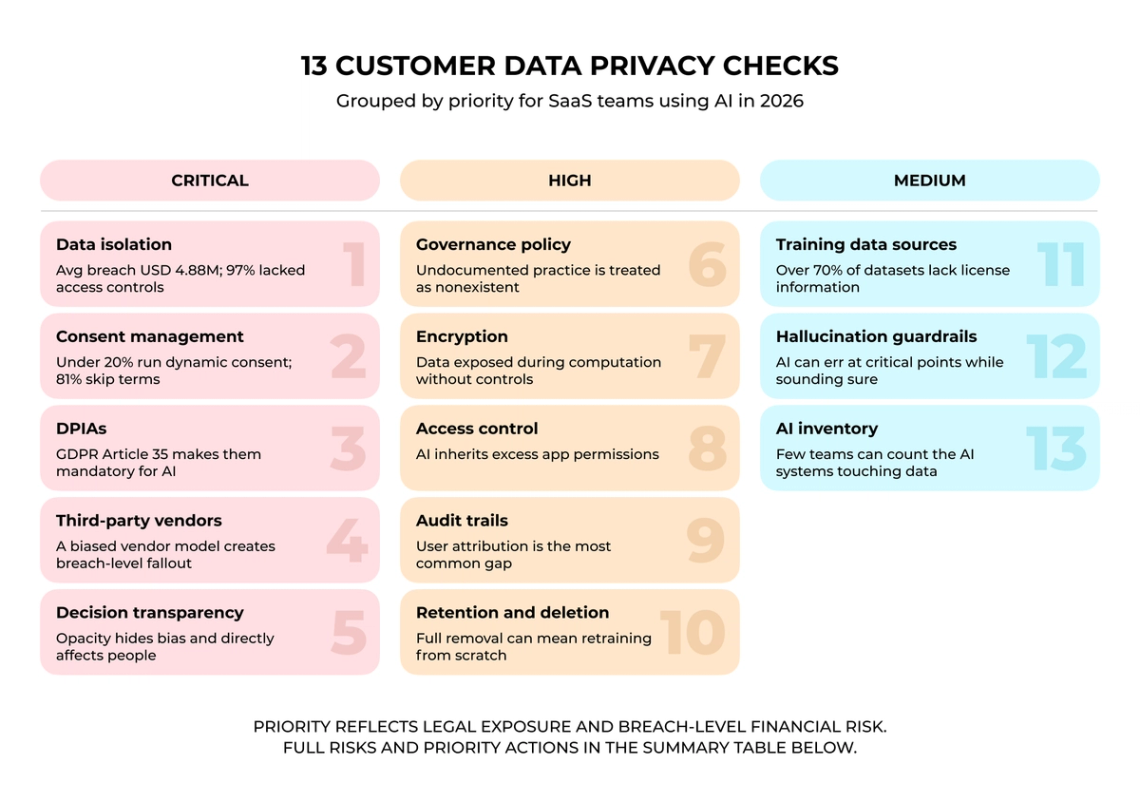
- The thirteen checks below cover training data, isolation, governance, DPIAs, consent, hallucination guardrails, decision transparency, retention, encryption, vendor risk, audit trails, access control and AI inventory.
- A checklist works only when the checks connect into a system: known inventory, enforced boundaries, explainable decisions and sustained review.
Customer data privacy in AI is no longer something a SaaS team can improvise. Models trained on customer records, campaign data flowing into ChatGPT Enterprise or Claude, CRM exports pasted into HubSpot AI or Salesforce AI: each one is a place where a control can quietly fail.
The distance between knowing AI is a risk and controlling it is measured in fines, breach costs and trust that does not return. AI readiness starts before customer data reaches a model, long before a breach forces the question. The same principle applies to marketing data readiness for AI agents further downstream, since automation only works when the underlying data, access rules and reporting logic are already clean. This checklist walks through thirteen checks that secure customer data inside AI tools. Each one maps to a real obligation and a real failure mode, written so a Marketing Ops, RevOps or security lead can act on it without a law degree.
What Separates a Privacy Checklist From a Privacy System
Thirteen checks read as a to-do list, and in practice they stay one until something ties them together. Teams that pass audits run privacy as four operating conditions that hold across all thirteen tasks.
The first condition is a clear view of what exists. An AI system nobody catalogued is a control nobody enforces, so every check starts from a live inventory of where customer data surfaces.
The second is connection. Data moves through training pipelines, vendors, retrieval-augmented generation (RAG) stores and logs, and a boundary counts only when it holds at every handoff, including each point where data passes between systems.
The third is clarity. Consent, retention and automated decisions have to be explainable to a regulator in plain language, prepared in advance so the answer is ready the moment an inquiry lands.
The fourth is momentum. Compliance quietly lapses in two common ways: a DPIA filed once and left, and a policy written then forgotten. Darwin Flux is the operating model built around those four conditions of surface, connections, clarity and momentum, and the checklist below reads differently once each check becomes one of those four conditions in action.
Underneath all four sits a governed data foundation that holds only when the data it protects lives in one controlled place. That foundation should give teams one source of truth for customer and campaign data before AI tools start using it downstream.
1. Verify AI Model Training Data Sources and Usage
Training data is where most AI privacy failures begin. This check confirms where it originates, whether the legal right to use it exists, and whether it hides sensitive information that breaks data minimization rules.
Where your training data comes from
Models ingest terabytes or petabytes of text, images and video, and somewhere in that pile sit healthcare records, biometric data, financial information and personal details scraped from social media. The volume makes oversight nearly impossible without a system in place.
Provenance tracking becomes non-negotiable, so a team has to document who created the data, when it was collected, what licenses apply and every modification along the way. One number frames the risk: license errors exceed 50% of widely used datasets, and over 70% miss license information entirely, which opens the door to copyright claims and regulatory penalties.
Building a provenance record that survives an audit
Provenance holds up when every pipeline is documented before an auditor asks. Start by mapping each data source feeding the AI systems, and for each one verify four things: accuracy and completeness, any conversions that compromise integrity, update frequency and staleness risk, and who owns that source.
Third-party vendors need extra scrutiny, with security standards that match or exceed internal ones and regular audits as data keeps flowing. Reddit began charging for API access precisely because AI companies were training models on user content without permission, which says plenty about licensing risk.
Classify data at intake. Tag everything as personally identifiable information (PII), financial, health-adjacent or child data before it enters the pipeline, then apply field removal, token replacement or masking. Pseudonymization helps, though rich behavioral features can still re-identify people when combined with other datasets. A 2025 advisory from CISA, NSA and FBI names data provenance as essential protection against data poisoning.
Scraping, purpose creep and the public-data trap
The failures here are predictable, and each one has burned a real company. Purpose creep kills trust: consent secured for personalization does not cover model training, so reacquire consent when use cases change.
Web scraping should go through legal, licensing and platform-terms review before any scraped data enters a training or enrichment pipeline. It can pull copyrighted material, and platforms like Facebook prohibit automated collection without written permission.
Public data is not free data either. Public posts still carry intellectual property rights and usage limits, so verify provenance and obtain vendor indemnification clauses before any dataset purchase.
2. Audit Customer Data Isolation Architecture
In a multi-tenant SaaS, isolation is the defense layer that matters most. The goal of this check is simple to state and hard to prove: one tenant must never reach another tenant's data.
Partitioning organizes data; isolation enforces who touches it
Partitioning and isolation are not the same tool. Partitioning organizes data for structure and speed, while isolation enforces the boundaries that decide who can touch what, and a user authenticated for their own tenant could still reach another tenant's resources without the right isolation constructs.
Four boundaries need simultaneous enforcement. Data isolation keeps each tenant in separate logical namespaces. Performance isolation stops one tenant's heavy workload from degrading everyone else through the noisy neighbor effect. Lifecycle isolation lets tenants run different retention schedules on the same platform, and operational isolation keeps maintenance from interrupting tenant operations.
Five sub-boundaries sit underneath and need platform-tier enforcement: separate identity and access management (IAM) realms per tenant, per-tenant encryption keys, tamper-evident audit logs, residency boundaries for data jurisdiction and operational access boundaries that track personnel. The stakes are concrete: IBM's Cost of a Data Breach report puts the average breach at USD 4.88 million, and in a multi-tenant system one compromised admin account can reach everyone's data.
Matching isolation strength to tenant scale
The right isolation model depends on tenant count, and over-building costs as much as under-building. For 10 to 100 tenants, pooled models using tenant_id columns do the job.
Between 100 and 1,000 tenants, move to schema-per-tenant or database partitioning with tenant-aware caching. At 1,000 to 10,000 and beyond, use a hybrid bridge model with silo architecture for high-compliance customers and pooled models for the rest.
Treat the models themselves with the same sensitivity as the raw training data, and make sure tenants understand how their data trains models. Use tenant-aware key naming for caching layers with proper access control lists, require mutual TLS (mTLS) on all inter-service communication, and carry tenant_id inside JSON Web Tokens (JWTs) for context propagation.
When on-paper multi-tenancy leaks
Isolation that lives only in software filters is not isolation. That approach creates a statistical certainty of context leaks, because true isolation needs separation at the application database level through distinct schemas or separate database instances.
Avoid creating individual tables per tenant in one database, since it cannot support large tenant counts and makes querying harder. Testing is the part teams skip: verify that one tenant's data does not leak to another and that noisy-neighbor outcomes stay acceptable. Azure Chaos Studio can inject faults that simulate real-world outages.
3. Review AI Data Governance Policies and Documentation
To a regulator, a policy that lives in someone's head does not exist. This check verifies that governance is documented, versioned, approved and enforced in the stack.
Why undocumented policy does not exist to a regulator
AI governance has moved from a back-office task to a strategic lever that reduces risk and builds trust, yet many teams still treat documentation as an afterthought.
A working framework has to cover data classification, quality management, privacy protections, compliance tracking, transparency, ethical guidelines, data lineage, model management, risk assessment, training and incident response. Each governance policy turns abstract principle into something a team can act on, and teams that start from an AI readiness framework avoid rebuilding governance from zero.
Skip it and the consequence is direct: undocumented or confusing practices get treated as nonexistent in a regulatory review, and programs stall when governance slows AI adoption, creating compliance debt that costs more to repay than a proper framework would have cost upfront.
Policy-as-code and immutable audit logs
Governance holds when enforcement is automatic and built into the system itself. Extend existing frameworks and avoid building from scratch. Financial services teams integrated metadata, data lineage and quality standards into AI workflows by embedding data stewards into model development teams, and that adaptation approach works better than wholesale replacement.
Document clear ownership through a governance charter that names who handles data quality, model validation, privacy compliance and ethical review. Cross-functional teams spanning technical, legal, compliance and business stakeholders catch risks that siloed teams miss.
Turn governance rules into policy-as-code, so executable checks validate consent and residency at the point of processing. Create immutable audit logs using write-once-read-many (WORM) storage for tamper-proof records of data access and model execution.
How fragmented governance stalls AI programs
Fragmented governance is a quiet killer. When one team does not know what another is doing with data, the result is redundant effort, conflicting priorities and dependencies nobody can manage.
Scaling governance from a small project to an enterprise program is not a bigger version of the same thing. It means adapting processes throughout business units while managing real complexity, done proactively and not as a rushed overhaul. Weak documentation also makes auditing nearly impossible, because without traceable decisions and data flows a team cannot demonstrate compliance or run root-cause analysis.
4. Conduct AI Privacy Impact Assessments (DPIAs)
Most enterprise AI deployments trigger a mandatory Data Protection Impact Assessment, whether teams realize it or not. It confirms a DPIA exists and covers the risks that are specific to AI.
What a DPIA has to cover that generic templates miss
Under GDPR (General Data Protection Regulation) Article 35, a DPIA is required before any AI system involving systematic profiling, automated decision-making with legal effects or large-scale sensitive data processing goes live, and enterprise AI usually meets at least one criterion.
“The essential goal is to describe personal data flows as fully as possible so as to understand what impact the innovation or modification may have on the personal privacy of employees or customers.” – David H. Flaherty wrote that as Professor Emeritus at the University of Western Ontario. He helped define the modern privacy impact assessment.
Generic templates built for conventional systems cannot capture model opacity, training-data memorization, automated decision bias or concept drift. A DPIA needs to weigh both allocative harms, meaning loss of financial opportunity or freedom, and representational harms like stereotyping along identity lines.
It is also not a one-time exercise. DPIAs work as living documents that need review at decision points such as before a purchase, before a launch, during reconfiguration and at vendor contract renewals.
Running the assessment step by step
A usable DPIA follows a fixed order. Document processing operations first: what customer data the AI collects, the purposes, the parties involved and the intended outputs, then map where AI decisions affect individuals.
Weigh necessity and proportionality next. Ask whether the same outcome is reachable with less data or without AI, and compare algorithmic and human accuracy where AI replaces a human decision.
Identify AI-specific risks beyond standard privacy threats, score each on likelihood and severity, and document a mitigation for every one. Simple controls go a long way, from limiting what data the model sees to logging every access. Involve a Data Protection Officer (DPO) throughout the process, from early design through sign-off, and consult the supervisory authority before deployment if high residual risks remain.
Where DPIAs quietly fail
The common failures share one root: treating the DPIA as paperwork. Generic templates create false comfort, since AI demands dedicated assessment steps a conventional checklist does not include.
Skipping stakeholder consultation weakens the assessment unless commercial confidentiality genuinely justifies it, so seek input from affected individuals or their representatives. One-and-done assessments ignore how AI behaves over time: demographics shift, behavior changes in response to processing and model quality degrades, which is why regular review is part of the control.
5. Validate Consent Management for AI Customer Data
Static consent forms fall apart the moment AI enters the picture. This area focuses on whether consent is granular, explained in plain language and enforced the instant a user withdraws it.
Why AI breaks conventional consent
Forms built for simple data collection cannot handle systems that gain new capabilities, combine data points in unexpected ways and make automated decisions affecting real lives.
The gap between what those forms assume and what AI does is wide. Fewer than 20% of organizations using personal data in AI run dynamic consent tracking, so most teams operate on permission models that were outdated before their AI shipped. Users receive an average of 13.5 privacy-related requests per day, and 81% admit they do not read terms before they agree.
Meaningful consent needs granular control over each processing purpose, plain explanations of automated decisions and a withdrawal that truly stops AI processing. Because AI systems behave as black boxes, consent interfaces have to explain processing in plain language and let users approve specific activities separately, giving each activity its own distinct choice.
“You should treat all agents like third-party applications. This means that the user should give explicit consent whenever delegating access to an AI agent.” – Michał Trojanowski is Product Marketing Engineer at Curity and puts the standard plainly.
Wiring consent into AI in real time
Consent has to enforce itself at the moment data is used. Connect a Consent Management Platform directly to the AI systems, so that when a user withdraws consent the processing stops immediately, within the same session the choice is made.
For AI agents, grant only the minimum permissions, make consent time-limited and enable per-transaction approval for sensitive actions. Track consent metadata throughout: when permission was given, what it covers and every modification or withdrawal. Tie consent to specific model versions with version control, so a significant change triggers re-consent automatically.
Darwin applied the same logic in a privacy-aware analytics setup for Cleo. Consent handling, cookie configuration and analytics infrastructure had to work together as one system.
Consent mistakes that create compliance gaps
Most consent failures trace back to two mistakes. Pre-ticked boxes and buried disclosures break the rule that consent be freely given, specific, informed and unambiguous, and withdrawal has to be as easy as granting, which many teams make deliberately hard.
The second is reuse. Relying on consent collected for a pre-AI use case leaves a gap when the original permission never covered AI, so reacquire consent when purposes change materially. The same discipline applies upstream, where Google Consent Mode V2 mistakes quietly break analytics and reporting long before AI enters the picture.
6. Test AI Hallucination Guardrails and Accuracy Controls
A confident, wrong answer erodes trust faster than almost any other failure. Start by verifying that AI outputs are checked against trusted sources before a user ever sees them.
What guardrails verify
An AI can fabricate information, contradict a source document or make a claim with no evidence behind it. Guardrails act as verification systems that compare AI responses to predefined rules and approved databases, and hallucinations fall into three types: context-conflicting, unsupported claims and fabricated facts.
Automated Reasoning checks deliver up to 99% verification accuracy using mathematical logic, and provenance validators flag when outputs depart from supplied source documents. These systems sit between the model and the user and block responses that fail validation.
Building layered validation
One validation method is never enough, so layer three. Start with provenance validators that work sentence by sentence, set thresholds that control sensitivity and define failure actions like removing a suspect sentence.
Add consistency checking. Generate multiple independent responses and compare them on critical fields, since disagreement signals uncertainty that should trigger a retry, fallback logic or human review.
Then add trustworthiness scoring through frameworks such as NeMo Guardrails with Cleanlab's TLM, which returns a fallback or escalates to a human when it detects misalignment. Configure confidence thresholds that route uncertain outputs to human review, and keep testing as an ongoing habit with evaluation suites that measure behavior under realistic failure modes.
Guardrail pitfalls that create liability
The pitfalls all trade short-term speed for long-term risk. A single validation method leaves blind spots, since one approach favors precision and another favors recall, and combining them catches more.
Removing human fact-checking is the second mistake, because reviewers catch what AI misses and improve the system over time. Treating validation as optional for low-stakes cases ignores how errors compound: an overconfident wrong answer does more damage than a slower correct one.
7. Establish Automated Decision-Making Transparency
When AI decides on an account, a loan or eligibility, opacity hides the bias and errors behind the outcome. The check here is whether people can understand why an automated decision affected them, which the law now requires.
What the law requires when AI decides
GDPR Article 22 gives individuals the right not to be subject to a decision based solely on automated processing that produces legal or similarly significant effects, and it requires meaningful information about the logic involved. The EU AI Act goes further, requiring clear explanations of the role the AI system plays in the decision.
Transparency builds trust by increasing how well users understand a system, and most AI still operates as a black box where even its builders struggle to explain how a result emerged.
Making decisions explainable in practice
Explainability becomes real when it is published and audience-fit. Publish algorithm registers that document which AI systems make automated decisions, following the model that Chilean and New York City repositories demonstrate.
Fit the explanation to the reader. Avoid jargon with end users while giving auditors and regulators enough detail to validate fairness.
Put human oversight in place so customers can request a manual review, document intended uses, data inputs and known limits, and provide a plain-language explanation of an adverse outcome and the user's rights within 30 days.
Transparency traps to avoid
The subtle trap is mistaking explainability for transparency. SHAP plots and feature importance show how a model decides but not why the decision makes sense to the specific person it affected, and a misaligned explanation creates confusion.
Shallow technical output can satisfy a transparency requirement on paper while ignoring what a user needs, since context-relevant clarity beats a statistical summary. Transparency also does not solve governance on its own: disclosure takes ongoing commitment and runs into intellectual property limits, so it enables accountability but does not guarantee it.
8. Implement Data Retention and Deletion Protocols
AI makes a basic privacy duty surprisingly hard: keeping data only as long as allowed and deleting it on request. This check confirms both hold, even once data has trained a model.
Why deleting data from an AI model is genuinely hard
Keeping data indefinitely breaks storage-limitation principles in every major privacy law, and AI adds a second problem on top. Once data influences a model during training, deleting the original record does not stop the model from acting on what it learned.
Engineers acknowledge that full removal means retraining from scratch, which is costly and impractical, and machine unlearning attempts to remove specific data while leaving the model intact, though reconstructing forgotten information stays nearly impossible. The scale is what makes it hard: frontier models can be trained on massive datasets, which turns deletion into an architecture problem that reaches far beyond a simple delete request.
Retention and deletion that hold up
Durable retention starts with rules tied to each data type, with the window set separately for every kind of data. Define retention periods by data type, purpose and regulatory requirement, then automate deletion with policy-driven tools that remove data past its window and cut human error.
Keep traceable data lineage that records how user data moves through the AI models from collection through training, deployment and deletion, since this record is what lets a team demonstrate compliance while doing the right thing.
Tag data with retention metadata that triggers expiry alerts. For large datasets where record-by-record deletion becomes impractical, use cryptographic erasure through encryption-key deletion for secure, auditable disposal.
Retention pitfalls
Good retention work gets undone by two habits. A policy written once and left unrevisited becomes useless, since new regulations, departments and products each demand an update.
Leaning on a platform's native tools alone leaves most teams short of real retention requirements, since native defaults are built for general use and stop well short of a specific compliance obligation.
9. Verify Encryption Standards for Customer Data in AI Tools
Every AI vendor claims the data is secure, and few mean the same thing by it. The check is whether customer data is encrypted at rest, in transit and during processing, with keys managed properly.
What good encryption looks like end to end
Strong encryption has to hold across three states of data, and most vendors quietly cover only two. The specifics matter: TLS 1.2 or 1.3 for data in transit and AES-256 for data at rest. Conventional encryption protects data at rest and in transit but requires decryption during computation, which opens an exposure window, so confidential computing closes that gap through trusted execution environments that keep data encrypted while it is processed.
Key management is the second question: where keys live, who accesses them and when they were last rotated. A key management system should handle generation, storage, distribution, rotation, backup and revocation, and some enterprises hold customer-managed keys to keep control of the full lifecycle. Audit logging completes the picture, because encryption blocks unauthorized access while logging catches an attempt when something goes wrong.
Implementing encryption proportional to risk
Match encryption effort to data sensitivity, and verify every claim first. Check vendor certificates before deployment, since SOC 2 Type II and ISO 27001 show real commitment, and request Data Processing Agreements that spell out encryption requirements.
AES-256 remains resistant to currently known quantum attacks, and data in transit should use TLS with AES-256 or a post-quantum protocol. Deploy customer-managed keys when regulation demands control, store keys separately from the data they protect and rotate them every 90 days.
Apply encryption at the collection point, covering training datasets, inference requests, model outputs and system logs, since a single gap becomes an exposure window that gets exploited.
Encryption pitfalls
Encryption fails quietly when the basics are skipped. It creates false comfort when upstream data discovery is missing, since a team can encrypt only the data it has already found, so classification comes first.
Default cloud settings are a starting point that still needs work beyond the defaults, so confirm encryption is active and effective through periodic verification. Key management deserves the same attention as the encryption itself: the safety of encrypted data depends entirely on the safety of the keys, and weak key handling hands an attacker the master key regardless of algorithm strength.
10. Audit Third-Party AI Vendor Compliance
Internal controls are only as strong as the weakest vendor with access. This check confirms that third-party AI providers meet standards conventional vendor reviews were never built to test.
What conventional vendor reviews miss about AI
Conventional third-party risk management weighs financial viability and data security, but it misses algorithmic bias, training-data misuse and model opacity. A biased vendor model triggers the same regulatory fallout as a direct breach, yet most organizations have no systematic way to track vendor AI risk.
A thorough review examines vendor governance frameworks, dataset attributes like quality and ownership, model attributes like learning method and bias metrics, and compliance with evolving rules like the EU AI Act. Those technical details are where the real risk hides, and a structured approach to AI auditing and risk review keeps this from becoming a checkbox exercise.
Building continuous vendor oversight
Oversight has to be continuous, since a one-time review ages badly. Reclassify vendors by AI impact, asking whether they use AI for customer-affecting decisions, whether the model trains on proprietary data and whether it touches sensitive information, and give high-risk vendors enhanced due diligence.
Go past SOC 2 by adding questions on ISO/IEC 42001 compliance, bias monitoring, training-data sources, decision-logic documentation and auditability of AI outputs.
Require compliance attestations, model-change notifications and drift tracking, and update contracts to prohibit client-data use for external training, mandate bias mitigation and grant audit rights.
Vendor-audit pitfalls
Checkbox diligence without depth is the recurring failure. Existing SOC 2 reports lack AI-specific controls and cannot show how a vendor handles model governance or training data.
One-time assessments age fast given how quickly AI systems change, and manual vendor discovery is slow. Automated tools that read DNS traffic for AI provider connections catch what manual reviews miss without the onboarding delay.
11. Create AI Privacy Audit Trails and Logging Systems
Regulators want documented evidence they can inspect. This check confirms that every AI decision leaves an immutable record that names the person behind it.
What regulators expect an audit trail to prove
Without a trail, an AI operates in the dark: unaccountable, and one inquiry away from a serious problem. Requirements differ by regulation, so the EU AI Act wants documentation of training data, design choices, operation logs and human oversight, HIPAA demands access logs for protected health information, and SOC 2 expects monitoring with at least a 12-month retention window.
The most common gap is user attribution, since GDPR and FedRAMP both require data-access events to name the specific individual behind each one, tracing every event back to a named person even when a service account or API key performed it. The goal is audit-ready privacy controls that hold the moment a regulator asks, with the evidence already in place before the inquiry arrives.
Building audit capability from the start
Audit capability has to be designed in, since retrofitting logging onto a live system leaves permanent gaps. Use structured logging with consistent schemas throughout the services.
For every AI interaction, capture the model version, the full prompt including system prompts and retrieved context, the complete output with token usage, the authenticated user identity, human-in-the-loop approvals, data sources accessed and any error or safety-filter trigger.
Store logs in append-only systems that block modification, then use tiered retention: hot storage for recent logs, warm storage for months of analysis and cold storage for the years of records a regulator may later request.
Logging pitfalls
Logging can defeat its own purpose in two ways. Recording only successful requests without error trails blocks an investigation at the exact moment it is needed.
Capturing API keys in place of end users breaks the accountability chain, because a service account is not an answer when an auditor asks who accessed what and when.
12. Enable User Rights and Data Access Controls
AI systems tend to inherit far more access than they need. The check is whether access follows least privilege and whether individual data rights work in practice, holding up in real use as well as on paper.
Why AI systems end up over-permissioned
Authentication verifies identity through multifactor mechanisms, while authorization decides what an identity may do, and AI systems routinely inherit far more access than they need from existing apps and service accounts.
The exposure grows with retrieval-augmented generation. When AI ingests data from several sources, the original access permissions attached to that data have to travel with it, so a user authenticated for their own tenant cannot pull another tenant's records through a well-worded query.
Beyond system boundaries, individuals hold rights to access, rectify, erase and object to AI processing under data protection law, and those rights need working controls behind them, not policy language.
Applying least privilege to AI
Least privilege is the anchor: grant each AI identity the minimum its function requires and review permissions quarterly, since role-based or attribute-based controls handle AI environments better than a static permission set.
For data flowing into AI stores from several sources, map source permissions through metadata tags that filter results at query time, and configure vector databases to match each querying user's entitlements against those tags.
Then confirm it works. Audit access configurations regularly and run penetration testing to prove the controls cannot be bypassed.
Access-control pitfalls
Most access breaches come from two patterns. Over-provisioning grants too much on day one, and privilege creep piles on permissions as employees change roles without anyone revoking the old ones, leaving people with access to data they have no reason to see.
One shortcut surprises teams: using system prompts for access control. It sounds reasonable while failing in practice, since adversarial prompting bypasses it, and real access controls belong at the infrastructure level, built into the system itself where a text instruction to the model can never reach.
13. Maintain AI System Inventory and Risk Classification
A team can protect only what it can name. This check confirms that every AI system is catalogued and sorted by risk, including the ones running in shadow IT.
Why an unseen system stays unprotected
Most organizations lack a clear count of how many AI systems touch customer data across departments, third-party tools and shadow IT. An inventory catalogs every model, pipeline and automated decision system, then classifies each by risk.
The EU AI Act defines four categories: unacceptable, high, limited and minimal. High-risk systems include AI in recruitment, credit scoring, law enforcement and biometric identification, and they carry duties around risk assessment, data quality, logging, documentation, human oversight and system resilience.
That inventory is what turns compliance from guesswork into management. It shows exactly how AI runs through the organization, and without it a team is flying blind.
Building and maintaining the inventory
A useful inventory has an owner and a cadence. Assign it to a Chief AI Officer, CISO or Chief Compliance Officer, and run discovery through cross-functional teams from IT, procurement, legal, compliance and business units, since no single team sees the whole picture.
Classify each system against regulatory frameworks using automated discovery tools that scan code repositories, cloud billing for GPU usage and API traffic patterns. Document the owner, purpose, data sources, deployment environment and risk tier for every entry.
Set a quarterly review as a minimum, and update the inventory whenever a system is procured, modified or decommissioned, or whenever regulations shift.
Inventory pitfalls
Defining AI too narrowly is where most teams stumble. Rule-based systems, robotic process automation (RPA) with cognitive elements and informal generative AI tools all count, and vendor AI often carries the largest impact yet gets overlooked.
Treating this as an IT-only project underreports business-side adoption. The spreadsheet a marketing team is using to test an AI tool counts too.
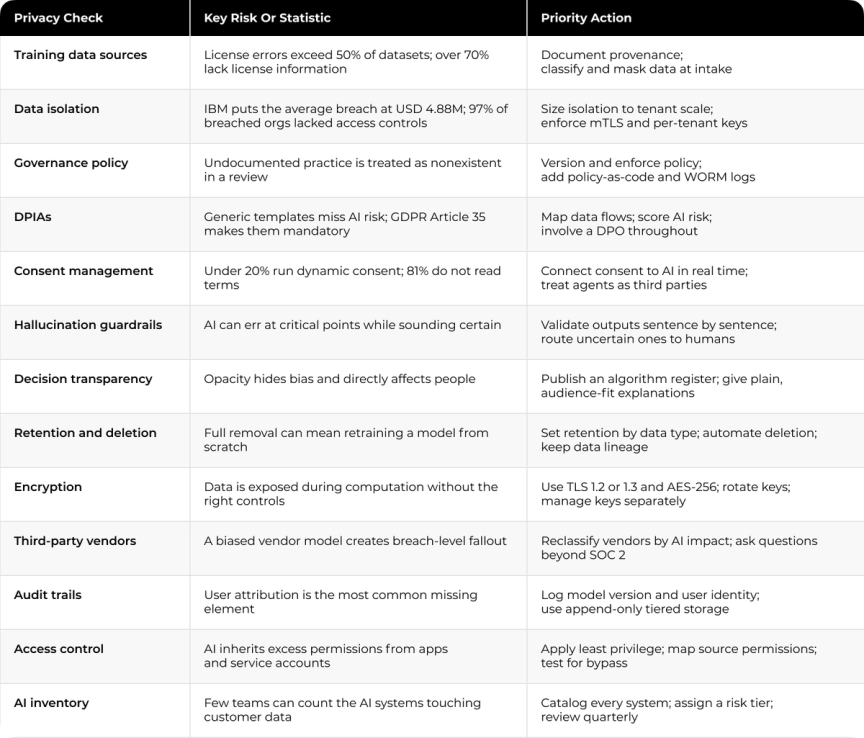
The 13 Checks, Their Risks and Priority Actions
The table below is a quick reference to every check with its main risk and the first action to take.
Teams comparing data privacy tools for SaaS marketing teams should still start with the control question: what has to be governed before another tool enters the stack?
How Darwin Can Help
Thirteen checks are easy to endorse and hard to enforce across a live system with real vendors, real customer data and a regulator on the other end. The failure is rarely one missing control. It is the distance between a policy on paper and a stack that enforces it, and that distance is widest when customer data is scattered through disconnected tools nobody governs as one.
Cleo needed GDPR-compliant analytics that preserved reporting visibility and turned to Darwin for it. Darwin connected consent handling, cookie configuration and analytics infrastructure into one governed setup. The work shows the same principle behind this checklist: privacy controls work only when enforcement lives inside the system itself, built into the infrastructure where the policy document alone can never reach.
That is the difference between a team that can name thirteen checks and a team that can prove them. The checklist tells you what to verify. A governed setup decides whether the answer holds when someone asks.
FAQs
Q1. What are the main privacy risks when using AI in SaaS products?
The biggest risks are training models on customer data without consent, weak isolation between tenants, hallucinations that leak sensitive information and opaque automated decisions. Many teams also under-implement encryption and keep no audit trail of how customer data moves through AI.
Q2. How does the EU AI Act affect SaaS companies using third-party AI APIs?
SaaS companies using AI APIs are usually deployers under the EU AI Act, with duties beyond data residency. They need to document AI use, run risk assessments, add logging and traceability and stay transparent with users. Most B2B SaaS falls under limited risk, which centers on transparency.
Q3. What is the difference between data isolation and data partitioning in multi-tenant AI systems?
Partitioning organizes data, for example through tenant_id columns or separate schemas. Isolation enforces the boundaries that stop one tenant from reaching another's data. Real protection needs isolation at several levels: data, performance, lifecycle and operational.
Q4. Why can you not simply delete customer data from an AI model when requested?
Once data has influenced a model during training, deleting the original record does not remove what the model learned. Full removal usually means retraining from scratch, which is impractical. Machine unlearning helps, though reconstructing forgotten information stays nearly impossible with large models.
Q5. What should a SaaS team prioritize first when implementing AI privacy controls?
Start where risk is highest. Teams processing sensitive data at scale should prioritize encryption and isolation, while teams leaning on third-party AI should audit vendor compliance first. For most, the practical order is to inventory AI features, classify risk and add logging and transparency.