
Quick answer:
ChatGPT still leads U.S. chatbot usage in 2026 (about 51.5% per First Page Sage, August 2026), followed by Google Gemini (about 27.6%) and Claude (about 10.2%). Grok, Perplexity, Microsoft Copilot and DeepSeek hold low single digits, and a long tail of tools serves privacy, multi-model access and open-source needs.
The models have changed substantially since the last edition, including updates across ChatGPT, Gemini, Claude, Grok, DeepSeek and Meta AI. Free tiers now cover more everyday tasks, so the practical choice depends on the workflow, ecosystem and data available to the assistant.
TL;DR
- ChatGPT leads the cited U.S. usage estimate, with Gemini and Claude forming the next tier.
- Free tiers are capable enough to trial several assistants and pick a paid plan once one fits.
- Model access, ecosystem fit, privacy and current-information needs should drive the choice.
- For business use, reliable answers still depend on clean, connected company data.
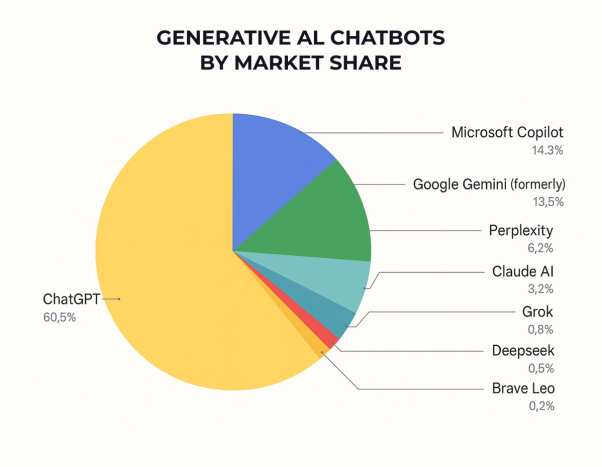
Usage estimates show a more competitive chatbot market than in 2025. First Page Sage estimates ChatGPT at roughly 51.5% of U.S. chatbot usage as of August 2026. The figure covers U.S. web and mobile monthly active users, so it reflects one market and methodology, not a universal global share.
In the same estimate, Google Gemini accounts for about 27.6% of U.S. usage and Claude for about 10.2%. Grok, Perplexity, Microsoft Copilot and DeepSeek each hold low single-digit shares, while smaller tools focus on privacy, multi-model access and open-source use. Other trackers produce different results because they measure web visits, app activity or referral traffic, so each percentage needs its source and scope.
Chatbot adoption and product capabilities continue to change quickly. This guide compares 15 active chatbots in 2026, including their models, pricing, main use cases and intended users. Estimates are identified as such and separated from vendor disclosures.
Why the Right AI Chatbot Depends on Your Data Foundation
Choosing a chatbot is the easy part; getting reliable answers out of one depends on the data underneath it. A model can only reason over what it can reach, and most marketing and revenue teams keep their numbers scattered across analytics tools, a CRM, ad platforms and spreadsheets that never agree with each other. Point any assistant at that mess and you get confident answers built on broken inputs.
This is the problem Darwin works on before the model layer. The approach rests on four pillars. Surface covers the public touchpoints where people meet a brand, such as the website, forms, page speed and search presence, so those signals are captured and usable. Connections join records that live in separate systems, so a customer in the CRM matches the same customer in analytics. Clarity resolves the conflicting definitions and mismatched metrics that make two dashboards disagree, which is what earns trust in the reporting. Momentum keeps the pipeline current, so answers reflect this week and not last quarter. Together they turn a pile of tools into clean, connected data an AI can trust. That foundation is what Darwin Flux is built to deliver.
1. ChatGPT
OpenAI launched ChatGPT in November 2022. It remains the most widely used chatbot in the U.S. usage estimate cited in this guide.
ChatGPT Overview
ChatGPT now runs on OpenAI's GPT-5.6 family, which splits into three durable tiers: Sol for flagship reasoning, Terra as a balanced everyday model and Luna for speed and low cost. As of August 2026, Luna became the default for Free and Go users, who also gained unlimited text chats. Plus and Pro subscribers get GPT-5.6 Sol with a reasoning slider that controls how much thought the model applies to each answer.
Key Features of ChatGPT
The product has grown well past simple text chat. Current capabilities include:
• Unlimited text conversations on the free tier, with a Think button for harder questions
• Web browsing for current information and cited sources
• Image analysis, file uploads and advanced data analysis
• Voice conversations that handle natural back-and-forth
• Memory that carries context and preferences between chats
• Codex and agentic coding workflows on paid tiers
ChatGPT Use Cases
People use ChatGPT for writing, coding help, research, translation and brainstorming. Businesses apply it to customer service, marketing content, recruitment screening, data analysis and knowledge management. The step that separates a demo from real value is giving the model company context AI can reason over. OpenAI reports that roughly one billion people use ChatGPT each week, making it one of the highest-reach AI assistants.
ChatGPT Pricing
OpenAI offers several individual and business tiers as of September 2026.
• Free: unlimited text on GPT-5.6 Luna, with caps on images, uploads and voice
• Go: paid individual plan; price varies by region
• Plus: paid individual plan with GPT-5.6 Sol and the reasoning slider
• Pro: high-usage individual plan with agent and video access
• Business and Enterprise: per-seat pricing with admin controls and stronger data protections
Who Should Use ChatGPT
The free plan now covers most casual needs on its own. Plus fits professionals who rely on AI daily and want the reasoning slider. Pro targets power users and researchers who need the highest limits, while Business and Enterprise serve teams that need collaboration, security and compliance.
2. Microsoft Copilot
Microsoft Copilot brings AI assistance into Microsoft 365 products and a standalone chat experience.
Microsoft Copilot Overview
Copilot lives directly inside Word, Excel, PowerPoint, Outlook and Teams, and it connects to your Microsoft Graph data so it understands your work context. Available models vary by Copilot experience and plan, spanning Microsoft 365 Copilot, Copilot Studio and Cowork. Because Bing Copilot shares ChatGPT's underlying system, some market trackers fold its usage into the ChatGPT figure, which makes Copilot's standalone share look smaller than its real footprint inside enterprises.
Key Features of Microsoft Copilot
The value shows up when Copilot works inside an existing workflow and not in a separate tab. You get:
• AI assistance built into Word, Excel, PowerPoint, Outlook and Teams
• Natural-language requests that turn into documents and data analysis
• Copilot Pages for organizing and developing detailed work
• Voice conversations in more than 40 languages
• Web search with current information
• File upload and analysis
Microsoft Copilot Use Cases
Different teams find their own uses. Sales teams analyze customer data and draft communications, executives summarize long reports and meeting notes, and IT departments lean on it for troubleshooting and documentation. Marketing teams use it heavily inside Word for campaign development. Standalone chatbot usage sits near 1.3% of the U.S. market per First Page Sage, a figure that understates its embedded use across Microsoft 365.
Microsoft Copilot Pricing
Microsoft 365 Copilot costs 30 USD per user per month with an annual commitment and requires a qualifying Microsoft 365 subscription. Microsoft 365 business customers can also access a limited free Copilot Chat experience.
Who Should Use Microsoft Copilot
If your work already lives in the Microsoft ecosystem, Copilot becomes an easy call. It pays off most for enterprises that want AI across many departments and no extra platform. Individuals can test the free chat, though the real value depends on Microsoft tools being central to your day.
3. Google Gemini
By September 2026, Google Gemini ranks second in the U.S. usage estimate cited in this guide.
Google Gemini Overview
Gemini is Google DeepMind's multimodal model family, built to reason across text, images, audio and video. The current lineup includes Gemini 3.1 Pro for balanced work, Gemini 3 Deep Think for hard reasoning, Gemini 3.8 Flash as the fast everyday model released in September 2026 and Gemini 3.5 Flash-Lite for high-volume tasks. Note that many third-party trackers still list an older Flash version, so the 3.8 figure comes straight from Google's own model pages.
Key Features of Google Gemini
Gemini reads long documents and handles multi-step research with ease. Standout capabilities include:
• A one-million-token context window for very large inputs
• Deep Research that analyzes many sources in a single pass
• Code generation and debugging in multiple languages
• Native integration with Gmail, Docs and the rest of Google Workspace
• Gemini Spark, an always-on agent for Pro and Ultra subscribers
Google Gemini Use Cases
Gemini shows up in education, marketing and professional research. Google reports the Gemini app has passed one billion monthly active users, driven largely by Android and Gmail integration. In the First Page Sage estimate it holds the number-two position in U.S. chatbot usage.
Google Gemini Pricing
Gemini offers free, Pro and Ultra consumer tiers as of September 2026.
• Free: Gemini 3.x Flash with basic access and usage limits
• Google AI Pro: paid plan with expanded access and Deep Research
• Google AI Ultra: premium plan with the highest feature limits
Who Should Use Google Gemini
The free tier suits students and casual users who need solid everyday help. Pro works for professionals who need deeper research and content creators who want more capable outputs. Ultra fits enterprises and power users already invested in the Google ecosystem.
4. Claude AI
Claude built its reputation on careful reasoning and long-document work over raw speed. It comes from Anthropic, an AI safety company founded by former OpenAI researchers.
Claude AI Overview
Claude runs on Anthropic's current model lineup. Claude Sonnet 5, released June 30, 2026, is the default model for Free and Pro plans and narrows the gap with the larger Opus tier. Claude Opus 4.8 remains available for the most complex work, with Claude Haiku 4.5 for faster tasks. First Page Sage estimates Claude at roughly 10.2% of U.S. chatbot usage as of August 2026.
Key Features of Claude AI
Claude stands out for reasoning quality and natural writing. Its strengths include:
• Large context windows suited to long documents and codebases
• The Artifacts feature, which produces standalone content you can reference and edit through a conversation
• Strong document analysis and detailed, well-structured output
• Image and document uploads for analysis
• Web search for current information
Claude AI Use Cases
Anthropic's own usage data points to software development and content creation as the top applications, followed by document summarization, collaborative writing and coding assistance. Independent estimates of Claude's total user base and revenue vary widely, so treat any single monthly-active-user or revenue figure as an estimate unless Anthropic publishes it directly.
Claude AI Pricing
Claude offers Free, Pro, Team and Enterprise plans.
• Free: basic access with daily usage limits
• Pro: individual professional plan with substantially higher usage
• Team: per-user plan with central billing for small groups
• Enterprise: custom pricing with enhanced security
Who Should Use Claude AI
Claude works well for developers who need coding help, analysts working through long documents and writers who want a more natural style. The free tier suits casual use, Pro fits individual professionals, and Team and Enterprise serve groups with collaboration and security needs.
5. Perplexity AI
Perplexity launched in 2022 as an answer engine that presents sources alongside its responses.
Perplexity AI Overview
Perplexity delivers answers with direct citations, which sets it apart from assistants that leave you guessing where information came from. It combines language models with live search, and consumer plans now run its Sonar 2 model alongside access to other frontier models. The earlier Sonar, Sonar Pro and Sonar Reasoning Pro remain as API models, with support ending September 27, 2026. Its U.S. usage share fell to about 2.0% by August 2026 as larger assistants folded search and citations into their own apps, though its enterprise and revenue base kept growing.
Key Features of Perplexity AI
Pro Search is the feature that defines Perplexity, offering guided exploration in place of a single reply. The platform can also:
• Search internal files alongside web results
• Generate and edit images
• Schedule recurring alerts on a topic or task
• Create shareable research spaces for collaboration
Perplexity AI Use Cases
Financial services teams use Perplexity to speed up research, engineers use it for code reviews and investors use it for market diligence. Its citation-first design makes it a fit for anyone who needs answers they can verify against sources, and it is worth understanding how these systems surface current information and cited sources when they decide which brands to mention.
Perplexity AI Pricing
Perplexity offers Free, Pro, Enterprise Pro and Max tiers.
• Free: unlimited quick searches
• Pro: paid individual plan
• Enterprise Pro: per-seat business plan
• Max: a premium tier for heavy users
Who Should Use Perplexity AI
Perplexity fits researchers, data analysts and market researchers who value structured, sourced answers. It explains technical terms clearly, which makes it useful for fast, verifiable research more than open-ended conversation.
6. DeepSeek
DeepSeek gained broad attention in January 2025 after releasing its R1 reasoning model. It now offers both consumer chat access and models for developers.
DeepSeek Overview
DeepSeek operates as an independent AI research lab founded by Liang Wenfeng under the Chinese hedge fund High-Flyer. Its current flagship is DeepSeek V4, with a V4-Pro variant that reached general availability in August 2026. V4-Pro is a large open-weight model released under an MIT license, with a one-million-token context window, and it competes on cost against models several times its price. DeepSeek holds a small U.S. usage share but ranks among the fastest-growing chatbots relative to its size.
Key Features of DeepSeek
DeepSeek combines reasoning models, open weights and comparatively low API pricing. Its notable traits include:
• Open model weights under a permissive license, so developers can self-host
• A one-million-token context window on V4-Pro
• Reasoning quality competitive with far pricier flagship models
• Free chat access on the web and mobile app with no query cap
DeepSeek Use Cases
Developers and cost-conscious organizations use DeepSeek for reasoning tasks and self-hosted deployments. Its open weights support teams that need to keep data on private infrastructure. Casual users get free chat, while API customers pay usage-based rates.
DeepSeek Pricing
DeepSeek chat is free on the web and app. API access uses usage-based pricing with peak and off-peak rates.
Who Should Use DeepSeek
DeepSeek suits developers on a budget, teams that need self-hosted open weights and anyone comfortable with a model built outside the U.S. ecosystem. Its price-to-capability ratio is the main draw.
7. Grok
Grok is xAI's assistant, with direct integration into X and access to current social-platform data.
Grok Overview
Grok now runs on Grok 4.6, released in August 2026 as an upgrade over the July flagship Grok 4.5 at the same price. It carries a 500,000-token context window and became available on Amazon Bedrock in EU regions for teams with data-residency needs. Grok holds roughly 2.8% of U.S. chatbot usage, which recently moved it ahead of Perplexity. Availability varies by region.Grok 4.6
Key Features of Grok
Grok's differentiator is live access to X data and a direct tone. Its capabilities include:
• Live awareness of current events and trending discussion on X
• A large context window for long inputs
• Configurable reasoning levels and support for longer agent workflows
• Image understanding and generation
Grok Use Cases
Social media managers, trend analysts and content creators get the most from Grok's live view of X. For users already active on the platform, it provides context on current events and viral content that other assistants miss.
Grok Pricing
Grok is available through X subscription tiers and xAI plans. Access and pricing vary by plan and region.
Who Should Use Grok
Grok fits users who need answers informed by current discussion on X. Social media managers, trend analysts and active X users benefit most from its live-data capabilities.
8. Meta AI
Meta AI reaches a large audience through Facebook, Instagram, WhatsApp and Messenger, apps that billions already open every day.
Meta AI Overview
Meta rebuilt the engine behind Meta AI in 2026. The assistant now runs on Muse Spark, the first model from Meta Superintelligence Labs, which replaced the earlier Llama models as the consumer engine in April 2026, followed by Muse Spark 1.1 in July. Meta AI works inside Instagram, Facebook, WhatsApp and Messenger, and also as a standalone app. Meta last published a firm user number in 2025, when it reported one billion monthly active users, so any larger figure circulating since then is a third-party estimate and not an official disclosure.
Key Features of Meta AI
Meta AI personalizes responses and handles multiple input types. Its features include:
• Memory of details you share, such as preferences, for tailored responses
• Natural voice conversations with several voice options
• Image generation and editing through simple prompts
• Photo analysis that identifies details in images you share
• Translation across multiple languages
Meta AI Use Cases
People use Meta AI for content creation, trip planning, everyday questions and image generation inside the apps they already use. Because much of its reach comes from passive interactions inside social feeds, its raw user count is not directly comparable to active chatbot sessions on standalone products.
Meta AI Pricing
Meta AI is free across all platforms. Meta has signaled that future monetization could include paid features, though no subscription is required today.
Who Should Use Meta AI
Meta AI fits people already living in Meta's apps who want AI inside them. Content creators benefit from image generation, and casual users get capable, free assistance built into daily tools.
9. Jasper AI
Marketing teams know the grind of endless blog posts, social updates, product descriptions and email campaigns that all need to sound on-brand. Jasper is built for exactly that workload.
Jasper AI Overview
Jasper is a marketing-focused AI platform, not a general assistant. It learns a brand voice from your guidelines and existing content, then produces campaign material that matches your tone. In 2026 Jasper restructured its plans, and its Pro tier now leads the lineup while the older Creator tier is being phased out for new users. Earlier revenue and customer figures circulate widely, so treat any specific 2024 number as dated unless Jasper reconfirms it.
Key Features of Jasper AI
Jasper's strength is brand consistency at speed. The platform offers:
• Brand Voice that learns and applies your tone across content
• A large template library for emails, product descriptions and more
• A Chrome extension that brings Jasper into your browser workflow
• Campaign mode that turns one brief into a coordinated set of assets
• Team collaboration and progress tracking
Jasper AI Use Cases
Businesses use Jasper for social posts, blog content, product descriptions, ad copy and email sequences. Large enterprises value how it holds brand consistency across many channels and campaigns, which is the feature that most justifies its price for teams.
Jasper AI Pricing
Jasper offers a Pro plan and a custom Business plan. The older Creator tier is no longer the primary option for new customers.
• Pro: 69 USD per month, or about 59 USD per month billed annually, with unlimited word output
• Business: custom pricing for larger teams and agencies
• A seven-day free trial is available on paid plans
Who Should Use Jasper AI
Jasper suits marketing teams managing high content volumes, solo marketers working across formats and agencies handling multiple client brands. Its main value is maintaining brand consistency across campaign assets.
10. Brave Leo AI
Brave Leo is built to keep your conversations private inside the browser you already use, at a time when many chatbots collect and store what you tell them.
Brave Leo AI Overview
Brave Leo is a privacy-first assistant built into the Brave browser sidebar, free for all Brave users. It reads the page you are on to summarize articles, answer questions about PDFs and translate content, and it routes requests through an anonymization server that strips your IP address before it reaches the model provider. Brave notes that Leo's model set changes over time, and availability depends on your Brave version and platform, so check the Leo page for the current lineup.
Key Features of Brave Leo AI
Leo works inside your browsing, not in a separate app. It can:
• Summarize long web pages and technical documents
• Analyze PDFs and answer questions about them
• Translate pages without copy-pasting elsewhere
• Run without an account, with conversations never stored on Brave servers
Brave Leo AI Use Cases
People use Leo to condense long reads, compare products while shopping and pull details from technical specifications and research papers. It fits everyday browsing tasks where privacy matters and a built-in assistant saves a trip to another tab.
Brave Leo AI Pricing
The free version covers casual use. Leo Premium is a paid upgrade; price may vary by region.
Who Should Use Brave Leo AI
Brave Leo fits people who already use Brave as their daily browser and want a private assistant built in. It suits anyone who values keeping data private while still getting useful AI help.
11. Komo AI
Searching for sensitive information online often feels like being watched. Komo AI is a privacy-first search engine that aims to deliver AI answers without the tracking.
Komo AI Overview
Komo merges web search with AI assistance and keeps a clean, ad-free interface. It delivers concise answers while still linking to original sources, and it offers three modes: Explore for discovering topics with visual cards, Chat for conversational follow-ups and Search for standard link-based results with AI summaries. Komo remains a smaller, niche player among the larger assistants.
Key Features of Komo AI
Komo focuses on speed and simplicity. Its features include:
• An interactive chat mode for follow-up questions on difficult topics
• A social trend scanner for current discussion across platforms
• Content summarization and a concept-breakdown tool for difficult ideas
• Live news access
Komo AI Use Cases
Privacy-conscious researchers use Komo to gather information and leave no trail, journalists use it for topic research and summarization, and students use its concept breakdowns to make sense of difficult material. It fits research that calls for a low-tracking, distraction-free tool.
Komo AI Pricing
Komo offers free and paid access. Current paid-plan details are available through the product's own purchase flow.
Who Should Use Komo AI
Komo fits people who prioritize privacy in research and content creators who want a clean, distraction-free way to gather information.
12. Andi
Andi set out to replace the wall of blue links with direct answers. Founded in 2021, it treats search like a conversation with someone who knows the topic.
Andi Overview
Andi has shifted its focus in 2026. Its developer site at andiai.com now offers a search API and MCP server that give AI agents live web search and page reading, while the consumer search app stays at andisearch.com and runs as a progressive web app. It uses semantic search with language models to read the meaning behind a query in place of matching keywords. Andi reports strong independent-benchmark accuracy and repeated recognition as a free AI search engine, though those claims are self-reported or third-party and worth checking on the Andi site.andiai.com
Key Features of Andi
Andi keeps a conversational interface and direct answers. Its features include:
• A conversational search experience with direct answers and source links
• A Generate Text feature for summaries and explanations
• Follow-up prompts to explore a topic in depth
• A search API and MCP server for developers building AI agents
Andi Use Cases
People use Andi for quick factual lookups, understanding difficult topics with reliable sources and creating well-sourced summaries. Developers increasingly use its API to give their own agents live web access, which reflects the product's move toward serving builders alongside end users.
Andi Pricing
Andi offers free anonymous consumer search, with developer API access available separately.
Who Should Use Andi
Andi fits busy professionals who value quick, sourced answers and developers who need a web-search and page-reading layer for their own AI agents. Privacy-conscious users and content creators also benefit from its streamlined approach.
13. Mistral Vibe
Mistral Vibe, formerly Le Chat, is Mistral AI's assistant for work and coding.
Mistral Vibe Overview
Mistral Vibe is Mistral's AI chat assistant and agent for work and code. It combines Vibe for work, formerly Le Chat, with Vibe for code in one product for individuals, teams and enterprises. The product supports web search, document work, coding tasks, voice input and connections to more than 100 tools through connectors and MCP.
Key Features of Mistral Vibe
Mistral Vibe combines general work assistance with coding and automation tools. It offers:
• AI chat for research, writing and document work
• Vibe for code in the CLI, supported IDEs and remote coding agents
• Connections to more than 100 tools through connectors and MCP
• Voice input powered by Voxtral
• Private-cloud, on-premises and data-residency options for enterprise customers
Mistral Vibe Use Cases
People use Mistral Vibe for research, document creation, coding and multi-step work connected to business tools. Teams can use shared workspaces and connectors, while enterprise customers can assess private-cloud, on-premises and data-residency options for regulated environments.
Mistral Vibe Pricing
Mistral Vibe offers Free, Pro, Team and Enterprise tiers.
• Free: limited access to chat, web search, content creation and Vibe for code
• Pro: 14.99 USD per month
• Team: 24.99 USD per user per month
• Enterprise: custom pricing on request
Who Should Use Mistral Vibe
Mistral Vibe suits individuals and teams that want one product for general work, coding and privacy-sensitive work. Its deployment and data-residency options may also be relevant to European organizations assessing privacy and infrastructure requirements.
14. Poe
Testing several AI chatbots usually means juggling a dozen accounts. Poe solves that by putting them behind one login.
Poe Overview
Poe is Quora's multi-model platform, launched in early 2023. It gives access to more than 200 models from leading AI companies, plus over a million user-created bots, all through one account and a shared compute-point system. You can switch models mid-conversation and compare answers side by side, which makes Poe a practical way to sample the whole field without separate subscriptions.
Key Features of Poe
Poe's value is breadth and comparison. Its features include:
• Access to models from OpenAI, Anthropic, Google, xAI and others in one place
• Multi-bot chat to compare responses from different models at once
• A large library of user-built bots for specific tasks
• Image generation through supported models
• Custom bot creation with no code
Poe Use Cases
People use Poe to compare model outputs, run the same prompt across several systems and access specialized bots for niche tasks. Developers use it to build and monetize custom bots through Poe's revenue-sharing program. Quora reports usage in the millions, and the platform's revenue has roughly doubled since 2024 by third-party estimates.
Poe Pricing
Poe offers a free daily compute-point allocation and several paid plans for higher usage.
• Free: a daily compute-point allocation for light use
• Paid tiers: a range of monthly plans from a low-cost starter up to high-volume options
Who Should Use Poe
Poe fits people curious about different models who prefer one subscription. Developers, researchers comparing outputs and anyone needing specialized AI for specific tasks find real value in one interface across many models.
15. HuggingChat
HuggingChat puts open-source models front and center, in plain view of how they work.
HuggingChat Overview
HuggingChat is Hugging Face's open-source assistant, and after a shutdown it relaunched in 2026 with an Omni model router that picks a suitable model for each task. It gives free access to a rotating set of leading open-weight models, and the available lineup changes over time. Because it exists partly to showcase open-source AI, it has not chased market share among the large commercial assistants.
Key Features of HuggingChat
HuggingChat's strength is model choice and openness. It offers:
• A choice of open-source models suited to different tasks
• The Omni router, which selects a model automatically
• Web search that pulls current information
• Custom assistants and file uploads for analysis
HuggingChat Use Cases
People use HuggingChat for content creation, coding help, image generation and document analysis. Its real advantage is letting you compare outputs across open models side by side, which suits developers and anyone curious about open-source AI. Free credits are limited, so it works best as a laboratory more than a primary daily assistant.
HuggingChat Pricing
HuggingChat is free to use on the web platform, with limited free credits.
Who Should Use HuggingChat
HuggingChat fits privacy-conscious users, developers who want to customize models and anyone comparing open-source options across one interface. It also serves people who simply want a no-cost alternative to paid assistants.
Comparison Table
The table below summarizes each chatbot on the points that drive a decision: what it runs on, roughly what it costs and who it suits. Usage-share figures are omitted here because trackers disagree and the numbers shift monthly; where share matters, the individual sections above give the source and scope.
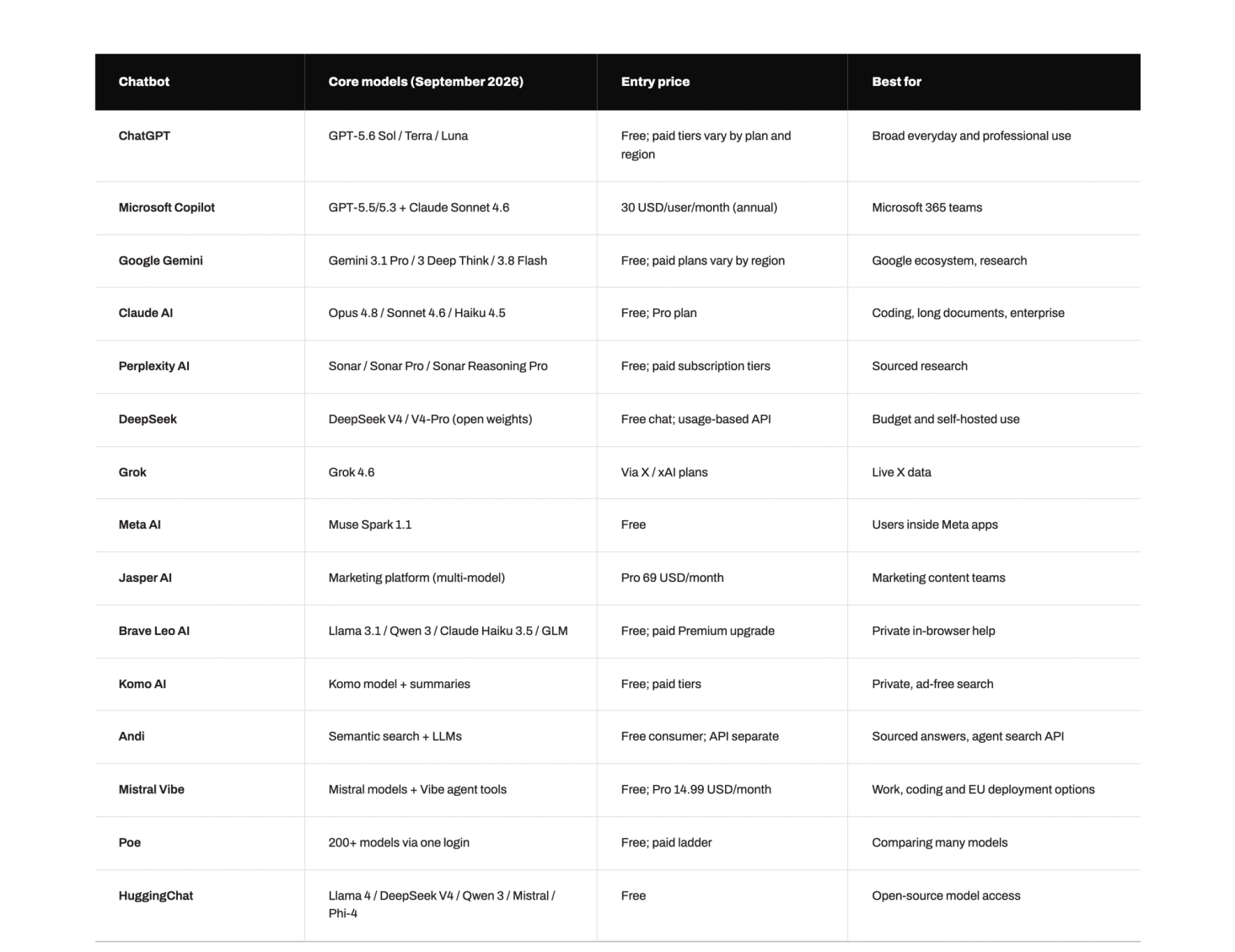
Consumer pricing is similar across several leading assistants, so model access, integrations and workflow fit often matter as much as the monthly fee. Free tiers also make it possible to test several options ahead of a paid plan. For business use, implementation effort shifts to AI workflows and depends heavily on the quality and accessibility of the underlying data.
Choosing an Assistant Your Data Can Support
The AI chatbot world has exploded since ChatGPT first caught everyone's The chatbot you pick is only one part of the result. When an assistant works with scattered analytics, CRM records and ad-platform exports, inconsistent inputs can produce unreliable answers. This helps explain why AI projects fail when teams automate on top of poor data quality and access. Marketing data readiness for AI agents therefore needs to be in place first, ahead of using these systems for marketing and revenue decisions.
Cleo saw this firsthand. Their reporting pulled from GA4, Salesforce, BigQuery and Looker Studio, and the numbers did not line up, which left the team second-guessing decisions. Darwin rebuilt the foundation underneath those tools. Reporting accuracy moved from 70% to 90%, the team recovered around two days a month that had gone to manual reconciliation, and the cleanup saved roughly 50,000 USD a year. The AI layer on top only became useful once the data below it agreed with itself.
Choose the assistant that fits the workflow, then make sure it can access consistent, governed data. That foundation makes AI agents for marketing operations more dependable and supports answers teams can use in real decisions.
FAQs
Q1. Which AI chatbot leads the market in 2026?
ChatGPT still leads, at roughly 51.5% of U.S. chatbot usage as of August 2026 per First Page Sage. OpenAI reports roughly one billion weekly users, making ChatGPT one of the highest-reach AI assistants, though Google reports its Gemini figures on a monthly basis, so the two are not directly comparable. Google Gemini sits second near 27.6% and Claude third near 10.2% in this U.S. estimate, and different trackers report different figures depending on what they measure.
Q2. Are there strong free AI chatbots in 2026?
Yes, and the free tiers have improved sharply. ChatGPT now offers unlimited text on its free plan, and Google Gemini, Claude, Perplexity, Mistral Vibe, DeepSeek and HuggingChat all offer capable free access with some limits. You can test several free options and pay only if one earns it.
Q3. Which AI chatbots are designed for marketing?
Jasper is designed specifically for marketing teams, with Brand Voice and campaign tools for maintaining tone across channels. General assistants such as ChatGPT, Claude and Gemini can also support marketing content, so the choice depends on whether the team needs dedicated brand-governance features.
Q4. Which AI chatbots offer privacy-focused features?
Brave Leo routes requests through an anonymization server and states that conversations are not stored on Brave servers. Mistral Vibe offers private deployment and data-residency options for enterprise customers, while Komo focuses on ad-free, low-tracking search. Teams should compare each vendor's current privacy and security documentation with their own requirements.
Q5. What changed most since the last version of this guide?
The main changes are newer model lineups and a different usage picture. In the U.S. estimate used here, Gemini ranks second behind ChatGPT. You.com also shifted toward enterprise search, so this edition includes Mistral Vibe, formerly Le Chat, in its place.