
Quick Answer
The AI sales development representative (SDR) platforms most often shortlisted for inbound work in 2026 are Knock AI, Fin, Qualified Piper, Conversica, Dashly, Chili Piper, HubSpot Breeze and 11x. Drift is included separately as a case study on platform lifecycle, not as a buying recommendation. Each of these platforms can cut first response time when channels and routing are configured correctly. The difference that decides the outcome sits after qualification: which CRM the platform writes to, how routing rules are defined and who owns the definition of a qualified lead. Tool choice comes second to that.
TL;DR
- Median B2B lead response time sits at 42 hours. Sub-five-minute response remains rare.
- Nine platforms reviewed here, priced from $39 per month to $128,000 per year.
- Pricing here comes from current vendor pages. Several figures still in circulation are out of date.
- Drift appears here as a case study on platform lifecycle. Its sunset was announced in March 2026 and it is closed to new contracts.
- An AI SDR inherits your routing rules and CRM fields. Those come first.
A prospect lands on a pricing page, fills out a demo form and waits. The median B2B company replies 42 hours later. Research from the Lead Response Management study puts the odds of qualifying that lead roughly 21 times higher when the reply arrives within five minutes.
Every vendor in this review sells against that gap, and each can shorten first response time once the intake channels and routing rules are configured correctly. The useful question is what each one does in the twenty seconds after the reply: which fields it writes, which rule it routes by and how much context the rep receives.
A quick note on what counts as an AI SDR here. The term covers any tool that captures an inbound lead, qualifies it, routes it and follows up. The nine tools in this review do that job in different ways. Some are chat agents, one is a support tool that moved into sales, one handles routing and scheduling, and one is built into the CRM. What they share is the job, so read each one against the job you need done.
What Breaks Between the Form and the Calendar
Inbound response is rarely one broken step. A request has to reach a person who can act on it, carrying enough context for the first reply to be useful. Between those two points sit the forms, chat entries and high-intent pages where a visitor first signals interest (Surface), the routing rules, CRM syncs and calendar connections that carry that signal forward (Connections), the shared definition of a qualified lead and the response time the team commits to (Clarity), and the automation built on top once the first three hold (Momentum). Those four stages are what Darwin Flux describes.
"The most effective sales organizations are not simply layering AI onto existing ways of working. They are redesigning seller workflows so AI can support execution, recommendations and orchestration, while sellers focus their time on the moments where human judgment and customer value matter most." – Greg Hessong, Senior Director Analyst, Gartner
An AI SDR operates in the fourth layer. It replies faster than a person and works at any hour, and it inherits whatever the first three stages hand it. When marketing and sales hold different definitions of a qualified lead, a faster agent routes more leads by the wrong rule.
How These Platforms Were Compared
Six criteria were applied to every platform on this list.
- Inbound coverage. Which channels the agent can answer on, and whether it holds one conversation across them.
- Qualification logic. Where ideal customer profile (ICP) rules live, who edits them and whether a change requires vendor support.
- CRM handoff. Which systems the platform writes to, and what a rep sees when the lead arrives.
- Routing control. How leads are assigned, and how much a revenue operations (RevOps) team can adjust without a rebuild.
- Setup dependency. What has to exist before the platform works at all.
- Pricing transparency. Whether figures are published, and how far real contracts sit from the entry price.
Pricing figures come from vendor pricing pages where published, and from aggregated buyer reports where not. Several widely cited numbers proved out of date, so verify anything price-sensitive before you budget. Buyer-reported figures are marked as such and drawn from Vendr procurement data and published customer reports. Vendor result claims are attributed to the vendor throughout and have not been independently verified.
Knock AI

Starts a chat the moment a visitor shows intent, fills in the record as it talks and books the meeting in the same thread. Best fit when good traffic arrives and the form is losing it.
What It Does
Knock AI replaces the form-and-callback sequence with a conversation that opens at the moment of intent. The platform identifies a visitor on a pricing or demo page, starts a chat through Slack, LinkedIn, WhatsApp or email, enriches the record during the exchange and qualifies against ICP rules the team defines. Qualified prospects are routed to a rep and can book a meeting inside the same conversation.
The agent-per-intent model keeps sales, support and partnership conversations separate, so a partnership question stays out of the sales queue.
Key Strengths
Enrichment runs during the conversation and syncs to the CRM, which keeps records populated without manual entry. The vendor states that UTM and source data is captured from the first interaction, before a lead begins chatting, which preserves attribution through to the CRM record.
Seats are unlimited on every plan, so a twenty-person team pays what a two-person team pays. Knock reports setup of about one hour from connection to go-live. Customer figures published by the vendor cite 38% pipeline growth within 90 days and a 75% reduction in lead-to-sales-qualified-lead (SQL) time.
Limitations
Knock AI covers inbound only. It generates no outbound pipeline, so prospects who have not yet found you stay outside its reach. Enrichment runs inside conversations without waterfall enrichment across external providers, which limits the firmographic and technographic depth available for later follow-up.
The model depends on inbound volume. Teams with a strong outbound motion and thin inbound traffic will struggle to justify the cost.
Ideal Use Case
B2B SaaS and mid-market revenue teams losing qualified traffic between the form and the first reply. High-traffic marketing sites that need qualification at the point of intent. RevOps teams that want cleaner CRM records with fewer manual handoffs.
Pricing Structure
Published pricing starts at $700 per month with unlimited seats and touchpoints, AI agents included at no extra cost. The vendor help centre lists $1,000 per month for the same entry tier, so confirm the current figure before budgeting. Enterprise pricing is custom.
Fin Sales Agent by Intercom

A support tool that moved into sales. It answers a product question and qualifies the buyer in the same conversation, and you pay per outcome. Best fit for after-hours coverage, where paying per outcome can make off-hours cheaper to run.
What It Does
Fin came out of customer service and moved into sales, which shows in how it handles a conversation. The agent answers a support question and qualifies a buyer in the same exchange without dropping the thread.
It engages based on page context and behaviour, explains pricing, handles objections, works through use case, budget, fit and timing against playbook logic, then books through Calendly or Chili Piper and syncs context to the CRM. Fin remembers returning visitors and resumes where the previous conversation ended.
Key Strengths
Fin runs on Salesforce, HubSpot, Freshworks and Zendesk without forced migration, so existing workflows stay in place.
Intercom publishes customer results. Fellow booked 18 meetings in January that would otherwise have been missed, converting at around 48%. Attio ran more than 1,600 inbound conversations producing over 50 SQLs and 30 program enrollments. Brightwheel piloted Fin for after-hours coverage and found demand its static form had never captured.
Limitations
Fin generates no outbound pipeline. The pricing model rewards volume, so lower-traffic teams still building inbound find the cost harder to justify.
One point about ownership deserves attention. Intercom renamed its corporate entity to Fin in May 2026, and on 15 June 2026 Salesforce signed an agreement to acquire the company for roughly $3.6 billion. As of July 2026 the deal was signed and not yet closed, with completion expected in the fourth quarter of Salesforce fiscal 2027, and pricing had not changed. Teams considering a multi-year contract should weigh that timeline.
Ideal Use Case
B2B companies with meaningful inbound traffic and inconsistent response times. Organisations that need coverage across time zones without adding headcount. Teams that want sales and support handled in one conversation.
Pricing Structure
Fin prices per outcome. Resolutions, procedure handoffs and disqualifications cost $0.99 each. Qualifications cost $9.99 each, and qualification is the outcome that matters for inbound sales work. Intercom describes this as $10 per qualified lead, with the customer defining what qualified means.
The standalone base plan for Fin on a non-Intercom helpdesk runs $49 per month including 50 resolutions. Inside Intercom, seats run $29 to $132 per seat per month depending on tier, charged on top of outcome fees.
Qualified Piper

Runs on Salesforce and works the website and inbox in 16 or more languages. Best fit for enterprise teams already on Salesforce, where that dependency turns into an advantage.
What It Does
Piper works across the website and the email inbox, holding conversations, qualifying leads, scheduling meetings and nurturing prospects without a human in the loop.
On the website it greets visitors through text, voice or video, recognises returning accounts, pulls live company context from Salesforce and guides buyers through the journey. In the inbox it sends follow-ups, nurtures warm leads and replies to inbound questions. The platform supports 16 or more languages and runs three ways depending on strategy: covering off-hours gaps, handling first contact, or managing all inbound traffic independently.
Key Strengths
The Salesforce integration runs deeper than most competitors. Piper pulls live CRM data to personalise interactions, routes conversations by territory rules and syncs full transcripts back to contact records automatically, which gives the receiving rep the full conversation and not a summary of it.
Qualified publishes customer figures: one team reported 6x SDR efficiency with 22% more opportunities, another booked 3x more meetings in six months, and at Sinch the platform is described as doing the work of 13 human SDRs. The vendor states that more than 500 companies have deployed it.
Limitations
Salesforce is a prerequisite. Most of the Piper value depends on it, which creates a $30,000 to $60,000 annual infrastructure cost before Qualified is priced at all. HubSpot users, Pipedrive teams and companies without established CRM infrastructure cannot use the platform.
Outbound sits outside its scope. There are no prospecting sequences and no cold outreach automation.
Ideal Use Case
Enterprise B2B companies with Salesforce already in place and meaningful website traffic. Marketing-led organisations supplementing human SDR teams for inbound qualification. Global companies that need multilingual engagement.
Pricing Structure
Qualified does not publish fixed pricing. Based on customer reports and procurement data, the starting price is around $42,000 per year, with enterprise deployments reaching $100,000 or more annually once Salesforce infrastructure and implementation are included. Tiers add multi-language support, custom retention policies and third-party intent signals at higher price points.
Conversica

Follows up by email, SMS and chat over days, built to keep working a cold database. Best fit for waking up dormant leads at volume.
What It Does
Conversica has run longer than most platforms in this category. The vendor states that it has processed more than 1.5 billion conversations since 2007.
Revenue Digital Assistants engage inbound leads through email, SMS and website chat, running persistent multi-touch campaigns to qualify prospects and book meetings. When someone submits a form, downloads content, clicks an ad or attends an event, the agent opens a two-way conversation within minutes. Discovery questions cover budget, authority, timeline and fit. If a prospect goes quiet, the system follows up across multiple days, adjusting tone and timing for each attempt.
Salesforce, HubSpot and Microsoft Dynamics integrate natively, pulling lead data and writing conversation outcomes back to the CRM.
Key Strengths
Coverage runs continuously across email, SMS and chat in any language, which closes the gap that opens on weekends and holidays. Conversica cites a customer who closed a $500,000 deal after an agent responded over a holiday weekend while the team was out of office.
Dormant lead re-engagement is where the platform separates itself. The agent works systematically through thousands of contacts that went cold months earlier and surfaces the ones showing current interest. The vendor lists IBM, ServiceNow and T-Mobile as enterprise customers operating at that scale.
Limitations
Conversations that move off-script expose the limits. Prospects asking questions outside anticipated parameters require human intervention, and some reviews describe the automated responses as repetitive or scripted. Getting the messaging right takes more iteration than most teams plan for.
Conversica qualifies and nurtures existing leads and sources none. There is no built-in B2B database, so leads arrive through CRM integration or manual upload, which means a separate data provider sits upstream.
Pricing puts this outside mid-market experimentation. The minimum is $2,999 per month on an annual contract, with $5,000 to $15,000 in setup fees.
Ideal Use Case
Organisations with high inbound volume that cannot follow up fast enough. Teams where leads go cold because nobody has bandwidth for five to seven touch attempts. Companies sitting on large dormant lead databases.
Pricing Structure
Conversica starts at $2,999 per month with annual contracts required. Setup fees run $5,000 to $15,000 depending on CRM integration work. Deployments with add-ons are reported at $4,000 to $8,000 per month, putting first-year totals in the $41,000 to $111,000 range. Pricing is charged per company, with seats uncapped.
Dashly

Splits the work across four agents, one each for engaging, qualifying, answering questions and booking, all from one inbox on seven channels. Best fit for SMB and mid-market teams that want multichannel coverage without a high starting price.
What It Does
One agent trying to qualify leads, answer product questions, handle objections and book meetings will drop something. Dashly splits the work across four agents, each with its own objectives and success metrics. Engagement opens conversations at peak intent. Qualifier asks ICP questions and routes. Support answers product questions without breaking the qualification thread. Booking locks meeting slots and runs nurture sequences.
The platform covers website, WhatsApp, Telegram, Instagram, Facebook, email and SMS from a single inbox. A native customer data platform builds unified lead profiles from every touchpoint and syncs to 22 or more CRMs including HubSpot, Salesforce and Pipedrive.
Key Strengths
Dashly reports 82% marketing-qualified-lead (MQL) to meeting conversion and states that the platform replaces 1.5 or more full-time equivalents (FTE) in SDR work, with payback landing between two and five months.
Every paid plan includes unlimited seats, which is uncommon in this category where per-user charges compound as the team grows. Multi-channel nurture sequences reduce no-show rates by sending reminders on the channel the lead already uses.
Limitations
No outbound email and no LinkedIn outreach. Pipelines that depend on cold sequences need a separate tool.
The interface draws consistent criticism in reviews, with deletion and editing creating more friction than expected. The add-on structure charges extra for branding removal and additional bots, so the entry price rarely stays the final price. Overrun fees apply when traffic exceeds the plan quota.
Ideal Use Case
B2B SaaS companies in MarTech, Sales Tech and HR Tech with high monthly traffic, sales cycles longer than a month and deal sizes large enough that a recovered lead pays for the seat.
Pricing Structure
Published plans run $39 per month for Conversation, $79 for Support and $109 for Marketing, each with unlimited seats. Mid-market deployments start around $2,500 per month once volume and add-ons are included. Overrun fees apply above plan quota, so volume projections belong in the budget before signing.
Chili Piper

Handles the routing and scheduling: the AI qualifies, the platform assigns the lead to the right rep. Best fit when leads arrive but sit unanswered because routing is where things break.
What It Does
Chili Piper exists to close the gap between a submitted demo form and a booked meeting. Chat AI qualifies visitors, answers product questions and books meetings without forms or delays. The vendor states that the platform books meetings or routes leads in under five seconds.
The routing infrastructure carries most of the weight. AI agents identify Fortune 1000 accounts on arrival, score intent and route to the right account executive (AE) with full context before the visitor leaves. Orchestrator catches form abandonment, confirms ICP fit and routes the buyer along with everything already typed.
Key Strengths
Chili Piper publishes a 70% lift in demo request form conversions, with one team reporting a lead-to-intro rate climbing from 10% to 80-85% within a year, and manual routing cut by 89%. Independent aggregated data cited by the vendor puts form-to-meeting conversion at 66.7% against a 30% industry average across roughly four million form submissions.
Chat AI hands the rep full conversation context before the human picks up, which removes the discovery repetition that usually opens a first call.
Limitations
Chili Piper is built for inbound, and outbound prospecting sits outside it. The learning curve is steep for layered routing rules and multi-team configurations, and reviewers report meaningful ongoing admin time.
Platform dependence is real. When Chili Piper goes down, lead routing and scheduling stop. The 2026 repricing also moved the floor: the old per-user Concierge and Distro model is gone, and the entry point now sits well above small-team territory.
Ideal Use Case
Mid-market and enterprise companies with multi-stage sales processes and meaningful inbound volume. Teams running paid campaigns, product demos or high-intent inbound funnels where faster scheduling changes conversion rates.
Pricing Structure
Routing and Scheduling starts at $1,250 per month, billed annually at $15,000 per year, with 15 seats and 45,000 AI credits included and additional seats at $45 per seat per month. Experiences starts at $3,500 per month, or $42,000 per year, with 30 seats included and additional seats at $50 per seat per month.
All plans are billed annually with no monthly option and no free trial. Multi-year commitments discount 15% for two years, 25% for three and 40% for four.
HubSpot Breeze Intelligence

Lives inside HubSpot and reads the CRM it already sits in, so there is nothing to integrate. Best fit for teams running everything on HubSpot as the single source of truth.
What It Does
Most platforms on this list add something to the stack. HubSpot built the AI into the CRM instead, so there is no separate purchase and no integration to configure.
Breeze runs across three levels. Assistant handles productivity prompts. Intelligence handles data enrichment, drawing on more than 200 million company profiles. Agents handle prospecting, customer support and CRM maintenance. The Prospecting Agent monitors buying signals and drafts outreach. Customer Agent resolves inquiries across chat, email and voice while qualifying leads. Data Agent answers questions about CRM data directly, including which prospects recently raised funding.
Key Strengths
There is no integration friction, no field mapping and no sync verification, because the AI reads the CRM structure it already lives inside. Every HubSpot user gets Assistant included, including on the free plan.
HubSpot publishes customer results: Sticos reached 91% chat deflection rates, Pingman Tools sourced a 150-seat deal through the Prospecting Agent, and teams using Assistant are reported to close 2.7 more deals on average and resolve 31% more tickets per rep. The AI respects existing permissions and excludes sensitive data properties without extra configuration.
Limitations
Breeze sees what sits inside HubSpot. Running Salesforce in parallel or storing product usage data in a warehouse puts that context out of reach.
Cost accumulates quietly. A team handling 500 monthly conversations on Customer Platform Professional can spend around $1,770 monthly in agent credits before seat overages enter the picture. Many agents remain in beta, and HubSpot reserves the right to begin charging for currently free features with 30 days notice. Professional and Enterprise tiers carry non-negotiable onboarding fees from $1,500 to $7,000 or more.
Ideal Use Case
Sales-led HubSpot Pro and Enterprise customers who want AI grounded in CRM context. Support teams managing high-volume repeatable ticket queues. Small to mid-market teams using HubSpot as their single source of truth.
Pricing Structure
HubSpot prices core agents by outcome: $0.50 per resolved conversation for Customer Agent, $1.00 per recommended lead for Prospecting Agent and $0.10 per answer for Data Agent. Credits come bundled with the HubSpot subscription, and additional credits run $0.01 each through capacity packs or pay-as-you-go.
11x.ai (Julian)

Qualifies inbound leads by phone, chat, SMS and WhatsApp within a minute, and is priced to replace headcount. Best fit for enterprise teams swapping out SDR seats.
What It Does
11x runs two agents covering both sides of the pipeline. Alice handles outbound prospecting. Julian takes the inbound side, qualifying leads across phone, chat, SMS and WhatsApp within 60 seconds of a form submission or intent signal.
Julian scores leads against ICP criteria during the live conversation, so qualification happens while the buyer is still present. Qualified leads route to the right rep with full context, call outcomes sync to Salesforce or HubSpot, and no-shows receive re-engagement on the channel the lead prefers.
Key Strengths
11x publishes results from teams running Julian: a 99% reduction in speed-to-lead, a 61% improvement in inbound conversion rate and a 3.5% lift in win rate. One customer is reported to have crossed $1 million in pipeline within three months, with 11x credited for 35% of it.
Coverage runs continuously across multiple languages and channels, which removes the Monday morning backlog of unworked weekend leads.
Limitations
The price sits at the top of this list. Alice starts at $36,000 annually and Julian adds $2,417 to $5,333 monthly depending on activated channels. Annual contracts are standard, and 11x positions the product as an SDR replacement, with pricing built on that premise.
Procurement data tells a fuller story than the entry price. Vendr reports median contract values around $40,125 per year with a typical range of $38,250 to $65,550, and reviewers report that a full annual contract was required before any pilot or validation phase.
Ideal Use Case
Enterprise sales teams with real inbound volume and the budget to replace SDR headcount. Teams whose loaded cost per human SDR is high enough that the substitution economics work. Run that calculation on your own payroll figures before treating the pricing as a saving.
Pricing Structure
Alice starts at $36,000 per year on the Growth plan. Julian starts at $2,417 monthly for chat or $5,333 monthly for voice on the Growth plan. Pro and Enterprise tiers are custom-quoted on call volume, channels and concurrency. Implementation fees are reported to exceed $3,000.
Drift (legacy, migration only)
The tool that created the category, now closed to new contracts after its March 2026 sunset. Included as a lesson on platform lifecycle.
What It Does
Drift appears in this review not as a purchase recommendation, but as an example of how quickly the AI SDR market can change beneath a team that has already committed to a platform.
Drift created the conversational marketing category in 2015, replacing static forms with live chat that qualified and routed visitors in real time. Salesloft acquired the platform for $500 million in February 2024 and merged it with Clari in 2025. On 6 March 2026, Clari and Salesloft announced a gradual sunset. No hard shutdown date has been confirmed, no new contracts are being issued, and existing customers are being referred to 1mind as the designated successor.
Key Strengths
The product worked. Companies using Drift for inbound qualification reported 40-50% increases in qualified pipeline with response times under 60 seconds, and conversion improvements of two to three times over form-based capture. Routing logic sent enterprise prospects to senior reps while smaller accounts stayed with bots, and the Salesforce integration was consistently well reviewed.
That record is the point worth taking from this entry. A capable, well-adopted product with roughly 6,000 customers still reached end of life inside two years of acquisition.
Limitations
Drift only worked while a visitor stayed on the site. Once they left, the conversation ended, with no cross-channel follow-up.
Two events matter more than any feature gap. In September 2025, an OAuth token breach compromised more than 700 organisations using Drift, including Cloudflare, Palo Alto Networks and Zscaler, and the platform was temporarily removed from the Salesforce AppExchange. Six months later came the sunset announcement.
Historic pricing, for context only: the Premium plan started at approximately $2,500 per month on a $30,000 annual minimum, with advanced plans running $6,000 to $10,000 monthly. Those figures describe a product no longer sold.
Ideal Use Case
No current buyer. For teams running Drift today, the useful work is migration planning: exporting conversation history, documenting routing rules before they are lost with the platform, and confirming which CRM fields the integration populates so the replacement can write to the same schema.
Pricing Structure
No longer available for purchase. New contracts are not being issued.
Comparison Table
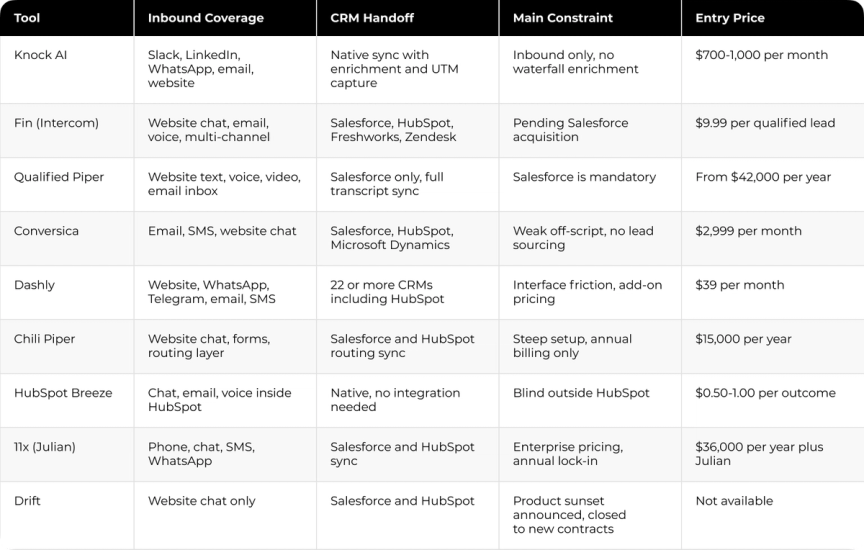
The table below summarises how the nine platforms differ on the criteria that decide fit.
Where to Start When Several Platforms Fit
Most shortlists narrow quickly once the constraints are named in the right order.
- Start with the CRM. Salesforce with budget makes Qualified Piper viable. HubSpot as the single source of truth makes Breeze the shortest path. A mixed or immature CRM means the integration question outranks the agent question.
- Then inbound volume. At low inbound volume, most platforms here cost more than the leakage they recover. Darwin uses a practical test: estimate the number of qualified leads currently lost each month, multiply by close rate and average deal size, and compare that to the annual contract. Dashly and Fin scale down furthest. Conversica, Qualified and 11x need volume to justify the floor.
- Then the failure point. Leads arriving but sitting unanswered is a routing problem, and Chili Piper addresses it directly. Leads arriving unqualified is a conversation problem, which is where Knock AI and Fin operate. Leads going cold in the database is a follow-up problem, and Conversica is built for it.
- Then who maintains it. Every platform here needs an owner. Routing rules drift, ICP definitions change and qualification logic needs review. A platform nobody owns degrades quietly.
Where Each Tool Fits
Read the four constraints above against your own stack, then use the shortcuts below. They name the platform that usually survives the shortlist first, which narrows the evaluation work to two candidates.
- Salesforce enterprise: Qualified Piper, where the CRM dependency is an asset and the transcript sync gives the rep the whole conversation.
- HubSpot only: HubSpot Breeze, because the integration work disappears and the AI reads the CRM structure it already lives in.
- Form to meeting and routing: Chili Piper, which treats routing as the product and not as a setting.
- Dormant lead nurture: Conversica, built for persistent multi-touch follow-up across a cold database.
- Multichannel SMB and mid-market: Dashly, one of the lowest published entry prices in this comparison.
- After-hours conversational coverage: Fin, where outcome-based pricing can make off-hours coverage more economical.
- Enterprise SDR replacement: 11x with Julian, priced and positioned as headcount substitution.
- Point-of-intent qualification on a high-traffic site: Knock AI, which opens the conversation before the form does.
"AI agents are everywhere, but there is a value ceiling. Beyond a certain point, more AI does not mean more productivity. In fact, layering additional prompts and tools onto already complex workflows risks overwhelming sellers and accelerating burnout." – Melissa Hilbert, VP Analyst, Gartner
What Has to Be Working Before an Agent Helps
The pattern repeats across inbound projects. A team buys a qualification tool to fix response time, and six weeks later response time has improved while conversion has not moved. The agent replies in seconds to leads it routes by a rule written two years ago, against an ICP definition that marketing and sales describe differently.
Darwin works on the stages underneath. For Wizehire, that meant rebuilding the path between paid traffic and the sales team: response time moved from two to four hours down to 15 minutes, cost per lead fell 26% and funnel volume rose 60%. No agent was involved. The gain came from routing logic, qualification criteria and the connections between them.
A second project shows the same order of operations. For a kitchen and interior design client under NDA, AI qualification and lead scoring were built on top of a defined ICP and an agreed scoring model, producing 30% growth in lead conversion and 95% qualification accuracy while inbound scaled without added headcount. The AI worked because the definitions underneath it were settled first.
Every platform in this review will answer faster than your team does today. What none of them will do is decide what qualified means, or which rep should receive which lead, or which fields have to be populated for the first reply to be useful. Those decisions sit with you, and they determine what the agent is worth.
FAQs
Q1. What is the average B2B lead response time in 2026?
Median response time sits at roughly 42 hours, close to two full business days. Research from the Lead Response Management study found that replying within five minutes makes qualifying a lead roughly 21 times more likely than replying after 30 minutes.
Q2. Can an AI SDR replace a human SDR team?
For inbound qualification and routing, these platforms handle first response, ICP screening and meeting booking. Discovery calls, negotiation and multi-stakeholder deals still need people. Most teams use agents for coverage and screening, with people retained for later stages.
Q3. Which AI SDR tool works without Salesforce?
Knock AI, Fin, Dashly, HubSpot Breeze and 11x all run without Salesforce. Qualified Piper requires it. Chili Piper supports HubSpot, though reviewers report the routing depth is lighter than the Salesforce version.
Q4. How long does implementation take?
Knock AI reports about one hour to go live. HubSpot Breeze needs no integration for existing customers. Conversica implementations are commonly reported in months, longer when CRM data needs cleaning. Chili Piper and Qualified take weeks for routing configuration.
Q5. Why is Drift included if it cannot be purchased?
Drift was a category leader with roughly 6,000 customers when its sunset was announced in March 2026. It illustrates that routing logic, CRM integrations and qualification workflows often outlive the platform itself. Build those so they can be exported and rebuilt elsewhere.