Quick Answer
Test an AI content workflow by giving a small group of editors one recurring CMS task with real source content and sending each draft through their normal review. Record where the AI draft saves time and where it adds rework, then decide whether to scale the workflow, redesign it or stop.
TL;DR
- Test the whole workflow. The pilot checks whether editors can take an AI draft all the way to publication in their own CMS.
- Start with one task. Pick one recurring page type that already has a page family and a named reviewer.
- Use real work. Editors work from real content on their own accounts.
- Record friction as evidence. Missing context, heavy revisions, unclear handoffs and setup problems all feed the decision.
- Decide on evidence. Scale, redesign or stop, and add new use cases one at a time.
AI assistants can now draft full CMS pages from a brief, and some, like the ChatGPT-to-Drupal connection we built, work inside the CMS itself. For a marketing or web lead, the open question is whether the team can rely on that workflow week after week, inside its existing review and publishing rules.
A demo shows that the assistant can produce a page. It cannot show how much rework editors take on, which CMS context is missing or where drafts stall in review. This article gives a pilot method for one recurring task, an evidence record for each attempt and a decision table for when to scale, redesign or stop.
Why AI Draft Tests Need Your Own Editors
An AI draft test needs the team's own editors because they carry every draft through review and publication, and they see problems that a validation check or a demo leaves hidden. Editors know which published page a draft should follow, which claims need approval, which form belongs on the page and how long a fix takes inside the CMS.
Those details decide whether the workflow saves time or turns writing time into rework, and the people who publish the pages are the ones who can judge them.
If the team skips that test, the costs show up later. Editors spend time on rework that nobody tracks, and pages built outside the CMS components add to design debt. A form that fails to reach the marketing platform can lose leads before anyone notices. A pilot finds these problems while they affect only a few pages.
A draft that looks usable can still create rework in review. When we tested a Drupal integration for a client, we reviewed the editor-facing experience along with the drafts themselves and fixed the issues it surfaced.
Choose One Editorial Task for an AI Pilot
Choose one recurring editorial task the team knows well, such as a webinar page or a case study. A narrow task keeps the evidence comparable from one draft to the next.
The page type should already have a clear page family on the site. If the team still debates which structure a partner page or an event page should follow, settle that first, using the published pages that already do that job as the page family for the pilot.
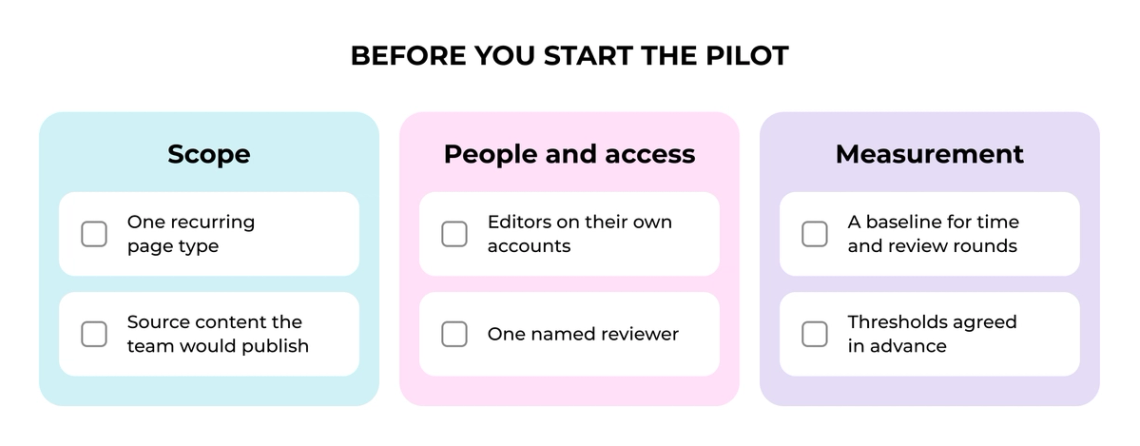
A short readiness check shows whether your CMS is ready for AI drafts on this task:
- Content source.A real brief or source text the team would publish anyway.
- Accounts.Each editor signs in with their own CMS account and normal permissions.
- Reviewer.One named person approves drafts for this page type.
- Baseline.How long the task takes today and how many review rounds it needs.
Permissions and approval rights come from the team's governance model, which already defines who drafts, who approves and who publishes. The pilot treats those rules as given. If the source content sits in several systems, fix the data gaps that block AI agents first, so the pilot results reflect the workflow itself.
How Editors Run an AI Pilot on Real CMS Work
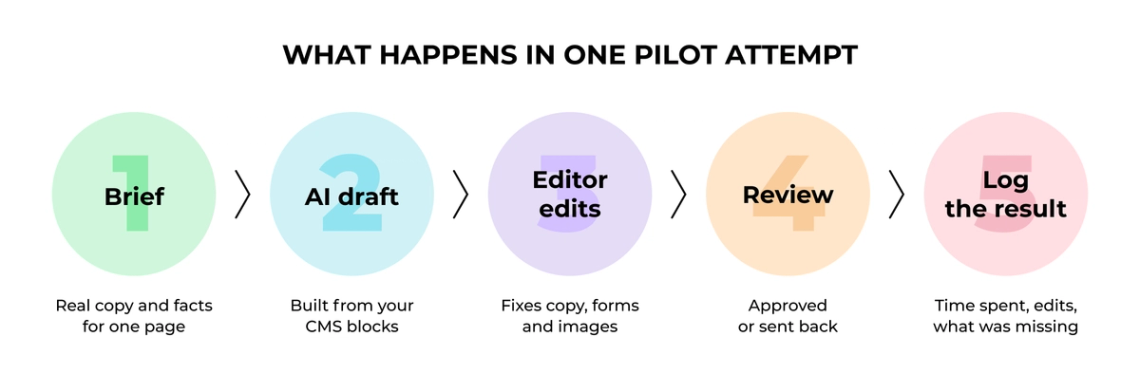
A pilot week should look like a normal week with one change: the first draft comes from the AI assistant. Each editor requests a draft from real content and finishes it in the CMS, and the reviewer judges it by the same standard as any other page, on a test site or staging copy.
Give editors a pilot evidence record with one row per attempt:
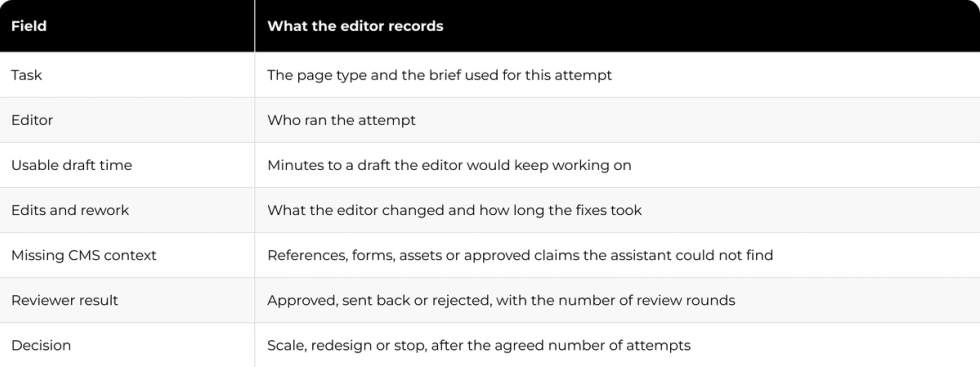
For actions the assistant takes inside the CMS, an audit log of each automated action adds the system side of the record. When drafts drift from the site's components, the assistant needs clearer design-system documentation to pick the right blocks.
I watch the first setup session as closely as the drafts. Account access, admin approval for new tools and sign-in steps can decide whether editors keep using the workflow after the pilot.
Where Editors Find Friction With AI Drafts
Editors find friction in five places, and each one belongs in the evidence record.
- Missing context.The assistant lacks a reference page, a form, an approved claim or a current asset, and the editor fills the gap by hand.
- Rework.The changes take longer than the time the draft saved, or the same fix repeats on every page.
- Handoffs.Nobody is sure who picks up the draft next, or the draft waits for a person outside the pilot.
- Review fit.The draft needs a different check than other pages of the same type, so the workflow and the review process disagree. A shared pre-launch QA checklist for AI-built pages keeps that check the same for every draft.
- Confidence.Editors hesitate to use the drafts or drift back to their old process.
“Instrument both the system and the sentiment by capturing both quantitative and qualitative insights.” – Everett Zufelt, VP Strategic Partnerships & Emerging Technology, Orium
In our client test, forms remained an important boundary. The assistant can find and reference form mappings, and submitting a form through an external marketing platform needs its own test.
How to Decide Whether to Scale, Redesign or Stop an AI Pilot
Decide by comparing the evidence record with the baseline for the task.
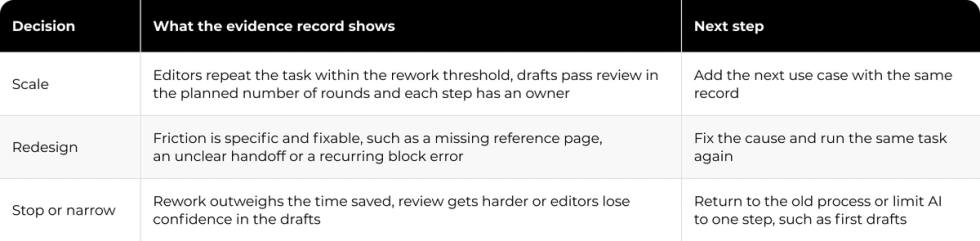
Agree on the thresholds ahead of the first draft, for example the number of review rounds the team accepts, so the decision rests on criteria chosen in advance.
How to Scale an AI Content Workflow One Use Case at a Time
Scale an AI content workflow by adding one page type or task at a time and tracking each one the same way, so every problem traces back to one change.
Each new use case gets its own reference pages and thresholds, and write access stays limited to drafts.
When the results show the workflow holds, the team can plan a production connection between the AI assistant and the CMS and run a pre-launch automation audit on the wider workflow. New pages should still come from CMS components, because pages built outside them become design debt that someone maintains by hand later.
What a Client Marketing Lead's Test of AI Drafts Exposed
A B2B integration software company wanted to stop moving HTML from custom GPTs into Drupal by hand, and we tested the new workflow with its marketing team.
Our team connected ChatGPT to Drupal through an MCP server on a test site. The company's website marketing lead connected from his own account and created pages from real content. Every test page was saved as an unpublished draft for review, and during a live call the team created three pages, each in about two minutes. That figure measures page creation, and the editorial review cycle is a separate measure.
The session also surfaced the setup friction a pilot should expect.The company account needed admin approval for a new plugin, so the team connected through a skill, and the first sign-in used credentials from a different copy of the site. One requested form was missing on the test site, and the marketing lead corrected the draft with a follow-up prompt after the assistant listed the available forms.
The integration remains on a test site, and publishing stays with the client's team. That session was a single hands-on test with one marketing lead. A team pilot repeats it with more editors and logs each attempt until the team can make the call.
FAQs
Q1. What should an editor test in an AI content workflow?
An editor should test the full path of one real page: brief, AI draft, edits, review and handoff to publishing. At each step the editor notes the time spent and anything the assistant missed.
Q2. How many editors should take part in an AI workflow pilot?
Start with the editors who already handle the task and their reviewer. Include enough people to see whether results depend on one editor's habits or on the workflow itself.
Q3. When is an AI content workflow ready to scale?
It is ready when editors repeat the task with rework inside the agreed threshold, drafts pass review in the agreed rounds and each step has an owner.
Q4. How long should an AI content workflow pilot run?
It should run until each editor has completed the task enough times on real content for the team to compare the results with its baseline.
Q5. What should a team do when editors reject AI-created drafts?
The team should record the reason for each rejection, fix specific causes such as missing context and rerun the task. Repeated rejections with unclear reasons point to narrowing or stopping the pilot.