
Quick Answer
A Global Privacy Control request is a profile-level opt-out that has to reach every system holding that person: web forms, CRM records, suppression lists, ad audiences and reporting. Detecting the browser header is only the first step. California enforcement through early 2026 has focused on what happened to the preference after detection.
TL;DR
- California announced a $2.75 million settlement with The Walt Disney Company in February 2026 over opt-out requests honored in one place while linked services and devices continued as before.
- A browser header creates a profile-level obligation, so the preference follows the person into your CRM, your suppression rules and your paid media audiences.
- Most compliance failures happen between systems. A form captures the opt-out, the CRM field stays as it was, and a Customer Match list uploaded last week keeps targeting the contact.
- Consent logs carry the evidentiary weight, because a regulator asking about one visitor on one date needs a timestamped record to look at.
- Seven checks below locate the break, and a system ownership table shows which team holds each part of the path.
On February 11, 2026, the California Attorney General announced a $2.75 million settlement with The Walt Disney Company. For marketing teams, the settlement highlighted one point: an opt-out applies wherever and however a business sells data, so honoring it only where the request arrived falls short. The investigation found gaps in Disney opt-out toggles, in the webform path and in the handling of opt-out preference signals. California regulators issued more than $4.22 million in penalties during the first quarter of 2026 alone, with attention on opt-out mechanisms and browser-based preference signals.
The investigations exposed the same failure. The cookie banner worked and the browser header was received, then the opt-out stopped moving, and the systems downstream of the website kept operating on data the business could no longer sell, share or use for cross-context behavioral advertising.
A Global Privacy Control request reaches your site as an HTTP header, Sec-GPC: 1, on every request from a browser where the setting is enabled. Reading the header is only one part of the implementation. Honoring it requires updates to your forms, CRM schema, suppression rules, ad audiences and reporting logic. This article covers the second part.
Where an Opt-Out Signal Loses Its Way Between Systems
Darwin treats this as a data integrity problem, and Darwin Flux gives it four checkpoints. Surface is where the preference enters, meaning the web form, the page load and the browser header. Momentum is what runs on top, covering suppression rules, campaign QA and audience refreshes.
The failure in this article sits in the two checkpoints between those. Connections decides whether the opt-out moves from the browser into your CRM sync jobs, audience upload APIs and vendor feeds. Clarity decides whether the business can prove what happened, through a single authoritative record of the preference, clear system ownership and reporting that holds up under questioning.
Surface usually works, because it was implemented as part of the cookie banner rollout and someone tested it. The audience list refreshing every Tuesday from a CRM segment that carries no GPC field is where the compliance gaps open.
How the GPC Signal Moves From Browser to Ad Audience
A browser header describes one request. A suppression obligation describes a person, and it stays attached to that person on every device, session and channel until they opt back in. The challenge is turning a browser request into a profile-level preference every downstream system can use.
The W3C specification defines two access points. Server side, the header appears in incoming traffic and your middleware reads it. Client side, the navigator.globalPrivacyControl property returns true when the setting is active, which lets you gate third-party scripts and tags that load dynamically. Both paths matter, because tags firing before your consent logic resolves create the gap that enforcement actions target.
Attaching the Preference to an Identity
Capture the request, then connect it to whatever identifiers your business already uses to recognize a person: authenticated account IDs, email addresses, CRM contact IDs, loyalty numbers. A GPC status field on the contact or lead record turns a browser event into something your marketing systems can act on.
Store a timestamp alongside the boolean. California law bars a business from asking a consumer to opt back in for at least 12 months after an opt-out, so the date of the request is operationally relevant, and it is also what a consent log needs to be useful in an audit.
Propagating the Preference Downstream
Automated triggers reduce the delay between detection and downstream updates, because the window between a GPC detection event and the next audience refresh is where contacts get targeted after opting out. Salesforce, HubSpot and Microsoft Dynamics all support workflow rules that fire on field changes. The rule to build is: GPC status field updates, and the update propagates to segmentation membership, email suppression and audience sync jobs in the same pass.
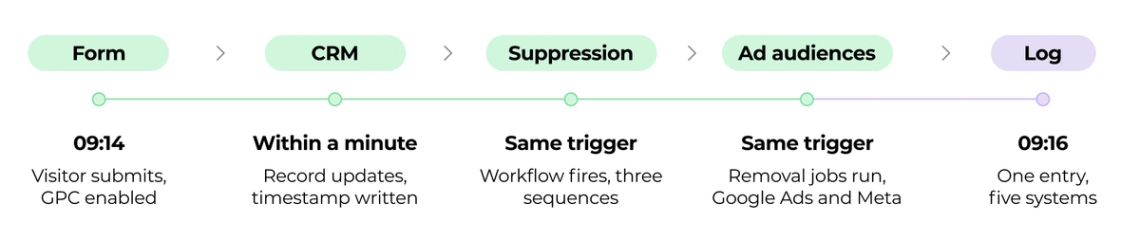
A working sequence looks like this. A visitor with GPC enabled submits a form at 09:14. The contact record updates within the minute and the timestamp is written. The HubSpot workflow fires and drops the contact from three active sequences. The Google Ads removal job and the Meta audience removal run on the same trigger. By 09:16 the consent log holds one entry naming the visitor, the jurisdiction, the action and the five systems updated. Every step in that sequence can fail independently.
One question worth settling internally: when a single contact at an account opts out, does the preference cascade to other contacts at the same organization? The answer depends on your data model and your legal position. Deciding it in advance keeps the logic consistent.
Removing Contacts From Paid Media Audiences
Google Ads Customer Match and Meta Custom Audiences hold uploaded lists that persist independently of your CRM. A list uploaded last month keeps its membership until something actively removes the contact from it. Google exposes an API for removals based on email match, and marketing automation platforms support triggered actions against Meta audiences when field values change.
Identity matching resolves some contacts and misses others, so a person can persist in an audience under an address held only by the ad platform. A remarketing exclusion list built from converters and purchasers gives you a second line of coverage where identity matching falls short.
Programmatic buying works through a separate mechanism. The IAB Global Privacy Platform carries privacy status to downstream vendors as an encoded string. Your consent management platform updates the GPP string to reflect opted-out status, and vendors receiving it process the impression in restricted mode. Retargeting pools, behavioral segments and lookalike seeds all need the same exclusion applied.
Seven Checks That Locate the Break
Run these against your own stack. Each check reflects an implementation issue Darwin has encountered in client systems.
1. Header and property. Does your server read Sec-GPC: 1, and does your client-side logic check navigator.globalPrivacyControl before third-party tags load?
2. Subdomains and apps. Your primary domain may handle GPC correctly while a marketing subdomain, a mobile app or an email tracking pixel operates on separate consent logic.
3. CRM field. Does a GPC status field exist on both contact and lead objects, with a timestamp, and does anything write to it automatically?
4. Segmentation. Do your audience, enrichment and personalization workflows filter on that field, or do they still filter on a legacy unsubscribe field that sits outside the GPC path?
5. Audience sync. When the field changes, does a removal fire against Customer Match, Meta Custom Audiences and every other uploaded list, or does the next scheduled refresh handle it days later?
6. Consent log. For a given visitor and date, can you produce the signal receipt, the jurisdiction determination, the action taken and the systems updated?
7. Verification. Does anyone test the path with a GPC-enabled browser on a schedule, or was it verified once at launch?
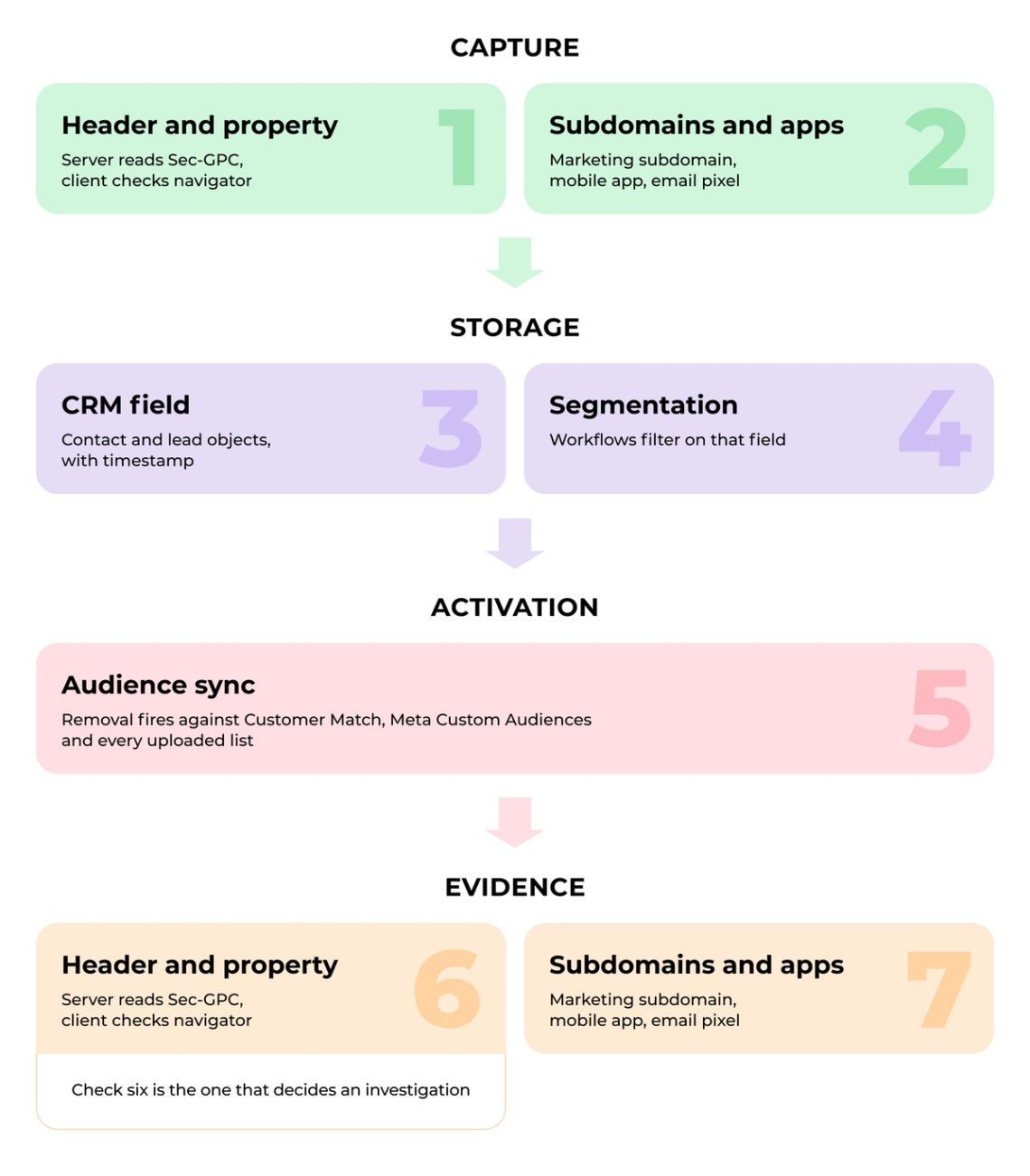
Check six is the one that decides an investigation. Regulators examining GPC handling inspect web traffic directly, and a misconfiguration that drops requests looks identical from the outside to a business choosing to ignore them. The log is what separates the two.
Darwin runs this as a Compliance Gap Analysis for opt-out handling: a trace from the browser header through the CRM field, suppression rules, consent logs and every audience destination. The output is a documented map of where propagation breaks, what each system owns and which fixes need to happen before the opt-out path can be defended in an audit.
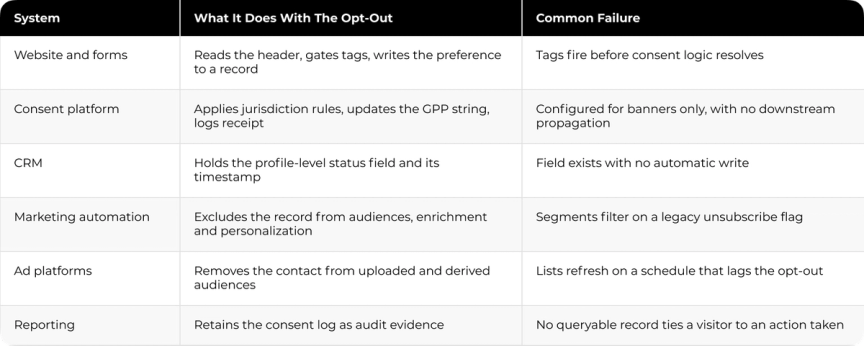
What Each System Owns in the Opt-Out Path
Most failures happen because responsibility is split across several teams, and each row below usually belongs to a different one. The reporting row is where a broken opt-out path eventually surfaces as a marketing analytics problem.
Making Your Handling Verifiable From the Outside
A site can publish a GPC Support Resource at /.well-known/gpc.json declaring that it recognizes and honors the browser header. State law treats the file as optional, and publishing it gives regulators and privacy researchers a machine-readable statement they can check programmatically. The specification covers the format and the caching behavior, including the requirement that the preference is evaluated on each top-level navigation.
Publishing the file while your downstream propagation remains incomplete raises your exposure. Treat it as the last step after the seven checks pass, and as a claim you can defend with logs.
The volume of these requests is set to rise. California AB 566, the Opt Me Out Act, signed in October 2025, requires any business that develops or maintains a browser to include an easy-to-locate opt-out preference setting from January 1, 2027. That moves the signal from an installed extension to a standard browser feature on desktop and mobile. Teams building the propagation path now will process a larger share of traffic through it next year.
How Darwin Builds This in Client Systems
Compliance exposure of this kind is a systems problem before it is a legal one. Opt-out handling fails in the same places measurement fails, because both depend on the same data flows. Three client systems show the parts that matter here.
For Cleo, Darwin connected GA4, Salesforce, BigQuery and Looker Studio into a single governed reporting path. Reporting accuracy moved from roughly 70 percent to over 90 percent, the team recovered two reporting days each month, and the setup produced $50,000 in annual savings. The relevant point for GPC sits in the same place: once a preference or a conversion has one authoritative path through those systems, propagating a change through it becomes a configuration question. Where the path is broken, every update has to be replayed by hand in five places.
For AlertMedia, Darwin built the monitoring and audit-trail side: scheduled checks, alerting and monthly reporting that produce a legible history of what was found, what was fixed and who was notified. Consent logs need the same discipline. A log that nobody reviews is documentation in name only, and the review cadence is what turns it into evidence.
For Seagate, Darwin built the governance side of a large content and data operation: role-based permissions, controlled publishing and multi-team approval paths, so a change made by one team holds everywhere it applies. Large organizations carry the specific risk this article describes. A preference lands correctly in one system while CRM records, audience jobs and vendor workflows continue on their own logic, because no single owner sees the whole path.
A privacy preference behaves like any other governed data asset, and it stays consistent only when the connections between systems are maintained. Marketing operations owns more of that path than a compliance review usually assumes.
FAQs
Q1. Our cookie banner already handles GPC. What else is there?
The banner covers detection in the browser. The Disney settlement turned on the CRM record, the suppression list and the uploaded ad audience holding the same person, each of which updates on its own path.
Q2. Where do these implementations usually break?
Between the CRM field and the audience refresh. The field updates correctly, then a Customer Match list or a Meta audience rebuilds from a segment that filters on a legacy unsubscribe flag, and the contact stays targeted.
Q3. Which CRM field should hold the status?
A dedicated field on both contact and lead objects, holding a boolean and the detection timestamp. Reusing the email unsubscribe field merges two different obligations and breaks segmentation the moment someone unsubscribes from email while their GPC status stays clear.
Q4. How long does the opt-out bind us?
California law bars asking the consumer to opt back in for at least 12 months. Set the retention rule for the log itself alongside your deletion request handling, since a deletion request from someone who already opted out creates two obligations that need separate processing paths.
Q5. Does the preference cascade to other contacts at the same account?
That depends on your data model and your legal position, so the answer belongs to your team. Leaving it undecided creates inconsistent workflows between teams.