Quick Answer
AI content generation goes wrong when teams hand a model a topic and expect a finished piece. Weak briefs, missing source material and unclear review rules produce generic and inaccurate drafts. The fix is a workflow: a clear brief, approved sources, drafting in stages, human fact-checking and a named reviewer who decides what gets published.
TL;DR
- AI is now standard in content work. Adoption alone has not raised quality, so the results depend on how teams use it.
- Quality problems start with the brief. In Contentoo research, 56% of content teams named poor or incomplete briefs as a reason content quality drops.
- Bad AI content has recognizable signs. Repetitive phrasing, invented facts, flat tone and broken formatting point to a gap in the process.
- Six steps fix most of it. Define the audience, pick the tool for the task, prompt in stages, fact-check, optimize for search and measure results.
- Scaling AI content production requires connected tools, clear approval processes and defined ownership.
AI adoption among marketers continues to grow. Ahrefs' 2026 survey found that 93% of 301 marketers use it to create or help create content, up from 87% a year earlier. Quality has not improved at the same rate. Generic blog posts, product copy that misses the brand voice and social captions that sound like a template are still easy to spot.
The tools are rarely the main problem. Teams get weak results when they treat AI as a replacement for the writer and skip the work that makes a draft usable: a clear brief, reliable sources, careful editing and a person who owns the final decision. This guide covers why AI content goes wrong, what bad output looks like and a practical process to fix it.
What Has to Be in Place Before AI Writes for Your Brand
AI writes well for a brand when the system around it is ready: the content readers see, the tools that feed the model, the rules it follows and the people who keep the workflow running.
Weak AI copy shows up first on the Surface, in the pages, posts and emails your audience reads. The cause usually sits further back. Drafts improve when Connections between the brief, the AI tool, the CMS and the CRM carry the right context automatically, and when Clarity comes from approved sources, brand rules and review criteria that the model and the editor share. Momentum follows from there: once a workflow produces reliable drafts, the team can scale it, as long as someone owns review, publishing and measurement. These are the four questions of Darwin Flux, and they apply to AI content as much as to any other marketing system.
When one of these is missing, better prompts only go so far.
The Root Causes of Poor AI Content
Poor AI content usually comes from how people use the tools. Models write fluent text quickly, and teams expect them to supply judgment, facts and context they never received.
Misunderstanding What AI Can and Cannot Do
AI writing tools are fast at drafting, summarizing and restructuring text. They predict likely wording from patterns, so they miss cultural references, humor and emotional nuance unless a person supplies them. A model also knows only the context it receives about your product, customers and positioning, whether that context comes from the prompt or from connected sources such as the CMS, a knowledge base or the CRM.
Weak Briefs and Missing Context
A model can only work with the context it receives. Contentoo's State of Content Teams research found that 56% of content teams identify poor or incomplete briefs as a reason content quality drops. Only 7% pointed to heavy reliance on AI with too little editing.
Data works the same way. Marketing data readiness for AI agents starts with current, governed context, and content generation needs that discipline too.
Lack of Human Oversight
AI tools produce confident text with no built-in fact-check, so editors need to verify claims, check sources and approve each piece. Publishing pure AI content is growing: in the 2026 Ahrefs survey, 7% of marketers using AI said more than 75% of the content they publish is pure AI, up from 4% in 2025.
Treating AI as a Replacement for Writers
Teams that hand the whole article to AI lose the parts readers value most: experience, opinion and specific examples. AI works better as a drafting partner. It handles research summaries, outlines and first drafts, and people add the insight, proof and voice that make content worth reading.
"AI has undeniably raised the floor of content marketing." – Ryan Law, Director of Content Marketing, Ahrefs
Strong content still requires original insight, reliable sources and editorial judgment.
What Bad AI Content Looks Like
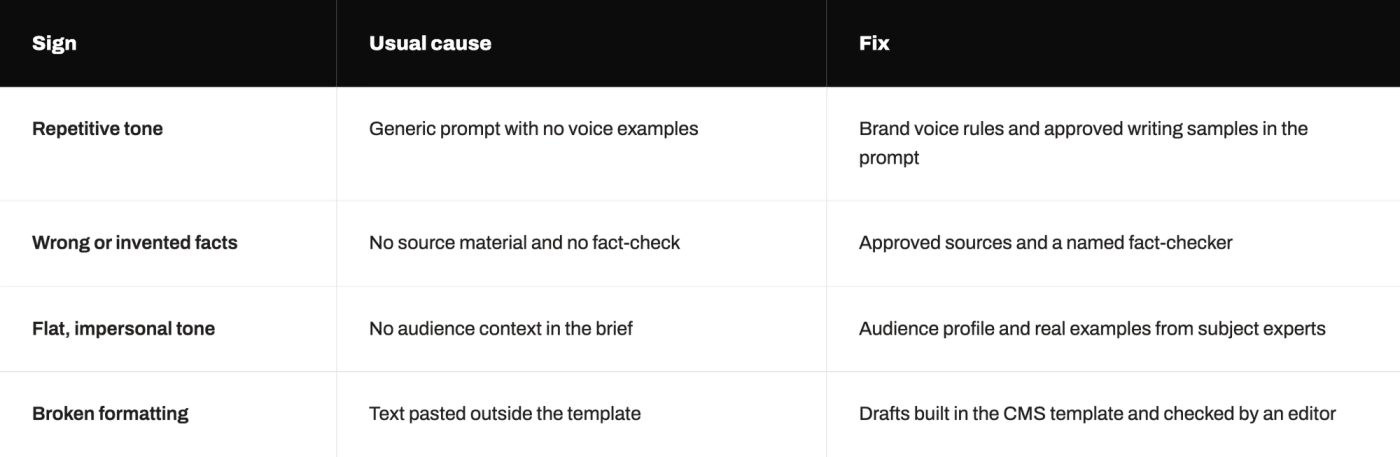
Bad AI content shows four signs: repetitive phrasing, inaccurate facts, missing nuance and messy formatting. Each one points to a specific gap in the process.
Repetitive or Robotic Tone
The same transitions, sentence lengths and stock phrases repeat from one piece to the next. When several articles share that pattern, the brand starts to sound like every other company using the same tool.
Inaccurate or Outdated Information
Language models can produce convincing details that are wrong, including invented statistics, people and citations. CNET learned this in 2023: after an internal review, the publication corrected 41 of its 77 AI-written stories. Every figure in an AI draft needs a source that a person has checked.
No Emotional or Cultural Nuance
AI analyzes patterns in text and has no sense of the reader's situation. It can strike a cheerful tone where the moment calls for empathy, or miss irony and regional references entirely.
Inconsistent Formatting and Structure
Pasted AI text often brings broken line breaks, uneven heading levels and lists that ignore the template. On a website, these drafts can also drift from the design system and add to design debt on a B2B marketing website. Our guide to design-system documentation for AI page builders explains how documented components give AI tools a consistent set of blocks.
The same problem appears when AI builds CMS pages: a draft can use approved components and still follow the wrong structure for the visitor's task.
The table below maps each sign to its usual cause and the fix that addresses it.
Fixing the Process: A Step-by-Step Guide

Fixing AI content is a process change. The six steps below combine AI drafting with human review throughout content production.
1. Define Your Audience and Goals
Start each brief with who the piece is for, what they need to decide and what you want them to do next. A brief that names the reader, the problem and the call to action gives the model enough context to write for a real person.
2. Choose the Right AI Tool for the Task
General chatbots handle outlines and first drafts well. Specialized tools often do better at SEO research, editing or repurposing. Compare cost, accuracy, security and team features, then test each candidate on a real brief first.
3. Create Detailed Prompts and Outlines
Avoid asking for a 1,000-word article in one prompt. Build the outline first, then draft section by section with prompts that include the audience, the point of the section and the sources to use. Smaller steps make errors easier to catch.
4. Edit and Fact-Check Everything
Check every statistic, quote and claim against its original source, and remove anything you cannot verify. Medical, legal and financial topics need review by a subject expert. For pages built with AI, our QA checklist for AI-built landing pages lists the checks to run ahead of launch.
5. Optimize for Search and Readability
AI tools can suggest keywords, meta tags and heading structure. An editor still checks that the copy reads naturally and matches the brand voice. Our guides on using ChatGPT for SEO and AI search optimization cover classic search and AI answer engines.
6. Test and Iterate Based on Results
Track engagement, conversions and rankings for AI-assisted content, then test headlines, intros and calls to action. To see whether AI answer engines cite your pages, compare options in our list of generative engine optimization tools.
Best Practices for AI-Based Content Generation
Good AI content comes from a few consistent habits: AI for drafts, people for judgment, a documented brand voice and regular checks for errors.
Use AI for Drafts and Keep Final Versions Human
AI is useful for structure, variations and first drafts. The final version should carry the author's thinking, examples and decisions, especially when a named person signs it.
Blend AI With Human Storytelling
People add the stories, customer details and opinions that a model cannot honestly invent. Ask subject experts for one real example per section and build the draft around it.
Keep Your Brand Voice Consistent
Write down voice rules, terminology and approved claims in one place, and give the AI tool the same document your editors use. A shared knowledge base helps with this, and our comparison of AI knowledge base software covers the main options.
Monitor AI Output for Bias and Errors
AI output can be biased, misleading or simply wrong, so review stays a permanent part of the workflow. If AI agents also take actions in your systems, AI agent audit logs show what each automated step did and who approved it.
"In short, slop transfers effort from the creator to the reader." – Si Quan Ong, SEO & Marketing Educator, Ahrefs
Start With AI Readiness
Teams often fail at AI content generation because their systems are not ready for it. Prompts and editing help only up to a point when the stack is fragmented and approvals are manual.
Contentoo's research shows where the friction sits: 45% of B2B content teams name internal review and approvals as their biggest workflow bottleneck. Teams that restructured their workflows around AI were also more confident in quality, with 54% very confident compared with 34% of teams that mainly added AI to existing tasks.
The common gaps look like this:
- Tools that do not share data, so people copy briefs and drafts by hand
- Scattered AI experiments with no shared prompts or rules
- Manual approvals, routing and asset handling that slow every piece
- No clear view of which AI-assisted content brings results
A readiness review maps these gaps ahead of any new tool purchase. Our AI readiness playbook covers the full framework, and a marketing automation audit applies the same checks to workflows that are about to go live.
How Tech.co Rebuilt Its Content Workflow With AI
Darwin applied this approach with Tech.co, a technology media platform whose content team was stretched thin by manual SEO and publishing work.
Planning, writing, editing, publishing and tracking consumed the team's time. Keyword research was manual, and the company had no plan to earn traffic from ChatGPT and Perplexity.
Darwin rebuilt the workflow around AI-assisted keyword research and theme clustering, an automated editorial calendar, AI-supported content creation and automated distribution to LinkedIn, X, Facebook and Instagram. The team also received training on optimizing content for generative engines. The Tech.co case study reports an 8X productivity boost, 4X more content at the same cost and 50% less manual work. It also reports more than $15,000 in monthly savings and over 20 hours freed up each month.
The gains came from connecting research, planning, drafting and distribution into one workflow. AI could write faster once the process around it was ready.
Teams that want to connect their AI tools, CMS and CRM into one content workflow can explore Integrations & Automations.
FAQs
Q1. Why does AI-generated content often sound generic?
Models predict the most likely wording, so with no voice examples, audience context or real sources they fall back on common phrases. Approved samples, a clear brief, expert input and connected sources such as a knowledge base give the draft a specific angle and voice.
Q2. How can a team improve its AI content generation process?
Start with a brief that names the reader, the goal and the sources. Draft in stages, fact-check every claim, optimize for search and readability, then measure results and adjust prompts and templates based on the data.
Q3. What role should human review play in AI content?
Human review decides what gets published. Editors check facts and sources, add experience and examples, and confirm the piece matches the brand voice. A named reviewer for each content type keeps that responsibility clear as volume grows.
Q4. How do companies keep a consistent brand voice with AI?
They document voice rules, terminology and approved claims in one shared place and give that document to the AI tool and the editors. Regular reviews of published pieces show where the voice drifts and which rules need updates.
Q5. When is a team ready to scale AI content production?
A team is ready when its tools share data, briefs and approvals follow a clear path and someone owns the results. If people still copy drafts between systems by hand, fixing the workflow first pays off more than adding volume.