Quick Answer
OpenAI sets a short list of requirements for the landing page itself: it must accurately represent the advertiser and the offer, stay consistent with the ad and be reviewable by OpenAI systems. Everything else that helps a B2B SaaS page convert ChatGPT Ads traffic is a recommendation: message match with the conversation, conversion tracking, CRM attribution, accessibility and conversion rate optimization.
TL;DR
- OpenAI requirements: landing page accuracy, consistency with the ad and reviewability, set out in the OpenAI ad policies. OpenAI also uses the landing page as one relevance signal when it selects ads.
- Best practices: a headline and CTA that continue the conversation, Pixel and Conversions API tracking, CRM attribution down to pipeline, WCAG 2.2 AA and fast mobile loading.
- Reach check: ads appear only for users on the Free and Go plans, and the early test focuses on consumer categories, so confirm B2B SaaS eligibility with OpenAI and estimate ICP reach before you build pages.
ChatGPT Ads gives B2B SaaS marketing leaders a new paid channel inside an AI assistant, and the first practical question is what the landing page has to include before a campaign goes live.
Part of the answer comes from OpenAI and is mandatory. The rest comes from how B2B buying works: a visitor who clicks an ad inside ChatGPT may have already compared vendors in the same conversation, and the lead still has to reach sales with its source attached. This article separates the two, starting with what OpenAI requires.
What OpenAI Requires From the Landing Page
OpenAI requires the landing page to pass the same review as the ad. Its ad policies, updated September 10, 2026, state that reviewers check "the title, copy, media, and landing page," and approved ads stay under ongoing review. Three rules apply directly to B2B SaaS pages:
- Accuracy. Landing pages "must accurately represent the advertiser, product, or service described in the ad."
- Consistency. The destination must clearly relate to both the advertiser and the offer in the ad.
- Reviewability. Ads or landing pages that OpenAI systems cannot review are not eligible to run, so a broken, blocked or fully gated page puts the campaign at risk.
The policies also prohibit unfounded claims about capabilities, pricing or outcomes and unsupported comparisons with other companies. A customer metric on the page needs a source, and a competitor comparison needs evidence.
The landing page also affects which ads people see. According to the OpenAI help center, ad selection uses the current conversation, the landing page, title and copy of the ad, advertiser context hints and targeting settings. A page that names the use case clearly gives the system a stronger relevance signal.
Check OpenAI Crawler Access
OpenAI checks landing pages with its own crawler, so the page has to be reachable for it. According to OpenAI’s crawler documentation, OAI-AdsBot "is used to validate the safety of web pages submitted as ads on ChatGPT," visits landing pages to check policy compliance and may use page content to decide when to show the ad.
OpenAI requires advertisers to allow OAI-AdsBot for landing-page validation and review. Its advertiser guidance says OpenAI crawlers respect robots.txt, so explicitly allow OAI-AdsBot on the relevant paths and check that WAF, CDN, bot protection, CAPTCHAs, authentication and rate limits do not block it. OpenAI also recommends allowing OAI-SearchBot, which can help it understand public web content.
Platform Context That Shapes the Page
Two platform facts decide whether the page will reach the right buyers. ChatGPT ads appear only for users on the Free and Go plans, and the help center confirms that Plus, Pro, Business, Enterprise and Edu accounts do not see ads. Senior buyers who pay for ChatGPT or use a company workspace will not see the ad on those accounts.
Category scope is the second fact. The ad policies state that during the initial test period ads are "primarily limited to consumer verticals," and the list includes digital products. Eligibility for a B2B SaaS offer is therefore conditional: confirm it in Ads Manager or with OpenAI before you plan a test or invest in dedicated pages.
Targeting also differs from LinkedIn. At the time of writing, the OpenAI campaign targeting documentation lists location, platform, custom audiences and context hints, and it describes no job title or firmographic targeting. Page copy carries more of the qualification work as a result, and HubSpot’s product team sees a related shift in how buyers move through the funnel.
"The middle of the funnel has gone dark, while the bottom of the funnel is wider and high intent." – Angela DeFranco, GM and VP of Product, HubSpot
DeFranco made the point in a B&T interview in September 2026. For a ChatGPT Ads page, it means that some visitors will skip the education stage and look for proof that helps them decide.
Message Match Recommendations
Message match is a general principle of paid landing page optimization and not an OpenAI rule: a page that continues the question and offer behind the ad makes it easier for the visitor to confirm they are in the right place.
Write a Headline That Continues the Conversation
One option is an H1 that restates the problem the visitor is likely to bring from ChatGPT, in the buyer’s own terms. For a visitor who asked how to cut admin time for a sales team of 20 to 50 reps, "Cut CRM admin time for sales teams of 20 to 50 reps" is more specific than "The CRM for growing teams."
Separate pages per use case or context-hint cluster make this easier to manage when the offers differ. OpenAI announced in September 2026 that Ads Manager suggests copy and imagery "based on their landing page and campaign objective," so the content of the page also feeds those suggestions.
Keep Visual Continuity With the Ad
Visual consistency between the ad and the first screen can help the visitor recognize the brand after the click. Depending on the creative, this can mean reusing the product image, keeping brand colors consistent or replacing generic stock photography. On mobile, check that the main offer and CTA appear on the first screen.
Phrase the CTA as an Answer
OpenAI has shared one early observation about CTAs. At Cannes Lions in June 2026, the head of its ads business described what the company was seeing in its own data. It is a platform-wide observation and not a B2B SaaS benchmark.
"One thing that we're learning is when the call to action is positioned as a benefit or as a response back to that original consumer question, we're seeing much higher response rates than someone just listing the name of the product." – David Dugan, VP, Head of Global Ads Solutions, OpenAI
For a B2B SaaS page, one way to apply it is to align the CTA wording with the offer in the ad. An ad that promises a pricing comparison could lead to "See pricing by team size," and an ad that promises a short demo could lead to "Watch the 4-minute demo." Whether a demo request belongs next to it depends on how ready the audience is to talk to sales.
Conversion Tracking Recommendations
OpenAI does not require conversion tracking to run ads, and its conversion tracking guide presents it as a way "to measure actions people take after interacting with your ads." For B2B SaaS it is still worth setting up before launch, because a campaign that cannot connect clicks to qualified leads cannot be evaluated.
Install the Measurement Pixel
The Measurement Pixel documentation instructs advertisers to place the snippet near the top of the <head> on every page that should capture conversions. The Pixel reads the oppref click identifier from the landing page URL and stores it in a first-party __oppref cookie, which expires "30 days after the Pixel writes the cookie."
Pixel consent defaults to true unless the site sets it to false or the Pixel finds a stored denial, and OpenAI states that blocked events are not replayed after consent is granted. Our guide on testing tags before consent covers how to check the order. Sites with a Content Security Policy need to allow the bzrcdn.openai.com and bzr.openai.com domains listed in the documentation.
Add the Conversions API With Shared Event IDs
The conversion tracking guide lists three setups: the Pixel, the Conversions API, or both "with shared event IDs to prevent duplicates." For the combined setup, the Pixel documentation says to "reuse the same event_id in both places," and OpenAI "uses the first event it receives for a matching key and ignores later duplicates."
The combined setup suits B2B SaaS, because qualified leads and opportunities are created in the CRM after the browser session ends. The Conversions API does not capture oppref on its own, so store the value on the lead record and pass it with the server event. Our comparison of server-side and client-side tracking explains the trade-offs.
Add UTM Parameters
UTM parameters connect ChatGPT Ads sessions to campaigns and ads in GA4 and the CRM. The OpenAI developer documentation does not prescribe a UTM template or ad macros, so use your existing naming convention, for example utm_source=chatgpt and utm_medium=paid, and keep it consistent with your channel definitions. Separate paid ChatGPT traffic from organic ChatGPT referrals, which our guide on tracking ChatGPT referral traffic in GA4 and CRM covers.
Measure Qualified Leads, Opportunities and Pipeline
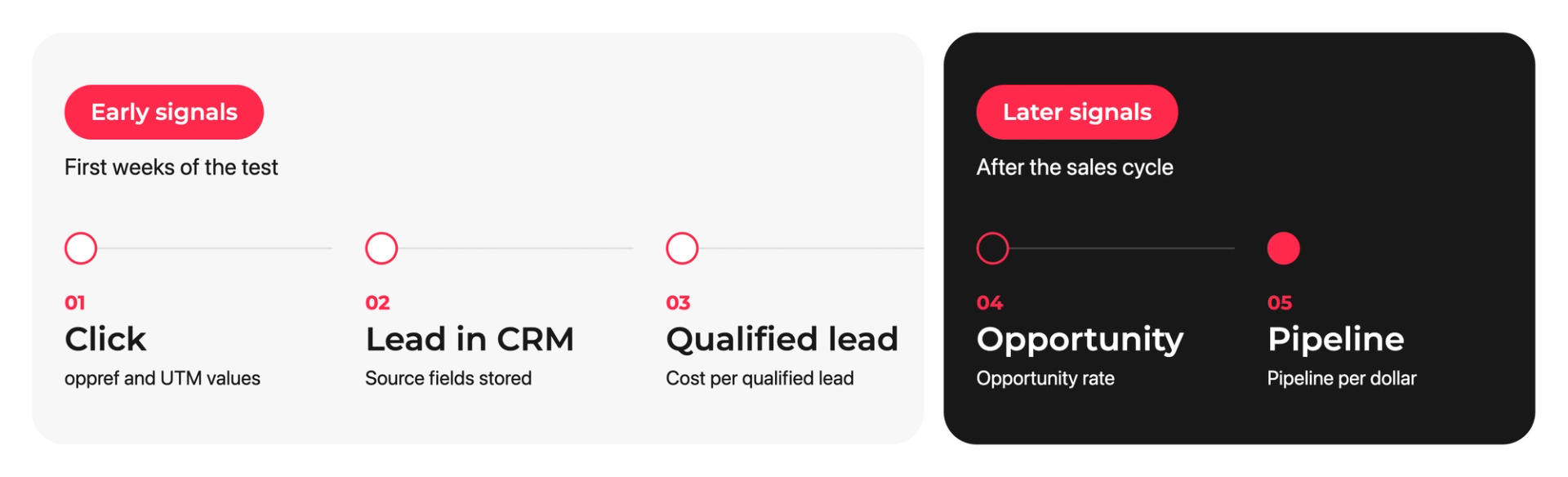
It helps to measure ChatGPT Ads in two stages, because a landing page test and a channel test answer different questions. Define a qualified lead, an opportunity and pipeline value with sales up front, send each stage back to OpenAI as a separate server event and keep the same stages in the CRM report.
- Early signals (first weeks): events fire correctly in OpenAI, analytics and the CRM, qualified leads arrive and cost per lead and per qualified lead stay within your target range.
- Later signals (after the sales cycle): the share of qualified leads that become opportunities, pipeline per dollar spent and cost per opportunity compared with your other paid channels.
Our guides on GA4 vs CRM attribution and on reconciling CRM, ad platform and finance numbers help keep the figures consistent.
Test Every Event Before Launch
Each conversion event needs a test confirmed in OpenAI event monitoring, the analytics platform and the CRM record. In OpenAI reporting, browser events use pixel_sdk and server events use server_to_server, which makes it easy to confirm that both paths fire. Add the checks to your paid media campaign QA checklist so they run for each new campaign.
CRM Attribution Recommendations
Every ChatGPT Ads lead should reach the CRM with UTM values, oppref and the landing page URL stored on the contact record, and the page should offer a next step that fits the visitor’s stage.
The offer and the form depend on the audience. Visitors who are still comparing options may prefer a research-stage offer, such as a pricing explainer, a product tour or a checklist. Form length is a trade-off between lead volume and the fields sales needs for qualification, and a second demo CTA suits pages where part of the audience is ready to buy.
For HubSpot users, OpenAI named HubSpot its first CRM partner and states that "businesses managing their customers in HubSpot can connect a ChatGPT Ads account" to create ads, track results and follow up on leads in HubSpot. If you are weighing tiers, see our take on HubSpot Enterprise.
For Salesforce and other CRMs, the documented route for sending server-side events to OpenAI is the Conversions API. How qualified-lead and opportunity events reach it depends on your stack, and the setup resembles our guide on LinkedIn offline conversions in Salesforce.
Accessibility and Page Speed Recommendations
OpenAI does not require WCAG conformance or specific page speed scores for ChatGPT Ads. WCAG 2.2 Level AA and Google’s Core Web Vitals thresholds still make a sensible baseline, since campaigns can reach iOS, Android and web users.
For accessibility, check against WCAG 2.2: text contrast of at least 4.5:1 for body copy, a visible label on every form field, error messages that explain how to fix the input, full keyboard access to the form and CTA, alt text for product images and touch targets of at least 24 by 24 CSS pixels.
For speed, Core Web Vitals define good results as Largest Contentful Paint within 2.5 seconds, Interaction to Next Paint under 200 milliseconds and Cumulative Layout Shift below 0.1. Test on mobile in PageSpeed Insights, compress hero images, defer scripts below the fold and load the Pixel asynchronously. Pages from a page builder should also go through our QA checklist for AI-built landing pages, and our guide on why landing pages fail to convert covers other causes of lost leads.
Trust Signal Recommendations
Trust signals are a best practice as well. Named customer logos and testimonials from the visitor’s segment, with real names and job titles, give a B2B buyer specific evidence. Security and compliance details, such as SOC 2 status or a link to the trust center, answer what procurement may ask later, if they apply to your product.
Pricing logic can help even when the final price is sales-led, because the visitor can judge fit early. Link each case-study figure to its source, which also keeps the page within the OpenAI policy on unfounded claims.
Search Ads Landing Page vs ChatGPT Ads Landing Page
Both channels can bring high-intent visitors with specific needs, and a search query can carry clear constraints too. The differences lie in what the page can assume about the click and in the measurement and review rules behind it.

Through Digital Multi-Channel Marketing, Darwin gives each paid channel a defined role, landing page and measurement plan.
When to Test, Scale or Pause ChatGPT Ads
These are practical guidelines and not platform rules. A test makes sense when OpenAI confirms your offer is eligible, sales calls or customer surveys suggest that part of your ICP uses free ChatGPT accounts, the Pixel and CRM fields are live and the budget covers both early signals and the later opportunity stage.
Before launch, agree with sales on a target cost per qualified lead and opportunity rate, based on your current paid channels, and on the number of qualified leads the team needs before it draws conclusions. Early signals show whether to keep the test running, and later signals show whether to scale it.
Scaling makes sense when cost per opportunity is close to that benchmark and sales accepts the leads. A pause or a narrower test makes sense when leads stall before the opportunity stage or tracking cannot connect spend to opportunities. Revisit the decision when OpenAI changes ad categories or targeting options.
ChatGPT Ads Landing Page Pre-Launch Checklist
OpenAI requirements
- The page accurately represents the advertiser and the offer in the ad
- The destination is consistent with the ad
- The page is reachable and reviewable, with no broken links or full gating
- Every claim, metric and comparison on the page has a source
Best practices
- ICP reach on Free and Go plans estimated and ad category confirmed
- One page per use case where offers differ, with an H1 and CTA aligned to the ad
- Measurement Pixel and/or Conversions API configured; if both measure the same event, they use shared event IDs
- Consent order tested for the Measurement Pixel
- UTM template set and oppref stored on each lead in the CRM
- Qualified lead, opportunity and pipeline stages agreed with sales
- WCAG 2.2 AA checks and Core Web Vitals passed on mobile
- Test conversions confirmed in OpenAI monitoring, analytics and the CRM
Turning a New Paid Channel Into Measurable Pipeline
A new paid channel exposes gaps in tracking and follow-up quickly, because the team has no baseline to compare against. ChatGPT Ads adds a new click identifier, a new pixel and a new kind of visitor, and each lead has to reach sales with that context intact.
Darwin worked on a related measurement problem with Wizehire, a SaaS company. The project did not involve ChatGPT Ads, and the lesson carries over. The team audited ad campaigns and the sales funnel, cleaned noisy analytics data and increased tracked conversion-relevant events from 4 to 9. Darwin then cut low-ROI ad spend, updated the value proposition and added AI tools for lead qualification. Within four months, cost per lead dropped by 26% and first response time went from 2–4 hours to 15 minutes.
For ChatGPT Ads, the landing page, tracking and CRM routing are best prepared together, with the test budget and success criteria set before launch. Through Digital Multi-Channel Marketing, Darwin plans the role of each channel in the customer journey, including landing pages, measurement and the handoff to sales.
FAQs
Q1. What should a B2B SaaS landing page include for ChatGPT Ads?
OpenAI requires an accurate page that matches the ad and can be reviewed. Best practice adds a headline and CTA that follow the conversation, Pixel and Conversions API tracking, CRM attribution to pipeline, WCAG 2.2 AA and fast mobile loading.
Q2. Do ChatGPT ads reach all ChatGPT users?
No. Ads appear only for users on the Free and Go plans. Plus, Pro, Business, Enterprise and Edu accounts do not see ads, so B2B teams should estimate how much of their ICP uses free accounts before they commit budget.
Q3. Can I reuse Google Search landing pages for ChatGPT Ads?
Yes, if the page already answers the specific question behind the ad and meets OpenAI ad policies. Many keyword pages still need a more specific headline, a research-stage offer and OpenAI tracking added.
Q4. How do I measure pipeline from ChatGPT Ads?
Track early signals first: event quality, qualified leads and cost per lead. Once leads have moved through your sales cycle, compare opportunity rate, pipeline per dollar and cost per opportunity with your other paid channels, using oppref and UTM values stored on each lead.
Q5. Does OpenAI review ChatGPT Ads landing pages?
Yes. OpenAI reviews the landing page with the ad title, copy and media, and approved ads stay under ongoing review. Pages must accurately represent the advertiser and offer, and pages its systems cannot review are not eligible to run.