
Quick Answer:
A website redesign can break conversion reporting even when the new site works. Use this website redesign checklist to document your baseline before launch, validate key journeys in staging and production, and compare post-launch results against independent records so a real change in demand can be told apart from a measurement failure.
TL;DR
- A redesign disturbs measurement and the reporting baseline in a single release, so a drop in results becomes impossible to read.
- A silent break can come from forms, URL paths, cross-domain movement, e-commerce data schemas and consent defaults.
- Baseline before launch: conversions with normal volume, source and medium attribution, priority journeys, consent states, and one named owner.
- Validate in staging while the old site still reports, then again in production once DNS switches.
- Watch the first 72 hours for absence, then read the first 30 days against the documented baseline to separate demand from measurement.
Website Redesign Tracking Checklist: 12 Checks Before Launch
1. Document conversion events and their normal volume.
2. Record source, medium and attribution baselines.
3. Map priority journeys and their consent states.
4. Assign one owner for measurement through launch.
5. Test form and CTA events against the new page structure.
6. Test URL changes and redirects before traffic moves.
7. Validate cross-domain journeys end to end.
8. Confirm checkout and data-layer events still send the expected data.
9. Confirm consent defaults preserve the intended collection rules.
10. Run the new tracking setup in parallel on staging.
11. Validate key journeys again in production after DNS switches.
12. Monitor for missing signals in the first 72 hours.
Where a Redesign Fits in a Reliable Measurement System
A redesign tests whether the current measurement setup can survive changes to templates, forms and domains. Teams that keep reporting intact treat measurement as infrastructure that has to survive change year-round.
Darwin Flux frames that work in practical terms: keep signals captured, preserve their connections across forms and domains, and keep reporting clear enough for marketing and finance to use after launch.
Why a Redesign Puts Your Reporting Baseline at Risk
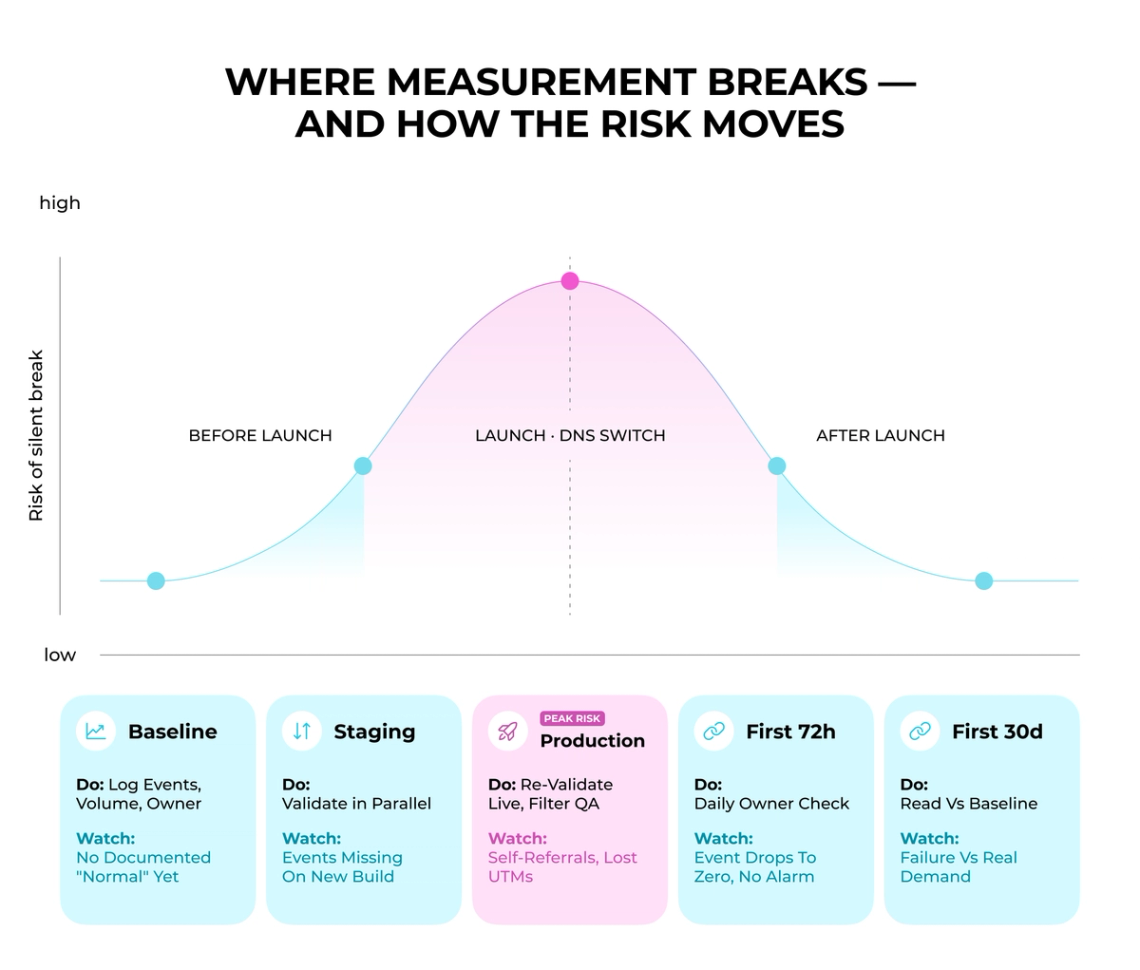
A redesign can disrupt reporting because the things analytics depends on are the same things a redesign changes. Tracking rarely fails with an error. It fails silently, and the report keeps populating with numbers that look plausible.
Before the failure points, it helps to see why they stay hidden. Confidence in measurement is already thin. In Haus's 2026 Marketing Decision Confidence Index, which surveyed 500 paid marketing and finance professionals, 35 percent said more than a fifth of their marketing budget was inefficiently allocated, with many unable to identify where the waste occurred. A redesign can make that uncertainty harder to resolve when the reporting baseline changes at the same time.
A Handful of Failure Points Cause Most of the Damage
A short list of predictable causes is behind most measurement breaks. Each one is worth recognizing as a symptom to check on the list below.
Form and CTA Events
Form tracking is a common break. When a form plugin updates, CSS class names and element IDs shift, and triggers built on exact matches stop firing. The form still submits and the lead still lands in the inbox, which is why nobody notices the conversion event went missing.
URL and Redirect Changes
Moving pages onto a new path leaves any trigger scoped to the old path firing on nothing. No error appears and the conversion data simply stops flowing. Redirects that drop query strings take campaign parameters down with them.
Cross-Domain Journeys
When a redesign reorganizes how domains and subdomains connect, a visitor crossing to a checkout or booking domain may split a session, create self-referrals, or lose campaign attribution. See Google's cross-domain measurement setup for the supported configuration. The chain linking a campaign to its conversion comes apart at that boundary.
Checkout or Data-Layer Changes
When checkout templates change, the data layer they feed changes with them and revenue events need rebuilding. Product, cart and purchase events depend on the page structure that a redesign is most likely to rewrite.
Consent Defaults
A new consent banner or default can legally suppress collection before a single tag is even at fault, so confirm your Consent Mode settings after launch. A changed default alone can move your totals, so it belongs on the checklist next to the technical breaks.
The Real Cost Is a Baseline You Can No Longer Trust
A silent break can leave teams unable to make a reliable comparison. Once the baseline becomes unreliable, teams have less confidence in decisions based on that data.
If an ad platform imports an affected conversion event, automated bidding may receive incomplete signals during the break.
Why Measurement Breaks Can Go Unnoticed
Conversion tracking breaks differently from the failures teams are trained to catch. A site outage or a disapproved ad throws an alert. A measurement break may produce no obvious warning, which makes missing signals easy to overlook.
The site loads, the tag manager loads, pageviews still arrive and campaigns still run. One possible symptom is that conversions stop appearing while the rest of the reporting still looks normal. Under launch pressure the first things cut are the invisible ones: QA, parallel tracking and post-launch validation. The build team declares success when the site works, and the analytics owner is often not in the room to disagree.
What Marketing Operations Should Baseline Before the Redesign
Protecting comparability starts before anything changes, by writing down what the current numbers are and how they are produced. You cannot defend a baseline you never documented, so the record has to exist before the build starts.
Capture the Conversion Baseline
Record what every conversion currently reports, including whether it fires correctly and its normal volume. Confirm each event fires once per intended action so a later gap has something to be measured against. Confirm which events are imported into your ad platforms as conversions, because that is what automated bidding reads.
Capture the Source, Medium and Attribution Baseline
Write down how traffic is currently attributed before the redesign has a chance to rewrite it. Export current source and medium splits, campaign attribution and channel groupings, and keep a plain record of what normal looks like. Self-referrals, lost UTMs and reclassified channels are among the first things a relaunch disturbs, and they are invisible unless you can hold the after against a documented before.
Map the Journeys and Consent States That Matter
Identify the few customer journeys the business reports on and treat those as the ones to protect. Walk each priority path end to end, the lead form, the demo request, the purchase, and record every step where a conversion is counted. Note the consent states too, because what a visitor accepts or declines decides what may be collected, and a new consent default can change your totals without any tag being wrong.
Name an Owner Before Launch
Assign one person accountable for measurement through the relaunch, by name, before the work starts. A redesign crosses design, development, SEO and analytics, and reporting integrity falls through the gap between them precisely because it is no one's default job. The owner holds the baseline, signs off the validation and watches the numbers after launch.
What to Validate in Staging and Production
Validation checks whether the new site records the same key actions as the old one before launch. Run it in staging, then repeat it in production after DNS switches.
Run Tracking in Parallel on Staging
Use staging to confirm new templates measure correctly while the old site remains the source of truth. Point staging to its own data stream so test events stay out of production, then walk priority journeys and check the expected parameters. Finding a missing event in staging gives the team time to correct it before launch.
Validate Once More in Production
Staging confirms the wiring, and production confirms the launch did not undo it. Once DNS has switched, walk every priority conversion path again on the live site, filter out internal and QA traffic so it does not distort the first days of the new baseline, and confirm attribution is landing on the right source, medium and campaign and not collapsing into direct.
Confirm Attribution Survives Redirects and Domains
Check that campaign identity survives the journey, because redirects and domain hops are where it silently disappears. Follow a tagged link through the full redirect chain and confirm the campaign parameters still arrive in reporting, and confirm a visitor crossing between your domains stays one continuous session and does not split into a self-referral. These two checks protect the attribution baseline that paid media reporting is built on.
The First 72 Hours After Launch
The first three days are an important window for catching measurement breaks early. Reports may still populate, so the job is to watch for absence and not wait for an alarm.
Put a short daily check in the owner's hands. Compare each priority conversion with its documented normal volume. Treat a sudden drop to zero on an event that normally fires as a signal to investigate tracking first. Route alerts directly to the owner so someone is accountable for acting on them. User feedback and support tickets can surface a tracking problem before a dashboard does, so keep those in view alongside the numbers.
Low-volume conversions will not show a clear signal in three days, so do not clear them on the traffic alone. Walk those paths manually on the live site and reconcile them against the CRM or order system, because for a rare event a hands-on check is more reliable than the early counts.
The First 30 Days: Telling a Measurement Failure From a Real Change
Use the first 30 days to assess whether a shift in results is real or an artifact of the relaunch. Every comparison runs back against the baseline you documented before launch, which is what makes the question answerable at all.
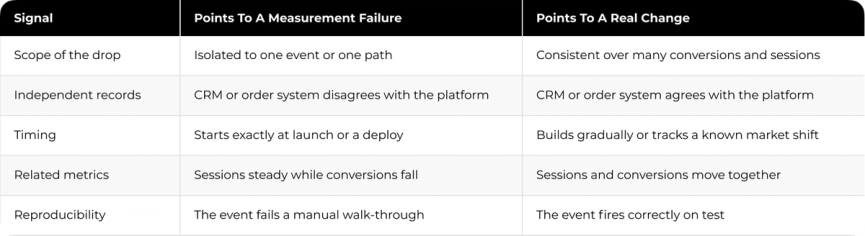
Read the numbers against that baseline with one question in front: is this a change in demand or a change in measurement. A drop that appears on one event while related events hold steady points at tracking. A move that shows up consistently over conversions, sessions and independent records like your CRM or order system points at a real change in results. Reconciling ad-platform conversions against back-end sales week over week is a useful way to investigate the difference, because a widening gap between what a platform reports and what truly closed is a common signal of gradual measurement decay.
The table below sets the two apart on the dimensions Marketing Operations can check quickly, so a movement in the numbers can be read as one kind of change or the other.
Recalibrate the automated safeguards for the new reality. Anomaly detection that learned the old site is comparing against the wrong history for a while, so its early flags need reading with that in mind. By the end of the window the owner should be able to state plainly which post-launch movements were measurement and which were genuine, and that statement is the whole point of the exercise.
Turning a Relaunch Into a Reporting System You Can Trust
A redesign can expose gaps in a measurement setup that was not designed to survive site changes. Documenting the baseline, validating the rebuild and assigning ownership help teams keep post-launch reporting comparable.
Cleo faced a related reporting problem. Working with Darwin across GA4, Salesforce, BigQuery and Looker Studio, the team lifted reported data accuracy from about 70 percent to 90 percent. The result was a more reliable source of truth for both finance and marketing.
FAQs
Q1. How can a website redesign break conversion reporting?
Form plugins shift element IDs, new URL paths strand triggers, reorganized domains create self-referrals, changed checkout templates break the data layer, and new consent defaults suppress collection. The site still works, so the only symptom is reporting that stops counting correctly.
Q2. How do I tell a real conversion drop from a measurement failure?
Compare against the baseline you documented before launch. A drop isolated to one event while related events hold steady points at broken tracking. A drop consistent across conversions, sessions and your CRM points at a real change in demand.
Q3. What should Marketing Operations document before a redesign?
Capture four things while the current site is still the source of truth: the conversion baseline with each event's normal volume, the source, medium and attribution splits, the priority journeys with their consent states, and one named owner accountable for measurement.
Q4. When should tracking be validated during a redesign?
Validate in staging first, while the old site still reports, by walking priority journeys and confirming each conversion fires with the expected parameters. Then validate again in production once DNS switches, filtering out internal traffic, to confirm launch did not undo the wiring.
Q5. Who should own measurement during a website relaunch?
One named person, assigned before the work starts. A redesign spans design, development, SEO and analytics, and reporting integrity falls through the gaps because it is no one's default job. The owner holds the baseline, signs off validation, and runs the post-launch comparisons.