
Quick Answer
The right marketing data integration tool depends on which layer you need: a managed marketing data platform, a low-code connector, or a warehouse-first ELT tool. Improvado, Funnel's Data Hub, Adverity and Supermetrics harmonize marketing data for teams that want less engineering work. Coupler.io, Windsor.ai and Hevo Data move data into spreadsheets, BI or a warehouse for smaller teams. Fivetran, Airbyte, Rivery and Matillion land raw data in a warehouse for teams with data engineering resources.
TL;DR
- This is a guide to the integration layer that extracts, normalizes and delivers data, not a guide to attribution or dashboards.
- Marketing data platforms (Improvado, Funnel Data Hub, Adverity, Supermetrics): marketing-specific harmonization, less engineering.
- Low-code connectors (Coupler.io, Windsor.ai, Hevo Data): fast setup, friendly to non-engineers, priced for smaller teams.
- Warehouse-first ELT (Fivetran, Airbyte, Rivery, Matillion): broadest coverage and control, but they assume a data team and a warehouse.
- Judge sources, destinations, freshness and total cost of ownership, not connector count alone. Where pricing is sales-led or usage-based, published starting prices are the only firm figures.
Marketing data integration is the layer that connects your ad, analytics and CRM sources, standardizes the metrics, and delivers a clean dataset to a warehouse or BI tool. Errors here carry into downstream reporting. In CaliberMind's 2025 State of Your Stack survey, 65.7% of marketers named data integration the biggest martech stack management challenge. HubSpot's 2026 State of Marketing survey of 1,505 marketers puts measuring ROI at the top, named by 33%. This guide compares 11 tools across three architectures to help you choose an integration layer that fits your team.
Four Questions to Ask Before You Trust the Number
We use four checks when looking at an integration setup. Surface asks whether the source data is complete and accurate. Connections looks at how records move and join across systems. Clarity covers shared definitions, metric ownership and reconciliation. Momentum looks at whether trusted data can support automation and decisions. Darwin Flux uses these four stages, and the tools below map to different points along them.
Marketing Data Platforms
Managed platforms built for marketing data. They pull from ad, analytics and CRM sources, harmonize marketing-specific metrics, and deliver to your warehouse or their own layer. You trade some control for less engineering work.
1. Improvado

Best for
Enterprise B2B marketing and data teams that manage 10+ channels and need marketing-specific governance before data reaches the warehouse.
Coverage and data workflow
- Sources: 1,000+ integrations across marketing, sales and related systems; Improvado also describes schema-change handling as managed within its connector layer.
- Destinations: Warehouses and BI tools including Snowflake, BigQuery, Redshift, Databricks, Power BI, Tableau and Looker Studio.
- Transformations: Marketing Data Governance provides pre-built rules for naming conventions, budget controls and data-quality monitoring.
- Freshness: Published plan limits range from daily sync on MCP Only to up to four times daily on Advanced; Enterprise sync frequency is custom.
- Security: Improvado lists SOC 2 Type II across its plans; HIPAA support is listed for Advanced and Enterprise.
Implementation, pricing, and limits
Engineering dependency is high: you need someone comfortable with data models. Advanced and Enterprise pricing is custom; Improvado also lists a $100/month MCP Only plan, which is a narrower product than the full platform. Not a fit for teams running 1-2 channels, where the platform's depth goes unused.
2. Funnel

Best for
Marketing operations teams that want a managed Data Hub to collect and normalize marketing data before it reaches a warehouse or BI tool.
Coverage and data workflow
- Sources: 600+ marketing connectors across paid media, analytics, CRM, ecommerce and other sources in Funnel Data Hub.
- Destinations: 36+ destinations spanning BI tools, data warehouses, spreadsheets and AI tools.
- Transformations: Funnel stores source data, supports field mapping and business logic, and applies updated transformations across historical data.
- Freshness: Funnel describes Data Hub as keeping connected marketing data fresh and up to date; plan capacity and destinations are governed through Flexpoints.
- Monitoring: Funnel manages and maintains its connector library, including API and schema changes.
Implementation, pricing, and limits
Engineering dependency is low to medium. Starter begins at $300/month billed annually; Business begins at $600/month, while Enterprise is custom. Flexpoints measure active subscription capacity. This article covers Funnel as a Data Hub only, not its measurement layer. Not a fit for very small teams or freelancers, where the starting price is steep.
3. Adverity

Best for
Enterprise marketing and data teams that need broad connector coverage with marketing-specific harmonization and data-quality monitoring built in.
Coverage and data workflow
- Sources: 600+ pre-built connectors across marketing categories, plus options for custom connectivity.
- Destinations: Customer-owned warehouses including Snowflake, BigQuery, Databricks and Redshift, plus other supported destinations.
- Transformations: Seven no-code transformation tools, Python-based functions and AI-assisted transformation are available in Adverity Connect.
- Freshness: Adverity Connect runs data-quality checks on every fetch; delivery cadence still depends on the connected source and pipeline configuration.
- Monitoring: Four universal monitors run automatically on every data fetch: duplication, volume, timeliness and column consistency. See how data-quality monitors fit into broader reporting QA.
Implementation, pricing, and limits
Engineering dependency is medium; initial setup carries a learning curve. Adverity publishes customized quote-based pricing rather than a fixed starting price. Not a fit for small teams that don't need enterprise harmonization or governance.
4. Supermetrics

Best for
Data teams that need a reliable extraction layer feeding marketing data into a warehouse or BI tool.
Coverage and data workflow
- Sources: 100+ native Supermetrics connectors, with Connector Builder available for additional web APIs.
- Destinations: Supermetrics packages support destinations such as Google Sheets, Looker Studio, Excel and Power BI; warehouse destinations are available in the platform as well.
- Transformations: Supermetrics supports data transformations such as custom metrics, dimensions, currency conversions and data blends, with availability depending on package.
- Freshness: Subscription refresh options can be weekly, daily or hourly, while actual data freshness also depends on each source API.
- Security: Supermetrics states that it undergoes annual SOC 2 Type II audits, is ISO 27001 certified, and uses TLS encryption for connector traffic.
Implementation, pricing, and limits
Engineering dependency is low. Starter is $44/month billed yearly ($55 monthly); higher packages and customizations vary by configuration. Not a fit for teams that need a warehouse-first engineering platform rather than a marketing intelligence layer.
Low-Code Connectors and Managed Pipelines
Lighter no-code tools that move data from marketing sources into spreadsheets, BI tools or warehouses. Fast to set up, friendly to non-engineers, priced for smaller teams. Transformation depth is limited by design.
5. Coupler.io

Best for
Marketers and analysts who need scheduled marketing data flowing into spreadsheets, BI tools or a warehouse with no engineering help.
Coverage and data workflow
- Sources: 400+ data sources; Coupler.io states that the source catalog is available across its plans.
- Destinations: Spreadsheet, BI and warehouse destinations are available, with the number of active destination tasks depending on plan.
- Transformations: Paid plans include data transformations; plan limits vary by tier.
- Freshness: Starter refreshes daily, Pro hourly, and Agency & Enterprise can refresh every 15 minutes.
- Security: Coupler.io states that it is SOC 2 Type II certified. Review its security and privacy documentation for GDPR or HIPAA requirements relevant to your use case.
Implementation, pricing, and limits
Engineering dependency is low. Starter is $24/month billed annually; higher tiers scale by accounts, destinations and refresh frequency. Not a fit for teams needing deep transformations or warehouse-scale modeling.
6. Windsor.ai

Best for
Budget-conscious marketing teams that want all connectors and destinations included without per-source upsells.
Coverage and data workflow
- Sources: 350+ data sources; Windsor.ai says all data sources and destinations are available across plans.
- Destinations: Looker Studio, Google Sheets, BigQuery, Snowflake, Power BI, Tableau, Excel and other warehouse or storage targets.
- Transformations: Windsor.ai describes its connectors as no-code ELT/ETL and includes access to Windsor MCP for AI analysis.
- Freshness: Basic supports daily scheduled syncs, Standard adds hourly syncs, and Professional supports 15-minute scheduled syncs.
- Security: Windsor.ai states that it completed a SOC 2 Type II audit and processes personal data in compliance with the EU and UK GDPR.
Implementation, pricing, and limits
Engineering dependency is low. A 30-day trial is available; Basic starts at $19/month billed annually ($23 monthly), with higher tiers scaling by data sources, accounts and sync frequency. Not a fit for teams that need heavy in-warehouse modeling, not just extraction and delivery.
7. Hevo Data

Best for
Non-technical teams that want a working no-code pipeline into a warehouse in an afternoon, with CDC for database sources.
Coverage and data workflow
- Sources: 150+ ready connectors across SaaS tools, databases, files and REST APIs.
- Destinations: Hevo loads data into major cloud warehouses and lakes, with schema handling managed in the pipeline.
- Transformations: Hevo supports dbt, SQL models and Hevo transformers; Starter includes dbt integration.
- Freshness: Free includes 1-hour scheduling; Business Critical includes streaming pipelines.
- Monitoring: Hevo provides live operational dashboards for latency, throughput and activity logs.
Implementation, pricing, and limits
Engineering dependency is low to medium. Free covers up to 1M events/month; Starter is $299/month or $265/month on the annual option shown by Hevo, with event-based tiers above it. Not a fit for teams with unpredictable high volumes where event-based cost can rise quickly.
Warehouse-First ELT Tools
General-purpose ELT built to land raw data in a cloud warehouse, then transform it in place with SQL or dbt. Broadest source coverage and the most control, but they assume a data team and a warehouse already exist.
8. Fivetran

Best for
Data teams that want fully managed, low-maintenance ELT into a warehouse with automated schema handling.
Coverage and data workflow
- Sources: 700+ fully managed connectors on Fivetran Standard.
- Destinations: Fivetran supports major cloud warehouses and other managed destinations; destination availability varies by connector and product workflow.
- Transformations: Standard includes integration for dbt Core for in-warehouse modeling.
- Freshness: Standard includes 15-minute syncs; 1-minute sync is available on Enterprise and Business Critical for supported standard connectors.
- Pricing metric: Fivetran meters connection usage in Monthly Active Rows (MAR).
Implementation, pricing, and limits
Engineering dependency is medium: analysts comfortable with dbt can run it. Pricing is usage-based on MAR, with the Free plan covering up to 500,000 MAR for connections; warehouse compute is separate. Not a fit for teams wanting predictable flat costs at high volume.
9. Airbyte

Best for
Engineering teams that want open-source ELT with a large connector catalog and the option to self-host for control or compliance.
Coverage and data workflow
- Sources: Airbyte lists 700+ connectors and provides Connector Builder for additional sources.
- Destinations: Airbyte supports warehouse, database, file and lake destinations; the catalog includes BigQuery, Snowflake, S3 and other common targets.
- Transformations: Airbyte focuses on data movement; teams can pair replicated data with downstream SQL or dbt workflows.
- Freshness: Standard has a maximum sync frequency of 1 hour; Pro and Enterprise Flex support 15-minute syncs.
- Security and governance: Airbyte Pro adds SSO, RBAC, row filtering, hashing and encryption, with additional controls on Enterprise Flex.
Implementation, pricing, and limits
Engineering dependency is high for self-hosting: Airbyte Open Source runs on your own infrastructure. Standard starts at $10/month with volume-based pricing; Pro uses capacity-based pricing. Not a fit for non-technical analysts that do not want to own pipeline configuration or infrastructure.
10. Rivery

Best for
Data teams that want ingestion, transformation, scheduling and reverse ETL in one warehouse-centric platform.
Coverage and data workflow
- Sources: Boomi Data Integration, formerly Rivery, lists 200+ data sources in its current pricing documentation and supports CDC plus custom connectivity.
- Destinations and workflow: Boomi Data Integration loads to cloud warehouses and combines ingestion, transformation, orchestration and activation in one platform.
- Transformations: SQL transformations are available across editions; Python is available from Professional upward.
- Freshness: Published maximum sync frequency ranges from 60 minutes on Base to 5 minutes on Enterprise, with CDC available across editions.
- Monitoring: Monitoring and alerts are included across the published Data Integration editions.
Implementation, pricing, and limits
Engineering dependency is medium to high. Boomi publishes edition-based Data Integration plans but routes pricing through sales rather than listing a fixed public starting price. Not a fit for teams that require a simple flat monthly price.
11. Matillion

Best for
Data teams already committed to a cloud warehouse that want visual, warehouse-native ELT with pushdown transformation.
Coverage and data workflow
- Sources: Matillion publishes pre-built and custom connector support but does not state a single current connector count on its pricing page.
- Destinations and deployment: Matillion's Data Productivity Cloud supports warehouse-oriented pipelines and hybrid deployment options on Scale.
- Transformations: Matillion includes a low-code canvas plus SQL and Python components.
- Freshness: Scheduled pipeline execution is available, while Scale adds streaming change data capture.
- Monitoring: Teams and Scale include audit logging; Scale adds lineage and extended log retention. Maia is available with Data Productivity Cloud.
Implementation, pricing, and limits
Engineering dependency is medium to high. Matillion uses consumption-based credits and does not publish a fixed list price on the current pricing page. Not a fit for teams without a cloud data platform or those wanting a simple fixed monthly fee.
How to Choose the Right Integration Layer for Your Team
Match the Architecture to Your Team
Start with which of the three layers fits. A marketing data platform suits teams that want marketing-specific harmonization and less engineering. A low-code connector suits smaller teams that need data in a spreadsheet, BI tool or warehouse without a data engineer. A warehouse-first ELT toolsuits teams that already run a cloud warehouse and have engineering resources to model data downstream.
Judge Coverage by Depth, Not Count
Connector count is a weak signal. What matters is whether a tool extracts every metric and dimension your specific platforms hold, and where it can deliver the result. Check the exact sources you run, the destinations you need, and whether the tool writes to your own warehouse or keeps data in a vendor layer. If the data also needs to return to CRM or ad platforms, evaluate reverse ETL separately. For customer or revenue data, assess vendor security and data-handling controls before procurement.
"You have one number. Sales, marketing, operations, and customer success are all looking at that same number… It is your single source of truth. Nobody disagrees about that data." – Peter Ikladious, Co-Founder and Partner, Unlocking Growth.
Price the Whole Stack, Not the License
Usage-based and warehouse-first tools carry costs past the subscription line. Fivetran meters Monthly Active Rows, while warehouse-first setups can add warehouse compute, transformation and engineering costs outside the connector subscription. Where pricing is sales-led or usage-based, treat the published starting price as the only firm number and model your own volume ahead of signing.
Marketing Data Integration Tools Comparison Table
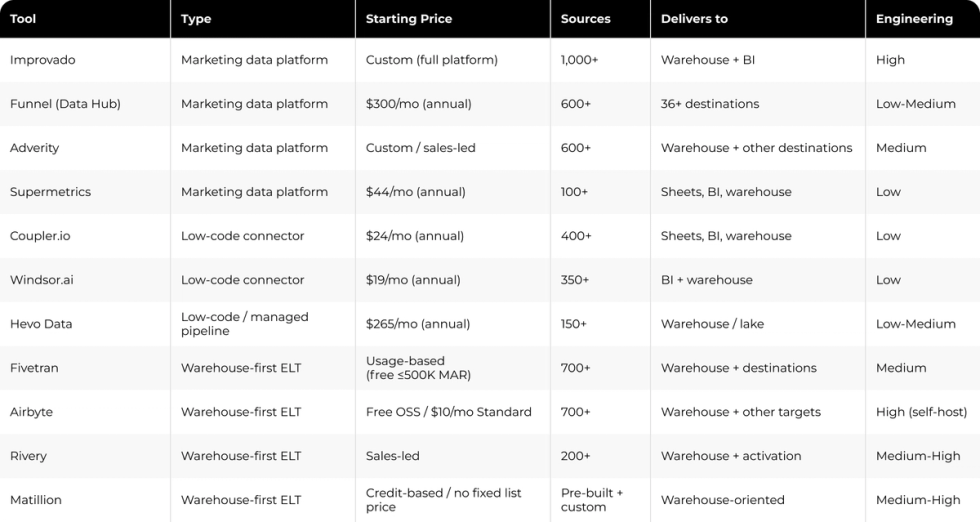
Note: prices are current published official starting points or the vendor’s current public pricing model. “Custom / sales-led” and usage-based entries should be confirmed against your own volume and contract terms before procurement.
Conclusion
Start with the architecture your team can support. For marketing-specific harmonization with less engineering, consider Improvado, Funnel's Data Hub, Adverity or Supermetrics. Smaller teams that need data in a spreadsheet or BI tool can look at Coupler.io, Windsor.ai or Hevo Data. Teams already running a warehouse with engineering support have options such as Fivetran, Airbyte, Rivery and Matillion.
Whichever layer you choose, clean sources, shared metric definitions and one agreed dataset decide whether the reporting holds up when the numbers get questioned.
How Darwin Can Help
A connector can move data correctly while the reporting still breaks because metric definitions, ownership or reconciliation are unclear.
Cleo's stack already included GA4, Salesforce, BigQuery and Looker Studio, but monthly reporting still took two working days and the numbers were difficult to reconcile. Darwin rebuilt the integration and reporting logic, clarified metric ownership and automated the monthly output. Reporting accuracy increased from 70% to 90%, the team recovered two working days per month, and Cleo cut $50K in annual third-party attribution spend. The Cleo case study has the full breakdown.
FAQs
Q1. What does a marketing data integration tool actually do?
It pulls data from systems like ad platforms, analytics tools, and CRMs, then prepares and sends that data to a reporting or storage destination. An attribution tool has a different job: it helps explain which channels or touchpoints influenced a conversion.
Q2. Do I need a marketing data platform or a warehouse-first tool?
It depends on where you want the data to live and who will manage it. Marketing data platforms are usually easier for marketing teams to manage directly. Warehouse-first tools make more sense when your reporting already depends on a cloud data warehouse and your data team owns the pipeline.
Q3. How many connectors do I actually need?
Probably fewer than the headline number suggests. Check whether the tool supports the specific sources and destinations you use, then look at the depth of those connectors: available fields, historical data, refresh options, and API limitations.
Q4. Why don’t some tools publish fixed pricing?
Pricing often depends on factors such as data volume, connector usage, destinations, refresh frequency, or the number of accounts being synced. For these tools, the subscription price can only be evaluated against your actual setup.
Q5. What other costs should I plan for besides the subscription?
Include warehouse and compute costs, implementation time, data transformation, monitoring, maintenance, and any additional tools needed for reporting or activation. The lowest subscription price does not always mean the lowest total cost.